The Future of Fabrics: How innovative materials originating from Silicon Valley enable your clothes to achieve intelligent temperature control?
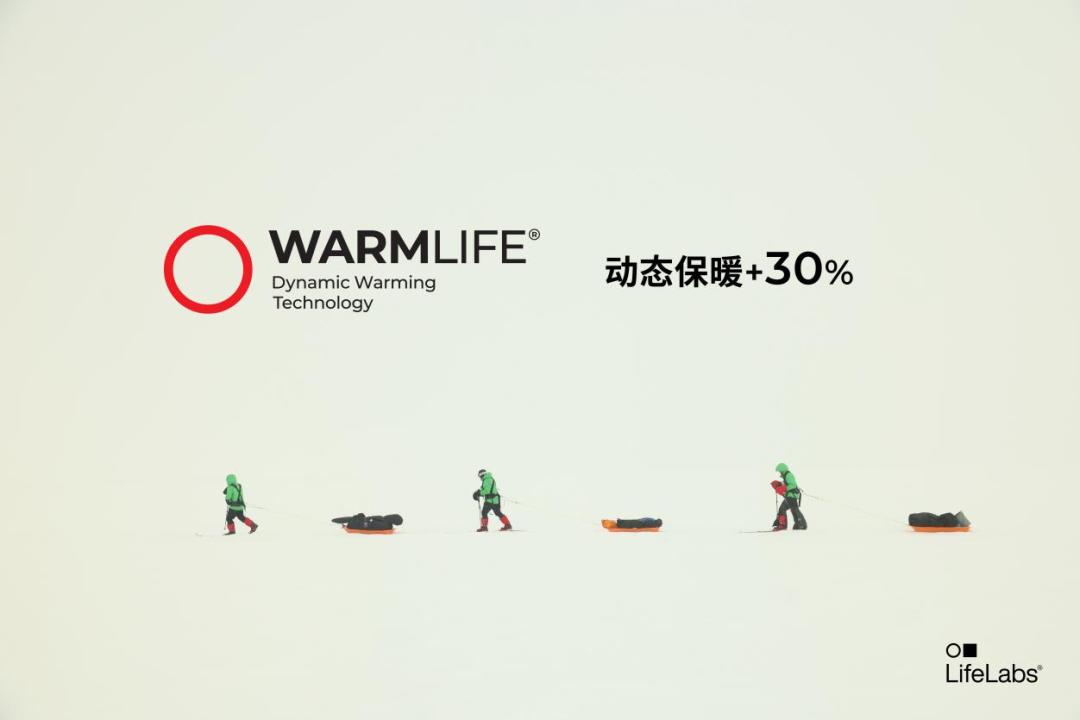
In December 2025, the LifeLabs Antarctic test team led by Sun Bin, coach of the Chinese National Mountaineering Team, spent a full six days trekking the last degree of latitude at the South Pole, hiking 10 to 11 hours every day. Before that, they had just summited Mount Vinson, the highest peak in Antarctica at an altitude of 4,892 meters, where the top was hit by extreme cold of over minus 30 degrees Celsius and strong winds.
The team uniforms of the test team are equipped with LifeLabs' proprietary WarmLife® dynamic thermal insulation technology. Different from traditional polar equipment that relies on thick stacking for warmth, the technology behind it is an extremely thin nano-metal reflective layer. The total weight of the metal used in the entire garment is even less than that of a paperclip, which has withstood the rigorous field tests in the harsh Antarctic environment.
It took people decades to improve thermal clothing, with various technical routes making sense and continuous innovations in material properties, but one question has never been answered: how can fabrics actively manage human body heat dissipation in a better way?
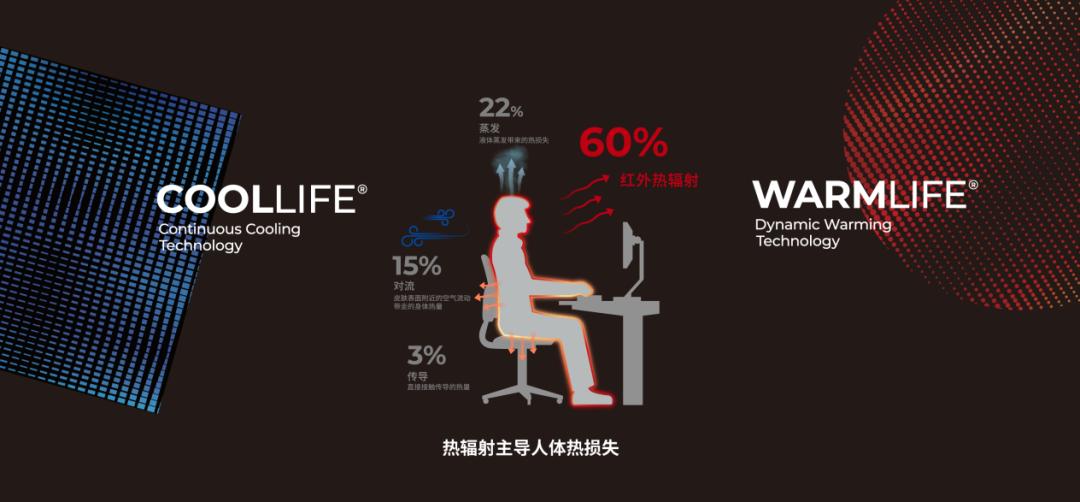
Scientific principles show that 60% of the total body heat loss is dissipated in the form of invisible infrared radiation. Traditional down jackets and fleece jackets still use the old method of blocking air convection, which only blocks the 15% heat convection loss, while this 60% infrared heat has long been ignored by the industry.
01. Origin and Cross-Disciplinary Innovation
The one who noticed this gap is Professor Yi Cui, from the Department of Materials Science and Engineering of Stanford University.
Professor Cui Yi's research spans nanomaterials, energy batteries and thermal management technologies. His laboratory has long been committed to solving a type of engineering problem: how to precisely control heat transfer and loss under extreme temperature conditions. This set of ideas originally served the aerospace, chip and energy storage fields where the fault tolerance rate is extremely low. Overheating of batteries is a disaster, and heat dissipation failure of spacecraft is also a disaster. Around 2019, the team began to try to apply the same logic to the textile industry, reducing human dependence on HVAC systems through the thermal comfort performance of clothing, so as to cut down energy consumption.
Two new nano-textile technologies were thus born. One technology can reflect back 60% of the human body's infrared heat, while the other allows this heat to pass through the fabric almost unimpeded. The technology is feasible, but there is still a whole industrial chain gap between laboratory achievements and commercial implementation.
Professor Cui Yi needed a knowledgeable partner. When the time came, Sophia Ou, co-founder of LifeLabs, joined the team.
She has been deeply engaged in the clothing and textile industry for more than ten years. She worked in the marketing department of The North Face for four years, then joined Invista, focusing on the CORDURA® yarn business in Greater China for four years, in charge of brand promotion and business development.
She later recalled her feelings when she first came into contact with these two technologies: "There has not been such an exciting new technology in the textile material field for a long time. To promote and apply this new material on a large scale is the common dream of people in our industry."
Over the past 20 years, the problem of how to make heat reflection technology both warm and breathable has never been truly solved. In her view, the nano-treatment process developed by Professor Cui Yi's team is the first path that truly bypasses this bottleneck. After Sophia Ou took office as the CEO of LifeLabs, she decided to promote mass production at the forefront of China's textile industry. Choosing China as the mass production base is no accident. In her opinion, there is no second market in the world that has such a complete depth of textile supply chain and such a large volume of brand customers at the same time.
02. New Dimension, New Technology
To understand what LifeLabs is doing, you have to abandon a habitual perception first.
Warmth and cooling sensation, in most people's impression, are two completely different things corresponding to two completely different material systems. But the starting point of Professor Cui Yi's team at Stanford University is to look at these two things under the same logic: the human body is radiating infrared heat outward all the time, and the only question is whether you want to keep it or let it escape.
Among the two major textile technologies of LifeLabs, WarmLife® chooses to reflect heat, while CoolLife® chooses to transmit heat.
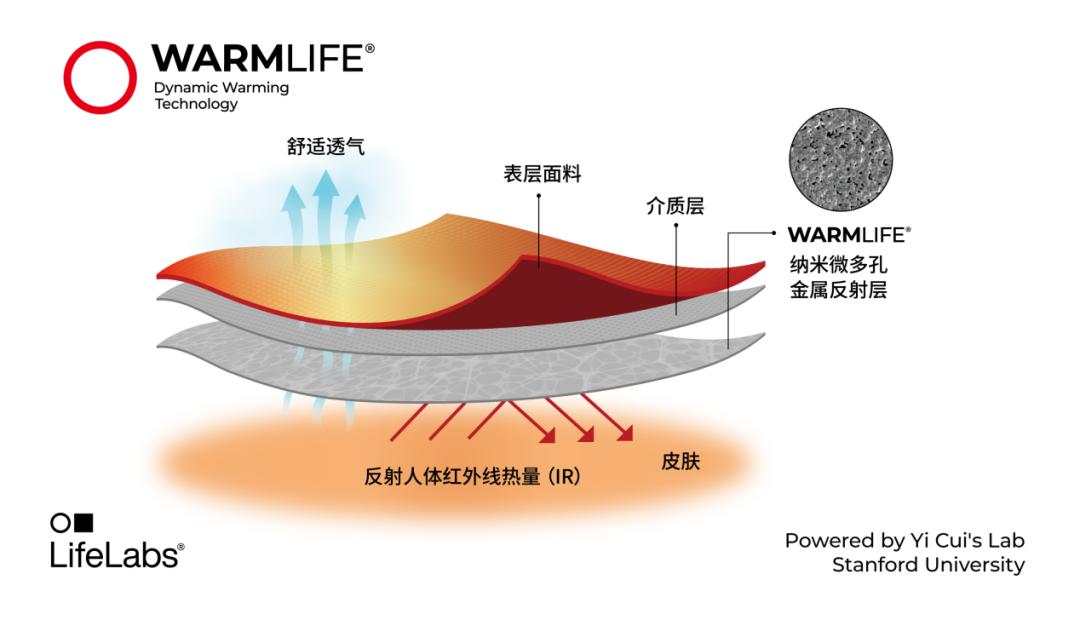
WarmLife® dynamic thermal insulation technology builds a metal reflective layer on the fabric surface through nano-manufacturing processes. The infrared heat radiated by the human body is reflected back to the body through this metal layer to achieve the thermal insulation effect. This principle itself is not new, and the aluminum foil emergency blankets used at disaster sites also follow the same logic. But all previous attempts were stuck at the same bottleneck: the whole metal film is not breathable, making people feel like wearing a layer of tin foil, stuffy and airless.
WarmLife®'s solution comes from a basic feature of nanotechnology: the gaps between nano-particles are large enough for gas molecules to pass through freely, while water molecules cannot. This is in the same line with the logic that Gore-Tex® uses porous membranes to achieve "waterproof and breathable" performance. And Gore-Tex® has already educated the market: as long as the size is properly controlled, two seemingly contradictory properties can be established at the same time.
In addition, there is the dynamic adjustment mechanism of WarmLife®. When the wearer's body temperature rises, excess heat and moisture can be quickly discharged through its nano-microporous structure, avoiding the risk of hypothermia caused by sweat cooling.
In terms of performance data, compared with traditional thermal insulation filling materials, the application of WarmLife® can reduce the filling amount of the whole garment by about 30%, while still achieving the same or even better thermal insulation effect. This means that the new generation of thermal insulation materials can be made lighter and thinner.
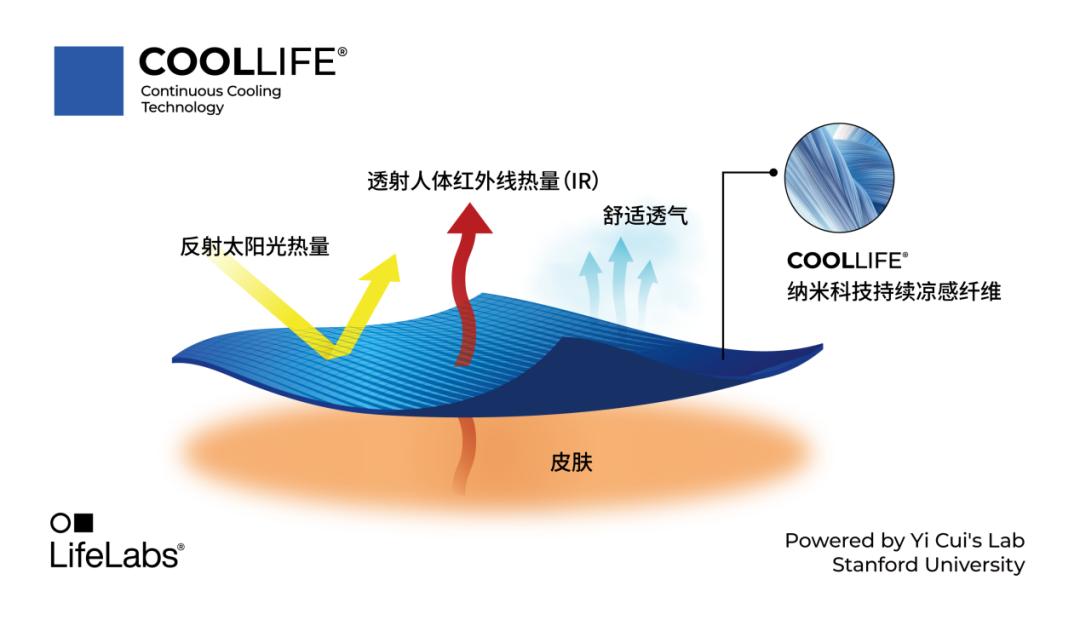
Using the same human body infrared heat management logic, CoolLife® continuous cooling yarn allows human infrared heat to penetrate and transmit out of the fabric. Professor Cui Yi's team developed a nanotechnology-modified PE polyethylene yarn with an infrared transmittance as high as 96%.
The common cooling fabrics in the market dissipate heat through the evaporation of human sweat, which only accounts for 22% of the total human heat dissipation mechanism. CoolLife® targets the infrared radiation that accounts for 60% of the total heat loss, reducing heat accumulation from the source before people sweat, to achieve advanced continuous cooling comfort effect.
The underlying materials of these two technologies actually come from the battery and chip fields. The target materials used and the manufacturing methods are not the existing accumulation of the textile industry, but stand in a brand new industry dimension.
From a broader perspective, LifeLabs' narrative is not limited to the textile industry, but also extends to the energy issue. About 14% of global energy consumption comes from heating, ventilation and air conditioning systems. If clothing can share part of the work of body temperature regulation, people's dependence on HVAC systems will be reduced accordingly.
03. From Silicon Valley Technology to Commercial Implementation
There is a reality in the functional fabric industry that outsiders can hardly see.
Many "innovative materials" displayed at brand press conferences are still quite far away from stable mass production. Between laboratory samples and mass-produced products for the market, there are a series of thresholds that must be solved one by one, including process stability, cost structure, supply chain cooperation, standard certification and so on. When Sophia Ou came into contact with the samples in 2019, she had a clear judgment on the distance between technology and commercial implementation: "At that time (2019), the technology of Stanford University needed at least three to five years to be applied on a large scale in the industry."
Facts have proved that it is true. The mass production breakthrough of WarmLife® is to add a metallized nano-process outside the traditional production process. The team established a small production laboratory in Chinese mainland, using special equipment, after multiple rounds of trial production and several months of intensive debugging, the stable mass production process was finally realized in the autumn of 2021.
It was not easy. The nano-metal particles need to be deposited uniformly, the hand feel and breathability remain excellent, and all standard testing and certification must be passed. On this basis, WarmLife® technology began to carry out R&D and innovation according to market demands, such as the WarmLife® warm merino wool filling layer, which significantly improves the thermal insulation performance of natural fiber filling by applying nano-reflection technology to merino wool filling wadding, and won the "Best Product Award" (Fiber and Filling Category) at the ISPO Munich 2026/2027 Autumn/Winter Exhibition in Germany.
The ISPO Award has high industry recognition in the field of functional outdoor materials, and leading material brands such as Gore-Tex® and Primaloft® have all won this award. For a new material company that has been established for a short time, the endorsement of this award carries great weight.
The mass production path of CoolLife® yarn is closer to the mode of Lycra or Coolmax®: LifeLabs independently controls the upstream polymer modification and spinning, and the weaving, dyeing and finishing parts are authorized to mature fabric factories that have been serving international brands. This division of labor makes the supply chain get through faster than building a full production line from scratch, and the cost structure is also easier to decrease with the expansion of scale.
LifeLabs' technology R&D is also ongoing, and it has built a "four-university joint research" mechanism. Stanford University is responsible for basic research and preliminary verification of new materials, Peking University, Nanjing University, Wuhan Textile University and other universities undertake further demonstration and modification work, and finally connect with the fabric development of the industrial end.
This chain tries to fill the long-existing time loss between university scientific research and industrial implementation. During Sophia Ou's work in foreign enterprises, she witnessed how slow the decision-making of the company's headquarters was. By the time the instructions were passed down to China layer by layer, the market opportunities had long been missed.
In September 2025, LifeLabs completed a Pre-A round of financing of over 10 million US dollars, which is used for the rapid expansion and scaling of proprietary textile technologies. With the financing closed, the company's development direction has also become clear.
04. Opportunity and Future
LifeLabs' business model is not the most common choice among textile technology startups. The more common script is: after obtaining new material technology, build your own brand and sell directly to consumers. This path has a direct logic and seems to have a larger profit margin.
However, there is a fundamental contradiction between the operation structure of building a clothing brand on your own and the continuous investment in material R&D. Sophia Ou defines LifeLabs' business model as: "There is no need to go gold mining yourself, it is enough to be the one who sells shovels."
This metaphor has a very specific reference in the context of the functional fabric industry. Lycra never makes its own sports pants, but the Nulu™ fabric containing 21% Lycra supports Lululemon's Align series, which contributed about 1 billion US dollars in sales to Lululemon in 2024. Polartec® does not make its own jackets, but its fleece is still one of the highest-selling categories of Patagonia. In 1998, Gore-Tex® cooperated with Arc'teryx to launch the Alpha hard shell jacket, helping the latter establish a decades-long leading market position in this category.
Consumers ultimately buy brands, but what really drives product differentiation is the inconspicuous technical woven label on the inner side of the fabric, which brings differentiated experience.
After Sophia Ou saw Professor Cui Yi's technology, the first judgment that flashed through her mind was: the temperature control field is a huge quadrant that does not have an absolute leader so far. "Gore-Tex® is great, Lycra is also great, but they are all in their own quadrants. One does waterproofing, the other does elasticity. There is no absolute leader in the temperature control field."
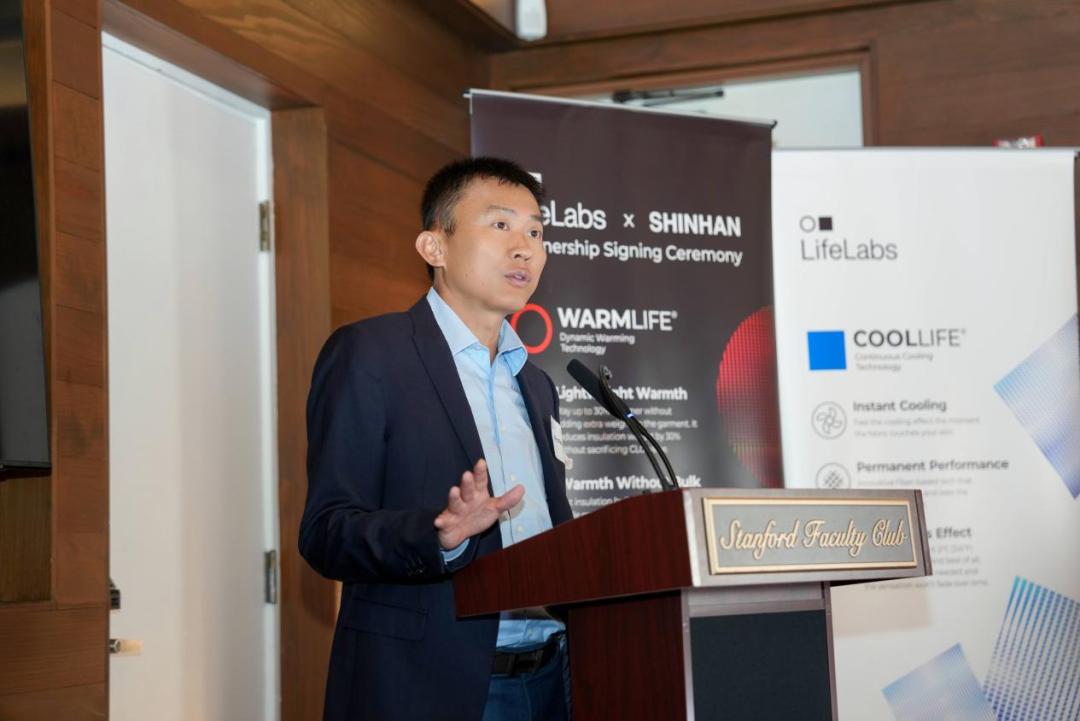
Professor Yi Cui
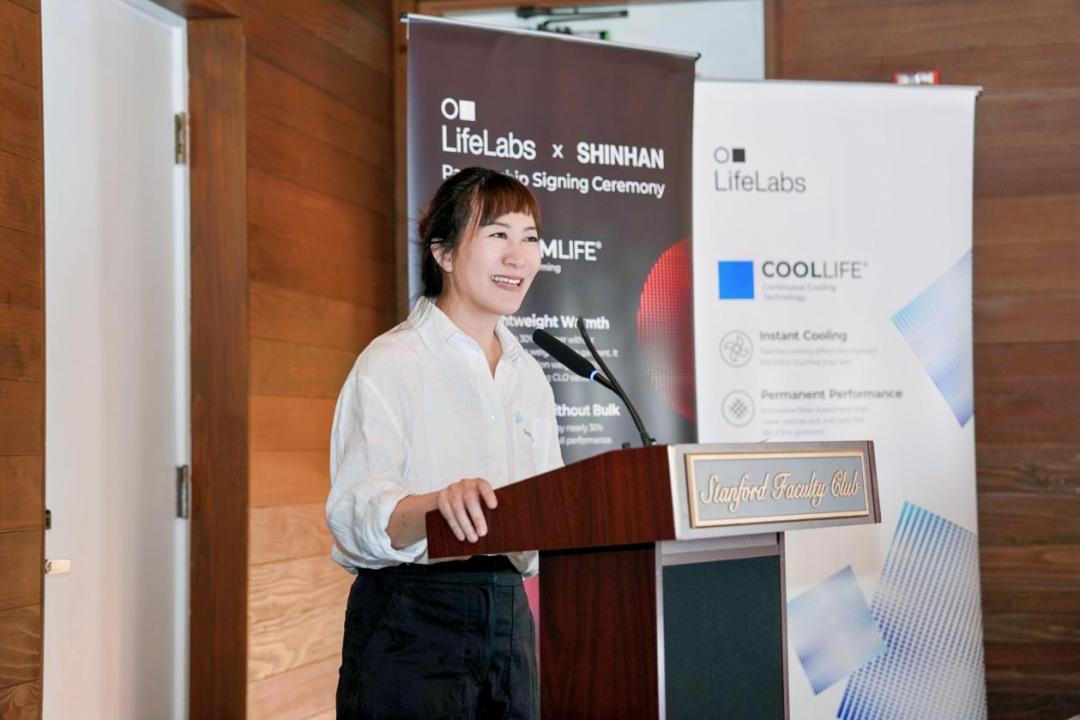
Sophia Ou
In terms of the selection of cooperative brands, LifeLabs adopts a top-down entry strategy, first locking the leading brands in each sub-sector, selecting a benchmark customer in each track such as skiing, outdoor, sports, etc., using the market influence of these brands to complete the first round of consumer awareness cultivation of the technology, and then gradually expanding downward.
Of course, this path is not easy to take. Gradually building consumer awareness through cooperation with brands is no different from the way Gore-Tex® slowly entered the public view with its diamond logo back then. The establishment of brand awareness takes time, and requires enough leading brands to be willing to use it and place it in a prominent position.
Sophia Ou has a clear expectation for this rhythm, but she also observed a more optimistic signal than expected: "The domestic market is highly competitive, and many Chinese brands have a more positive attitude towards new materials than expected. The current promotion speed is much faster than I expected."
The logic behind it is not difficult to understand. The competition density of the outdoor and sport