A leading mobile phone player unexpectedly becomes a "dark horse" in the robotics field.
At 7:30 a.m. on April 19th, the starting gun sounded at the starting point of the Beijing Yizhuang Half Marathon.
12,000 human runners and more than 100 robot teams started simultaneously on both sides of the safety isolation belt.
Surprisingly, just 48 minutes into the race, the first finisher reached the finish line - the remote - controlled version of "Lightning" from Honor's "Jueying Chitu Team", completing the half - marathon in 48 minutes and 19 seconds. According to the rules of this year's competition, the results of the remote - controlled group need to be multiplied by a weighting coefficient of 1.2. The Jueying Chitu Team finally ranked fourth. However, six "Lightning" teams under Honor occupied the top six positions. Among them, the fully autonomous navigation version of "Lightning" from the "Monkey King Team" won the championship in 50 minutes and 26 seconds, breaking the human half - marathon world record of 57 minutes and 20 seconds.
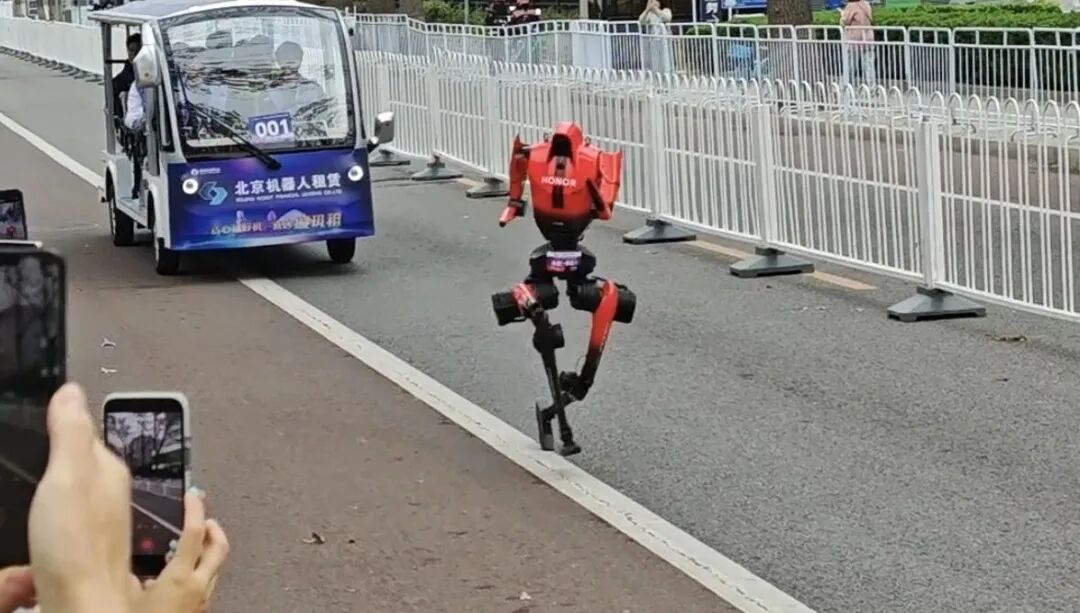
Photography: Kong Yuexin
In addition, last year's champion, Tiangong Ultra (2 hours, 40 minutes and 42 seconds), upgraded from the semi - autonomous mode to fully autonomous navigation, and completed the race in 1 hour and 15 minutes this year. The "N2" model carried by the runner - up, Songyan Power, ranked second and third in this year's best gait selection.
Not only has the speed of robots increased significantly, but the completion rate is also impressive: Last year, only 6 out of 20 participating teams completed the race. This year, 47 out of 102 robot teams completed the race, with a completion rate of over 45%.
Shoucheng Holdings is an investor in many participating companies such as Unitree, Songyan Power, and Accelerated Evolution. Kang Yu, the general manager of the capital market department of Shoucheng Holdings and the general manager of Shoucheng W, revealed that she set off early in the morning with the logistics vehicle of a Unitree robot team. Unfortunately, that robot failed to complete the race. However, in her opinion, as an investor, the key point of watching the race is to judge what the industry still lacks, which links are worth investing in, and which links are highly competitive and hide potential risks. She also pays special attention to small teams doing secondary development on the field, hoping to discover "geniuses" from them.
This event is not only a grand occasion in the venture capital circle but also successfully "broke the circle" and attracted wide attention from the general public. Before the race, videos of robot tests had gone viral on social media, and the "Baby Bottle Robot" in particular had won countless fans. Many spectators got up early and rushed to the scene specifically to see it with their own eyes. During the official race, the side of the robot track was full of spectators, including many parents bringing their children to "watch the excitement", and the number was significantly larger than last year.
A middle - aged couple drove from home a little after 5 a.m. and arrived at the scene at 6 a.m. They proudly told "China Entrepreneur" that their child was studying robotics at university, and there was also a team from their son's school participating in the race. An old man who had run several half - marathons said that although he couldn't run anymore, he had been following the robot marathon since last year and came specifically with his camera to take pictures this time.
Kang Yu believes that this event has two main significances:
First, accelerate industrial equalization. Even an ordinary college student, as long as they are willing to sign up and someone provides a free robot body, can compete with manufacturers such as Honor, Unitree, and Tiangong on the same stage. They can also directly enter the base camp and communicate with engineers from various companies - without any barriers, they can talk to whoever they want. "In this open atmosphere, everyone can fully communicate about their own advantages and disadvantages. The industry is not isolated, and the frank communication among young people will greatly accelerate technological equalization."
Second, accelerate the emergence of young talents. As long as they perform well, they will naturally be noticed, without the need to write a business plan, raise funds, and then find the media. Technology is the only standard. This event provides an opportunity for ordinary people to make an appearance with zero threshold. "Some teams dropped out after running 14 kilometers, but everyone was still very happy. This is like a 'Martial Arts Contest on Mount Hua'," Kang Yu said.
After Honor Occupied the Top Six
It was almost unexpected before the race that a mobile phone manufacturer, with a single robot, occupied the top six positions. Honor officially established its robotics department in mid - 2025, and most of the core members of the team came from the original mobile phone R & D team. The R & D cycle was less than a year.
Wang Ai, the chief strategic officer of Honor's embodied intelligence, said after the race: "Why was Honor able to create 'Lightning' in such a 'lightning - fast' time of six months? Behind this is our ten - year accumulation of experience in the mobile phone manufacturing supply chain." The supply chain system that Honor has built in the consumer electronics field, from precision structural parts to sensors, from lidar to heat dissipation pumps, has all been applied to robots.
Wang Ai explained that the reason why the "Lightning" robots occupied the top six positions is mainly due to several capabilities: In terms of battery life, a dual - battery design is adopted to ensure continuous power; liquid - cooling heat dissipation technology is used, and the equipment is integrated on the back, providing effective protection even if the robot falls, ensuring temperature control of the joints during high - intensity running; the motion control algorithm can quickly adapt to complex road conditions such as uphill, downhill, sharp turns, and even gravel on the road, achieving a balance between perception and decision - making to maintain a stable speed; through multi - sensor fusion, the robot is ensured to always run on the optimal trajectory, without deviating from the course or losing speed.
Moreover, Honor's suppliers such as Lens Technology, Lingyi iTech, Orbbec, AAC Technologies, and Huake Cold Core have attracted much attention. The stock prices of Lingyi iTech and Lens Technology have risen, and the liquid - cooling heat dissipation concept sector soared collectively on the 19th.
However, the phenomenon of Honor "dominating" the victory has also triggered calm thinking in the industry.
On the one hand, some industry insiders believe that having the top six positions occupied by the same company actually weakens the overall momentum of the event. Last year, each company had its own ranking, and six companies could each promote that "I'm great". This year, with one company dominating, "it's even embarrassing to mention the seventh place".
On the other hand, Kang Yu believes that it is only a matter of time before large - scale manufacturers enter the robotics field, and Honor's occupation of the top six positions is almost an "industrial inevitability". In terms of hardware, large manufacturers do have supply - chain advantages, being more reliable in battery density, motor supply, and product consistency. However, these advantages are not insurmountable. Hardware will eventually achieve equalization, and the real core barriers lie in motion control algorithms and "brain" capabilities. For example, although Unitree didn't make it into the top three, its robots are very stable and difficult to fall because of their strong motion control performance, which large manufacturers may not necessarily have an advantage in.
Kang Yu reminded that the marathon is only a single - dimension extreme test. The robotics industry cannot rely solely on "market dream ratios" to tell stories. Ultimately, it has to survive through orders and high - quality deliveries.
Xu Huazhe, the founder of Shell - breaking Robotics, also pointed out during a live broadcast that the marathon is like a "college entrance examination" for humanoid robots. A good score in the college entrance examination doesn't represent everything, but it does show capabilities from a certain dimension, such as being able to run for two hours and cover more than twenty kilometers. More importantly, it's about the progress speed, or the growth rate.
"Last year when I watched the race, the robots basically fell at the start, and their parts scattered while running. The champion was Tiangong, and the runner - up was Songyan Power. This year, it's hard to get a good ranking without long legs and large motors." In Xu Huazhe's view, this shows that the supply chain for robot bodies is becoming more and more mature. Once the motion control algorithm stabilizes, the remaining work is to adjust the performance, which in a sense is a linear growth and can be rapidly improved before reaching the motor's upper limit. "I believe that if there is a weight - lifting competition, the results will also double every year," Xu Huazhe said.
Fu Sheng, the chairman of OrionStar, also recognized the rapid progress of robots. "I'm not surprised that robots can run so fast. It's precisely because of the rapid development of AI that the gait of bipedal walking has improved much faster than before." However, he also believes that simply looking at how far and how fast a robot can run in a marathon, or even claiming to "surpass humans in 1500 meters", doesn't make much sense.
"Humans are not born to run fast. What we need is the ability to adapt to various complex environments. Today's cars can run very fast, and airplanes can fly. In terms of speed alone, humanoid robots will never be able to compete with them. The real key question is: What abilities are the most important for humanoid robots? What abilities can truly promote implementation and commercialization?" Fu Sheng said.
What Can the Robotics Hundred - Billion "Roadshow" Bring?
After the marathon, in addition to the excitement in the market, people are also waiting for a more long - term answer: How many real commercial orders can the victory in the race be converted into?
Take Honor as an example. The 1.69 - meter - tall "Lightning" won a great victory on the field, but what it really wants to promote to the consumer market is the 1.37 - meter - tall small humanoid "Yuanqizai", which is targeted at directions such as store shopping guides and family companionship that involve "interacting with people". This path seems more attractive but is also more difficult: The requirements for cost, safety, and interaction experience in consumer - level scenarios are much higher than those in industrial scenarios.
Fu Sheng also pointed out that the business rules themselves are not complicated: ROI, stability, and ease of use. "Today, whether it's called a robot or embodied intelligence, ultimately it's just a product that has to withstand the rational test of consumers." Fu Sheng said, "Both consumers and businesses are very realistic."
Therefore, not only Honor but also all participating manufacturers and start - up companies in the field of embodied intelligence have to face this real problem. On the one hand, the financing in the field of embodied intelligence is currently booming. According to incomplete statistics from IT Juzi and others, in the first quarter of 2026, there were more than 50 disclosed financings in the domestic embodied intelligence track, with a cumulative financing amount of about 20 billion yuan, a year - on - year increase of nearly 60%, setting a new historical high. The number of companies with a valuation of over 10 billion yuan has increased to more than a dozen.
On the other hand, financing will eventually come to an end. How to generate profits and survive is a more crucial topic.
Xu Biao, an investment director of Shoucheng Holdings, believes that currently, embodied intelligence is roughly at a level between GPT - 1 and GPT - 2 of the large - language model. The technical path has not yet converged, and there is still a long way to go before reaching true AGI. He estimates that if one day robots can show the ability to draw inferences from one instance, then a relatively clear quantitative expectation can be given, which will take at least three to five years. Currently, many vertical scenarios that were originally difficult to upgrade with traditional automation can now form solutions by combining embodied perception and dexterous capabilities, achieving a commercial closed - loop. As for the ultimate proposition of general - purpose robots entering households, he estimates that it will take five to eight years or even longer.
Therefore, in this long - term and promising track, many manufacturers choose to take a two - pronged approach. Li Jiasheng, an investment director of Shoucheng Holdings, explained: "One prong is to collect data and train large models by taking on high - difficulty tasks; the other prong is to achieve implementation in vertical industries." He believes that whether directly attacking large models or achieving commercial implementation midway, both paths can be successful. However, only focusing on commercial implementation will not make a great company in the end. A combination of the two methods is required.
Kang Yu also said bluntly: "The robotics industry is currently only in its 'two - year - old' stage, and the final outcome is far from certain. Our strategy is simple: only invest in the best companies and cover different links."
She said that currently, Shoucheng has terminal scenarios looking for excellent secondary development teams, and mergers and acquisitions in the future are not ruled out. "My contact list has been flooded recently, and I'll screen them one by one later," Kang Yu said.
The race has ended, but the long - distance race of capital and technology is far from over.
This article is from the WeChat official account “China Entrepreneur Magazine” (ID: iceo - com - cn), author: Kong Yuexin, published by 36Kr with authorization.