A giant company worth 26 billion spent 240 million on a pair of hands.
A robotics company with a market value of 26 billion yuan spent 240 million yuan to buy a pair of "hands".
Recently, Woan Robotics invested 240 million yuan to acquire a 21% stake in Huiling Technology - the latter is the top-ranked industrial robotic hand company in China.
Most current robots can see clearly and move around, but they can't grasp objects well or perform tasks effectively. This pair of "hands" is the key to solving this problem.
01 What was bought for 240 million yuan?
Woan Robotics' main business is household intelligent robots, such as family companion robots and housekeeper robots. It ranks among the top in the global household robot field.
On December 30th last year, Woan Robotics was listed on the Hong Kong Stock Exchange, and its current market value is approximately HK$26 billion.
Huiling Technology, which was targeted by Woan Robotics, was established in 2015. Its core products include industrial-grade dexterous hands and collaborative robotic arms, such as flexible robotic hands that can grasp precision electronic parts, lightweight robotic arms that can help with household chores, and multi-degree-of-freedom dexterous hands suitable for humanoid robots.
Based on the annual shipment volume of industrial robotic hands in 2025, Huiling Technology ranks first among domestic industrial robotic hand companies. In particular, its four-axis collaborative robotic arm has a domestic market share of over 90%.
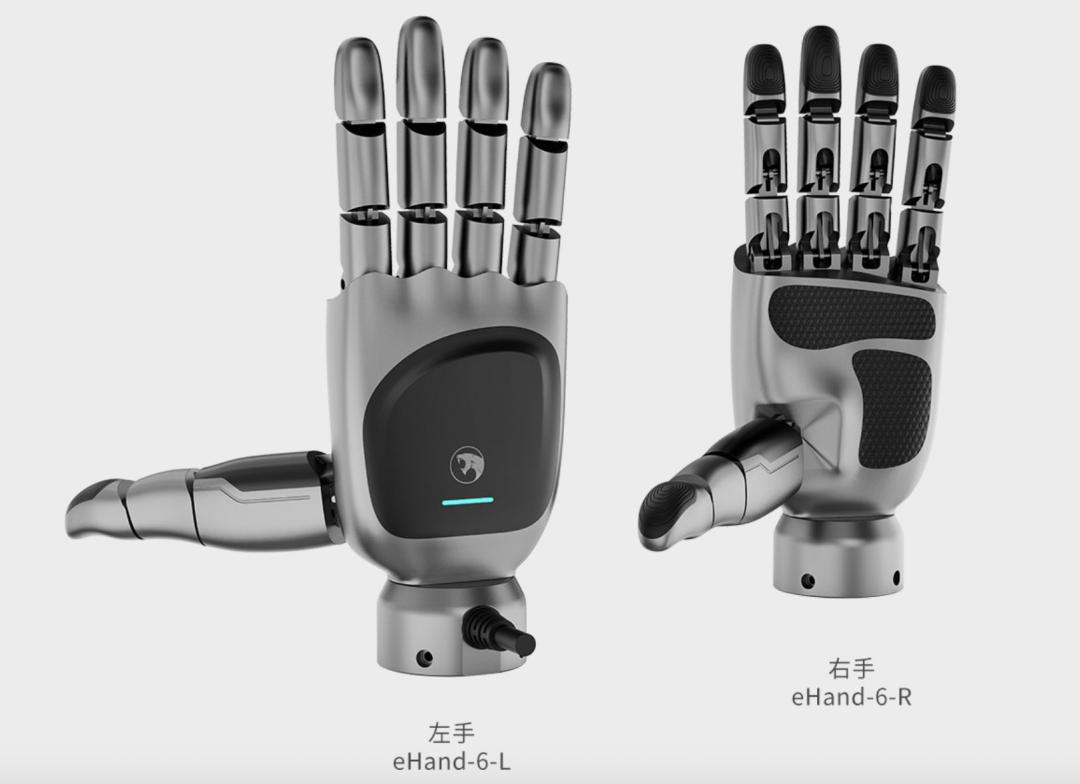
Huiling Technology's robotic hand
Huiling Technology has received hundreds of millions of yuan in multiple rounds of investment from Lenovo, Zehou, Shunwei, CCV, Boyu, Moliang Capital, etc. Its customers include thousands of companies such as Xiaomi, Huawei, Foxconn, and Panasonic.
Woan Robotics spent 240 million yuan to bring the top domestic "robotic hand" team and core technology onto its own "chariot".
To put it simply, this investment combines two capabilities: Woan provides the "brain", responsible for perception and decision-making; Huiling provides the "hands and feet", responsible for implementing actions in real scenarios. Together, they form a complete chain - from seeing, judging, to actually taking action.
Meanwhile, Huiling has carried out a large number of on-the-ground projects in factory and commercial scenarios. It knows how to break down tasks and run systems. This front-line experience will be transformed into real data, which will in turn be fed to Woan to train and optimize its models.
Interestingly, Li Zhichen and Pan Yang, the founders of Woan Robotics, and Tian Jun, the founder of Huiling Technology, are all alumni of Harbin Institute of Technology.
Based on the acquisition amount of Woan Robotics, the valuation of Huiling Technology is approximately 1.15 billion yuan.
Huiling Technology's peer, the German company Schunk, is the global leader in end-effectors. It has strong technological barriers in high-end industrial scenarios. With a pair of "robotic hands", the single-unit equipment is sold for over 100,000 yuan, and its gross profit margin is over 45%.
02 Why is a pair of "hands" worth this price?
Let's first look at a painful lesson.
Tesla's Optimus robot aimed to sell 5,000 units in 2025, but the actual sales were still in the "hundreds" scale. One of the biggest obstacles was the poor performance of the "hands" - insufficient load capacity, short transmission life, and overheating problems.
Now, Tesla's warehouse is filled with "robots without hands". Tesla has suspended the mass production of Optimus and is redesigning the hands and forearms.
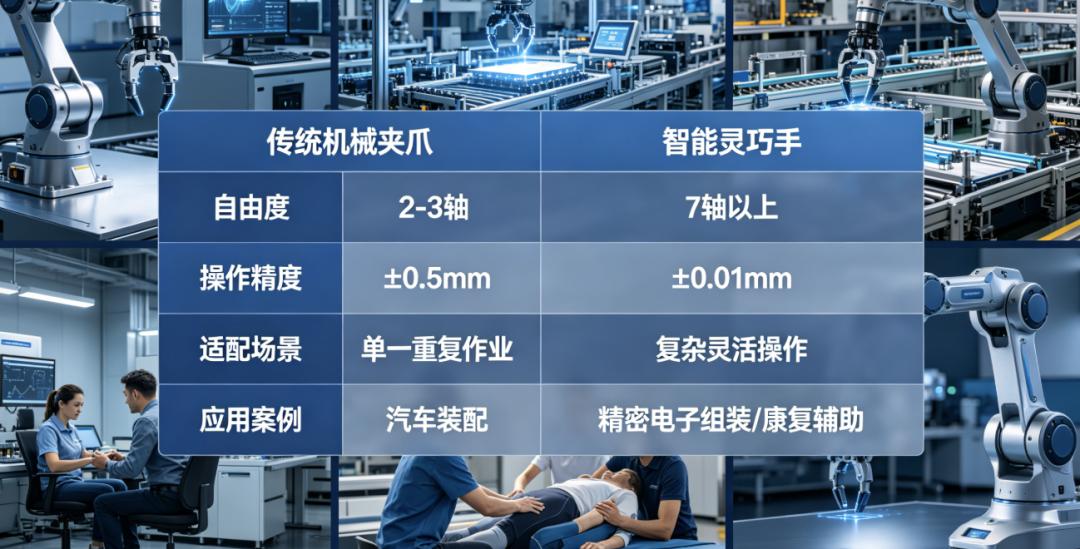
Many people think that simply installing a clamp on a robot can enable it to grasp objects. However, the real challenge of a "robotic hand" lies in two words: flexibility.
There is a concept called "degrees of freedom". Simply put, it refers to the number of directions in which the hand can move and the number of joints that can rotate independently. The higher the degrees of freedom, the more dexterous the hand.
Traditional mechanical clamps can only grasp objects of fixed shapes - square boxes and round bottles. When faced with irregular objects, they either can't grasp them or will crush them.
"Precise operation" is another challenge.
On Huawei's 3C electronics production line, it is necessary to insert precision cables and tighten micro screws for mobile phone camera modules. These parts are smaller than a fingernail. Huiling Technology's flexible electric gripper can control the force to 0.1 Newton - equivalent to the force of gently picking up a piece of paper. After using it, the error rate has dropped below 0.1%, and the efficiency has increased by more than three times.
The same is true in the medical field. Rehabilitation robots use dexterous hand modules to guide stroke patients through hand rehabilitation training. They can adjust the force adaptively according to the patient's strength, avoiding secondary injuries.
These are things that ordinary mechanical clamps cannot do.
Previously, Woan's household robots could move and communicate, but the functions of their "hands" were relatively simple - they could only pick up the remote control and hand over a cup, and were unable to perform precise operations such as peeling fruits and organizing clothes.
This is also the reason why it invested 240 million yuan to acquire a stake in Huiling: to make up for the shortcoming in "precise operation".
03 This track is experiencing a crazy wave of financing
There is a saying in the industry: Robots are the "last mile" of automation, and dexterous hands are the "last centimeter" of robots. This "last centimeter" is becoming a huge market worth hundreds of billions.
In 2024, the global market size of multi-fingered dexterous hands for robots was approximately $123 million. It is expected to grow to $5.849 billion by 2031, with a compound annual growth rate of up to 65.9%.
From 2024 to 2025, the market size of China's dexterous hand industry increased from 12.5 billion yuan to 50.1 billion yuan, quadrupling in one year. In 2025, Chinese companies accounted for half of the global dexterous hand enterprises.
Woan Robotics' 240 million yuan investment in Huiling Technology is not an isolated case.
According to the statistics of Xifan Capital, since 2025, the total financing amount of dexterous hands has increased by more than 300% year-on-year. It has jumped from a niche and segmented track to the most popular sub - field in robot investment. The proportion of strategic investments from industrial players such as Ant, Xiaomi, SAIC, and Lenovo has increased significantly, indicating that dexterous hands have entered the stage of real commercial verification.
In February this year, Lingxin Qiaoshou announced the completion of a nearly 1.5 billion yuan Series B financing, with a valuation exceeding 10 billion yuan; in March this year, Pacini Perception Technology, which specializes in hand tactile sensors, completed a Series B financing of over 1 billion yuan, with a valuation exceeding 10 billion yuan; in March this year, Xinuo Future completed a Pre - A round of financing of hundreds of millions of yuan.
In terms of shipment volume: In 2025, the annual delivery volume of Yinshi Robotics' dexterous hands exceeded 10,000 units; Zhixing Robotics focuses on dexterous hands and electric grippers. In 2025, it achieved batch shipments of thousands of sets, with an order revenue of nearly 100 million yuan, and became a supplier to companies such as Zhiyuan Robotics, Huawei, and Tencent. According to Xiong Kun, the CTO of Critical Point, in an interview with Gaogong Robotics, in 2025, the total shipment volume of dexterous hands in the industry was between 20,000 and 30,000, and it is predicted that this year it will exceed 100,000.
Why are everyone rushing to invest?
From an industry perspective, dexterous hands account for 20% - 30% of the total cost of the robot, but they directly determine whether a robot can transform from "able to move" to "able to work". This is why, after the valuation of humanoid robot bodies has been driven to a high level, funds have started to shift upstream - investing in a dexterous hand company is often more cost - effective than investing in the whole robot.
At the Zhongguancun Forum in 2026, Wang Qiang, the director of the embodied operation algorithm of Leju Robotics, said that in the next 1 - 2 years, embodied intelligence will experience explosive growth in the commercial and industrial fields. Many participants at the forum believe that dexterous hands are the key breakthrough point.
The logic behind this is simple: Whoever masters the "hands" will master the real productivity entry point of robots.
As dexterous hands move from the laboratory to mass production and from costing tens of thousands of yuan to thousands or even hundreds of yuan, they are not just a component but are rewriting the cost structure and application boundaries of humanoid robots.
In the next stage of competition, it's no longer about who can make their robot walk more steadily, but about who can make their robot "complete the task".
This article is from the WeChat official account "Pencil News" (ID: pencilnews), author: Honest. Republished by 36Kr with permission.