How can a robot complete a half marathon of 21 kilometers?
At noon on April 19th, the "2026 Beijing Yizhuang Half Marathon and Humanoid Robot Half Marathon" came to an end. The champion of this year's race was won by the "Lightning" robot from the Glory Monkey King Team, and it exceeded the world record for the men's half - marathon by humans.
An interesting aspect of this year's half - marathon is that robots and humans appeared as contestants "competing on the same field" for the first time. After the starting gun fired, human contestants rushed out of the starting point in a swarm. On the other side, humanoid robots started running one by one at a pre - set pace. After entering the track, some robots quickly accelerated. With a compact stride frequency and a stable rhythm, they almost "flashed by" from the onlookers' perspective.
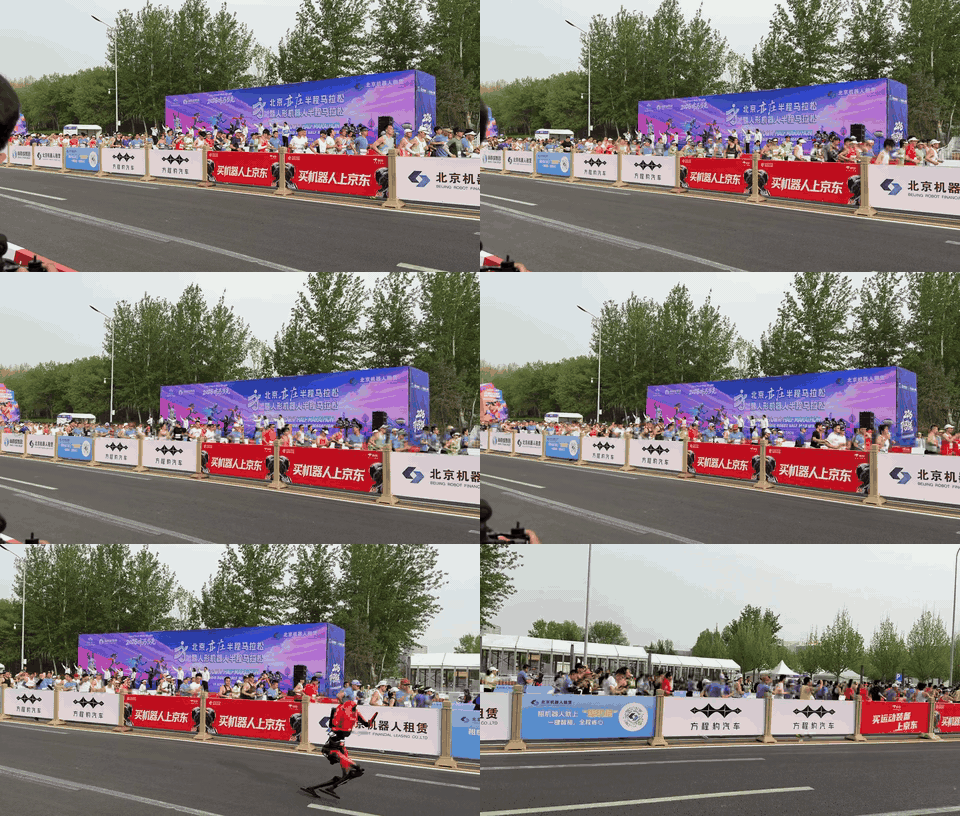
Source: Photo taken by Tencent Technology
Of course, there was not only speed but also plenty of "highlights" on the race track. Robots in various shapes attracted a lot of attention.
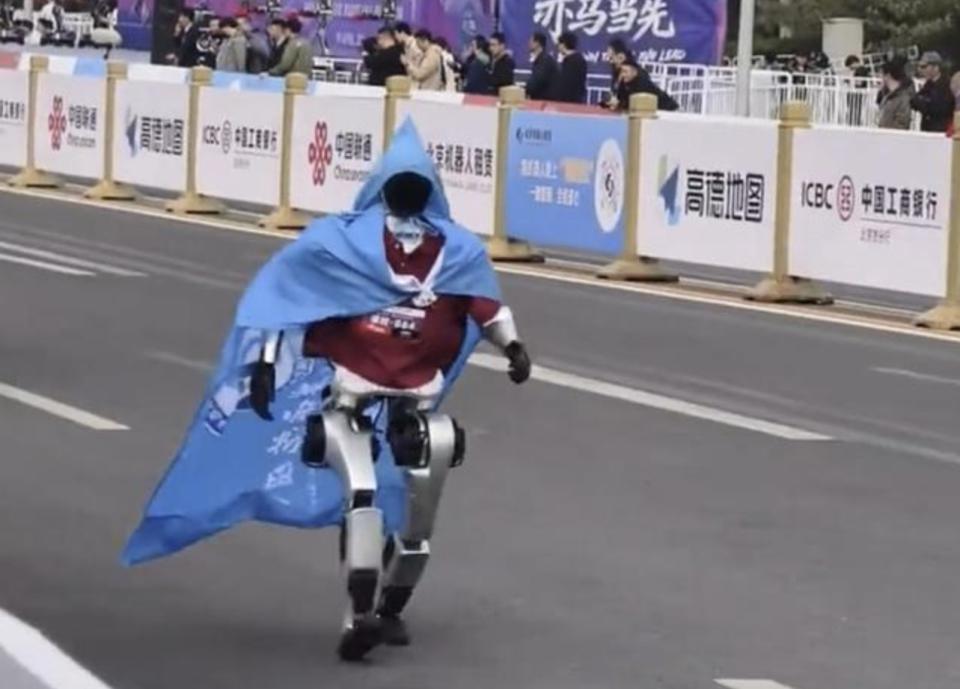
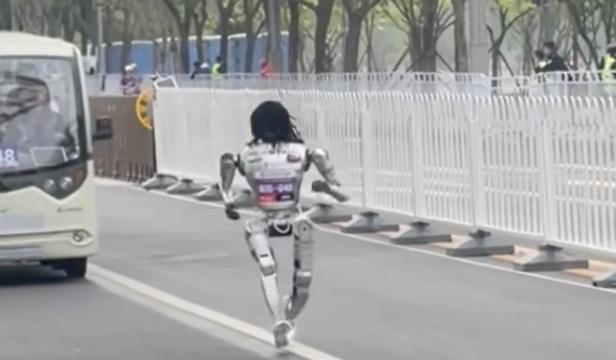
There was a "peerless knight" wearing a blue cape that fluttered in the wind; there was a contestant with a wig on its head and a sloppy appearance, which netizens called "the creepiest";
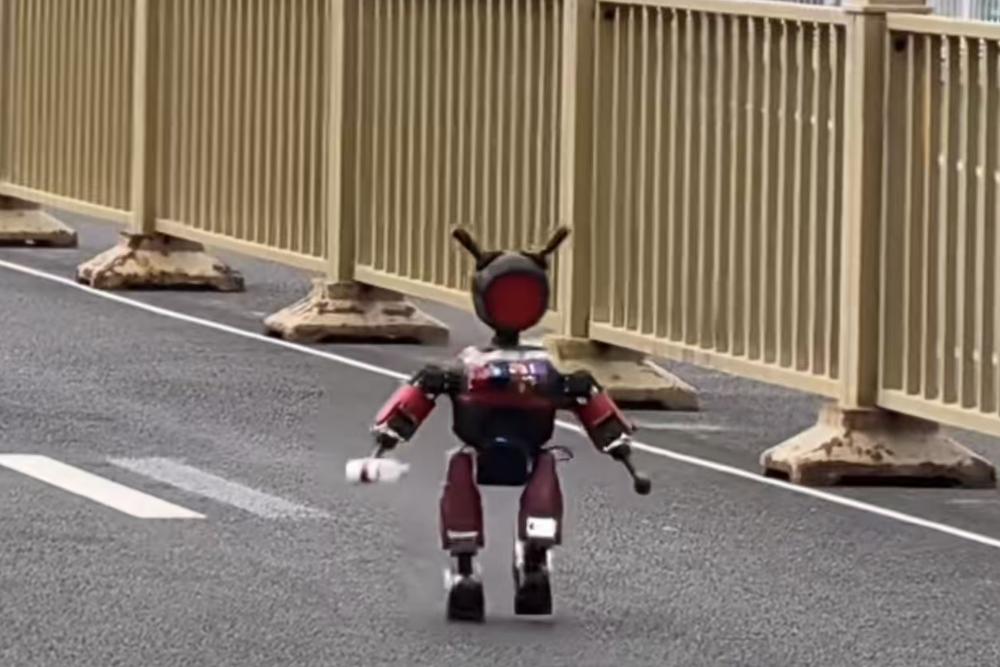
There was also a small - sized contestant that the audience called the "underage robot" - with a short stature, wearing two pigtails, holding a baby bottle, and taking small, rapid steps forward. Although it couldn't run fast, it didn't give up throughout the race and was recognized as the "cutest and most hard - working contestant" on the track. It also invited netizens to joke, "Underage robots are prohibited from participating in the race."
A technology industry practitioner who was following the event sighed online, "I used to think that humans and robots running together was something that only happened in science - fiction movies, but this year it has magically come true."
2026 is the second year of this event. In 2025, the atmosphere of the entire race was more like a "technology carnival" - the robots had all kinds of strange shapes, and there were frequent unexpected situations on the track, such as sudden falls and "equipment breakdowns" with parts falling off, which created a series of laugh - inducing moments. Eventually, the Tiangong Ultra robot from the Beijing Humanoid Robot Innovation Center won the championship (with a time of 2 hours, 40 minutes, and 42 seconds).
Although there were still unexpected situations this year, the overall operation was more stable, the viewing experience of the race was significantly improved, and the race was more standardized and mature than last year. For example, in the race rules, the starting method was further clearly defined. Contestants were arranged in two columns in a Z - shape with a 1 - minute interval between starts to increase the distance through staggered positions and reduce interference during the starting phase; overtaking must be done from the left, and a safety distance of more than 5 meters must be maintained during the race; in terms of battery replacement, changing the battery at the supply station would not result in a time penalty, but changing to a backup robot would result in a time penalty to balance safety and fairness.
Behind each rule is a pitfall encountered last year.
Undoubtedly, from technology exhibitions to official races, from isolated displays to on - the - same - field competitions, humanoid robots are entering real life at a visible speed.
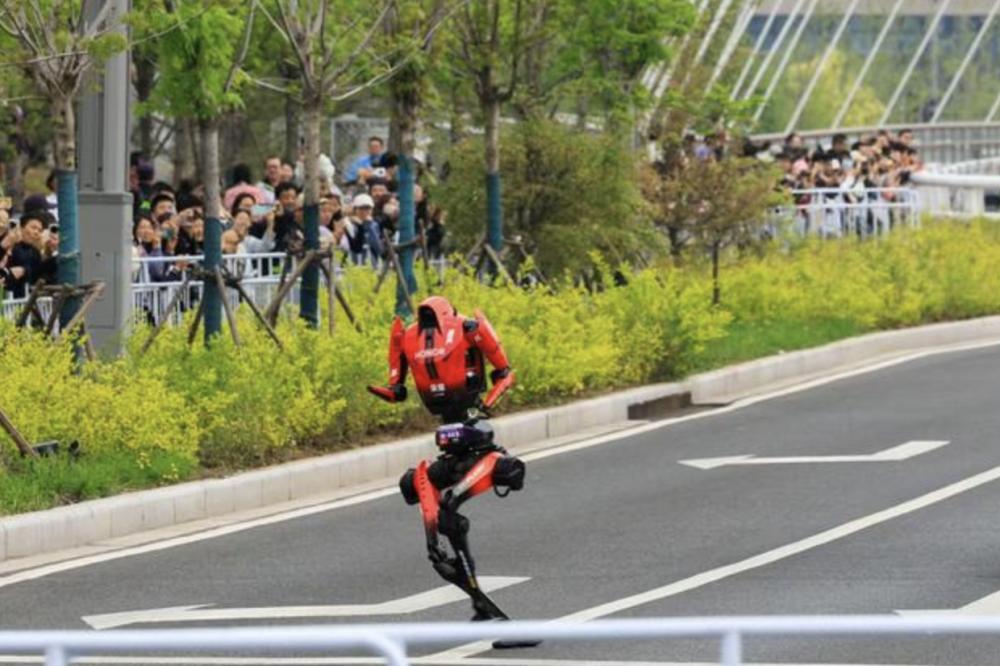
Glory's "Lightning" robot
Changes in participants: "Mobile phone manufacturers" also participate
According to official information, the scale of participants this year increased by about five times compared to last year. The participating teams were from 76 entities in 13 provinces, municipalities, and autonomous regions, forming more than a hundred teams. The participating lineup included companies such as Glory, Unitree Technology, and the Beijing Humanoid Robot Innovation Center. University teams and overseas teams also appeared in large numbers for the first time, making the overall structure much more diverse than last year.
Glory is a new face in the field of humanoid robots. This year is its first official participation in the race. However, the result surprised many people: three of its participating teams occupied all the positions on the podium. The "Lightning" robot from the Monkey King Team won the championship with a time of 50 minutes and 26 seconds, the Thunderbolt Team won the second place with a time of 50 minutes and 56 seconds, and the Spark Team won the third place with a time of 53 minutes and 01 second.
In some industry discussions, Glory's move was interpreted as a "cross - border exploration." However, if we look at the long - term timeline, we can see that this is a path that has been paved for a long time.
In March 2025, at MWC2025, Glory's CEO Li Jian announced the "Alpha Strategy" (HONOR ALPHA PLAN), declaring the transformation from a smartphone manufacturer to a "globally leading AI terminal ecosystem company" with an investment of $10 billion over three years. At that time, the mainstream interpretation in the industry was still focused on "developing AI Agents" and "creating on - device large - scale models."
One year later, at MWC 2026, Glory introduced the Robot Phone to the stage. Its camera has the flexibility similar to a human neck, and technologies such as micrometer - level motors and folding - screen materials were applied to the mechanical structure. For the first time, "robots" appeared as an independent product form at a mobile phone manufacturer's press conference.
Then came the appearance of the "Lightning" on the Yizhuang track.
From the perspective of capability development, this participation in the race is not a complete cross - border exploration but an extension based on on - device AI, hardware manufacturing, and supply - chain capabilities.
It is not easy to complete this race. It is understood that the total length of the track is 21.0975 kilometers, covering various complex road conditions such as flat ground, slopes, and curves, which pose significant challenges to the robot's motion stability, battery life, and heat dissipation.
Glory's engineers said that the "Lightning" is equipped with a liquid - cooling heat - dissipation system. The liquid - cooling pipes extend into the motor, and the heat - transfer flow rate exceeds 4 liters per minute; the peak torque of the joint module reaches 400 Nm; the motion control algorithm combines multi - sensor fusion to help the robot adjust its center of gravity in real - time and maintain stability on complex road conditions.
Mi Lei, the founding partner of Zhongke Chuangxing, said that the ability of humanoid robots to complete long - distance running has similarities with human endurance sports at the underlying logic, and heat dissipation is one of the key factors. A similar concept is also applied to robot design. By using liquid - cooling and other methods to dissipate the heat generated by the motor and movement, the risk of overheating under high - load operation is reduced. In this race, many teams adopted relevant heat - dissipation solutions.
For Glory, this may only be the beginning. In the field of robots, more and more consumer electronics manufacturers are starting to enter. In March this year, Lei Jun posted a video of Xiaomi's humanoid robot CyberOne, showing that it can complete continuous operations such as screwing and installing self - tapping screws in the factory, truly starting to "work in the factory." The entry of mobile phone manufacturers is making the competition more interesting.
Rule upgrade: Autonomous navigation, the "toughest exam" on this year's track
The most notable change in this year's race rules is the official introduction of the autonomous navigation category.
Most of the robots last year completed the race under human remote control. This year is different - nearly 40% of the teams let the robots "run on their own." Without relying on the remote control, the robots need to observe the road, judge obstacles, and navigate through curves, making all decisions by themselves throughout the race.
On the track, the tension brought by autonomous navigation was obvious. A robot accidentally fell on the way but managed to recover on its own without external help and then continued the race.
Of course, autonomous navigation also means higher risks. Unitree Technology's H1 ran at an average speed of 7.51 meters per second in the qualifying race and was regarded as a favorite before the race. However, it lost its balance and fell near the finish line and was carried off the track on a stretcher, marked as a non - finisher. The gap between being a favorite and a DNF (Did Not Finish) was just a few hundred meters at the end.
Even the champion "Lightning" of this year didn't perform perfectly throughout the race. It fell during the sprint about 200 meters from the finish line. After being helped up by the staff, "Lightning" got up again and crossed the finish line.
Last year, falls and malfunctions were common on the track. From the post - race feedback, the overall stability has indeed improved this year, which is the most visible result of one - year's technological iteration.
To encourage more teams to move towards autonomy, the race set a 1.2 - times weighted coefficient for the results: the finishing time of the remote - control solutions needs to be converted according to the coefficient for ranking. This rule guides the participating teams to reduce human dependence and increase technology investment through performance pressure. At the same time, the intervention authority of the accompanying personnel was also tightened: each team can have at most 3 accompanying members, who can only intervene after being confirmed by the referee in cases such as battery replacement, changing to a backup robot, or when the robot falls. They should minimize human intervention at other times.
This design is also using rules to forcefully expose the real capabilities of the robots.
A robot engineer said, "The complexity of the road - running scenario is much higher than that in the laboratory environment. The track covers two types of scenarios: urban main roads and ecological parks, with constantly changing ground materials, slopes, obstacles, and lighting conditions. The robot needs to sense the surrounding environment in real - time, judge the situation ahead, decide whether to slow down, detour, or wait, and at the same time maintain dynamic balance."
However, in this race, 40% of the teams chose autonomous navigation, but it doesn't mean that the technologies of these robots are all mature. For example, some teams were already researching in the autonomous direction and participated in the race as a natural progression; some teams made the choice after weighing the pros and cons. After all, the results of the remote - control mode need to be multiplied by 1.2. Instead of getting a discounted ranking, it's better to run in the autonomous mode. Even if it's slower, proving the ability is more meaningful for the company in the future.
Beyond speed, there are also "secrets" in battery replacement and supply
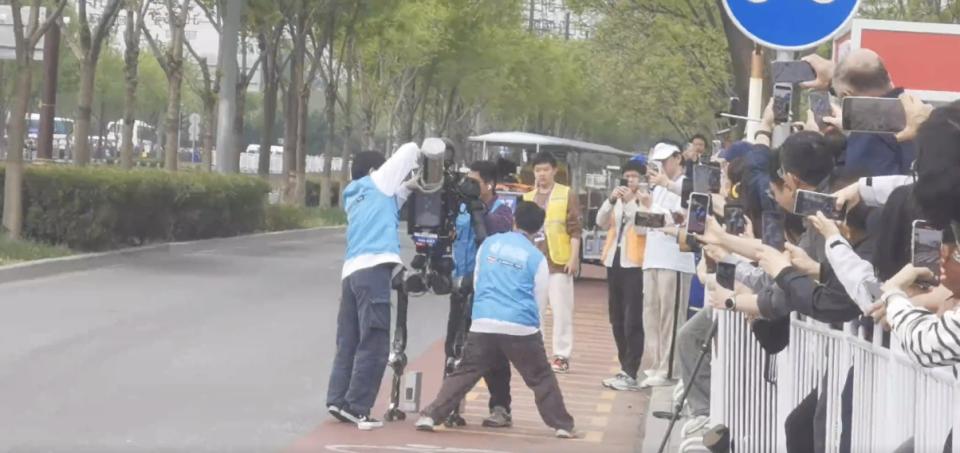
On - site robot battery replacement
This year, the battery - replacement rules have become more detailed. Although the race has a battery - replacement and supply process, the rules clearly encourage completing the race without battery replacement, which means that battery management efficiency directly affects the final ranking.
There is no time penalty for battery replacement at the station, but every second is counted in the total time. One second faster means a better result; off - site battery replacement is only allowed in emergency situations such as sudden battery failure and will result in a time penalty. Using a backup robot will adopt an increasing time - penalty mechanism. The more times it is used, the heavier the penalty. As for using a backup robot, it can be used at most twice in the whole race. The first time incurs a 15 - minute penalty, and the second time incurs a 20 - minute penalty. With the rules in place, each team needs to calculate their energy management in advance.
On the track, the battery - replacement scene of Unitree's H1 at the supply station was called "Formula 1 - level battery replacement" by netizens. It only took about 30 seconds in total. The operator and the staff had clear divisions of labor. One fixed the robot, one removed the battery, and one inserted the new battery. The whole process was smooth, just like the classic tire - replacement scene in the movie "Pegasus Rides Again" starring Shen Teng.
Actually, battery replacement is not easy.
A robot engineer on - site said, "After high - intensity exercise, the temperature of the robot's battery compartment is high, and the interface may be slightly deformed; during the battery - replacement process, the robot needs to maintain a standing posture. A slight shift in the center of gravity may cause it to fall. The staff needs to fix the robot while leaving enough space for battery replacement; whether the system can be quickly awakened and return to normal operation after the battery is inserted is also a test."
This is why the "hot - swapping battery replacement" solution began to be popularized on the track this year. Compared with the old method of shutting down, powering off, and then replacing the battery last year, hot - swapping allows battery replacement without shutting down the system. The system is not interrupted, and the state is not lost. The robot can run directly after the battery replacement, saving the time for restarting and re - initializing. This improvement in details also reflects the overall improvement in the preparation level of the participating teams.
Where will the robots "run" in the next race?
A year ago, there were only 20 teams on this track, and only 6 robots completed the race. The champion took more than two hours. A year later, more than a hundred teams competed on the same field, and the champion's time was under 50 minutes.
In short, it is obvious that the operating efficiency and stability of the robots participating this year have both improved, and their performance on the track has become more stable. This corresponds to the simultaneous progress of multiple underlying capabilities.
If we break down this marathon, it is actually a comprehensive manifestation of a series of key indicators such as motion control, power output, and heat - dissipation management.
For example, a robot "running fast" actually verifies the ability of the humanoid robot's motor for reciprocating motion. The higher the frequency, the faster the stride frequency, and the faster the speed. However, this is an extreme challenge to the motor's response speed, torque output, and heat - dissipation ability,