Reassessment of the value of nuclear power: From the power base load to the ultimate energy source for AI
In the first quarter of 2026, global technology giants are engaged in an "arms race." The protagonists of this race are not computing power or chips, but nuclear power.
Meta signed three major nuclear power agreements in just one month: collaborating with Oklo to develop a 1,200-megawatt advanced nuclear energy technology park, reaching a 2,609-megawatt power purchase and development agreement with Vistra, and investing in TerraPower to support its 690-megawatt sodium-cooled fast reactor project.
Microsoft, Google, Amazon, and Oracle have also followed suit, investing tens of billions of dollars to secure nuclear power supplies for the next 20 years.
On March 10, 2026, China officially joined the "Tripling Nuclear Energy Declaration," promising to help at least triple the global nuclear power installed capacity by 2050 compared to 2020. This marks the official start of the second global nuclear power construction cycle, and a super track lasting 20 years and worth over 10 trillion is unfolding before us.
Supply-demand Mismatch: AI is Detonating Global Nuclear Power Demand
Many people don't realize that AI brings not a linear increase in power demand, but an exponential explosion.
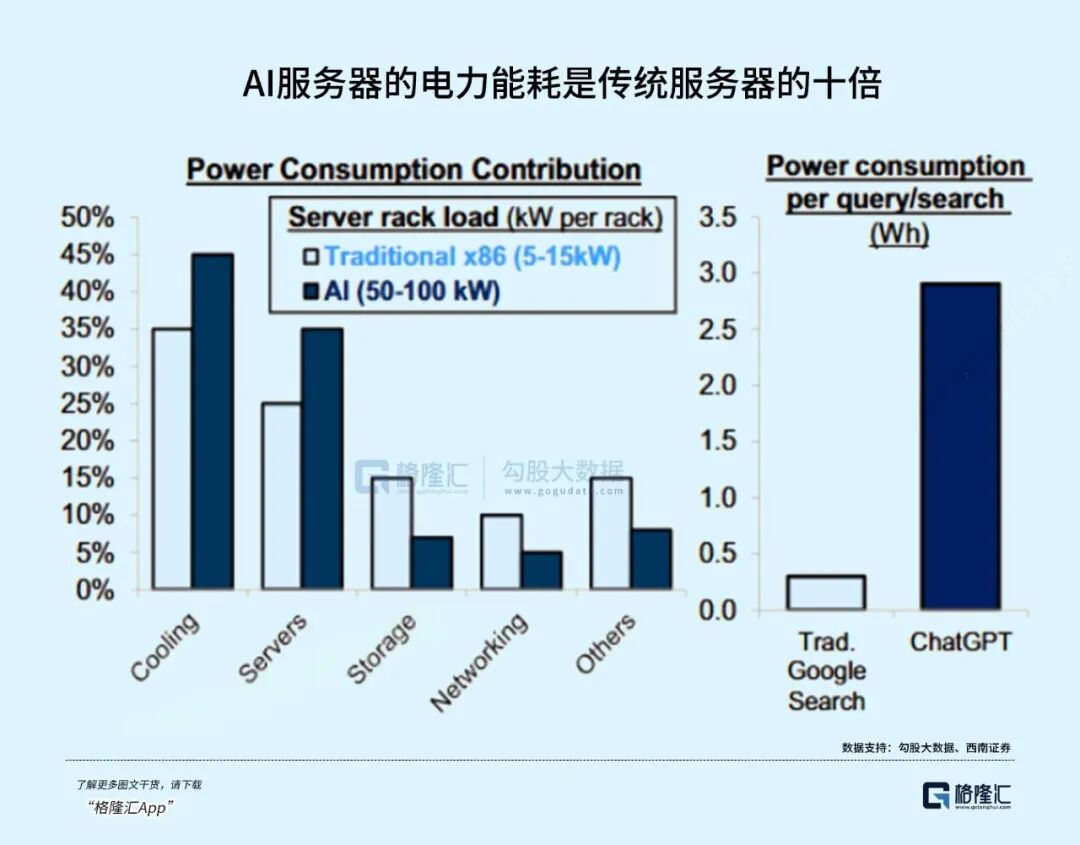
The single cabinet power of traditional data centers is only 5 - 15 kW, while that of AI data centers has soared to 50 - 100 kW, a full tenfold increase. The energy consumption of a single query of AI servers and AI chatbots has also reached ten times that of traditional servers and Google searches.
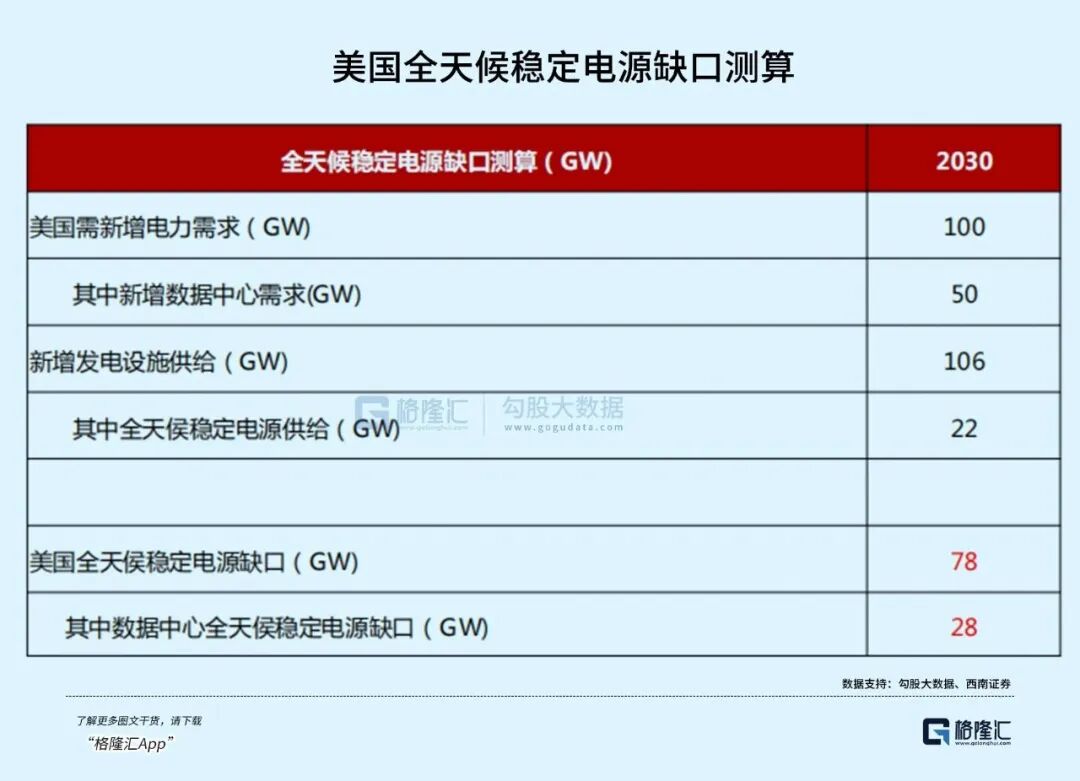
The "Resource Adequacy Report" released by the U.S. Department of Energy in July 2025 sounded the alarm for us. By 2030, the United States needs to add 100 GW of peak power supply, of which 50 GW will be directly used for data centers.
However, the problem is that data centers can be built in 18 months, while it takes at least 5 years for new power generation facilities to be connected to the grid. What's more fatal is that by 2030, the 104 GW of power plants that the United States has announced to close will be replaced by 210 GW of new power generation facilities, but only 22 GW of them are stable, reliable, and dispatchable power sources available around the clock.
This means that by 2030, the gap in all-weather stable power supply in the United States will reach 78 GW, of which data centers alone account for 28 GW. This gap cannot be filled by photovoltaic and wind power at all. Because photovoltaic power can only generate electricity for 4 - 6 hours a day, and wind power depends on the weather. Coupled with the high cost of energy storage, they can only be used as peak-shaving energy and cannot undertake the base-load power supply task of 7×24 hours.
So, technology giants have all turned their attention to nuclear power.
As of March 2026, U.S. technology giants have cumulatively signed nuclear power orders worth about $74.5 billion.
Amazon not only signed a 1.92 GW power purchase agreement with Talen Energy but also took a stake in the advanced nuclear reactor developer X-energy, with the goal of deploying up to 5 GW of small modular reactors in the United States by 2039.
Google plans to deploy 7 small modular reactors with a total capacity of 500 MW by 2030.
Oracle has designed a dedicated data center, which is expected to require more than 1,000 megawatts of power, all provided by three small nuclear reactors.
The domestic demand is also strong. As of the end of 2025, the commercial operation installed capacity of nuclear power in China has reached 61 GW. In April 2025, the State Council approved 10 nuclear power units at one time, setting a new record for the highest number of approvals in the first half of the year in the past 15 years.
The China Nuclear Energy Association predicts that during the 15th Five-Year Plan period, China will maintain a rhythm of approving 8 - 10 million-kilowatt nuclear power units per year. By 2030, the installed capacity of operating nuclear power will reach 110 GW, and by 2040, it will reach 200 GW. This means that in the next 15 years, China will build at least 150 nuclear power units, with a total investment of more than 3 trillion yuan.
However, the supply side far lags behind the explosive demand.
Global nuclear power has been dormant for more than 30 years. From 1990 to 2025, the overseas nuclear power installed capacity only increased by 108.1 GW, with a compound growth rate of only 0.7%. The industrial chain is seriously aging, there is a shortage of technical workers, and the supply of nuclear fuel is tight. This supply-demand mismatch will push the nuclear power industry into a high - growth cycle lasting 20 years.
Investment Logic: Long - term Potential and Short - term Catalysts
The investment logic of the nuclear power industry can be divided into long - term logic and short - term catalysts. The long - term logic determines the ceiling and duration of the industry, while the short - term catalysts determine the rhythm of stock price increases.
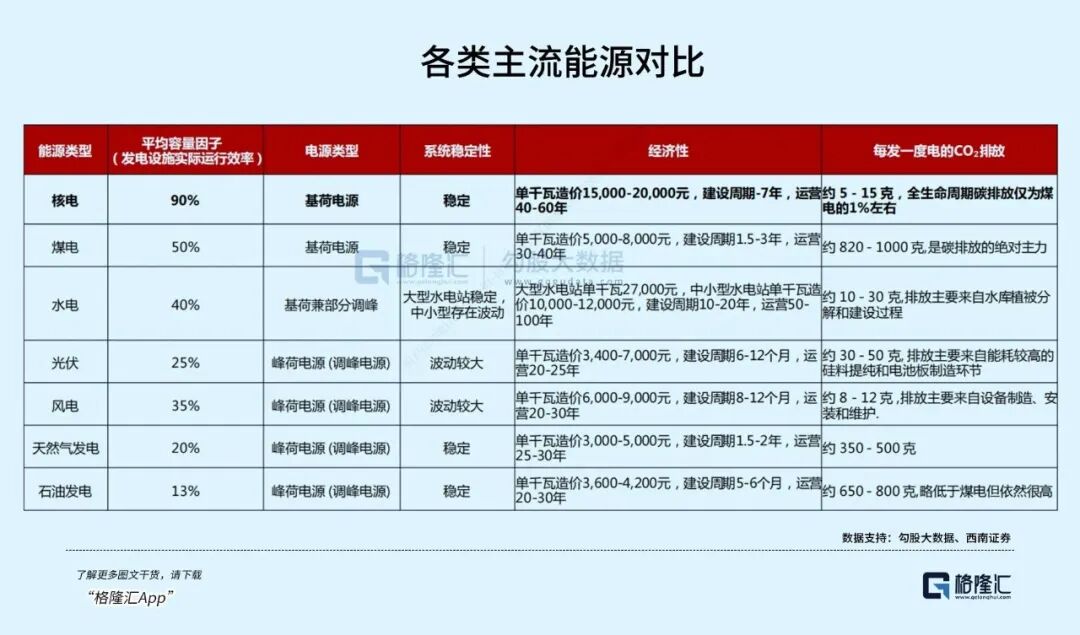
Let's first look at the long - term logic. Nuclear power is currently the only energy source that can simultaneously meet the four conditions of "large - scale, all - weather, low - cost, and zero - carbon emissions." Its capacity factor is as high as over 90%, which means it can operate at full power for more than 328 days a year. In contrast, the capacity factor of photovoltaic power is only 25%, and that of wind power is only 35%.
More importantly, the breakthrough in small modular reactor (SMR) technology has completely solved the pain points of large investment, long cycle, and difficult site selection in traditional nuclear power.
The single - reactor power of SMRs does not exceed 300 MW. Using the mode of factory pre - fabrication and on - site installation, the construction cycle is shortened from 10 years to 3 - 5 years, and the investment cost is reduced from $10 billion to less than $2 billion. It can be built directly next to the data center to achieve "factory - to - factory" direct supply, eliminating the loss and cost of grid transmission.
The International Atomic Energy Agency predicts that by 2050, the installed capacity of SMRs will account for 30% of the total global nuclear power installed capacity, corresponding to a market size of more than $1 trillion. This is a brand - new incremental market and also the core breakthrough point for China's nuclear power to go global.
Another long - term logic is the scarcity of uranium resources. Only 0.7% of uranium - 235 in natural uranium can be used by current thermal reactors, and the resources are extremely limited. As global nuclear power restarts, the gap between uranium supply and demand is expanding year by year. Moreover, the exploration and development cycle of uranium mines is more than 10 years, and the supply elasticity is very small. The pattern of tight supply - demand balance will exist for a long time.
Now let's look at the short - term catalysts. The first catalyst is the implementation of the nuclear power electricity price policy. In the first quarter of 2026, Liaoning and Guangxi successively introduced support policies for nuclear power electricity prices, establishing a price settlement mechanism for the sustainable development of nuclear power. This has removed the suppression of operators' profit expectations and valuations. It is expected that other provinces will follow suit in the future, which will be an important catalyst for the valuation repair of the sector.
The second catalyst is the arrival of the peak period of equipment delivery. The construction cycle of a nuclear power project is about 6 years, and the fourth year after approval is the peak period for equipment to enter the site. Since 2022, China has approved 10 million - kilowatt nuclear power units every year for four consecutive years, with a total of 40 units approved. This means that starting from 2026, the orders and deliveries of nuclear power equipment may experience explosive growth.
Layout Directions: Prioritize High - Certainty and High - Elasticity Segments
Facing this trillion - level market, we have sorted out several sub - segments worthy of attention based on certainty and elasticity.
First is the upstream uranium resource segment, which is a segment with relatively high certainty in the entire industrial chain. As the global nuclear power installed capacity grows rapidly, the demand for uranium will continue to rise, while the expansion speed of the supply side far lags behind the demand.
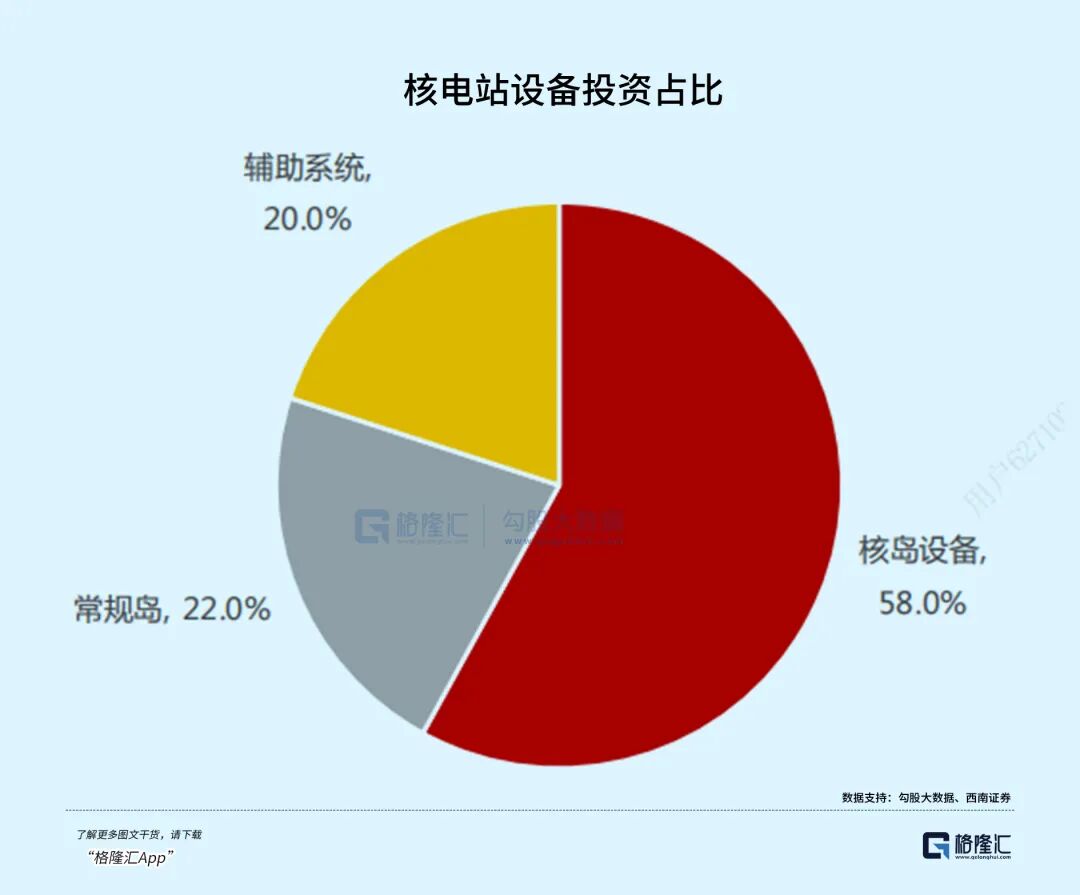
Second is the mid - stream equipment segment, which is a segment with relatively high elasticity. In the construction cost of a nuclear power plant, the equipment purchase cost accounts for 40% - 60%, of which nuclear island equipment accounts for 58%, conventional island equipment accounts for 22%, and auxiliary systems account for 20%.
The nuclear island equipment has high technical barriers and strong profitability. Shanghai Electric and Dongfang Electric cover the entire industrial chain from second - generation to fourth - generation nuclear power technologies and will directly benefit from the large - scale construction of nuclear power projects. In addition, the leading companies in sub - fields such as nuclear - grade valves, pipelines, and pumps are also worthy of attention.
The third is the downstream operation segment, which is a segment with relatively stable cash flow. Nuclear power operators have scarce operation licenses, with strong performance certainty and high dividend yields.
China National Nuclear Power and China General Nuclear Power are the two major nuclear power operators in China, together accounting for more than 90% of the domestic nuclear power market. As new units are put into operation one after another and the electricity price policy is implemented, the performance of the two companies is expected to maintain stable growth.
Finally, the SMR and nuclear fusion segments are the future directions and the segments with the most imagination space.
The Linglong One is expected to be connected to the grid for power generation within 2026, marking that China's SMR technology has officially entered the commercialization stage. In terms of nuclear fusion, the BEST compact fusion experimental device is planned to be completed in 2027. Although there is still a long way to go before large - scale commercial use of nuclear fusion, every breakthrough in related technologies will bring market catalysts to the sector.
Of course, we cannot ignore the risks when investing in nuclear power. Factors such as lower - than - expected nuclear power approvals, lower - than - expected mechanism electricity prices, the risk of a decline in utilization hours, lower - than - expected equipment deliveries, and technological path iterations are all factors that need to be vigilant.
We should avoid companies that are just following the trend, without core technologies and actual orders, and truly focus on enterprises that have occupied a core position in the industrial chain and have clear performance support.
Conclusion
Looking back at the history of human energy development, every energy revolution has been accompanied by a huge leap in productivity. From coal to oil, from electricity to nuclear energy, the energy density is getting higher and higher, and human's ability to transform the world is also getting stronger and stronger.
This article is from the WeChat public account “Gelonghui APP” (ID: hkguruclub), author: Editor of Gelonghui. Republished by 36Kr with authorization.