Eleven whys to understand the Yizhuang Robot Marathon
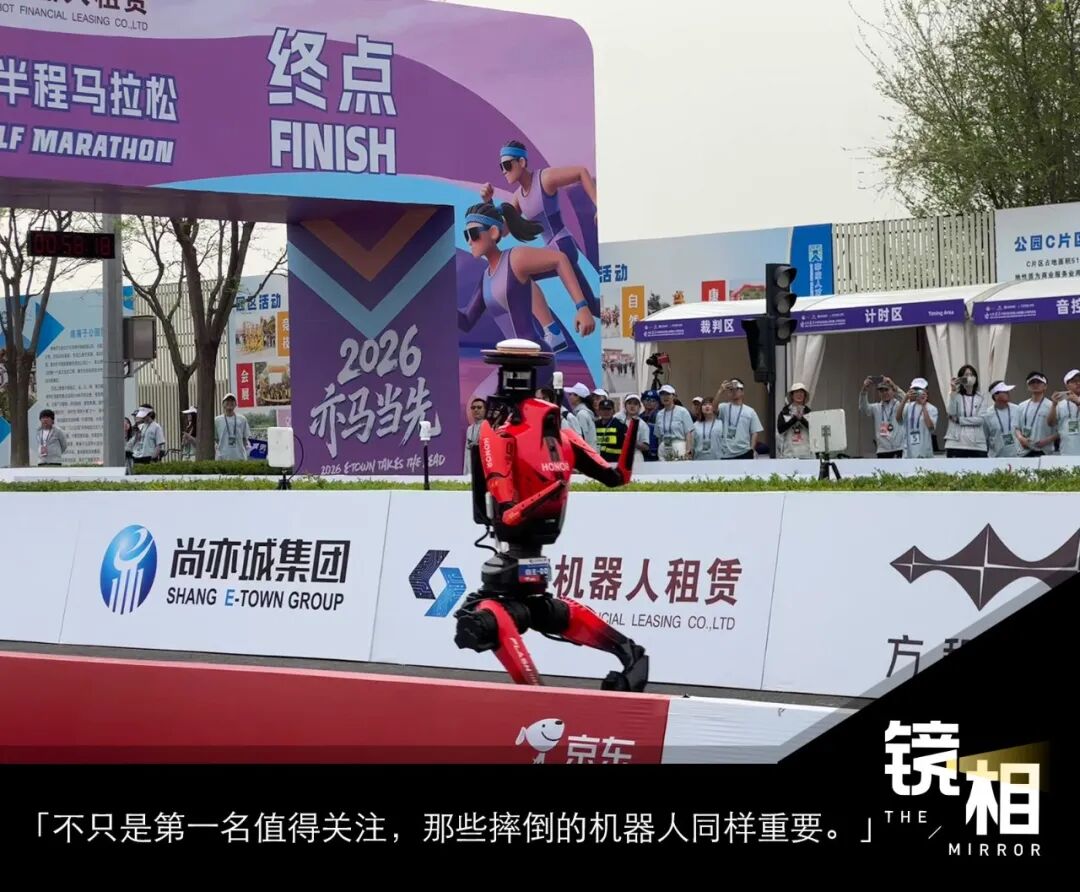
In front of the finish line at Nanhaizi Park in Yizhuang, Beijing.
"Tianggong Ultra" steadily rushed towards the finish line, attracting the focus of cameras, gazes, and the sound of shutters. At last year's Yizhuang, Beijing Humanoid Robot Half Marathon, it won the championship with a time of 2 hours, 40 minutes, and 42 seconds, becoming the king of that event.
However, in today's race, after crossing the finish line, it didn't go straight, slow down, or stop. Its body tilted slightly and it rushed directly into the roadside green belt. Engineers rushed forward for "first aid" and carried it off the track on a stretcher.

The audience joked, "The robot was also carried away by victory."
No one knows whether it was blocked by the crowd and misjudged the finish line as an obstacle, or if the navigation malfunctioned at the last moment. This short and unexpected scene precisely reflects the most straightforward reality of the robot industry - progress and loss of control are just a moment apart.
The development of humanoid robots has exceeded expectations. A year ago, humanoid robots were dragged to complete the race. Behind the participating robots, there was a line of engineers carrying computers. They guided and remotely controlled the robots on the side, frequently intervening to correct the direction, more like a human-machine collaborative relay.
A year later, the rules of the race itself changed. The pacemakers were cancelled, and human intervention was strictly restricted. Battery replacement inside and outside the field would directly affect the performance calculation. 40% of the robots achieved autonomous navigation. For the first time, humanoid robots independently faced a complex and long real road. However, the fastest completion time was directly shortened by nearly two hours, with the shortest completion time being 50 minutes and 26 seconds. The robots passed by in a blur.
This track itself is like a "problem set" specially designed for robots. It is 21.0975 kilometers long, including flat ground, slopes, continuous curves, narrow sections, and a combination of sharp turns and downhill slopes of nearly 90 degrees in Nanhaizi Park. More than a dozen types of terrains are connected together. It's not easy for human runners, and it's even more challenging for robots. Every turn and every change in slope is a simultaneous test of the perception, decision-making, and control systems.
On this track, the test of humanoid robots is broken down into multiple dimensions: motion control determines whether it can run stably, energy management determines how far it can run, perception and decision-making determine whether it can find the right direction, and thermal management and mechanical structure form the basis for all of this to run continuously.
In addition to success, robots have also presented a "wrong answer set": some need to pause to cool down due to high temperatures, some suddenly get lost and are in a panic, some have unsteady steps like a drunkard. Even last year's champion, "Tianggong Ultra," had the scene at the beginning.
But to a certain extent, failure is more meaningful than success. Every imbalance, misjudgment, and interruption exposes the shortcomings of robots that are covered up in the laboratory environment. These real faults can help the industry see the boundaries and find the direction more clearly.
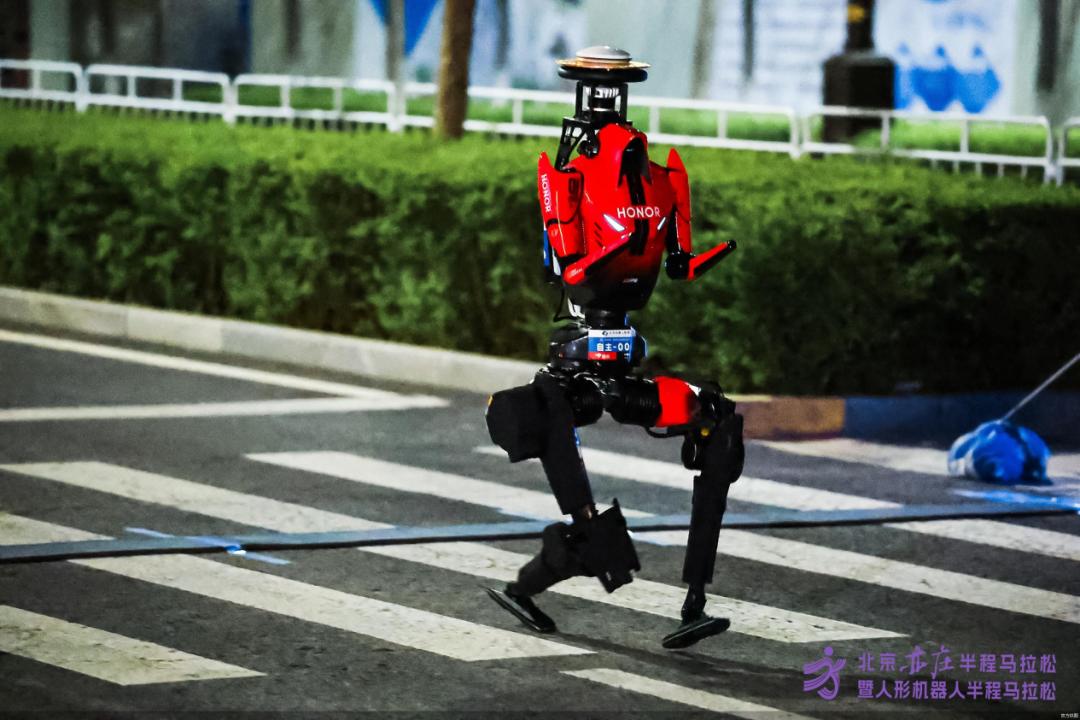
It is also in this context that the seemingly trivial differences on the field start to become intriguing: Why do some robots choose to wear shoes while others insist on being barefoot? Why do some have large strides while others move forward with high-frequency small steps? Why do some look like babies while others are in the form of adults? Why can some robots pass through the same curve smoothly while others have to slow down or even stop?
Regarding these seemingly simple phenomena, we invited Tian Feng, the dean of the Fast and Slow Thinking Research Institute, and Zhang Zhenyao, the founder and CEO of Linglinghou Technology, to analyze this "Humanoid Robot Half Marathon" from their respective perspectives.
Chasing Usain Bolt
● Some robots run like Usain Bolt, while others run like they're drunk. What factors fundamentally restrict the obvious differences in their speed and stride?
"When the control ability is not yet mature, many systems will actively choose a more conservative small-step strategy."
Tian Feng: The most direct determinant of stride is actually the torque of the joint motor. The greater the torque, the greater the "strength" of the robot, and the farther it can take a step. This is the most basic physical constraint. However, this is not the only factor. It is also closely related to the control algorithm. If the control system cannot control the stability of large gaits well, it may be forced to adopt a strategy of small and fast steps. The advantage of small steps is that there is more room for adjustment. Once there is a deviation in posture, it can be corrected more quickly, and the overall stability is higher.
A key point here is the response delay of the system. A humanoid robot may have dozens of degrees of freedom, such as more than 30 joint motors. When taking large steps, these motors need to complete posture adjustments very frequently and synchronously, which requires extremely high real-time performance of the control system. If the delay is too large and the center of gravity cannot be corrected in time, it is very easy to lose balance and fall directly. So when the control ability is not yet mature, many systems will actively choose a more conservative small-step strategy.
●
As for the step frequency, it essentially depends on the response speed and driving ability of the motor, which can be understood as the refresh frequency and execution ability of the control signal. If the motor performance is better and the driving force is stronger, more gait cycles can be completed per unit time, and the step frequency can be increased. From a system perspective, step frequency is not only a control problem but also closely related to the power system. Because higher-frequency movement means a higher demand for power output. If the power supply capacity is insufficient or the motor performance is not good enough, it is difficult to support high-step frequency operation.
● Why was the completion time of humanoid robots this year significantly shorter than last year?
"The electric vehicle industry chain is migrating to the robot field."
Tian Feng: In fact, it benefits from our electric vehicle industry chain, which is now migrating to the robot field. We can see that the joint motors, batteries, etc. are continuously improving, and the overall performance is increasing, while the localization rate is also getting higher and higher.
Another very important point is that manufacturers are also increasing their investment in algorithms. Some robot manufacturers invest half of their R & D expenses in the "cerebellum" and "brain," that is, the motion control and logical thinking parts. This actually brings great value.
● Now robots need to change batteries while running. Some change batteries four or five times in a single race. Can't the battery pack be enlarged?
"Increasing battery capacity is the worst strategy."
Zhang Zhenyao: According to the current development of electrochemistry, it is difficult for a single battery to drive a full-size humanoid robot with a height of 1.8 meters to complete a "half marathon." This is an objective reality, so there are solutions of mid-race battery replacement or robot replacement. The next trade-off is actually a mathematical calculation.
For example, to avoid battery replacement, we can increase the battery pack. Then the weight and volume of the whole machine will increase, which means the motor needs to output greater torque to maintain the same running speed. Greater torque means higher current and heat generation, and finally more electrical energy will be consumed... It falls into a cycle.
So increasing battery capacity is the worst strategy. The best state is to control the battery weight at 10 - 15% of the whole machine weight, so that the humanoid robot can complete the race with a relatively agile gait and multiple battery replacements.
An innovation this year is that some teams achieved non-power-off battery replacement. This is a very good technical route. In the original battery replacement process, the power cord was unplugged, the system was disconnected, and after battery replacement, the system was restarted and the sensors were calibrated. This process was very long and there were some engineering uncertainties. But now, they installed multiple battery packs on the robot. They can first replace one battery and let the backup battery supply power, achieving the effect of non-power-off and non-shutdown of the system.
We hope to use a single battery to complete the whole process. This is actually everyone's ultimate dream. But we can't expect a miracle - a major breakthrough in materials science suddenly occurs. We need to look at the existing situation. I think the breakthrough lies in "kinetic energy recovery," that is, changing from the current "servo structure" with relatively high energy consumption to a passive action state with very high energy recovery efficiency. For example, using the elastic energy storage mechanism of the legs to recover the kinetic energy of each step when landing. This is actually very similar to the design of new energy vehicles to recover kinetic energy when going downhill.
There's a Story Behind OOTD
● Why do some robots wear shoes while others don't?
"Robots can also wear out their 'meniscus'."
Zhang Zhenyao: Whether a robot wears shoes or not is reflected in three engineering indicators: the ground contact model, the friction coefficient, and shock absorption.
Every time a robot takes a step and its foot touches the ground, a reaction force 2 - 3 times its body weight is generated. If this reaction force is directly transmitted upward along the leg link, it will cause high-frequency impacts on the ankle and knee joints, making it very prone to metal fatigue and fracture. Just like humans, after running and climbing mountains a lot, the meniscus will wear out. Here, the role of running shoes is to absorb the impact force, isolate some high-frequency vibrations, and effectively protect the robot's joints and motors.
Another thing that people can intuitively feel is the design of the running shoe sole. The bare feet of robots are generally made of metal or carbon fiber, with a relatively low friction coefficient. Direct contact with the asphalt road is prone to small displacements and instability. This slight deviation will cause errors in the robot's algorithm, leading to a deviation in the center of gravity or spatial position, and even causing system oscillations. If the robot wears suitable running shoes, it can significantly increase the static friction and is not prone to small displacements on the asphalt road. Especially when turning a right-angle bend, the high friction brought by running shoes can help the robot maintain centripetal force.
Wearing shoes also brings two small problems. One is that in the pre - training model, the soft material of the running shoes and the thickness of the soles are not included, so the robot doesn't know it's wearing shoes, which may cause some disturbances to its algorithm, such as stepping into thin air. The other is that the weight of the shoes will increase the weight at the end of the robot's legs, further increasing the energy consumption of the legs. But I think these two problems are not very serious. The current reinforcement learning algorithm has strong robustness. It is more beneficial than harmful for the robot to wear a pair of running shoes.
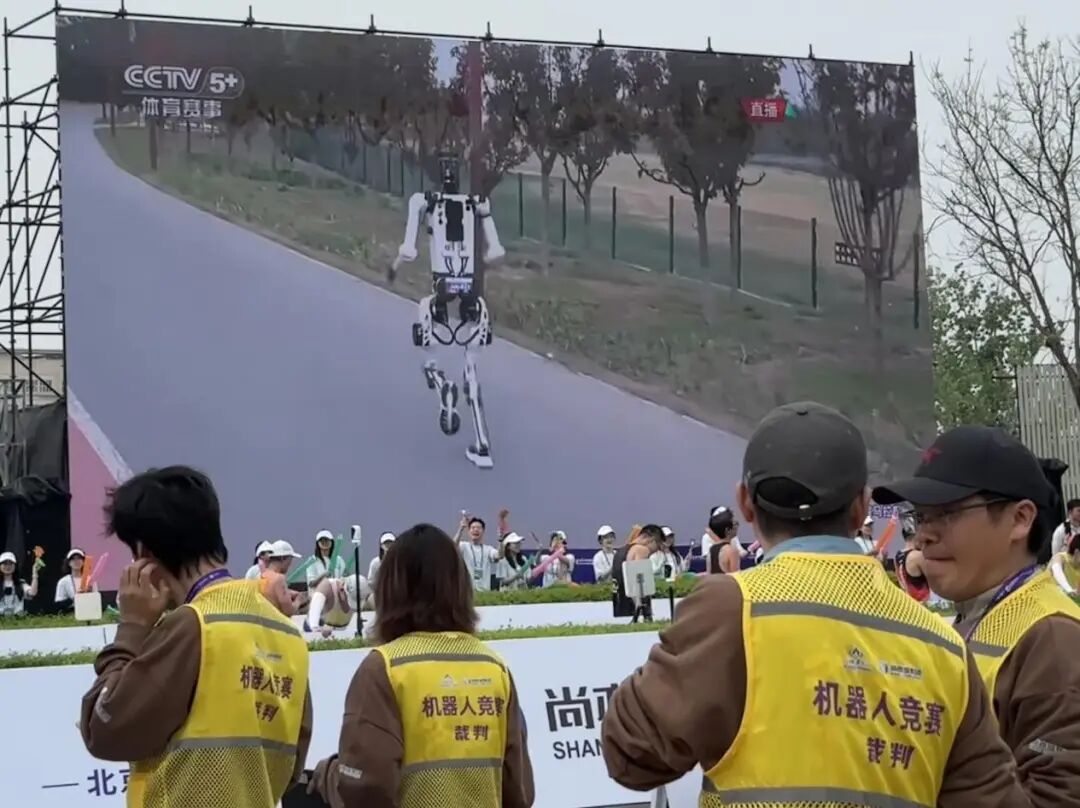
● A humanoid robot contestant wearing shoes. Photo by Huang Yiting
● It rained in Beijing a few days ago, and the participating teams put raincoats on the robots. Is it difficult for humanoid robots to be waterproof?
"If a waterproof model is really made, its overall cost will be at least five times higher than the current one."
Zhang Zhenyao: I think it's very difficult for robots to be waterproof. Humanoid robots integrate a large number of sensors and devices. They were not designed to be used in waterproof working conditions at the beginning. Their power interfaces, connectors between joints, and even many wiring are completely exposed. If someone wants to cause trouble and cuts one of the wires, it may lead to the complete paralysis of the entire robot system.
At this stage, making humanoid robots waterproof is too complicated. Now many teams have made a lot of innovative designs at the joints of robots to make them run more efficiently. These mechanical structures are experimental. If we consider waterproof performance now, I think it's too early. Further, if a waterproof model is really made, its overall cost will be at least five times higher than the current one, which actually does not meet the commercialization needs of humanoid robots.
Different Sizes, Different Purposes
● There are significant differences in the height, weight, and build of different participating robots. The shortest robot this year is only 75 cm tall. Does an optimal body type for humanoid robots exist?
"In different application scenarios, humanoid robots will have more suitable body types."
Zhang Zhenyao: There is actually no standard answer to this question. More accurately, it needs to be discussed in specific tasks. In different application scenarios, humanoid robots will have more suitable body types.
For example, a smaller robot has the advantages of light overall weight, a relatively high swing amplitude, a low center of gravity, and good stability. When it is disturbed by the outside world, such as being collided, it is not easy to fall; even if it falls, the risk of damage to the motor and the whole machine is lower, and the overall power consumption is smaller.
However, its limitations are also obvious. Its single-step span is limited. If it wants to reach a higher speed, it must rely on a higher step frequency, which will significantly increase the motor load and heat dissipation pressure. Small robots have poor adaptability to complex terrains, such as steps and potholes, which can easily become insurmountable obstacles. So this type of robot is more suitable for indoor environments or algorithm verification, and is not suitable for long-distance outdoor sports on complex road conditions.
Looking at full-size humanoid robots, their advantage is that they can better utilize dynamics, such as the passive dynamic mechanism similar to a pendulum, to make the leg swing more efficiently, resulting in lower energy consumption per unit distance. At the same time, they correspond one-to-one with the human space and can directly reuse infrastructure such as stairs and passages without additional adaptation.
However, the problem is that once they fall, the risk will be very high. Because of their large body weight, high potential energy, and greater impact force, they are likely to cause serious damage to the whole machine. These robots also have higher requirements for motor performance and control algorithms, requiring stronger torque output and more precise balance control to avoid falling. They are more suitable for scenarios such as industrial manufacturing, logistics handling, emergency rescue, and general tasks that require one-to-one replacement with humans.
● Will there be non-standard humanoid structures specially optimized for running in the future?
"Completely replicating the human bipedal upright form may not be the optimal solution."
Zhang Zhenyao: If we simply look at the goal of "running faster and longer," completely replicating the human bipedal upright form may not be the optimal solution. The fastest animals in nature, such as ostriches, are not in a standard humanoid structure. Their legs have a reverse joint structure, and the main muscles are concentrated at the root of the thigh to improve efficiency and explosive power.
A similar idea has also appeared in robot design. For example, there was a humanoid robot last year with a large buttocks. In fact, there were two large motors there, similar to human muscles. Or using a more lightweight material structure, or even removing the upper body or arms in some scenarios. But this type of design is more suitable for specific tasks.
In the long run, if the goal is to enter households, hospitals, or general