The price of charging piles has increased, and there are fewer and fewer "Pinhaodian" charging services available at 0.5 yuan per kilowatt-hour.
After consecutive increases in oil prices, many new energy vehicle owners have found that the charging pile fees have also quietly risen. Some Beijing owners reported that previously, it cost about 50 yuan to fully charge a vehicle, which could run for over 400 kilometers. Now, during peak hours, the price per kilowatt - hour has increased by nearly 0.5 yuan, and it costs over 80 yuan to fully charge a vehicle. For this reason, some people have bluntly said that "the cost advantage of electric vehicles is almost unsustainable."
However, investigations have found that the price increases of charging stations vary significantly across different regions. Most charging piles in shopping malls and residential communities in Shanghai, as well as ride - hailing drivers, said that the prices were basically stable and they did not feel any obvious increase. However, some Shanghai netizens reported that there were fewer low - priced charging piles nearby. The situation in other cities also shows a differentiation trend. Some users reported an increase in charging costs, while many owners said that the prices remained stable.
Different from fuel with a unified price, the electricity prices of public charging piles vary greatly depending on the time period and the charging station. Since there is no difference in the quality of electricity itself, it further amplifies users' sensitivity to price fluctuations. A lower vehicle - using cost is the core reason for most people to choose new energy vehicles. Especially when the cost of using fuel vehicles remains high, the relatively low energy consumption cost of electric vehicles is its core competitiveness.
For this reason, even a price increase of just a few cents or a few dimes per kilowatt - hour will directly affect the owners' perception of cost and their travel choices.
01
Different Charging Stations Have Different Price Trends
"I haven't felt any changes. The price has always been the same." In April, when visiting several old residential communities in Shanghai, the responses were that the charging pile prices were stable and there was no price increase.
Xiao Shen, who works part - time as a ride - hailing driver, drives a BYD Song with a pure - electric range of only about 100 km. He charges his car in the community and is not very sensitive to the electricity cost. "The price has always been 1.3 yuan per kilowatt - hour (0.6 yuan for electricity and 0.7 yuan for service fees)." Xiao Shen also said that there were limited charging pile spots in the community. Sometimes, when he returned the car late, he might not be able to charge it. In that case, he would use gasoline to run the car. So, "I'm more sensitive to the oil price. Anyway, it's just a part - time job, and I don't really care about the cost."
Xiao Dang, a taxi driver living in the relatively remote Chuansha area, also charges his car in the community. Compared with the urban area, the electricity cost in their community is cheaper. "It's 1.2 yuan per kilowatt - hour during the day and 0.6 yuan at night. My car's battery can run for 300 kilometers. I usually charge it once during the day and once at night."
Even though it's more expensive to charge during the day, in order to continue taking orders, he has to charge at the high - price time. Sometimes, to save time, Xiao Dang will also go to a battery - swapping station to swap the battery. "Swapping a battery with a 290 - kilometer range is a bit more expensive than charging, but it's faster."
In this way, the price increase of charging has not had an impact on the most in - need ride - hailing group. In office areas such as office buildings and shopping malls, the charging price fluctuations are not obvious either. For example, the author charged 51.43 kilowatt - hours at the same charging pile in the same office building last year, spending 68.3 yuan, with a unit price of 1.32 yuan. This year, when charging 37.71 kilowatt - hours, the payment was 48.88 yuan, equivalent to a unit price of 1.29 yuan per kilowatt - hour. Due to the combination of coupons, the unit price actually decreased instead of increasing.
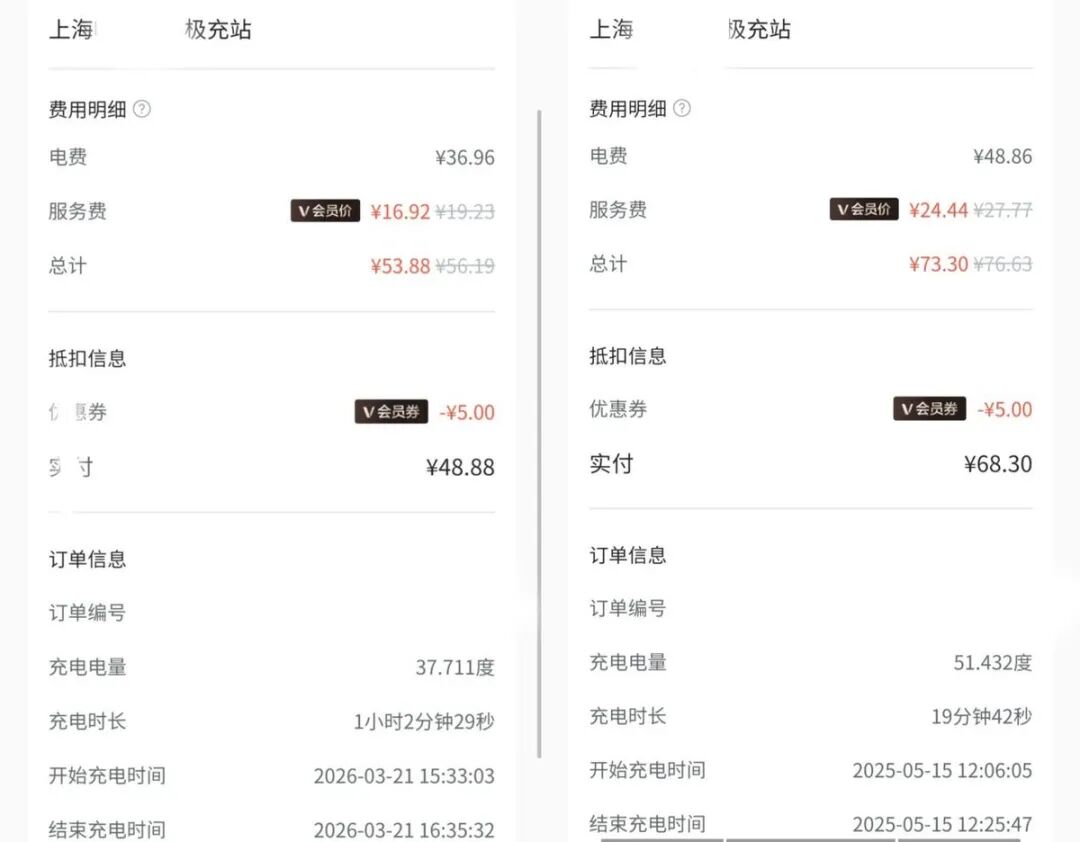
In the daily posts of users in other areas of Shanghai, some users mentioned that the nearby charging piles had increased in price, and it was difficult to find "cost - effective" charging piles at 0.5 yuan per kilowatt - hour at night. It can be seen that there is no specific pattern in the price adjustment of charging piles, and the differences between different stations are significant.
The situation in lower - tier cities is also different. Some netizens posted complaints about small price fluctuations in their local areas, while some owners in the same area replied that the charging prices were stable. Generally speaking, whether the charging cost increases depends largely on the region, charging time period, and the pricing strategy of the operator.
Consumers are worried about the price increase of charging piles, but operators have not increased their revenues due to the price adjustment.
Lao Jiang, the owner of a charging station in a fourth - tier city, said that he invested 900,000 yuan in 2020 to build the charging station. At that time, there were few charging stations, and car owners queued up to charge. One charging gun could charge up to 300 kilowatt - hours per day. According to the service fee of 0.3 yuan per kilowatt - hour, he made a net profit of 500,000 yuan that year.
However, after 2023, with more operators entering the market, the service fees of charging piles began to gradually decline due to competition. The original service fee of 0.3 yuan per kilowatt - hour was even reduced to 0.05 yuan. At the same time, the idle rate of charging piles also began to rise, and the profit decreased significantly. Lao Jiang said that since 2023, the income of his charging station has plummeted to 80,000 yuan. Now, the daily income of the entire charging station is only about 200 yuan, and the annual profit has further decreased to 60,000 yuan.
The obvious contrast between the "price increase" that users intuitively feel and the actual "difficulty in increasing revenue" of operators is not simply due to market supply - and - demand fluctuations. It is the result of the combined effects of electricity price policies, cost structures, and industry competition.
02
Price Returns to "Normal", but No One Wins
Upon in - depth understanding, it is not difficult to find that there is a clear pricing logic behind the rise and fall of public charging pile prices. Home charging piles follow the residential electricity price, which is uniformly set by the government and remains stable for a long time. The cost of public charging piles consists of two parts: the industrial and commercial electricity price and the operator's service fee, which is the core source of price fluctuations.
In December 2025, the National Development and Reform Commission and the National Energy Administration jointly issued the "Basic Rules for the Medium - and Long - Term Electricity Market", clearly stating that starting from March 1, 2026, the fixed peak - valley electricity price for public charging piles will be cancelled, and a market - oriented dynamic floating pricing system will be fully implemented. The electricity price will be adjusted in real - time according to the grid load, new energy power generation output, and market supply and demand. "It's not an increase, but the off - peak price has become more flexible," an industry insider said in a previous interview.
In addition to the flexible adjustment of the industrial and commercial electricity price, the price increase perceived by users is largely related to the adjustment of the service fee. The service fee is the main source of income for operators to cover site rent, equipment depreciation, operation and maintenance labor, and power loss. Operators have a relatively large degree of independent control. The core of the fluctuation in Lao Jiang's charging station revenue lies in the change of the service fee.
Industry data shows that Teclai and Xingxing Charging rank first and second in the industry with market shares of 18.88% and 15.37% respectively. However, even for these leading enterprises, their expansion has slowed down due to the continuous decline in service fees. As of December 2025, Xingxing Charging has deployed more than 38,000 charging stations across the country. Even with large - scale cost sharing, its full - cycle operating cost is still 0.4 yuan per kilowatt - hour, which means that the service fee needs to be higher than this standard to break even.
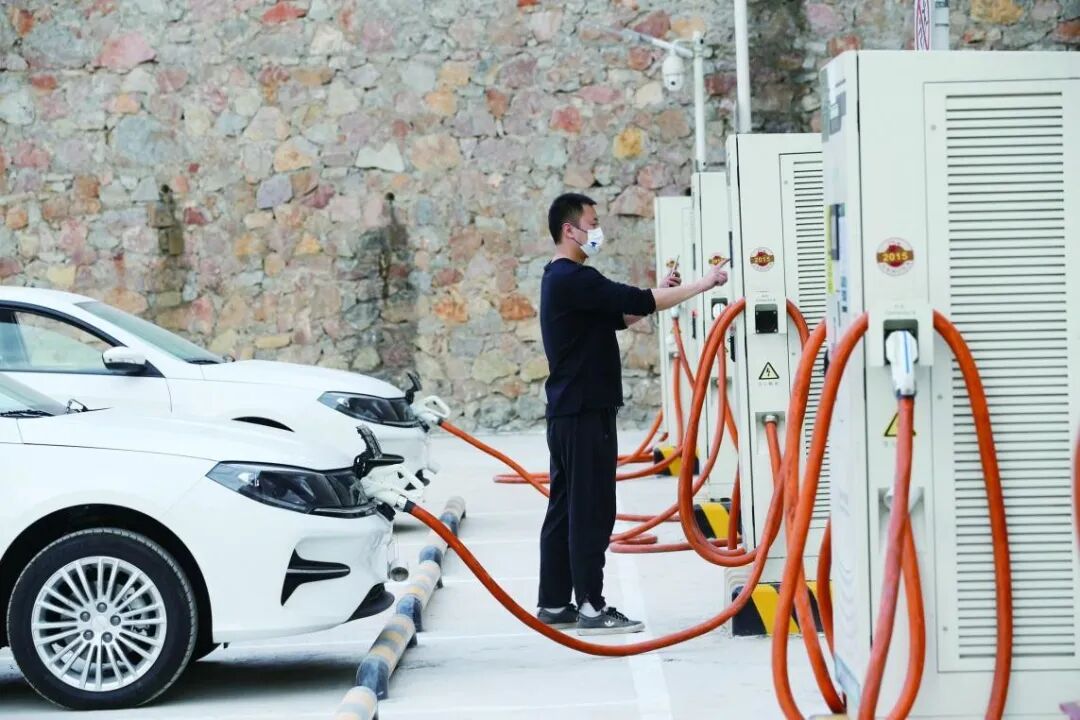
A service fee of 0.4 yuan per kilowatt - hour is not low. In Shanghai, where the charging price is higher, most charging pile service fees exceed this range. For lower - tier cities and electric vehicle owners who are used to low - priced charging of a few dimes per kilowatt - hour, this pricing is probably even more unacceptable.
From the huge gap between market acceptance and operators' costs, it is also clear that the industry's profit - making logic has completely reversed.
Comparing the situation in 2020 when private charging stations could earn 500,000 yuan a year with a service fee of 0.3 yuan per kilowatt - hour, to now when leading enterprises can only break even with a service fee of 0.4 yuan per kilowatt - hour, the benchmark line of the service fee in the charging pile industry has changed greatly in six years.
However, according to the normal market logic, as more players enter the market, the marginal cost should gradually decrease - just like in the automobile manufacturing industry, the more vehicles are produced, the lower the cost per vehicle and the greater the profit. Why is the situation in the charging pile market contrary to expectations?
On the one hand, a large amount of capital and players have entered the market. While improving the convenience of energy replenishment for users, it has also seriously dispersed the customer flow. A large number of charging piles are idle during weekdays, resulting in a waste of resources. Coupled with the increasing costs of site rent and manual maintenance year by year, the profit - making pressure on operators has continued to intensify.
On the other hand, there is an obvious gap in energy replenishment on the user side, and it is "hard to find a charging pile" during peak hours. It has become normal to queue up for charging at highway service areas during holidays, and the problem of energy replenishment is prominent. Currently, there are diverse players in the charging pile market, including professional operators such as Teclai, car brands, and individual investors.
From the perspective of operators, deploying charging stations is a necessary measure to spread costs and seize market share. For car companies, accelerating the deployment of super - charging stations and battery - swapping stations is not only to improve user services but also an important measure to bind car - buying rights and enhance brand competitiveness. For example, BYD plans to build 20,000 flash - charging stations this year, Li Auto is accelerating the deployment of super - charging stations, and NIO's battery - swapping stations even cover the 318 National Highway Sichuan - Tibet Line. The individual charging station operators who enter the market not only consider the interests but also actually fill the gap of charging piles in lower - tier cities, which is indispensable.
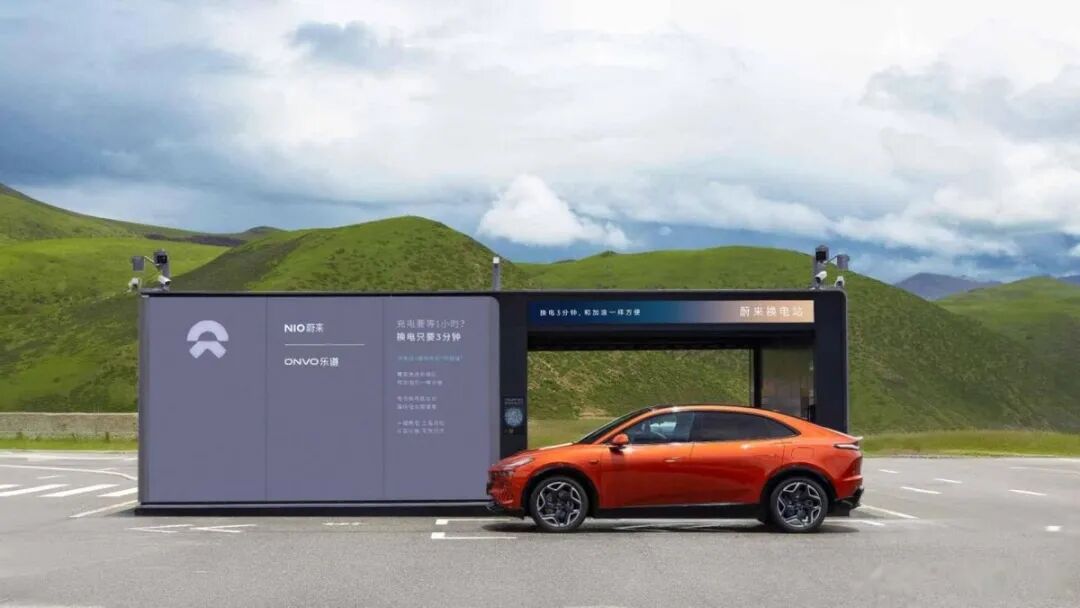
However, in the context of malicious competition to seize customers and the increase in user choices, it is difficult for operators to cover costs through reasonable pricing. They are caught between "lowering prices to grab orders" and "raising prices and losing customers". Previously, the person in charge of a leading operator said that after leading nearly ten suggestions to oppose the involution and advocate for the price to return to the normal range, it was still difficult to make progress.
For operators and car companies, the dilemma of highway charging stations is particularly typical. Limited by the geographical location, the maintenance cost of highway charging stations is higher, and the electricity price is also more expensive. Car owners usually try to complete energy replenishment before getting on the highway and only replenish energy on the highway during long - distance trips. As a result, the daily utilization rate of the stations is low, and the service fee cost is further pushed up. During holidays, the traffic flow surges, and the charging piles are in short supply. New stations have to be continuously built, forming a vicious cycle of "idle - price increase - queuing - building new stations".
From the perspective of individual operators, without the membership fees, government subsidies, and additional fees from battery sales brought by the scale advantage, they can only rely on lower service fees to attract customers.
In this way, although the service fee has been adjusted and is expected to rise and return to the so - called "normal" price, in the current situation, it is actually a lose - lose situation for both consumers and charging piles: consumers have to pay more for charging service fees and have a worse experience; the cost of charging piles is pushed up, and the operating costs cannot be covered.
For new energy vehicle owners, the fluctuation of charging costs is gradually eroding the core competitiveness of electric vehicles. Although this increase is not a widespread phenomenon at present, with the full implementation of market - oriented pricing, the charging price will more reflect the supply - demand relationship and the real cost. This means saying goodbye to the past "one - size - fits - all" low - price bonus and entering a charging era that requires price comparison, timing, and careful calculation.
For the entire industry, how to ensure a reasonable service fee, maintain the survival of operators, not overly transfer the charging cost to consumers, improve the utilization efficiency of charging piles, alleviate the structural contradiction of "idle on weekdays and insufficient during peak hours", and ensure good profitability will be the core issues that must be faced in the next few years.
This article is from the WeChat official account "Automobile Commune" (ID: iAUTO2010), author: Sai Jiatong, published by 36Kr with authorization.