Japan's largest "Sleepless Laboratory" is inaugurated, with efficiency a hundred times that of humans.
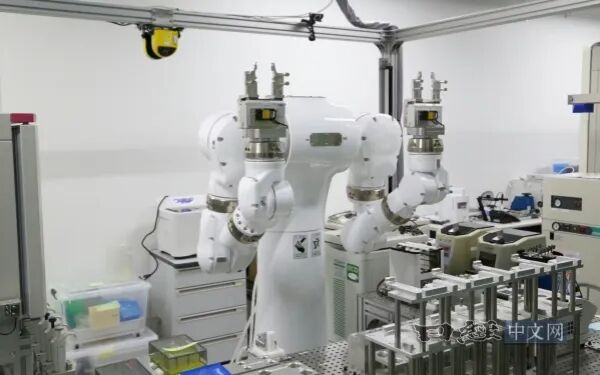
Tokyo University of Science launched a facility for 24-hour automatic experiments with the dual-arm robot "Mahoro" (March, Bunkyo-ku, Tokyo)
At the Yushima Campus of Tokyo University of Science, the largest-scale automatic experiment facility in Japan was launched. For a total of 10 research projects in areas such as cancer and regenerative medicine, a total of 10 robots, including the dual-arm robot "Mahoro" developed by Yaskawa Electric, were introduced. The robots can operate 24 hours a day, 365 days a year...
On April 15th, Tokyo University of Science inaugurated the largest-scale facility in Japan where robots replace researchers in conducting scientific experiments. The robots can carry out experiments such as cell culture and gene testing, with an efficiency 100 times that of humans. While addressing the shortage of manpower, it is expected to accelerate research in areas such as cancer and regenerative medicine.
The Sleepless Laboratory
The facility put into operation at the Yushima Campus (Bunkyo-ku, Tokyo) of Tokyo University of Science is the largest-scale automatic experiment facility in Japan. An opening ceremony was held on April 15th. For a total of 10 research projects in areas such as cancer and regenerative medicine, a total of 10 robots, including the dual-arm robot "Mahoro" developed by Yaskawa Electric, were introduced.
The robots can automatically complete tasks such as reagent mixing using pipettes, cell culture, and gene analysis. They can work continuously for 24 hours. Researchers only need to set up the experiment content and then leave work, and they can get the results the next morning. Professor Motonori Kanda of Tokyo University of Science said, "The efficiency of experiment progress is about 100 times that of humans." A large amount of experimental data can be accumulated in a short time, rapidly accelerating the research progress.
The robots can operate 24 hours a day, 365 days a year. Professor Kanda introduced, "They can replace the complex operations that require researchers to spend a lot of time to master." In the future, technical experience in the efficient collaborative operation of multiple robots will be accumulated. It is planned to increase the number of robots to 20 in 2028 and introduce about 2,000 robots in 2040.
Shinshu University in Japan also inaugurated a new automatic experiment facility in early April. About 10 dual-arm robots and about 100 single-arm robots were introduced for research in the fields of materials and chemistry. The whole process from material synthesis to performance evaluation is automated. Researchers can issue experiment instructions through the cloud.
The research team led by Professor Katsuya Teshima took the opportunity of researchers having difficulty gathering in the laboratory during the COVID-19 pandemic to promote the development of robot control technology and experiment-specific application programs. This application is based on about 100,000 pieces of experimental data from the past 50 years to explore the synthesis methods of high-performance materials and chemical products. Then the robots actually carry out the synthesis and verify their performance.
Overseas R & D Leads
Overseas countries have been leading in the development of autonomous experiment facilities. Institutions such as the University of Liverpool in the UK have vigorously carried out research using single-arm robots to find water decomposition catalysts and discovered compounds with activity more than six times that of the previous ones. 688 experiments were repeated in 8 days. And a paper was published in the British scientific journal "Nature" in 2020.
During the COVID-19 pandemic when it was difficult for humans to go to the laboratory, the attention to robots increased. The Canadian government decided to provide financial assistance to the University of Toronto in 2023, and US President Trump signed a presidential order in 2025 to use robots and artificial intelligence (AI) to accelerate the pace of scientific research.
In the United States, enterprises engaged in the manufacturing of experimental equipment and other businesses have emerged one after another. Former members of Google's AI development department "Google DeepMind" founded the startup Periodic Labs. Project Prometheus, founded by Jeff Bezos, the founder of Amazon.com, raised about $6.2 billion in 2025.
According to data from the research company Global Information, the global market size of systems that can automate scientific research and other activities will increase by about 40% compared with 2026 and reach about $12.2 billion by 2030.
The Research Environment is Changing

The Japanese Ministry of Education, Culture, Sports, Science and Technology is promoting the construction of automatic experiment facilities
In Japan, the Ministry of Education, Culture, Sports, Science and Technology plans to build automatic experiment facilities using AI. The ministry proposed a draft policy in March to set up at least about 3 automatic experiment bases that can operate 24 hours a day within 5 years. By building relevant bases, it aims to attract outstanding talents from around the world to help Japan enhance its scientific strength.
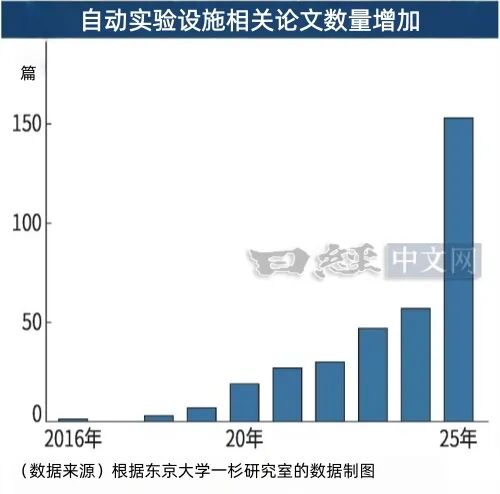
Taro Ichisugi, a professor at the University of Tokyo who participated in the government's expert meeting, believes that "in the next 3 - 4 years, automatic experiment facilities are expected to achieve great development." Professor Ichisugi and others investigated the number of global papers related to automatic experiment facilities and found that it began to increase around 2020 and tripled in 2025 compared with 2024, reaching 153 papers.
If robots that undertake experimental work become popular, researchers can use their spare time to formulate research concepts and train students. Especially in Japan, due to the problem of a declining birthrate and an aging population, there is a concern that it is difficult to ensure the number of researchers. Professor Ichisugi pointed out that the introduction of robots for scientific research should be accelerated.
This article is from the WeChat official account "Nikkei Chinese Net" (ID: rijingzhongwenwang), author: Ryo Matsuura. It is published by 36Kr with authorization.