Zhiyuan Robotics aims to build a large AI model platform and an open ecosystem.
Text | Wang Yuchan
Editor | Yang Xuan
What impact will it have on the industry when a robotics company decides to develop a large AI model platform and an open ecosystem?
Last month, Zhipu Robotics just crossed the threshold of "producing and delivering 10,000 robots in mass production". On April 17th, this robotics company co-founded by Peng Zhihui, a former "Genius Teenager" at Huawei, and Deng Taihua, a former vice president of Huawei, spent a great deal of time and space introducing new software products at the partner conference. In contrast, the coverage of hardware was relatively limited.
Zhipu Robotics launched six AI models and seven productivity solutions, and publicly unveiled the AIMA (AI Machine Architecture) full-stack ecological technology system for the first time. These software products, together with hardware robots, will form Zhipu's "One Body, Three Intelligences" architecture.
The so - called "One Body, Three Intelligences": "One Body" refers to the robot body; "Three Intelligences" include: Motion Intelligence (basic intelligence, serving as the actuator of the physical carrier); Interaction Intelligence (advanced intelligence, serving as the entry point for emotional value); and Task Intelligence (advanced intelligence, providing labor productivity).
"Zhipu Robotics is not just a robotics company, but also an embodied intelligence company. Without intelligence deeply integrated with the body, a robot is just a tool, not true embodied intelligence," said Peng Zhihui.
The key to enabling robots to not only dance and do somersaults according to pre - written programs, but also independently undertake tasks in industrial, commercial, and household environments lies in the robot's brain. Now, Zhipu Robotics hopes to build a platform for "incubating robot brains".
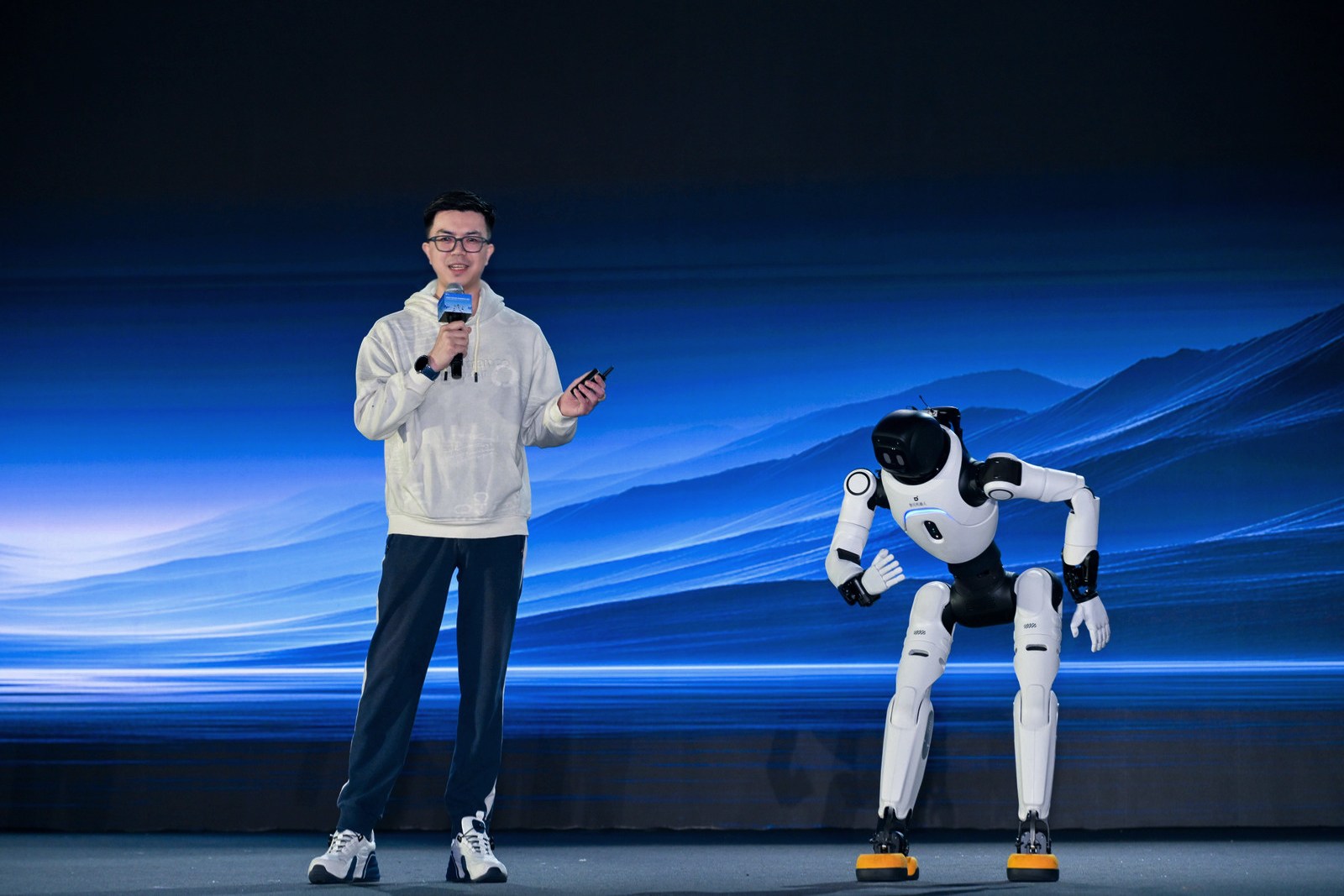
Peng Zhihui, Co - founder, President, and CTO of Zhipu Robotics
Zhipu Robotics Launches Six AI Models in One Go, Aims for an "Open Ecosystem"
Deng Taihua, Founder, Chairman, and CEO of Zhipu Robotics, announced that the company will launch six AI models this year, covering Motion Intelligence, Interaction Intelligence, and Task Intelligence in the "One Body, Three Intelligences" framework.
In terms of Motion Intelligence, two base models will be launched: a whole - body motion control base model that supports sensory - control integration (achieving adaptive motion control through environmental perception), and a generative motion control base model (capable of generating arbitrary actions in real - time through multi - modal interaction without pre - choreography).
In terms of Interaction Intelligence, based on the widely applied WITA large model, the industry's first end - to - end embodied multi - modal interaction large model, WITA Omni 1.0, will be released in the third quarter. This model retains information such as dialogue emotions, context, tone, and environment, enabling natural and anthropomorphic emotional interaction and expression, and supporting mid - conversation interruptions, corrections, etc.
The investment in Task Intelligence is the largest, with the highest density of algorithmic talents. Zhipu Robotics has recently released the GO - 2 model that integrates the "big brain" and "small brain", the action world model GE - 2, the open - source dataset AGIBOT WORLD 2026, the simulation platform Genie Sim 3.0, and Genie Studio 2.0. In the third quarter, the GO - 3 model will be launched, which integrates the ViLLA architecture and the world model architecture, has planning and deduction capabilities, as well as the ability to reason and execute complex tasks, with a data scale dozens to hundreds of times that of GO - 2.
Deng Taihua showed a graph to the industry partners in the audience - the XYZ curve of the development of embodied intelligence.
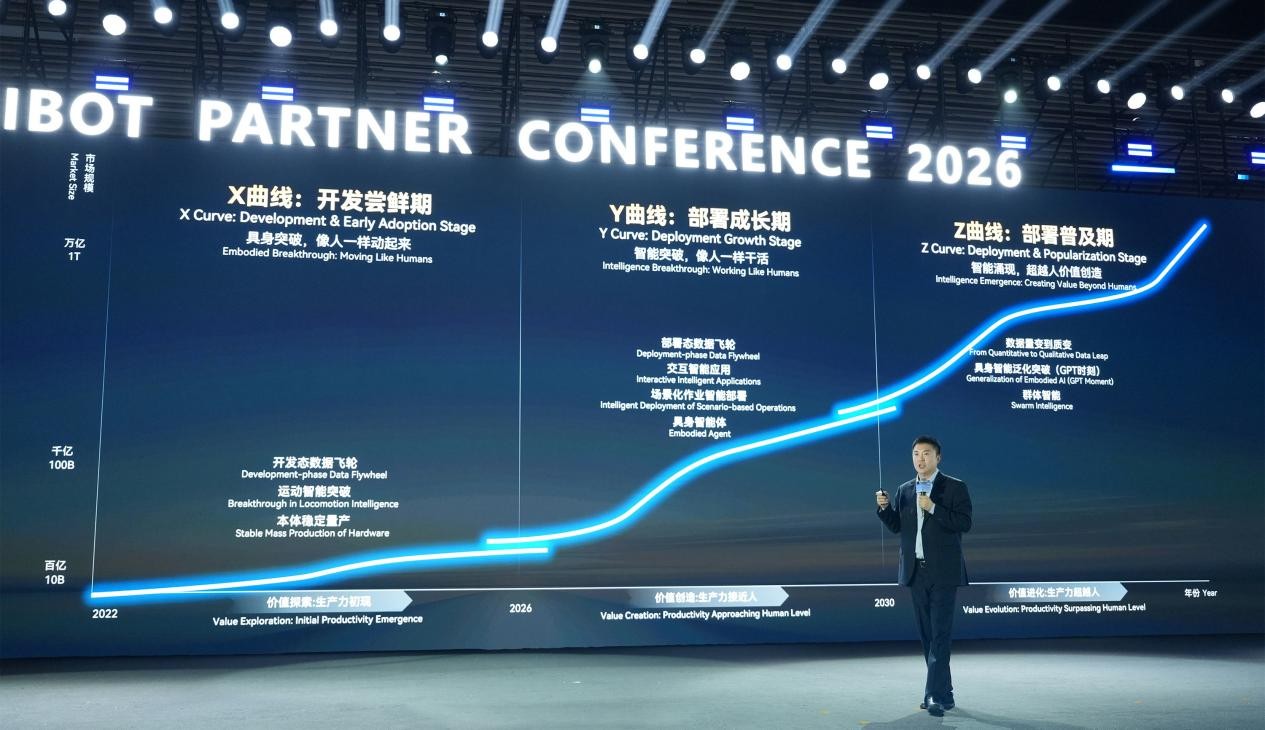
The XYZ curve of the development of embodied intelligence
The X - curve (from 2022 to 2025) represents the development and exploration period, achieving the leap from prototype to large - scale mass production. In 2023, the first humanoid robot was released, verifying the technical feasibility; in 2025, 5,000 units were mass - produced, and robots changed from "exhibition items" to "commodities", and robots could "move".
The Y - curve (from 2026 to 2030) represents the deployment and growth period. In March 2026, 10,000 Zhipu robots were delivered. Interaction Intelligence and Task Intelligence were implemented on a large scale, and the productivity of robots continued to approach that of humans.
The Z - curve (from 2030 onwards) represents the deployment and popularization period, when the emergence of embodied intelligence arrives - the productivity of robots in key fields such as manufacturing, logistics, and services comprehensively surpasses that of humans, the learning efficiency and evolution speed are extremely leading, and swarm intelligence begins to emerge.
According to Zhipu's plan, the company will go through the X - curve in three years, achieving the first one - billion - yuan revenue; go through the Y - curve in five years, completing the deployment of 10,000 units and achieving ten - billion - yuan revenue; and enter the Z - curve in eight years, co - creating with global ecological partners and achieving large - scale promotion from 1 to N. This plan is called the "358 Grand Plan", and 2026, as the beginning of the Y - curve, is called the "Year of Deployment State".
Peng Zhihui, President and CTO, said that Zhipu Robotics identified 2026 as a breakthrough point because "three factors are simultaneously established this year" - the breakthrough of large models; the robot body and the data flywheel.
First, in terms of large models, the models have enabled robots to understand and perceive the world. More importantly, these models are no longer isolated algorithms but have formed an open - source ecosystem, which has accelerated the iteration of robot technology.
Second, in terms of the robot body, robots have achieved large - scale mass production and can operate stably 24/7.
Finally, in terms of the data flywheel, Peng Zhihui said, "The more robots are deployed in the data flywheel, the faster the flywheel rotates, the more data is collected, and the stronger the model training ability becomes. Once this flywheel starts to turn, it will generate an exponential network effect. Zhipu Robotics believes that the flywheel will start to accelerate in 2026."
Based on this judgment, Zhipu's next step is - mass - produce the body, iterate the models, open - source data, and build an open - ecosystem platform. Peng Zhihui calls this "the most difficult but also the most rewarding path".
The Industry Lacking Data and Competitors Repeating the Same Work
To some extent, the attempt of robotics companies to move towards an open model with competitors in 2026 is also an inevitable result of resource shortages.
In 2026, large language models and large video - generation models are consuming a large amount of Tokens, while the embodied robot industry is experiencing a situation of "no Tokens to consume". Large models can "read" like humans, while embodied intelligence needs to gain data through real - world experiences - the lack of data has become a bottleneck for the entire industry.
One day before the partner conference, Mifeng Technology, a subsidiary of Zhipu Robotics, released a "one - stop physical AI data service platform", which is positioned as a To - B data service platform for other robotics companies.
"Who is the largest Token consumer in the AI era? It's not chat software, not code assistants, nor picture and video generators - it's the embodied intelligent agents," said Peng Zhihui. "The task space of embodied intelligent agents spans the digital world and the entire physical world. A robot operating continuously in the physical world consumes Tokens every moment."
Robots have been mass - produced, and large models have been developed. Now, what is lacking is the "data flywheel".
"GPT5 used 100 trillion tokens of training corpus. One token is approximately equal to 0.75 English words. If an ordinary person can speak at a rate of 150 words per minute, this corpus level is equivalent to a person speaking for 10 billion hours," said Yao Maoqing, Chairman and CEO of Mifeng Technology. "However, it's different for embodied intelligence. Today, the high - quality data from around the world combined may only amount to about 500,000 hours."
In the interview session after the conference, Peng Zhihui once again talked to the media, including those covering the topic of intelligent emergence, about the issue of the "data shortage".
"The data gap in embodied intelligence is still relatively large, which is a major bottleneck for the industry at present. Moreover, the requirements for data collection are high because real - world contact is needed to collect data such as friction and gravity," said Peng Zhihui. "Therefore, we have been launching data - collection products and business solutions and actively building various open - data ecosystems."
Moreover, the industry still lacks standardization, which has led to the problem of redundant work.
Peng Zhihui also serves as the deputy director of the Standardization Technical Committee for Humanoid Robots and Embodied Intelligence under the Ministry of Industry and Information Technology. "There is top - level guidance in China, and I am also involved in standard construction. (We hope) that everyone can work together to promote development," Peng Zhihui said. On the one hand, Zhipu Robotics will continue to expand the deployment of robot bodies, allowing more robots to enter real - world workflows to collect data. On the other hand, it hopes to attract more third - party developers to participate in co - construction.
The open ecosystem is aimed at jointly solving the data shortage and establishing "standards" to avoid redundant work by companies in the industry.
"The more open - source resources there are, the easier it is to form an ecosystem. The more people participate in the ecosystem, the more likely a 'de - facto standard' will be formed. This is also a path for us to promote standardization," said Peng Zhihui.
According to data from overseas authoritative institutions and the Development Research Center of the State Council, by around 2050, the embodied intelligence industry will reach a scale of 5 trillion US dollars. In 2035, 10 years from now, the embodied intelligence industry in China alone will reach a scale of 1 trillion RMB.
Comparing with the automotive industry, the current global car ownership is approximately 1.6 billion, with a corresponding market size close to 5 trillion US dollars. That is to say, the embodied intelligence industry will "re - create an automotive industry" in 25 years.
Facing such a huge but distant market, the industry struggling with the data bottleneck is far from the stage of competition.
"We do not require exclusivity, non - sharing, or a choice between two for all our partners. Everything is open to the entire industry. If other companies succeed based on Zhipu's system capabilities and promote the development of the industry, we welcome it. When the industry succeeds and productivity improves, we are all beneficiaries," said Deng Taihua.