Jensen Huang's Latest In - depth Interview: NVIDIA's Moat, TPU Threat, and Ecosystem Building
Don't fight for every city or territory, but control the rhythm of ecological evolution.
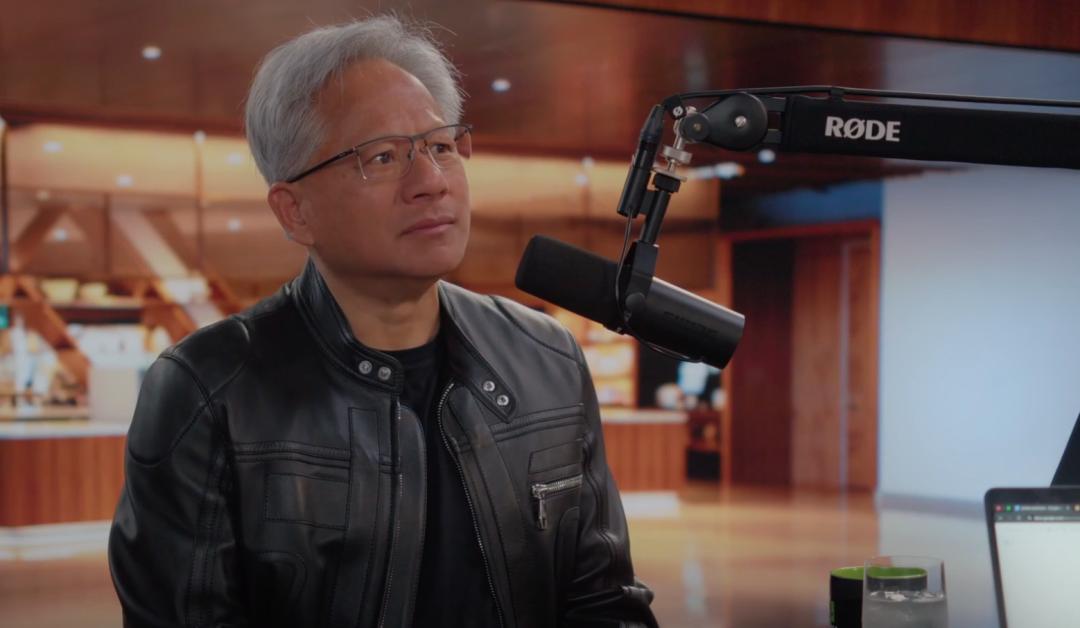
Recently, Jensen Huang, the CEO of NVIDIA, was interviewed by well - known tech host Dwarkesh Patel in a 103 - minute interview. At the beginning of the interview, host Dwarkesh Patel posed a sharp question: In essence, NVIDIA only writes software. Its chips are manufactured by TSMC, memory is provided by SK Hynix and Samsung, and assembly is outsourced to Taiwanese ODMs. If software is commoditized by AI, will NVIDIA also be commoditized?
Jensen Huang gave the most concise self - definition of NVIDIA: "The input is electrons, the output is tokens, and in the middle is NVIDIA."
He explained that converting electrons into tokens and continuously increasing the value of these tokens is difficult to be commoditized. NVIDIA's responsibility is to "do what is necessary and outsource what can be outsourced." It hands over all the things it doesn't need to do to its ecological partners. However, the truly core part is "incredibly difficult."
He also refuted the pessimistic view that software companies will be eliminated by AI. He believes that the number of AI agents will increase exponentially, and the tool call volume will also skyrocket. The demand for tool software such as Synopsys and Cadence will actually increase significantly due to the popularization of AI agents. "The current bottleneck is not the tools, but the insufficient number of engineers."
01 · Supply Chain Moat: A $250 - billion Commitment and the "Prefetching the Bottlenecks" Strategy
External analysis firm SemiAnalysis revealed that NVIDIA's total procurement commitments to wafer fabs, memory manufacturers, and packaging plants may reach up to $250 billion.
Jensen Huang does not deny that this is part of NVIDIA's moat. He explained the logic behind it: The upstream suppliers of NVIDIA are willing to make huge investments for NVIDIA because they believe that NVIDIA has strong enough downstream demand to absorb the production capacity. This mutual trust is not maintained by contracts. Taking the relationship between NVIDIA and TSMC as an example, the two parties don't even have a formal legal contract. It is based on "decades of trust and fair reciprocity."
He used the packaging technology CoWoS as an example to illustrate that "bottlenecks will be quickly filled by market forces." Two years ago, CoWoS was the biggest bottleneck in the industry. Later, the entire industry concentrated on solving it, and now it is basically no longer a problem. TSMC is now synchronously promoting the expansion of CoWoS production capacity with the production capacity of logic chips.
Jensen Huang proposed a core strategy: "Prefetching the bottlenecks." NVIDIA plans in advance for possible supply - chain bottlenecks several years ahead. He gave an example that NVIDIA started investing in the silicon photonics ecosystem (companies like Lumentum and Coherent) several years ago, and this layout has reshaped the entire supply - chain structure.
He admitted that the bottleneck he is really worried about is not chips or packaging, but energy policy. "You can't build a new industry without energy. Whether it's an AI factory, chip manufacturing, or a robot production line, the construction cycle of energy infrastructure is much longer than that of chip production capacity." He believes that the biggest constraint on the US re - industrialization vision (chip manufacturing, AI data centers, electric vehicles, and robots) is the power supply, which cannot be solved within a few years. This is also the fundamental reason why NVIDIA is so persistent in improving performance per watt.
02 · TPU Threat: Can Google and Amazon's Custom Chips Really Replace GPUs?
Patel pointed out that among the world's top AI models, Claude and Gemini are both trained on TPUs. What does this mean for NVIDIA?

Jensen Huang's answer was very well - organized. He first drew a conceptual distinction: NVIDIA is engaged in "accelerated computing," not "tensor processing units." The application scenarios of accelerated computing are far beyond AI and also cover scientific computing fields such as molecular dynamics, quantum chromodynamics, fluid mechanics, and particle physics. The market coverage of TPU or any dedicated ASIC cannot be compared with that of NVIDIA.
Regarding the argument that "AI is just matrix multiplication, and TPU is naturally more suitable," his refutation was very powerful. He believes that matrix multiplication is an important part of AI, but not all of it. New attention mechanisms, hybrid SSM architectures, the integration of diffusion models and autoregressive models, all algorithmic innovations require a sufficiently general and programmable underlying architecture. The core driving force for AI progress is the evolution of algorithms, and algorithm evolution requires flexible hardware.
He also took the cross - generation improvement from Hopper to Blackwell as an example. The performance increased by 30 to 50 times, far exceeding the 25% annual growth rate predicted by Moore's Law. This is completely dependent on the collaborative innovation of algorithms and software layers (such as the parallelization of the MoE architecture), which is exactly the advantage brought by CUDA's programmability.
03 · CUDA Moat: A Hundreds of Millions - Scale Installation Base is the Biggest Invisible Barrier
The real moat of CUDA lies in the breadth of the ecosystem and the scale of the installation base. Currently, there are hundreds of millions of NVIDIA GPUs in circulation, from A10, A100, H100 to the latest Blackwell series, which are distributed in every major public cloud, including Google, Amazon, Microsoft Azure, and Oracle OCI.
Jensen Huang's logic is that software developers care most about the "installation base." The real value lies in how many machines your code can run on. NVIDIA has made a large number of optimized code contributions to frameworks such as Triton, vLLM, and SGLang. Emerging frameworks in the field of RL training, such as verl and NeMo RL, also first emerged in the CUDA ecosystem. This "ecosystem thickness" is not just a simple technological competition, but a network - effect barrier.
He also acknowledged a phenomenon: Why did Anthropic choose Google's TPU instead of NVIDIA? He explained that this is due to the commercial investment logic. Google and Amazon invested billions of dollars in Anthropic, and the use of chips is just part of the investment terms. At that time, NVIDIA did not have the ability (nor the philosophy of corporate investment) to provide a similar "computing power for equity" arrangement.
04 · Why Doesn't NVIDIA Become a Cloud Service Provider?
This is an interesting question: Why doesn't NVIDIA directly become a hyperscale cloud service provider and skip the middlemen?
Jensen Huang's answer was clear and direct: NVIDIA's business model is based on "empowering operators," rather than becoming an operator itself. NVIDIA's chips can be used by any company, including university supercomputers, enterprise private clouds, Eli Lilly's drug R & D platform, and Elon Musk's xAI cluster. This universality is the core competitiveness. Once NVIDIA becomes a hyperscale cloud provider, it will become a competitor to all its existing cloud customers and destroy its own ecosystem.
He clearly stated that NVIDIA will never adopt an auction - style pricing for GPUs, nor will it become a hyperscaler.
05 · Conclusion: The Logic Behind the Single - Architecture Strategy
At the end of the interview, Patel asked why NVIDIA adheres to a single - chip architecture instead of launching multiple product lines for different scenarios. Jensen Huang's answer was consistent with his consistent thinking: A heterogeneous architecture will split the ecosystem and make software developers face fragmentation problems. Only a single programmable architecture combined with a rich - layered software stack can maintain the cohesion of the ecosystem.
This interview demonstrated Jensen Huang's consistent strategic thinking: Don't fight for every city or territory, but control the rhythm of ecological evolution. Whether it's the supply - chain layout, the CUDA ecosystem, or the pricing philosophy, NVIDIA's moat is not a single - point advantage, but a self - reinforcing flywheel. The greater the downstream demand, the more willing the upstream supply chain is to invest; the thicker the ecosystem, the less willing developers are to migrate; the faster the algorithm innovation, the higher the value of programmability.
This article is from the WeChat official account "Emphasize Next" (ID: leo89203898), author: Xin Jian. It is published by 36Kr with authorization.