PettiChat Secures Seed Investment Worth Millions of US Dollars, Develops AI Translator for Pet Wearables
36Kr learned that PettiChat, a pet AI technology startup, recently completed a $1 million seed round of financing. The investment was jointly made by the Alumni Fund of Zhejiang University, Oufang Angel, and Huadan Angel. The funds from this round of financing will be mainly used for the research and development of the animal behavior world model, the construction of high-quality datasets, and the market promotion of the first hardware product.
In today's world where general artificial intelligence (AGI) dominates the human language sphere, a neglected language scenario has caught the close attention of a startup - that is, the communication between humans and animals.
For a long time, human interaction with pets has mostly remained at the level of emotional speculation. Although the pet market is huge - statistics show that the global pet market is expected to reach $270 billion in 2025, with a compound annual growth rate of 6.45% - the market still lacks solutions to the core pain point of "understanding the real needs of pets".
PettiChat aims to break the species communication barrier between humans and pets by constructing an "Animal Behavior World Model".
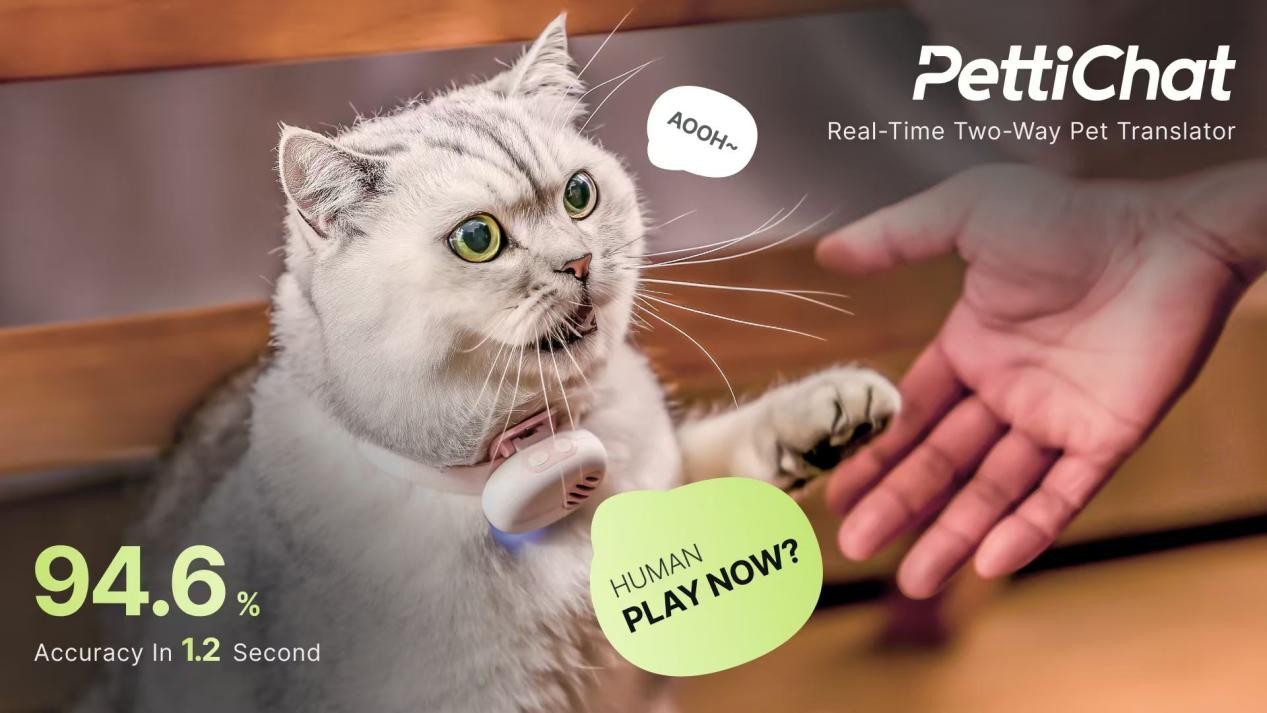
A cat wearing a translator
From "Translator" to "World Model"
Different from the simple and entertainment-based pet translation software on the market, the core underlying logic of Pettichat is "dual modeling of behavior and language". PettiChat believes that animal behavior has predictable "Tokens". Humans have about 86 billion neurons, while dogs and cats have 530 million and 227 million neurons respectively. The number of neurons in pets is much less than that in humans, so their behavior patterns are more regular under physical laws and biological instincts.
The core product architecture of PettiChat consists of three dimensions:
1. PET VOICE TRANSLATION:
2. PET TALK CONVERSATION: Based on AI Agent technology, it enables human intentions to be conveyed to pets in the form of sound, translating human language into pet language.
3. LOCATION & HEALTH TRACKER: It collects multi-modal data through wearable devices to achieve behavior warning and health management.
"What we want to do is not just a translator, but a world model of animal behavior," said Li Jingyuan, the founder of PettiChat. "Humans already have large language models and world models based on multi-modal data. We hope to build a world model for animals that includes visual, auditory, biochemical, and behavioral signals. By collecting high-quality animal behavior data, we can use a more reasonable physical modeling architecture to predict the health and behavior of pets."
The core product currently launched by PettiChat is a smart pet wearable device weighing about 27.2g, positioned as an "AI smart hardware" in the pet world. The product has IP56-level waterproofing and uses magnetic charging. It can be easily worn by clamping it on the collar. The owner can have real-time conversations with the pet through the supporting app: when the pet makes a sound, the device will automatically record and translate it in real-time; the owner can also send instructions through the app, and the device will convert them into pet language and convey them to the pet, thus achieving two-way communication between humans and pets.
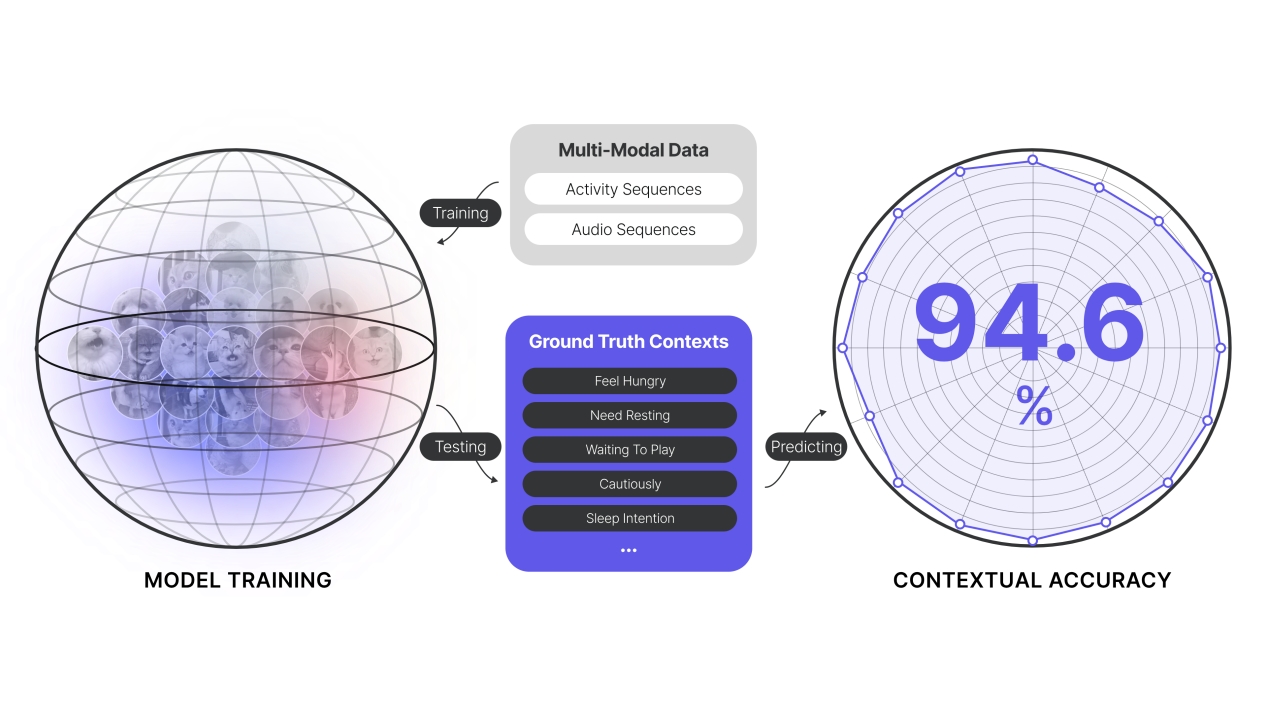
Pet language model
The "Pet Corpus" in the AI Era
In the second half of the AI competition, the quality of data determines the upper limit of the model. The PettiChat team realized that the reason there has been no breakthrough in the pet recognition field in the past is the lack of targeted, high-quality, and annotated animal behavior datasets.
To this end, PettiChat is continuously building a large animal behavior database that covers different dimensions of data, from daily interaction sounds and body language to abnormal physiological states. Currently, there are about 890,000 cat data and about 650,000 dog data after expert review. Through the "physical world" data feeding, the model can achieve a leap from "recognition" to "prediction". According to the data provided by PettiChat, the accuracy rate of the cat's situational acoustic pattern test reached 94.6%, and that of the dog reached 92.3%.
At the same time, the system has also strengthened the ability to recognize actions and understand the context of animal behavior based on AI Agent, which can better combine recent interactions to predict abnormal behavior and anxiety in pets.
Commercialization: A Multi-dimensional Matrix of Hardware and Software
In terms of the business path, PettiChat has chosen the model of "hardware carrier + subscription service". Its first real-time pet translator has started pre-sales. The pre-sale price of the product is $129 overseas and 799 yuan in China.
In addition to the consumer pet companion market, PettiChat's technological vision also points to a broader business-to-business (B2B) field. Since its underlying logic is to build an animal model of the physical world, this technology can be extended to scenarios such as animal husbandry and wildlife protection in the future. By monitoring the behavior and emotions of animals, it can improve breeding efficiency or achieve ecological early warning.
Currently, the global pet accessories market has reached a scale of $58.5 billion, and wearable devices and smart hardware are rapidly growing segments. With its original "world model" concept, PettiChat is trying to build a brand moat based on technological depth in this highly fragmented market.
The core members of the team are all from the School of Computer Science and the School of Artificial Intelligence at Zhejiang University. Li Jingyuan, the founder, is a Ph.D. in artificial intelligence from Zhejiang University and a serial entrepreneur in his 90s; Du Jiacun, the CTO, holds a bachelor's degree from Zhejiang University and a master's degree from Eindhoven University of Technology in the Netherlands, and has 8 years of work experience in the fields of the Internet of Things and large models at Alibaba Cloud.
Investors' Views:
The pet economy is an emerging market with great potential. The recent development of AI has made the interaction between pet owners and pets more diverse and interesting. As an early-stage science and technology investment institution that has invested in many excellent teams from Zhejiang University, Huadan Angel Investment is also very happy to support the entrepreneurial team of alumni from the Zhu Kezhen College's Intensive Class in this investment and jointly explore this new field.
We believe that Pettichat represents a new technological paradigm - using the methods of general artificial intelligence to understand non-human intelligent agents. This is a new field that is transferable, scalable, and full of imagination. Different from the pet translation products on the market that are based on rules or simple classification, the large pet interaction model built by Pettichat uses a Transformer-like architecture to unify the pet's calls, body movements, and physiological signals into predictable "behavior Tokens", achieving a leap from "recognition" to "understanding and prediction". The team has made solid investments in data engineering and has accumulated a large amount of expert-annotated pet corpus. The model can show commercial-grade accuracy in tasks such as situational acoustics, which all contribute to the long-term competitiveness of the enterprise.