Meituan has quietly invested in half of the tech circle.
In recent days, the capital market has been almost bombarded with a bunch of IPO news. The application for the listing of Unitree Technology on the Science and Technology Innovation Board has been accepted, with a valuation reaching 42 billion yuan; Zhipu AI was listed on the Hong Kong Stock Exchange, and its market value once exceeded 320 billion yuan; on the first day of listing, the market values of Moore Threads and Muxi Co., Ltd. both exceeded 100 billion yuan.
If you carefully read the prospectuses and equity structures of these companies, you'll find an interesting phenomenon: There stands the same name behind them all, Meituan.
01
A Calculated Layout
Meituan released its full - year performance for 2025 the day before yesterday, and the figures were not very impressive.
The author has conducted a special analysis (Loss of 23.4 billion yuan in a year! What's wrong with Meituan?), and won't go into details today.
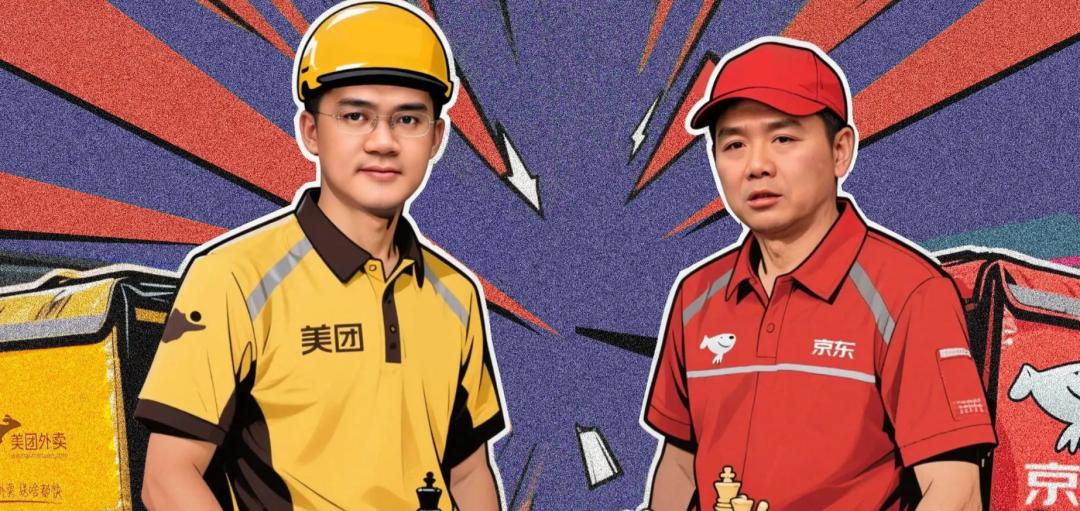
Wang Xing said very straightforwardly at the performance meeting: "Competition driven by subsidies is a typical irrational competition."
However, in the year when its core business was being fiercely attacked by competitors, Meituan quietly accomplished another thing. Its investment map in the hard - technology field has become so large that most VC institutions would feel ashamed.
According to an incomplete statistics by GeekPark, Meituan has invested in at least over 50 hard - technology companies, more than a quarter of which are already unicorn - level, and nearly 10 have either gone public or are in the process of going public.
Its investments span across five core tracks: embodied intelligence, large AI models, chip semiconductors, smart hardware, and autonomous driving. It has accompanied the growth of 28 unicorns and 7 listed companies in total.
This map is not just an investment map; it's more like a complete AI industrial chain map covering from the underlying computing power to the upper - layer applications.
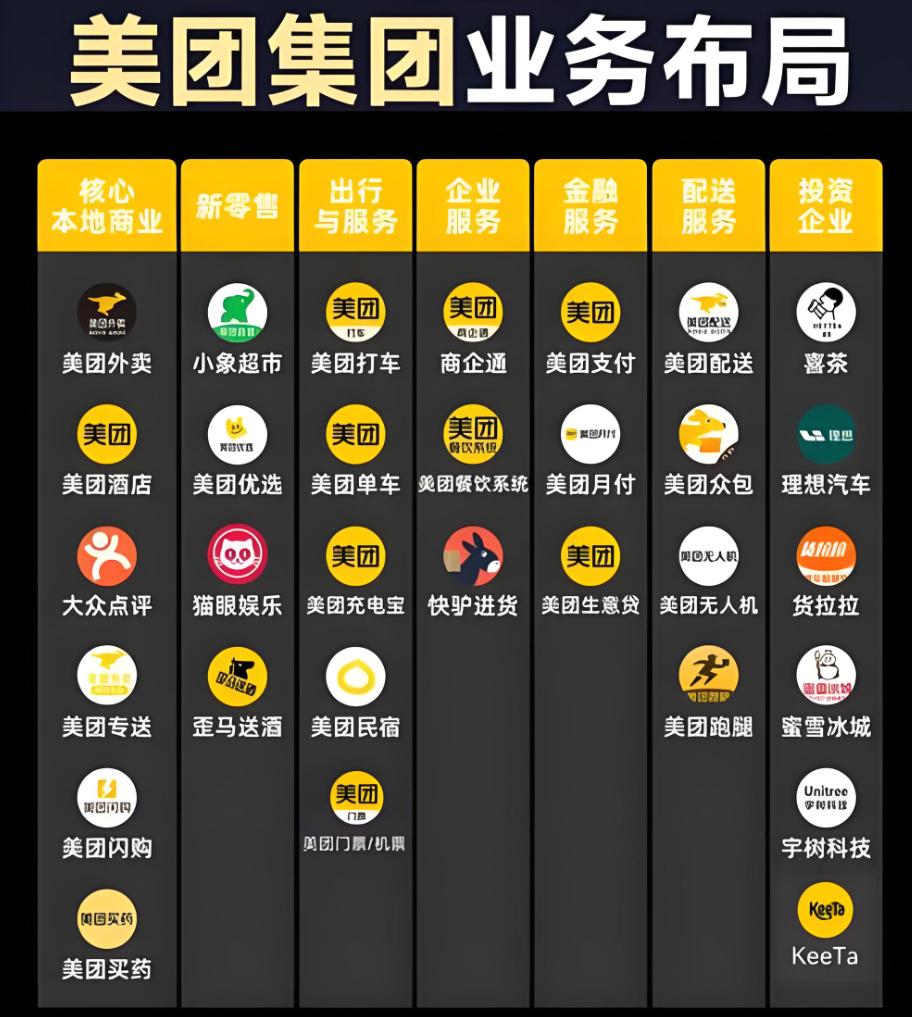
Image source: Public inquiry
02
Meituan's Tech Card
To talk about Meituan's hard - technology investments, we have to start with Wang Xing.
Wang Xing, the CEO of Meituan, is now jokingly called "China's No. 1 investor in embodied intelligence" by insiders. This title is well - deserved. When Unitree Technology was in its Series B2 financing round with a valuation of only 1 billion yuan, Meituan was already the lead investor, and then continued to increase its investment in Series B3 and C1.
By the time Internet giants like Tencent, Alibaba, and ByteDance entered the market intensively in the middle of 2025, Unitree's valuation had soared to 12 billion yuan. That is to say, when others were paying high prices for "defensive tickets", Meituan had already been sitting at the table for a year and a half.
This "early - arrival" rhythm runs through Meituan's entire investment map. In the embodied intelligence track, Meituan has invested in at least 16 companies, 10 of which have valuations exceeding 1 billion US dollars.
In the chip computing power layer, Meituan has invested in a large number of companies such as Moore Threads, Muxi Co., Ltd., Unisoc, Aixinzhiyuan, and Rongxin Semiconductor, covering leading domestic GPU and "national - team" - level semiconductor companies.
In the field of large AI models, Meituan is an early shareholder of Zhipu AI and also heavily invested in Dark Side of the Moon in the A1 round, covering a bunch of segmented directions such as AIGC 3D and video agents.
The core logic of Meituan's investment in hard technology is actually very simple: chip computing power is the underlying infrastructure, AI is the application, autonomous driving is the connection, and embodied intelligence is the execution. These four tracks are progressive and form a complete closed - loop from the digital world to the physical world. This investment logic may also be worthy of reference for many current VC/PE institutions.
To put it more straightforwardly, Meituan's business scenarios are very "ground - based". Every link in food delivery, warehousing and sorting, and offline retail has an extremely urgent demand for efficiency and automation. Instead of waiting for the technology to mature and then buying it, it's better to sit at the R & D table when the technology is still in its laboratory prototype stage.
03
How Much Has It Invested?
Based on publicly available data (which may not be complete), the author has compiled a table of Meituan's core investment layout:
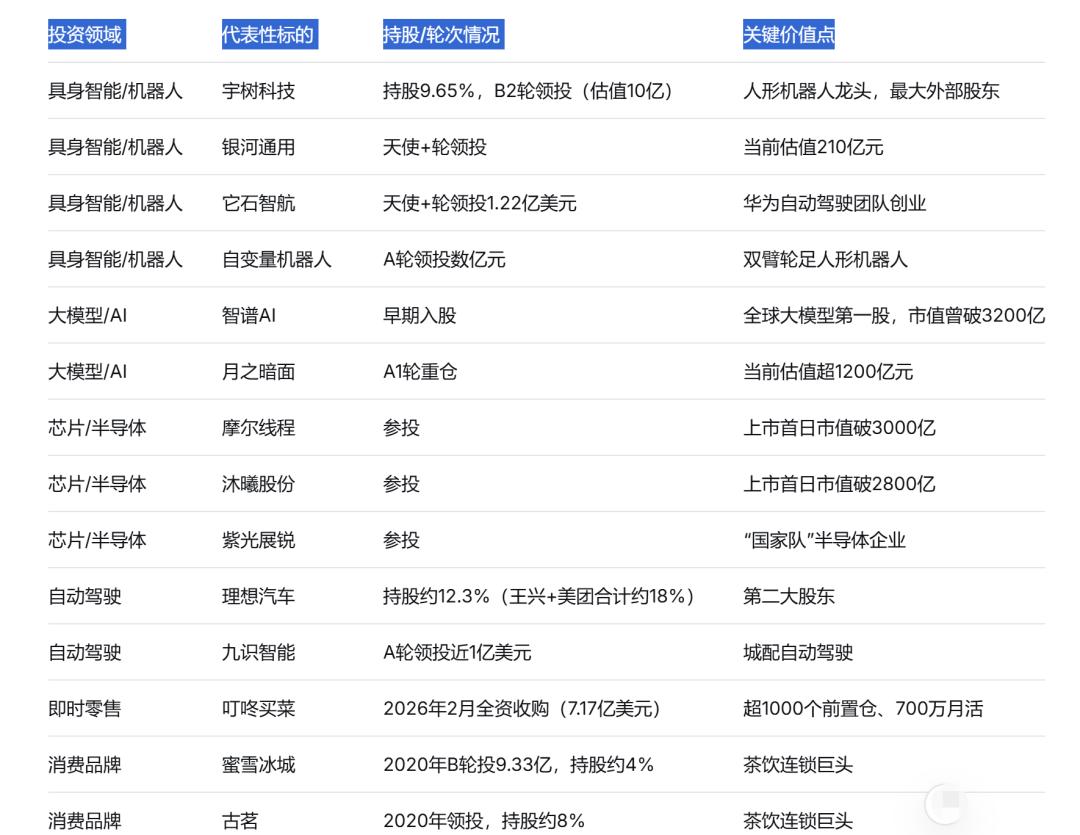
Data source: Public inquiry
This list is far from complete. There are also companies like Pudu Technology, Gaoxian Robotics, Future Robotics, Faao Robotics, as well as Kuaishou, Shein, Shuidi Company, Zhongan Online, and Beike...
Over the years, Meituan has invested in companies spanning almost every corner of hard technology and local life.
04
Flourishing but with Mixed Feelings
There's something quite ironic.
Those hard - technology companies invested by Meituan have been going public one after another in the past two years, and the book returns are quite considerable.
However, Meituan's own core business suffered the most brutal "food delivery war" in 2025, losing 23.4 billion yuan in a year.
On one hand, the technology companies in its investment map are having a batch of IPOs, and on the other hand, its main business is being beaten by competitors. Tencent also announced at its annual staff meeting in January this year that it had completely withdrawn from its strategic investment in Meituan.
This is actually the best perspective to understand Meituan's current situation. It's doing an extremely contradictory thing: While fighting bayonet - to - bayonet with competitors in the trenches and burning money to maintain its market share, it has also turned itself into the most active hard - technology industry investor in China.
Wang Xing gave an explanation at the 2025 earnings conference call: "Our strategy for AI is to attack rather than defend."
To put it simply, no matter how brutal the food delivery war is, it's only a short - term thing.
The real battle Meituan wants to fight is on the AI base in the future physical world. Meituan's R & D investment in 2025 reached 26 billion yuan, a year - on - year increase of 23.5%, with the focus on large AI models and embodied intelligence.
26 billion yuan, this figure has exceeded the annual revenue of most A - share listed companies.
05
Acquiring Dingdong to Complete the Last Piece of the Fresh Food Puzzle
On February 5, 2026, Meituan wrote a check for 5 billion yuan to acquire the Chinese business of Dingdong Fresh in a full - scale acquisition worth 717 million US dollars.
What did this deal bring? More than 1,000 front - end warehouses, over 7 million monthly active users, and the direct - sourcing supply chain from the origin that Dingdong has been developing for nearly 9 years.
The most crucial thing is that Dingdong has achieved profitability for 12 consecutive quarters and has run through the business model in the well - known "money - burning black hole" of the fresh food industry.
To be honest, Meituan has taken a lot of detours in the fresh food business. In 2018, it opened offline large - scale stores called Xiaoxiang Fresh, but the operating costs were too high, and they were closed a year later. Later, it switched to the front - end warehouse model for Meituan Fresh and upgraded it to Xiaoxiang Supermarket in 2023. Buying Dingdong directly this time is equivalent to making up for the time and experience gap all at once with money.
But what's more worth pondering is the signal behind this acquisition. While competitors are still desperately throwing in subsidies to grab users, Meituan has started to systematically integrate the supply chain and infrastructure. The instant retail track is shifting from "who can burn money" to a new stage of "who can improve efficiency".
06
What's Next?
Looking forward to 2026, the author believes that several key points are worth paying attention to.
First, the ebb speed of the food delivery war. If the industry can truly return to rational competition, Meituan's core local business is expected to return to the profit channel in the second half of 2026.
Second, the monetization rhythm of the invested companies. Zhipu AI has already gone public, Unitree Technology is about to have an IPO, and Moore Threads and Muxi Co., Ltd. have also completed their listings. It's worth paying attention to how much book profit the exit of these targets can bring to Meituan.
But more importantly, whether these technologies can feed back into Meituan's own business. Currently, Meituan's AI merchant operation assistant has served over 3.4 million merchants, and the AI assistant "Xiaotuan" served over 100 million users during the Spring Festival. If these technological capabilities can be transformed into real - world efficiency and cost advantages, that's real money.
Third, whether going global can become the second growth curve. Keeta's expansion in the Middle East is still ongoing. Although short - term losses are inevitable, Wang Xing has made it clear that the overall loss of the new business division will not exceed that of 2025.
For Meituan now, the loss in 2025 is more like "paying tuition fees" for the future. Although this tuition bill is expensive, with a profit evaporation of 59.2 billion yuan in a year, it has exchanged for an investment map spanning five hard - technology tracks and covering more than 50 unicorns.
Is Wang Xing betting on a future that others can't yet see clearly?
It may take another two or three years to get an answer to this question.
But one thing is already certain: When we thought Meituan was just a food - delivery platform, it has quietly become a technology investment institution.
This article is from the WeChat official account "Investment Banking Circle", written by the Senior Sister of Investment Banking, and is published by 36Kr with authorization.