Xiaomi's "Tie Da", which had disappeared for four years, is back.
After disappearing for four years, Xiaomi's humanoid robot has made a comeback.
In March, Lei Jun suddenly updated two videos on Weibo. One showed the latest progress of the dexterous hand of CyberOne (Xiaomi's humanoid robot), demonstrating that it could smoothly perform actions such as screwing and pinching feathers. The other was a video of installing self - tapping screws, showing that it could now work in a factory.
This is the first time in four years that Xiaomi has conducted such intensive promotion of its humanoid robot business.
It all started in August 2022 when Xiaomi preempted Tesla and high - profilely launched CyberOne, becoming the center of attention for a while. Interestingly, after a brief period of glory, CyberOne quickly disappeared from the public eye.
I remember around 2024, some media friends tried to write a report about Xiaomi's robots. However, during the process, Xiaomi's public relations clearly stated that the company did not want this business to be mentioned.
In other words, during these four years of CyberOne's disappearance, it was deliberately put on the back burner by Xiaomi.
But precisely during these four years, the global humanoid robot industry has changed rapidly. Optimus has been continuously iterated, Figure AI has frequently refreshed its demonstration capabilities, and Unitree Technology has gone public. A large number of robots have evolved from being able to walk to being able to run, from prototypes to mass - production, painting a new competitive landscape.
It can be said that the four - year disappearance made Xiaomi's humanoid robot miss the most critical development window and gradually widen the gap with its competitors.
But just today, Xiaomi's robot has unexpectedly made a comeback. So, after four years of disappearance, what's different about Xiaomi's humanoid robot upon its return? Has it been wasting time or secretly making plans in these four years? Facing more mature competitors, what strategies does the comeback Xiaomi humanoid robot have?
1
From "Showpiece" to "Factory Worker"
Unlike in 2022 when it first walked up to Lei Jun holding a flower, CyberOne in 2026 is clearly more eager to prove itself.
In the officially released video, CyberOne stands beside the work station, grabs self - tapping nuts from the automatic nail - feeding device, and places them on the self - tapping tightening positioning fixture. It repeats this process for three hours straight.
This is also the biggest difference between CyberOne this time and four years ago.
If four years ago, CyberOne was just a showpiece, a sample created by a big company to follow the trend and do marketing, today's CyberOne has become more practical and is capable of doing some truly useful things.
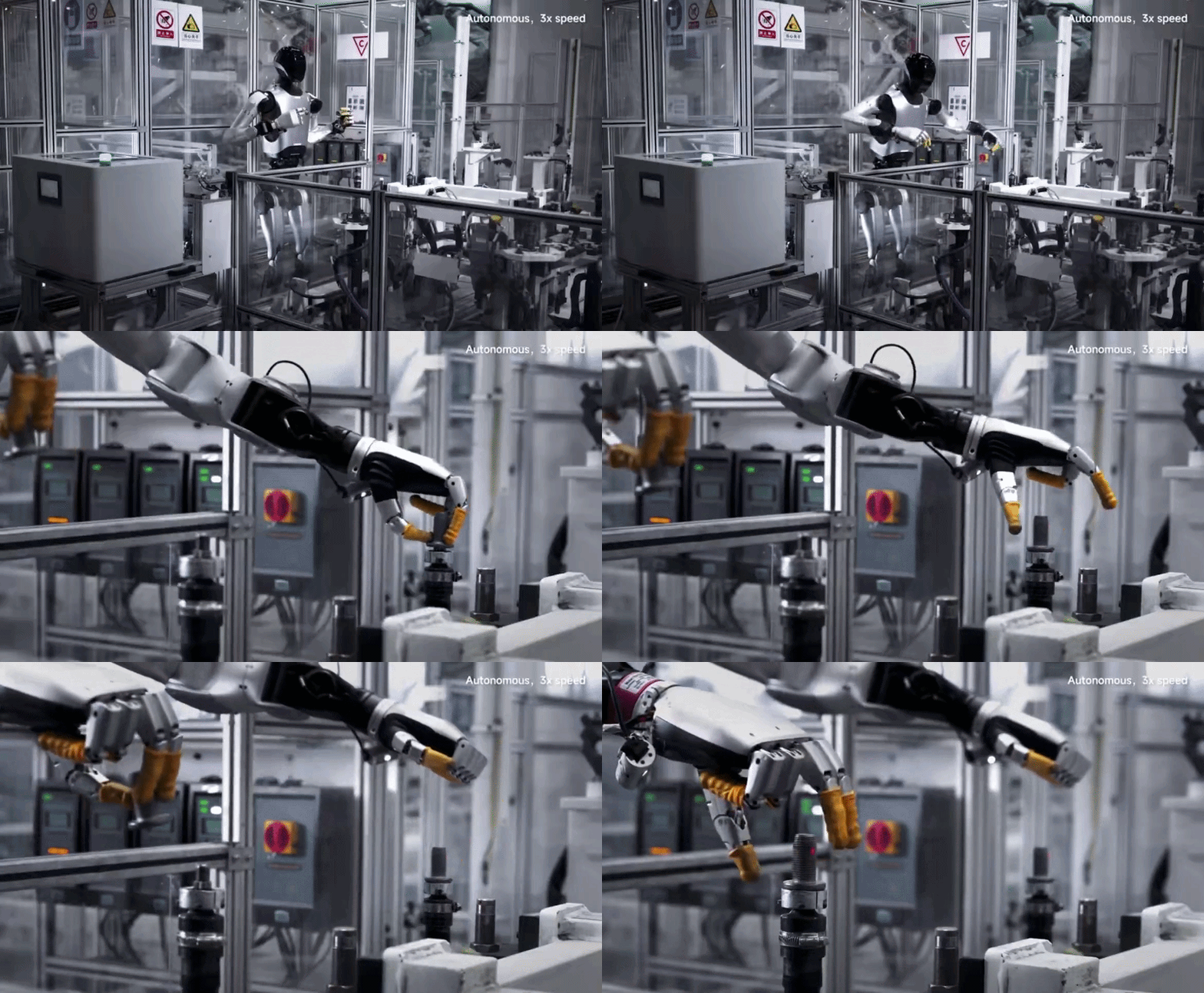
▲ Xiaomi CyberOne at the Xiaomi Automobile Factory
Of course, this is not particularly amazing.
After all, humanoid robots working in factories became a trend as early as the beginning of 2024, and it is now one of the most important directions for the application and implementation of humanoid robots.
So, although from the video, CyberOne's movements are standard and its rhythm is stable, in the context of today's humanoid robot industry, it doesn't bring any obvious surprises.
When compared horizontally with Figure and Optimus, what Xiaomi CyberOne presents is more of a limited set of capabilities: in a standardized space, facing a fixed work station, it completes a pre - designed operation path.
It has neither demonstrated multi - task switching like Figure nor entered the stage of large - scale production like Optimus.
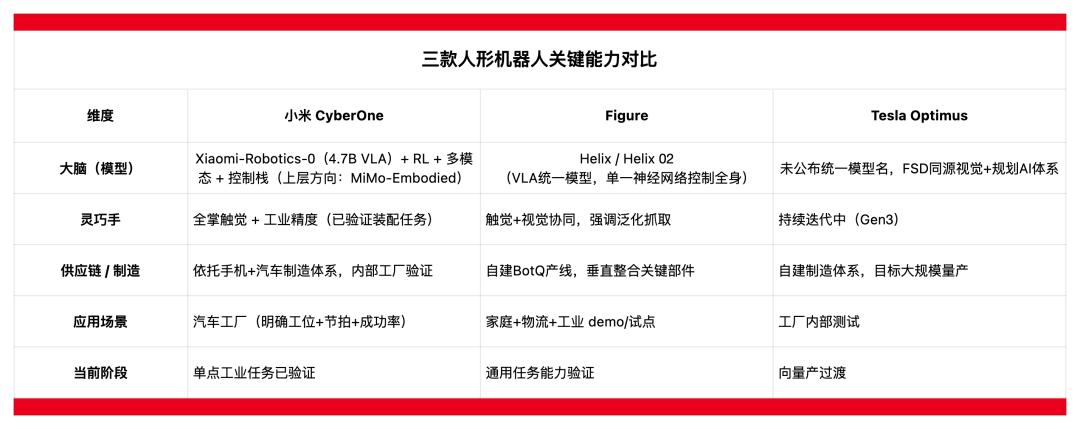
▲ Comparison of the key capabilities of three humanoid robots: CyberOne, Figure, and Optimus. Chart drawn by Youjie UnKnown
So, many people must be wondering if Xiaomi's humanoid robot has really been wasting time during these four years of disappearance?
Of course not. To be precise, in these four years of disappearance, Xiaomi was making up for what it lacked in making humanoid robots.
Just as Xiaomi invested in all the core links of the new - energy vehicle industry chain before entering the automotive industry, in the past four years, Xiaomi's capital has also been active.
According to IT Juzi data, from 2021 to the present, Xiaomi Group under Lei Jun and Shunwei Capital have made a total of 25 investments in the humanoid robot field, involving 15 companies distributed across the entire upstream and downstream of the humanoid robot industry, covering the entire chain of data, models, perception, execution, and scenarios.
Specifically, the relatively concentrated investment is in the relevant capabilities of the execution layer.
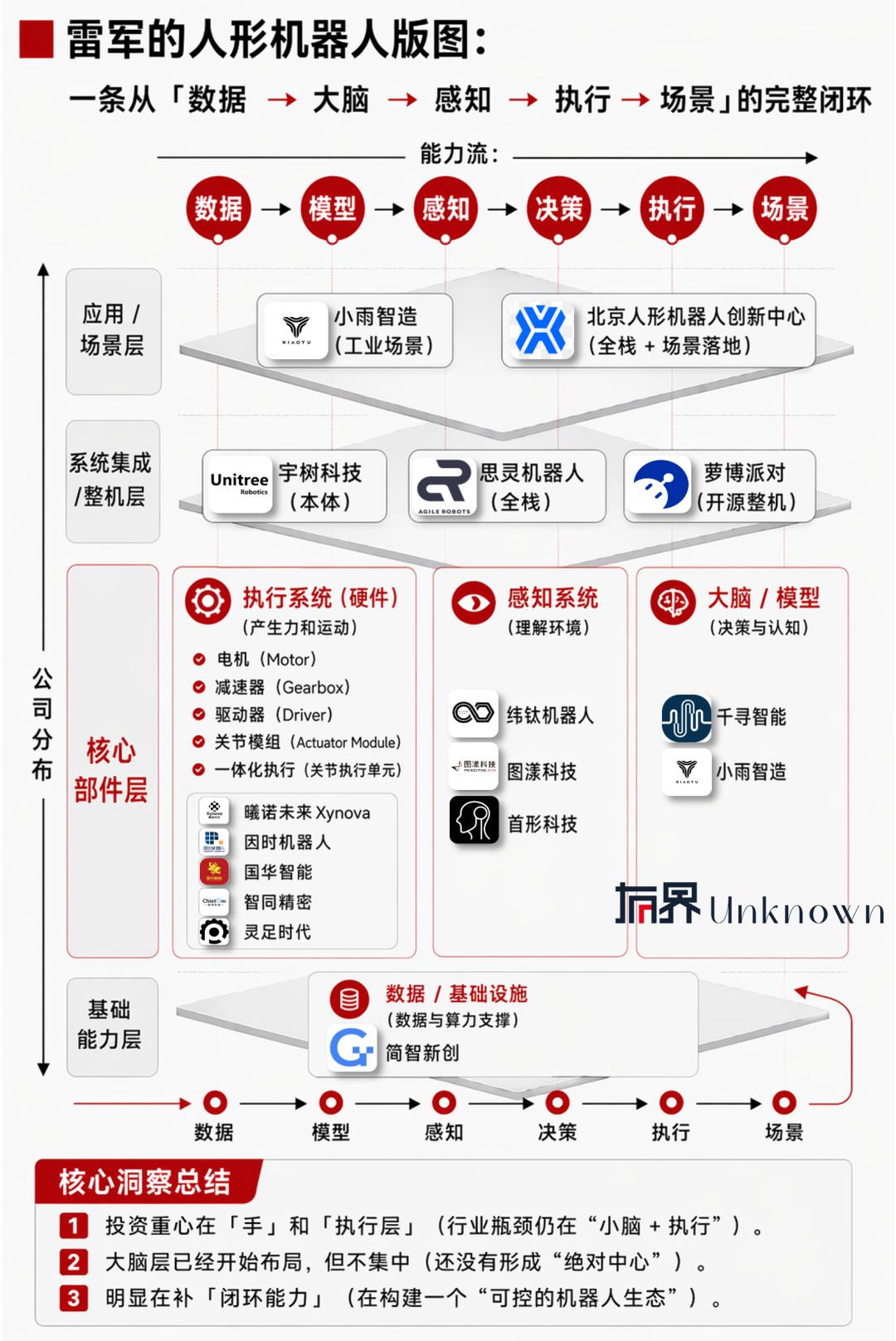
▲ Lei Jun's investment layout in the humanoid robot ecosystem
Among them, one category is core components, such as motors and reducers in basic links. Corresponding investments include Lingzu Times and Zhitong Precision. These capabilities directly affect the stability and controllability of the robot.
The other category is to supplement the capabilities around the dexterous hand, including Xynova, Yingshi Robot, and Siling Robot. This direction is also one of the current focuses of the industry.
In addition, Xiaomi has also invested in companies such as Qianxun Intelligence and Xiaoyu Zhizao at the level of embodied intelligence models, which correspond to the supplementation of capabilities such as perception and decision - making. In the direction more related to the product form, there are also attempts like Shouxing Technology, which involve the exploration of the appearance and interaction of humanoid robots.
Overall, these investments basically cover several key directions common in the current humanoid robot industry and are generally consistent with the capability modules commonly concerned by the industry.
Those familiar with Xiaomi know that this is Xiaomi's consistent style when entering a new industry: learn first, then practice; imitate first, then surpass.
Specifically, it first understands the industry situation through investment, learns the experience and methods of these advanced companies, summarizes and refines them, and then applies them to its own business.
For example, before entering the automotive industry, Xiaomi and Shunwei Capital invested in key enterprises in the upstream and downstream of the new - energy vehicle industry chain, which led to the subsequent launch of Xiaomi cars.
Judging from the fact that the capabilities presented by CyberOne this time are mainly concentrated in the execution layer, especially the operational capabilities represented by the dexterous hand, this is exactly the same as Xiaomi's investment path in humanoid robots in the past four years.
Anyway, today's Xiaomi humanoid robot is completely different from the one four years ago. It has transformed from a wobbly concept machine into a real and useful "factory worker" in the automobile factory.
2
Hidden for Four Years: Bad Timing?
In fact, it's really not easy for Xiaomi's humanoid robot to reach where it is today.
Of course, this doesn't mean that the technology it demonstrates is extremely difficult or there are some arduous stories. Its difficulty mainly lies in its awkward birth time - it's like a child conceived unexpectedly due to a momentary impulse, but the parents are reluctant to give it up.
You know, although Xiaomi's robot division is now under the Xiaomi Automobile Division, initially, this business belonged to the mobile phone division. The transition from the mobile phone division to the automobile division is the process for Xiaomi to straighten out its business relationships.
Xiaomi's robot business was first established in September 2020 when the trend of quadruped robot dogs was just emerging. At that time, Wang Chuan, Xiaomi's Chief Strategy Officer, gave a report to Lei Jun, mentioning that robots were a new product direction and Xiaomi shouldn't miss this opportunity.
Lei Jun agreed, and thus Xiaomi's robot dog CyberDog 1 (also known as "Tiedan 1") was born and made its debut at the autumn press conference in 2021, attracting a lot of attention.
Later, Elon Musk entered the field in the United States in a high - profile manner, claiming that humanoid robots were the future and every family should have at least one. This event directly brought the robot from the era of quadruped crawling (robot dogs) to the era of bipedal robots.
Xiaomi rushed to respond. Xiaomi's robot laboratory was upgraded to the Xiaomi Robot Division, and it divided its efforts into two directions. One was to develop "Tiedan 2" with the goal of mass - producing robot dogs, and the other was to develop humanoid robots to catch up with Tesla.
On August 11, 2022, Xiaomi finally launched the full - size humanoid robot CyberOne one month before the release of Optimus. This "head start" in terms of time made Xiaomi stand at the center of the humanoid robot stage and attracted worldwide attention.
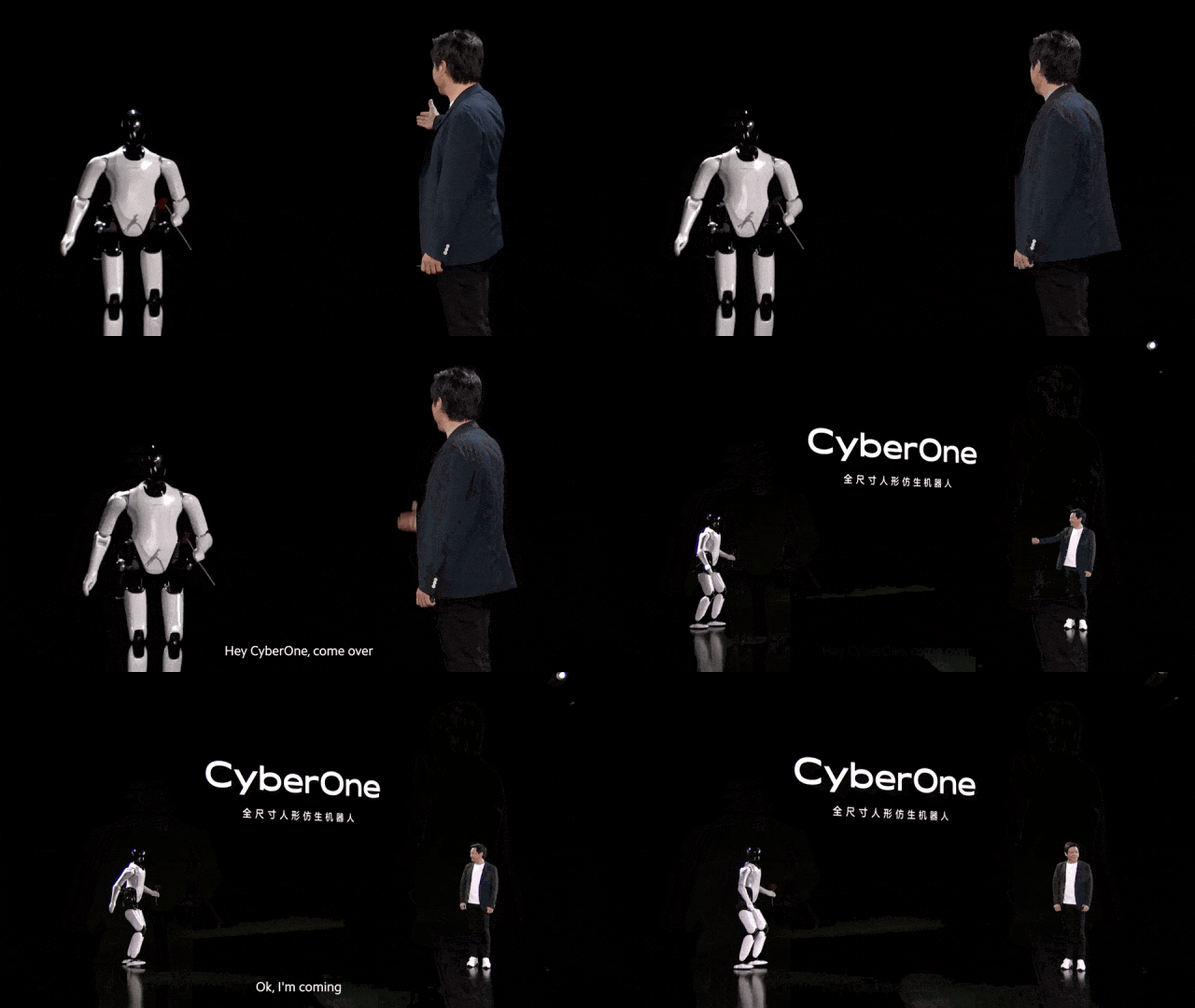
By this time, what we saw was a thrilling story, but this is only one side of the story.
Because just when Xiaomi's robot business was advancing rapidly, another major event was happening within Xiaomi Group, and this event was the main plot for Xiaomi.
In March 2021, Xiaomi's automobile business was officially announced.
At that time, Lei Jun publicly stated that making cars was his last important entrepreneurial project in his life and that he was "willing to bet all his accumulated achievements and reputation in his life for Xiaomi cars." Then, the entire Xiaomi Group was involved in the preparation for the intelligent automobile business.
So, in this year, Xiaomi simultaneously launched two projects: "making cars" and "making humanoid robots." The two projects advanced simultaneously in time, but the priorities of these two businesses were obviously different.
First, in terms of market maturity.
In 2021, the intelligent electric vehicle industry was already a proven industrial path, while the humanoid robot industry had neither a mature technical route nor a clear business scenario.
For Xiaomi at that time, the automobile business was a battle that couldn't be missed. Xpeng, NIO, and Li Auto had already entered the market. If Xiaomi didn't attack with full force, the opportunity window might close quickly. The humanoid robot business was more like a "participation - only" track.
Second, in terms of the team leaders.
Xiaomi's automobile business was led by the founder and CEO Lei Jun, who mobilized all the personal resources of the group's founder and went all out. In contrast, the robot team was more like a makeshift team. For a long time, due to the lack of professional talents, many positions in Xiaomi's robot business were filled by employees transferred from the mobile phone department. Coupled with the fact that the relevant business leaders were complete outsiders, the product route wavered for a long time, and many people who really understood robots left the company. [1]
For various reasons, Xiaomi's robot business progressed slowly internally.
But because Xiaomi kept benchmarking against Tesla after entering the automotive industry, Lei Jun didn't really give up on this direction. This also made the humanoid robot business in an awkward position within Xiaomi - the project always existed, but it could never find a suitable position.
The turning point came in 2024.
In March 2024, Xiaomi held a grand press conference in Beijing and launched its first electric vehicle, the SU7. The pre - order volume reached 88,898 within 24 hours after the model was released.
With the implementation of the automobile business, Xiaomi could finally truly benchmark against Tesla and connect "making humanoid robots" with "making cars."
In the middle of 2024, Xiaomi's robot division was merged into the Xiaomi Automobile Division. In June 2024, Xiaomi's robot business officially moved to the Xiaomi Automobile Factory in Yizhuang, Beijing and completed its first equity change, introducing Yizhuang State - owned Investment.
Through these integrations, like Tesla, Xiaomi connected the robot R & D with the automobile manufacturing system and tried to embed humanoid robots into the real production system.
By this time, Xiaomi's robots were finally on the right track.
3
Can CyberOne Still Compete?
After four years, Xiaomi has returned to the humanoid robot stage, but the rules of the game in the industry have changed.
Xiaomi, which once took the lead over Tesla, has now changed from a pioneer to a follower. In the past few years, Tesla has continuously iterated Optimus, and new players like Figure have also risen rapidly.
Since 2025, the humanoid robot industry has further entered the stage of intensive verification and mass - production ramp - up. From the debut of Xpeng's Iron to Unitree's popularity during the Spring Festival Gala and its progress towards an IPO, leading manufacturers have shifted the competition from "who can make it first" to "who can create real value first."
Meanwhile, the early - stage bubbles are receding, and some startups lacking cash - flow support are starting to drop out. The competition logic of humanoid robots is shifting from technological showmanship to commercial implementation. What the market really cares about is no longer whether it can be made, but whether it can create value and finally complete the commercial closed - loop.
So, in this context, can Xiaomi's humanoid robot still compete?
We may have to wait and see, but what we know now is that Xiaomi is at least trying hard to make it competitive.
In recent years, the focus of Xiaomi's robot development has gradually shrunk to the key links that truly determine the implementation ability. Whether it's the investment layout or the organizational adjustment, Xiaomi's actions in recent years have increasingly concentrated on two things most relevant to practical applications: the "hand" and the "brain."
At the hardware level, Xiaomi is betting on the bionic dexterous hand.
In the humanoid robot field, the dexterous hand has always been regarded as one of the most difficult core components, which directly determines whether the robot can truly enter real - world work scenarios.
In November 2025, Xiaomi poached engineer Lu Zeyu from Tesla's Optimus dexterous hand team to be responsible for integrating the technical route and promoting the design and engineering implementation of the hand. Since then, the volume of Xiaomi's bionic hand has been reduced by 60%, and it has achieved a 1:1 restoration of the adult hand shape.
At the software level, Xiaomi has clearly placed its bet on the AI foundation.
Xiaomi has clearly stated that starting from 2026, it plans to invest more than 60 billion yuan in AI in the next three years, with an investment of 16 billion yuan this year alone.
Lei Jun also clearly pointed out at the spring press conference that one of the important focuses of this investment is the MiMo - V2 - Pro large - scale model. Coupled with the previously open - sourced embodied model MiMo - Embodied, what Xiaomi wants to do is obviously not just to create a movable robot, but to integrate autonomous driving, agents, and embodied intelligence into the same set of underlying technical logic.