A post-90s Tsinghua University doctor's wealth increased by 5 billion in one month.
In just one month, the company completed two rounds of financing, and its valuation soared from 5 billion to over 10 billion yuan. Jijia Vision has suddenly become the darling of the capital market.
With its valuation increasing by 5 billion yuan in one month, according to the calculations of Pencil News DATA, this might be the case with the fastest valuation growth this year (among the publicly - known cases).
What lies behind this is a trendy buzzword these days: the World Model.
01
What's the Use of the World Model?
On April 13th, Jijia Vision completed a Series B financing of billions of yuan. Only one month had passed since its previous financing of nearly 1 billion yuan, and the company's valuation exceeded 10 billion yuan.
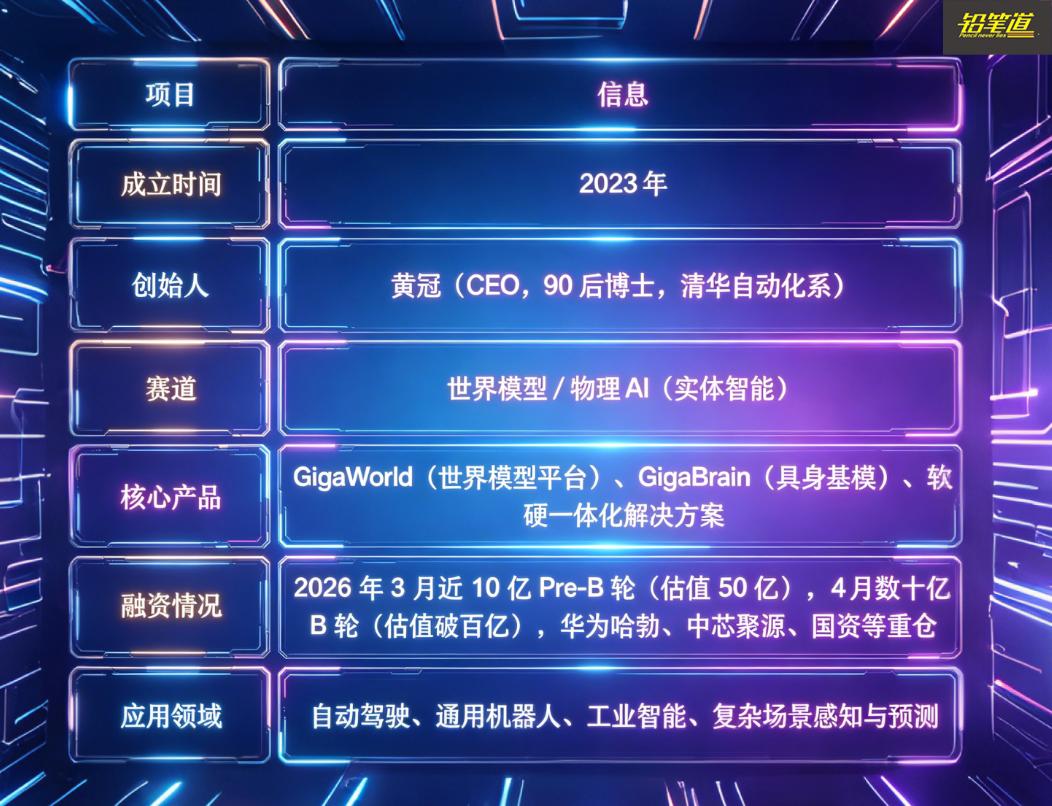
Its founder is Huang Guan, a post - 90s doctor who has followed a standard technical path: an undergraduate degree in automation from Huazhong University of Science and Technology, a master's degree from the Chinese Academy of Sciences, and a doctorate from Tsinghua University.
During his doctoral studies, he interned at Microsoft Research Asia, interacted with people like He Kaiming and Sun Jian, and participated in early - stage deep - learning research.
However, what truly matters is not his academic qualifications but his three subsequent "choices".
For the first time, he bet on "enabling machines to see".
Around 2016, when deep learning was just taking off, the first area to see its application was visual AI. Huang Guan joined Horizon Robotics, working on facial recognition and visual perception.
The essence of AI at this stage was quite simple: to enable machines to "understand pictures". The team created datasets, participated in competitions, and ranked highly. More importantly, AI stepped out of academic papers and into the real world, starting to perform practical tasks.
For the second time, he bet on "enabling machines to understand the world".
Around 2019, the industry realized that simply understanding pictures was not enough; machines also needed to know "where this place is and what is happening". So, he participated in founding Jianzhi Robotics, focusing on autonomous driving and using the BEV model to transform 2D images into a 3D world.
In simple terms, it's no longer just "seeing a car" but "knowing where it is and where it's going". AI has started to move from "describing pictures" to "understanding space".
For the third time, he chose an even more challenging path: enabling machines to "think ahead".
In 2023, he founded Jijia Vision. No longer satisfied with just "seeing" and "understanding", he aimed to enable machines to simulate events in their "minds" before they occur.
He calls this the "World Model", which you can understand as giving machines "imagination".
In the past few years, AI has become better at talking but still struggles with practical actions.
Writing articles, writing code, and serving as customer service - these tasks have one thing in common: they all happen on the screen. Once AI is applied in the real world, it often fails.
For example, asking a robot to pick up a cup. It's easy for humans but requires a machine to consider many questions: How heavy is the cup? Will it slip? How should the hand reach out? Should it stop if someone passes by?
The key to solving these problems is the World Model.
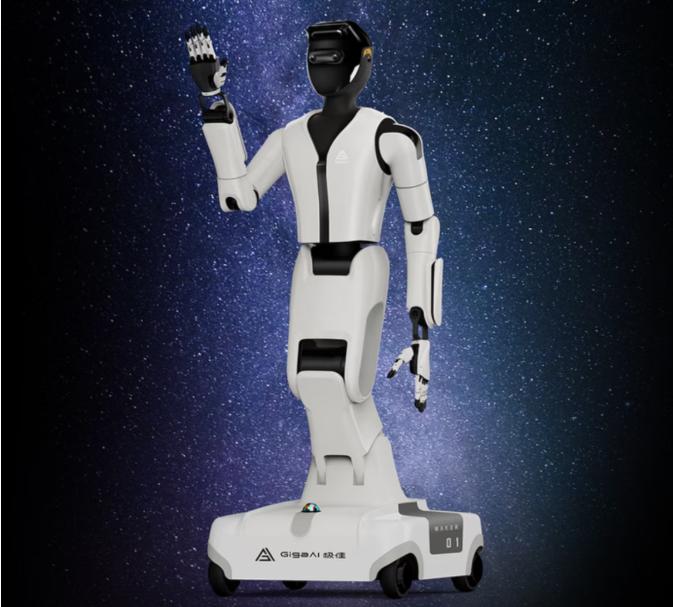
Jijia Vision has also launched its own robot product, which has a human - like upper body.
02
Who's Making Money? Several Types of Players
But the question arises: Who in this field has already started making money? The answer is a bit counter - intuitive: It's not those directly working on the World Model who are making money first.
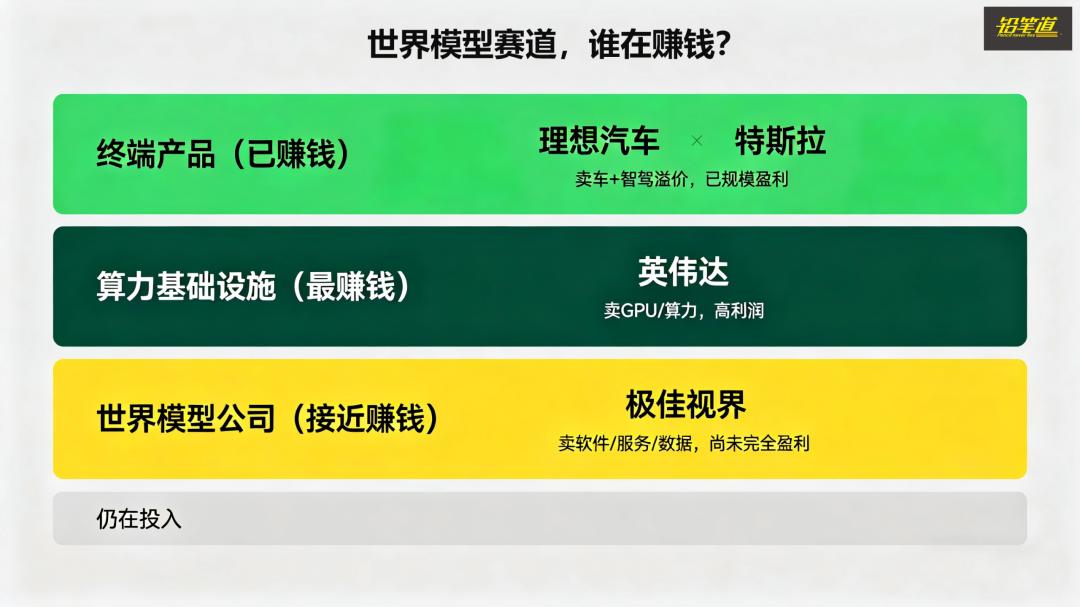
The first group to make money are autonomous driving companies. Representatives: Li Auto and Tesla.
Take Li Auto for example: In 2025, its revenue was about 112.3 billion yuan, and its net profit was about 1.1 billion yuan.
Why are they profitable? Because the World Model directly affects a core indicator: whether autonomous driving is "safer and more human - like".
In the same scenario, for example, when someone is standing by the roadside, traditional algorithms can only recognize "this is a person". However, the World Model takes an extra step: Will he rush out? Which way will he go? Should I slow down?
This ability directly determines whether users are willing to use and pay for autonomous driving.
So, you can see that autonomous driving has shifted from a "recognition competition" to a "prediction ability competition". Automobile companies are now competing to be "more like experienced drivers".
The money is earned from the premium of the whole vehicle and intelligent driving.
Taking Li Auto as an example, its high - end intelligent driving version usually brings a net premium of about 10,000 yuan. If hundreds of thousands of cars are sold in a year, this part of the "income determined by intelligent capabilities" amounts to billions of yuan.
The second group making money are computing power and infrastructure companies. A representative company is NVIDIA.
If autonomous driving companies make money from "the whole vehicle", this group makes money more directly: from computing power.
The reason is simple: The World Model is "heavier" than large - scale models. It needs to handle space (3D), time (dynamic changes), multi - modality (images + sensors) simultaneously, and its training cost is much higher than that of ordinary large - scale models.
As a result, those who sell computing power are the first to make money. This is why Jensen Huang said that if the World Model becomes successful, the market space could reach 100 trillion US dollars.
In 2025, NVIDIA reported extremely impressive figures: annual revenue of over 130 billion US dollars (over 900 billion yuan), net profit of over 70 billion US dollars, and a net profit margin of about 55%.
Computing power is the "shovel - selling business" behind the World Model.
The third group, which is approaching profitability, are companies that build "World Model platforms".
What do these companies sell? Most of them don't directly sell robots (except for Jijia Vision) or cars. Instead, they sell the ability to "make machines think", including autonomous driving simulation systems, robot training platforms, and physical world data generation.
Their business models are emerging:
1. Selling software (simulation systems).
Using virtual environments to replicate the real world, the price of a set of systems ranges from 5 million to 30 million yuan per year.
2. Selling services (training + optimization).
Helping enterprises train autonomous driving or robot models, with a single - project fee ranging from 10 million to 50 million yuan.
3. Selling data (high - quality scenarios).
Providing high - quality scenario data (extreme road conditions, complex interactions), with the price of a single data package ranging from hundreds of thousands to millions of yuan.
However, these companies have a common feature: they haven't fully achieved commercial success.
Generally speaking, most companies working on the "World Model" are still in the investment phase because this task is both difficult and expensive.
1. Data collection is difficult: The cost of collecting real - world data is extremely high.
2. The system is complex: Chips, sensors, models, and controls are highly coupled.
3. High computing power consumption: The training cost is much higher than that of large - language models.
However, the more difficult the field, the greater the potential market space.
According to a report by MarketsandMarkets in April 2026, the global physical AI market (with the World Model as the core technology) is expected to grow from 1.5 billion US dollars in 2026 to 15.2 billion US dollars in 2032, with a compound annual growth rate of 47.2%.
03
Plenty of Money, Hot Capital
Although most companies haven't made a profit yet, the fact this year is that financing has boomed, and capital is rushing in.
Jijia Vision is a typical example.
In March 2026, it completed a nearly 1 - billion - yuan Pre - Series B financing, with a valuation of 5 billion yuan. Just one month later, it raised billions of yuan in a Series B financing, and its valuation exceeded 10 billion yuan.
Actually, the primary market is quite cold at present, and the financing cycle for many AI projects is getting longer. In this environment, "two rounds of financing in one month and a doubled valuation" itself indicates one thing: The World Model has passed the storytelling stage and entered the stage of intense competition for investment.
More notably, it's not just financial investors who are placing bets; there's also industrial capital, such as Huawei Hubble, SMIC Juyuan, and local state - owned assets.
This means that the World Model is no longer just a technological direction but is regarded as future industrial infrastructure.
This change is global. In the first quarter of 2026, global financing around the World Model significantly heated up.
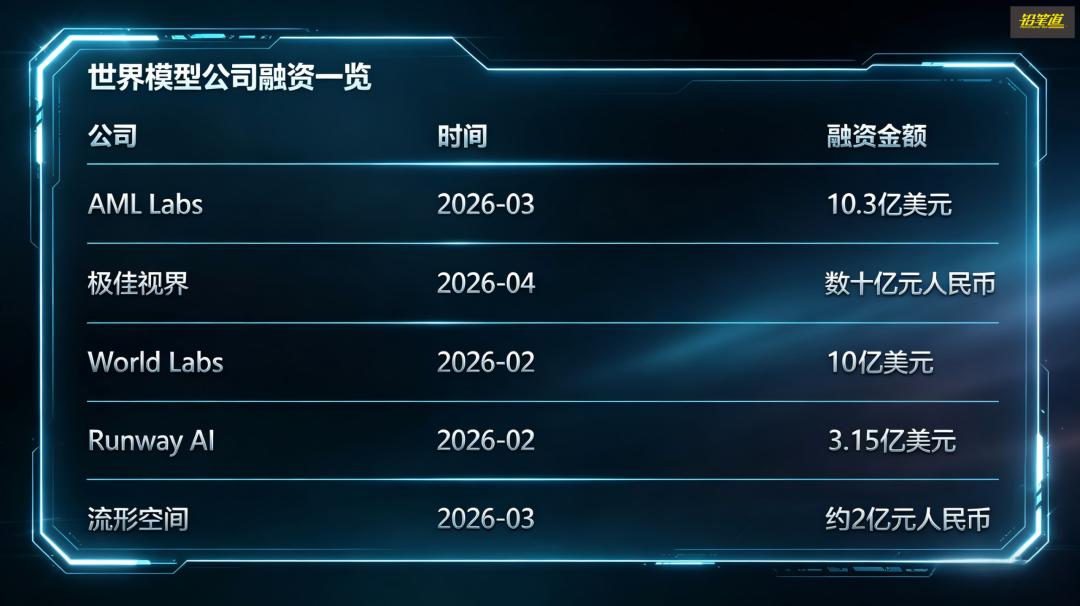
In the United States, Fei - Fei Li's World Labs raised over 1 billion US dollars, and Yann LeCun's new - generation AI architecture also received huge financing. Although there's still a gap in the single - deal amount in China, the number of projects has increased. In the first quarter of this year, there were over 20 related financings, ranging from hundreds of millions to billions of yuan.
However, more important than financing is that the World Model is starting to be implemented at an accelerating pace.
Take autonomous driving as an example. With the World Model, it's possible to predict in advance: Will this person rush out? Which way will he go?
Jijia Vision has cooperated with about 20 automobile companies, applying the World Model in scenarios such as complex intersections and pedestrian judgment. Some companies are using the World Model for robot grasping and sorting or building simulation platforms, reducing the training cost to one - tenth of the original.
Meanwhile, the industry is starting to differentiate. A small number of companies can continuously obtain financing and build a complete technical system; more companies are only involved in one aspect; and some are quickly eliminated.
The attitude of capital is also changing: from "not understanding" to "giving it a try" and then to "concentrating on top - tier companies". The money is no longer evenly distributed but is rapidly gathering towards a few projects.
Overall, in 2026, the World Model field is in the "early convergence stage": The technical path hasn't been unified yet, but the mainstream direction has emerged; commercialization is still in its early stage, but the implementation scenarios are becoming clearer; there are many players, but the leading companies are starting to stand out.
What will determine success in the future is no longer who can tell a more cutting - edge story but who can quickly transform capabilities into products and make them work in the real world.
This article does not constitute any investment advice.
This article is from the WeChat official account "Pencil News" (ID: pencilnews), written by Song Ge and edited by Wang Fang. It is published by 36Kr with authorization.