In - depth conversation with the founder of a16z: There is no bubble in AI, but the real showdown between China and the US lies in robotics.
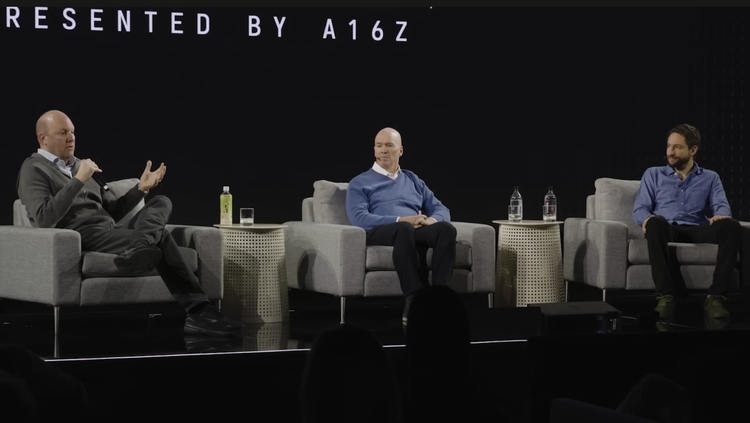
During the closing keynote speech at the a16z Runtime Conference, Marc Andreessen and Ben Horowitz, co-founders of a16z, along with General Partner Erik Torenberg (the host), discussed the highlights of this conference, the current capabilities of large language models, and why, despite the huge capital expenditure, artificial intelligence is not a bubble.
This article is compiled from the official video of the a16z Runtime Conference. The original link is: https://www.youtube.com/watch?v=Y7dwbJ0AtUA
Marc Andreessen: I think we actually don't know what the "ultimate form" of an AI product will look like. A very obvious historical analogy is that personal computers, since their birth in 1975, were essentially text command-line systems until around 1992. Seventeen years later, the entire industry suddenly shifted to the GUI graphical interface and has never looked back. About five years later, the industry suddenly shifted to web browsers, and again, it never looked back. So, of course, I believe that chatbots will still exist 20 years from now, but I'm also very certain that both current chatbot companies and new ones in the future will explore many interaction methods very different from today's, and those forms are something we haven't even fully figured out yet.
I. Can AI Really Create? The Boundary between Intelligence and Invention
Host: Recently, many people have been talking about the limitations of large language models. They can't truly invent new science or achieve true creative genius. At most, they just recombine and repackage existing content. What's your view?
Marc Andreessen: For me, such questions usually fall into two categories. The first is: Does a language model really count as "intelligent"? That is, can it truly process information like a human and achieve some conceptual breakthrough? The second is: Do language models or video models really count as "creative"? Can they create truly new art and achieve real creative breakthroughs?
My answer to both questions is the same rhetorical question: Can humans really do it? Because there are actually two levels here. First, even if some people can be considered "smart" and can come up with original conceptual breakthroughs, rather than simply repeating training materials or following existing scripts - what proportion of the population are these people? Frankly speaking, I've only met a few such people in my life. There are a few in this room today, but the total number is very small. The vast majority of people will never have a truly original breakthrough in their lives. It's the same with creativity. You might point to people like Beethoven and Van Gogh and say, "This is what creativity is." Yes, of course, this is creativity. But the question is, how many Beethovens and Van Goghs are there in the world? Obviously, very few. So, if AI can exceed 99.99% of human capabilities, it's already quite amazing.
II. Recombination, Originality, and the Essence of Human Creativity
Marc Andreessen: Looking deeper, you'll find a problem: In human history, how many real conceptual breakthroughs have there been? Compared with "recombining and remixing existing ideas," which is the mainstream? If you look back at the history of technology, you'll find that most major breakthroughs are often based on at least 40 years of previous accumulation. In fact, today's language models themselves are the result of 80 years of previous research accumulation.
The same is true in the art field. Novels, music, and paintings, of course, have truly leapfrog creations, but they also contain a lot of influence from predecessors. Even a master like Beethoven's works show traces of Mozart, Haydn, and earlier composers. So, the boundary between "originality" and "remixing" is often not as clear as we think.
Ultimately, this is a bit like a philosophical question of "how many angels can stand on the tip of a needle": If a system can approach that world-class, cross-era creativity and intelligence, even if it's just a tiny bit short, in practical terms, it may already be "almost there." Emotionally, of course, I also hope that human creativity still has something unique and irreplaceable. I really want to believe this. But to be honest, every time I use these models, I think: They are really very smart and very creative. So, I quite believe that they will eventually cross that threshold.
Host: I feel like this is your consistent analytical framework. Whenever someone talks about the limitations of LLMs, such as their ability to transfer learning or think by analogy, your first reaction is always: Can humans do it?
Marc Andreessen: Yes, exactly. For example, "lateral thinking" and "out-of-distribution reasoning." Many people are good at reasoning within familiar areas, but in fact, very few people can transfer knowledge and think across domains in unfamiliar fields. Among the people I know, I can probably count only three people in this room. And there are about 10,000 people in my contact list. That is to say, the proportion of people who truly and stably have this ability is only a few ten-thousandths. This actually makes me very excited. Because you see, although humans have so many limitations, we still create amazing art, movies, novels, technological inventions, and scientific breakthroughs. So, even if AI hasn't reached the point where you're 100% sure "it's having truly original thoughts," it doesn't prevent it from bringing about great progress.
III. Ben Horowitz on Hip-Hop, Innovation, and Genius
Host: Ben, you just held an event for the Paid in Full Foundation last week, paying tribute to a group of hip-hop legends. You must have thought a lot about the topic of "creative genius." What's your view?
Ben Horowitz: I basically agree with Marc. No matter how you finally define it, AI is already very useful. Even if it hasn't fully reached the level of "top genius creativity," it's already very powerful. However, in the art field, especially with the current generation of technology, there is still one area that isn't fully up to par: Humans really care about that real-time, personal life experience. And the pre-training data of current models isn't sufficient to truly capture this. But even so, it's already doing quite well.
Marc Andreessen: Ben has a non-profit project called the Paid in Full Foundation, which recognizes and provides a kind of "pension-style" support for important innovators in the hip-hop/rap field. If you consider the entire hip-hop field in the past 50 years, how many people do you think can really be called "conceptual innovators"?
Ben Horowitz: It depends on how broadly you define it. If you define it broadly, there were several people at the event last Saturday: Rakim, Dr. Dre, George Clinton, and these people can all be counted. If you define it more narrowly, for example, Cool G Rap also really came up with something new. But if you're talking about the most fundamental, bottom-level musical breakthroughs, then I'd probably narrow it down to Rakim and George Clinton. In short, the proportion is extremely low, very low.
Host: Jared Leto also mentioned yesterday that many people in Hollywood are very afraid of and opposed to AI. So when you talk to these musicians, like Dr. Dre, Nas, Kanye, are they excited, opposed, or already using it?
Ben Horowitz: There are indeed many musicians who are afraid of AI, but there are also many who are very interested in it. Especially those in the hip-hop circle are more likely to understand it. Because in a sense, this is almost what they did back then: taking existing music, splicing and reconstructing it to create something new. So for them, AI is a very powerful creative tool that greatly expands the creative palette. Moreover, hip-hop often talks about a very specific time, place, and personal experience. If your model has a deep understanding of this specific culture and context, it actually has an advantage over a music model with strong generalization ability but less relevance.
IV. Intelligence, Power, and Who Dominates the World
Host: Many people use the same logic to deduce about AI: The smarter thing will ultimately dominate the less smart thing. Marc, you recently made a well - known statement: "Top graphic reasoners only do graphic reasoning; but top 'word - type talents' can dispatch those graphic reasoners." You also said: "High - IQ experts often work for medium - IQ generalists." What does this mean?
Marc Andreessen: The meaning is actually very simple: Doctors usually work for MBAs. If you look at the world today on a larger scale, do you really think that "the smartest people are ruling the world"? Looking at the global reality, do you think that "we've put the geniuses in the most crucial positions"? Obviously not.
Two things are true at the same time here. First, we may generally underestimate the importance of intelligence. Second, those who particularly emphasize intelligence often overestimate its importance. Social science usually tells you that indicators such as fluid intelligence, the g - factor, and IQ are all correlated with many positive life outcomes, such as educational achievements, career achievements, income, life satisfaction, and even solving problems with less violence. These correlations are important, but they're still not everything. So, you can't directly infer from "intelligence is important" to "intelligence is the only determining factor" or "intelligence is the most important single variable." The reality is obviously not like this.
Even if you're an extreme IQ determinist, you have to admit that many outcomes can't be explained by IQ alone. Looking at the group level, things get even more complicated. Once any group of people becomes a "group" or even a "mob," the collective IQ usually drops. If you put a group of smart people into a group, they often become less smart. So, whether it's a company, an organization, or a country, who takes power is never determined only by IQ, and it may not even be mainly determined by IQ. Therefore, there's a common assumption in the AI circle: A smarter being will necessarily dominate a less smart one. I think this statement can be easily refuted by reality. Because intelligence is not a sufficient condition.
V. Beyond IQ: Leadership, Emotion, and "Theory of Mind"
Host: So, besides intelligence, what other abilities are more decisive for a person to successfully lead, start a business, solve complex problems, and organize a team? And why can't AI learn these abilities as well?
Ben Horowitz: Many things are important. For example, whether you can have conflicts with people in the right way. There's certainly a bit of an intelligence component in this, but more often, the key is whether you really understand who you're dealing with. You need to be able to read what the other person is thinking and see things from the perspective of the company's employees, rather than just from your own perspective. This ability comes from long - term communication, listening, and understanding with people, rather than being measured by an IQ test. And another key point in management is that you're not trying to make people do "the most popular thing," but rather to make them do "the right thing," even if they don't like it. This is the essence of a lot of management work.
Marc Andreessen: So, this involves courage, motivation, emotional understanding, and the so - called theory of mind.
Ben Horowitz: Yes. You need to know what others want, but at the same time, you can't just cater to them. Instead, you need to combine this with "what the organization really needs to do." You also need to judge: Who in the team is capable, who can't be lost, who won't affect much if their emotions break down, and who will cause the whole team to have problems if something goes wrong. These things are full of subtle situational judgments and are difficult to abstract into a few general formulas. This is why many management books are terrible. Because management highly depends on the specific situation: Your company, your product, your people, and your organizational structure are all completely different from others. So, books like "Five steps to build a strategy" often don't work at all.
Marc Andreessen: The theory of mind is very crucial. Simply put, it's: Can you accurately simulate in your own mind what's going on in someone else's mind? Intuitively, you might think that the smarter a person is, the better they are at this; but the fact may not be so. The US military is one of the earliest and most systematic institutions in American society to use IQ tests. They assign people to different positions, even leadership positions, through tests like the ASVAB. And through long - term observation, they've found that if a leader's intelligence level differs from the group they lead by more than one standard deviation, problems are likely to occur. It's of course not good if the leader is much less intelligent than the team; but conversely, being much more intelligent is also not good. If a leader's intelligence is two standard deviations higher than the average level of the organization, they often lose the "ability to model others' minds." That is, very smart people may actually have a hard time really understanding the thinking process of ordinary - smart people.
So, there needs to be a certain "connectability" between leaders and those being led, which can't be solved by intelligence alone. By analogy, if there really is a person or machine with an extremely high IQ in the future, such as a "1000 IQ" being, its way of understanding reality may become so alienated that it can't establish a real connection with the people it manages. This is why I think that for a long time in the future, the world won't be organized simply according to IQ.
Ben Horowitz: Zuckerberg said it well: "Intelligence is not life itself." Life has many dimensions, and these dimensions don't depend on intelligence. Some people are too smart and may over - rationalize, assuming that others will also be that rational, and thus misinterpret many things.
VI. Embodied Intelligence: The Problem of Mind and Body
Marc Andreessen: I also suspect that this problem will ultimately become more and more related to biology. More and more research now shows that human cognition, self - awareness, information processing, decision - making, and subjective experience aren't just the work of the brain. The traditional "mind - body dualism" - completely separating the mind from the body - is very likely to be wrong. Human existence experience is a whole - body process. The nervous system is of course important, but the gut microbiota, sense of smell, hormones, and various biochemical processes all affect human cognition and judgment. If we continue along this research line, I guess we'll finally find that human cognition is more like a "whole - body - involved" experience than people originally thought.
And this is exactly a fundamental problem in the current AI field. The currently functioning AI is essentially a form of "complete mind - body separation" - it's like a brain detached from the body. But the robot revolution will come sooner or later. When AI is put into an entity that can move, perceive, and act in the physical world, it may be closer to that real "intelligence - body integrated" experience structure. Robots will bring more sensors and more real - world data, which may make the system closer to that complete intelligence. But at least from the current research, this direction is still in its early stages, and we still have a lot of work to do.
VII. How Good Is Today's AI at "Reading Minds"?
Host: What do you think of how well today's AI is doing in terms of the "theory of mind"? What are its boundaries?
Marc Andreessen: Generally speaking, I think they're already quite good. I personally like to let language models generate "character roles" and then let these roles have a Socratic dialogue. Any advanced large model can do this quite well now. However, they have a really annoying problem: They always want to make everyone happy and reach an agreement in the end. The discussion may be a bit interesting at first, but it quickly turns into a plot of "everyone understands each other and has a happy ending," which I really hate. So, I'll deliberately give it instructions: Make the dialogue more tense, angrier, let the conflict between the characters escalate all the way; add a bit of swear words and let them completely turn against each other and enter a state of "I'm going to destroy your reputation." Then it becomes very interesting. Later, I may go too far, for example, saying "actually they're all secret ninjas," so Einstein takes nunchucks to fight Bohr - and the model can actually continue to make up the story along this line. So, you also have to restrain yourself a bit.
But this exactly shows that it's already very good at "simulating the thinking states of different people." Another example: A startup company in the UK that does political - related business found that the most advanced language models today are good enough to accurately reproduce a real voter focus group within the model. A real - world focus group is very expensive. You need to recruit people, screen them, organize