Jensen Huang took the lead in open-sourcing the large quantum AI model.
NVIDIA's latest AI open - source initiative targets quantum computing:
It has launched the world's first open - source quantum AI model family — NVIDIA Ising.
Specifically, it includes:
Ising Calibration: A vision - language model (VLM) with 35 billion parameters, capable of quickly interpreting and reacting to the measurement results from quantum processors. Based on this model, the Agent can shorten the calibration work from days to hours.
Ising Decoding: Using 3D CNN for real - time error correction, including two versions optimized for speed and accuracy respectively. Compared with the current open - source industry standard pyMatching, Ising Decoding is up to 2.5 times faster and 3 times more accurate.
In NVIDIA's own words, the Ising series of models greatly simplifies the understanding of complex physical systems and provides high - performance, scalable AI tools for quantum error correction and calibration.
Quantum error correction and calibration are precisely the two most critical challenges when building hybrid quantum - classical systems.
Jensen Huang also has high hopes for Ising:
AI is crucial for the practical application of quantum computing. With Ising, AI will become the operating system of quantum computers, transforming fragile qubits into scalable and reliable quantum - GPU systems.
Accelerating the Practical Application of Quantum Systems
When it comes to the practical application of quantum computing, people always joke about the "5 - year curse": It's always said that large - scale application will be achieved in the next 5 years, but in fact, 5 years pass after another, and the expectation is still unfulfilled.
One of the important reasons is that quantum computers are very error - prone:
The current most advanced quantum processors may make an error once every 1000 operations. From the perspective of large - scale application, the error rate must be reduced to one in a trillion or even lower.
Therefore, for quantum computing, real - time calibration and error correction before error accumulation are very critical.
NVIDIA believes that AI is most likely to break through this problem.
In this open - source initiative, Ising focuses on both calibration and quantum error correction decoding.
NVIDIA Ising Calibration
Ising Calibration is a large vision - language model (VLM) that can understand the output results of quantum computing scientific experiments and compare the results with the expected trends.
Ising Calibration can be used in the Agent's workflow to respond to the measurement results of quantum processors and perform active calibration.
The data used to train Ising Calibration covers a variety of qubit modalities, including superconducting qubits, quantum dots, ions, neutral atoms, electrons on helium, etc.
To verify the effectiveness of Ising Calibration, NVIDIA and its partners, including Fermi National Accelerator Laboratory and Harvard University, jointly developed the QcalEval benchmark based on the output of real quantum computers. This is the world's first benchmark for evaluating the calibration of Agent quantum computers.
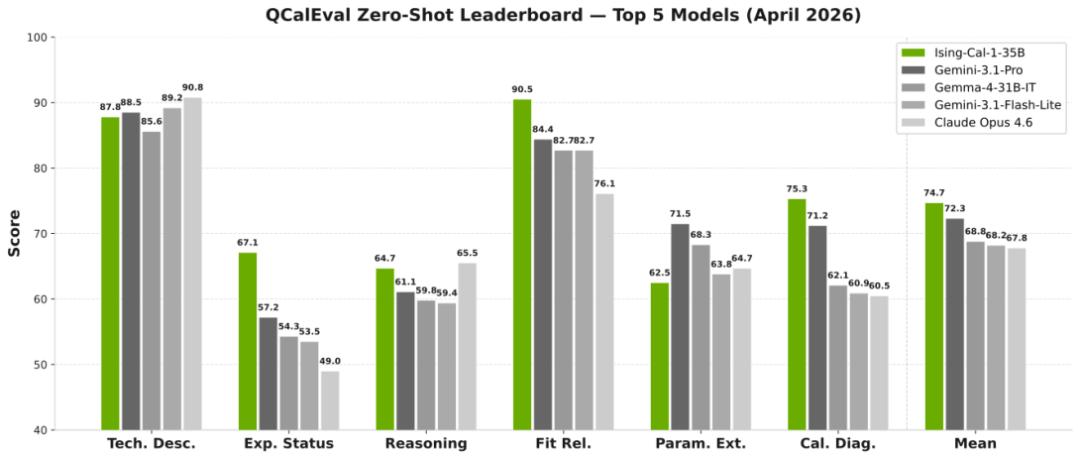
The results show that Ising - Calibration - 1 with 35 billion parameters has an average score of SOTA in six evaluation dimensions, including interpreting experimental results, classifying results, evaluating the importance of results, evaluating the quality of fitting and key features, and generating feasible suggestions, surpassing top - level closed - source models such as Gemini 3.1 Pro, GPT 5.4, and Claude Opus 4.6.
NVIDIA Ising Decoding
Ising Decoding is an AI training framework and model collection based on 3D CNN, specifically designed for the highly demanding real - time decoding tasks in quantum error correction.
As a "pre - decoder", Ising Decoding can be extended in space and time. By processing a large number of local syndrome errors, it can accelerate and improve the accuracy of the global decoder.
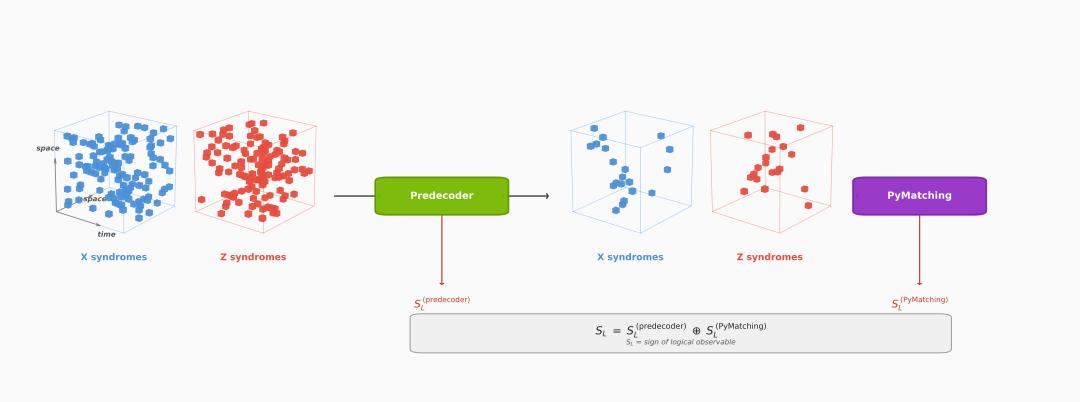
Users only need to define the noise model, the direction of the rotated surface code, and the model depth. The Ising Decoding framework can automatically generate synthetic data and train a 3D CNN optimized for the decoding performance of the task.
NVIDIA has open - sourced two basic model instances on HuggingFace:
The Fast model optimized for speed
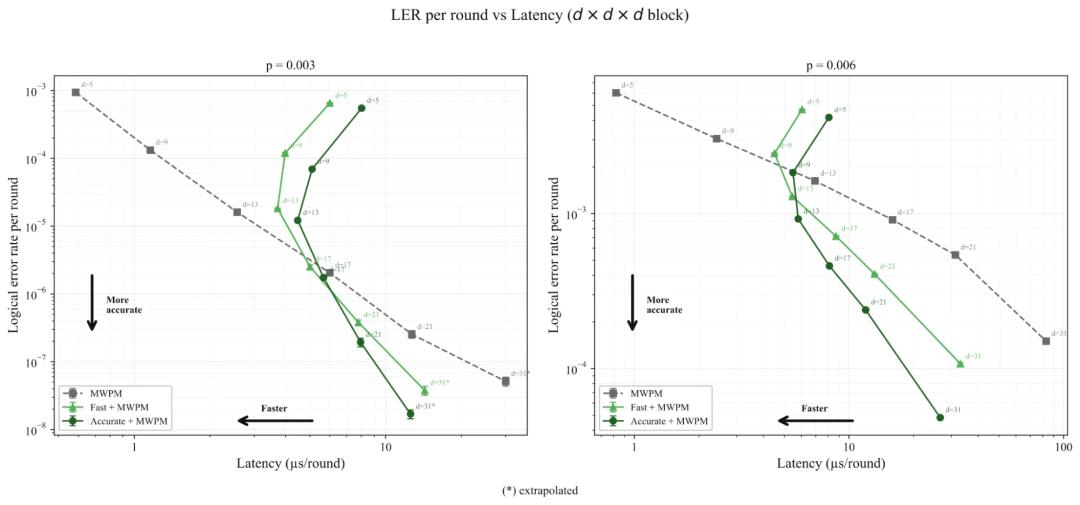
The model has approximately 912,000 parameters, fewer layers, and a smaller size. Therefore, Ising - Decoder - SurfaceCode - 1 - Fast can run efficiently on GPUs.
Compared with the standalone PyMatching solution, the Fast model can provide 2.5 times acceleration and increase the accuracy to 1.11 times the original.
The Accurate model optimized for accuracy
The model has approximately 1.79 million parameters. Compared with the Fast model, the Accurate model can correct longer error chains, but the running time will also be longer.
Compared with using PyMatching alone, the Ising - Decoder - SurfaceCode - 1 - Accurate + PyMatching solution is 2.25 times more effective, and the accuracy can reach 1.53 times.
It is worth mentioning that the Ising series of models adopt the Apache - 2.0 license, which is a relatively loose and business - friendly open - source license.
In addition, there is also a story behind the name Ising:
The Ising Model is a very classic and important mathematical model in statistical physics. It was originally proposed by physicist Wilhelm Lenz in 1920, and his student Ernst Ising conducted a detailed study on its one - dimensional case in 1925.
Now, the Ising Model has become the most basic model for studying phase transitions and critical phenomena and is widely used in the fields of physics, chemistry, biology, computer science, and even sociology.
One More Thing
NVIDIA's sudden large - scale open - source initiative in the field of quantum computing has led to a wave of more than 6% increase in its stock price.
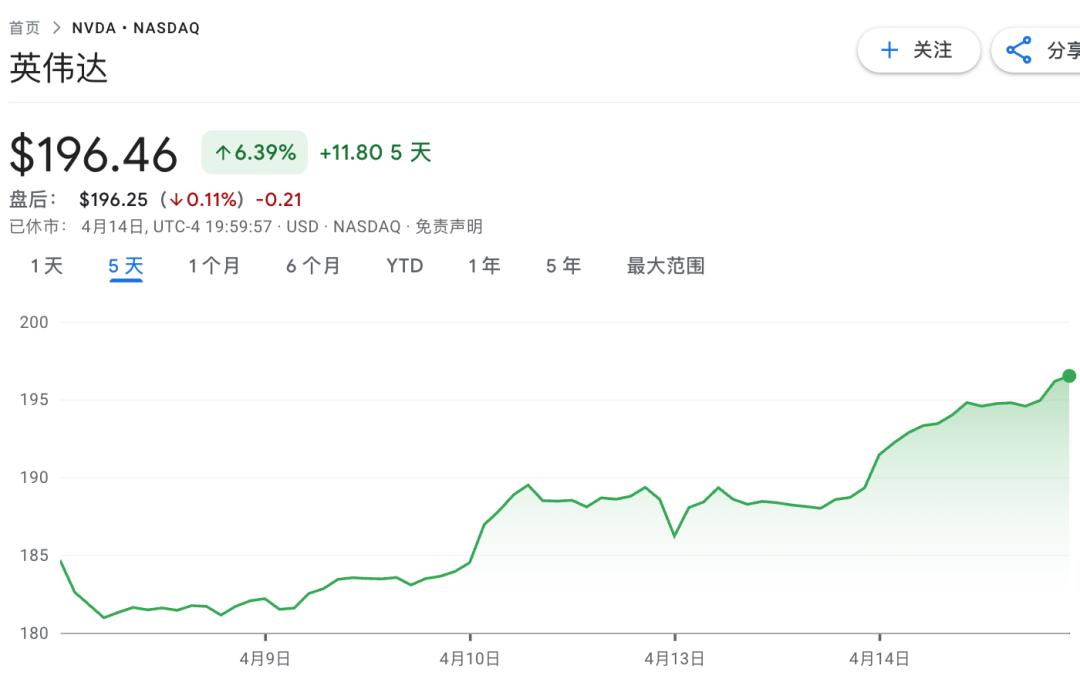
Some netizens have sharply commented: NVIDIA has released a mass - production quantum toolchain. Before 5 years pass, everyone will be in a hurry again.
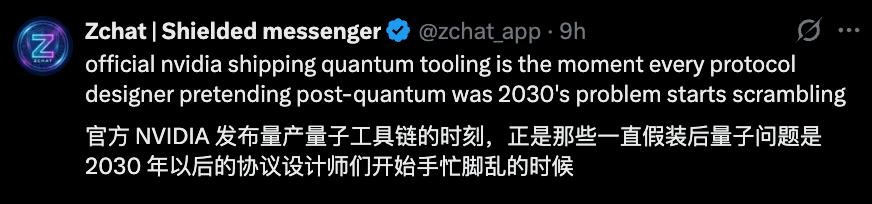
Going back to Jensen Huang's words, "AI will become the operating system of quantum computers." Therefore, taking the lead in occupying a place in the quantum ecosystem through open - source is an important move for NVIDIA in this future game.
It is still not limited to hardware but starts to lay the foundation for influence at the level of software underlying logic.
Open - source address:
https://huggingface.co/collections/nvidia/nvidia - ising
Reference links:
[1]https://nvidianews.nvidia.com/news/nvidia - launches - ising - the - worlds - first - open - ai - models - to - accelerate - the - path - to - useful - quantum - computers
[2]https://developer.nvidia.com/blog/nvidia - ising - introduces - ai - powered - workflows - to - build - fault - tolerant - quantum - systems/
This article is from the WeChat official account "Quantum Bit" , author: Yuyang. Republished by 36Kr with permission.