After Wu Yi joined Meta, Tsinghua University's Institute for Interdisciplinary Information Sciences removed his faculty information from its official website.
Amid the heated discussions about Wu Yi's joining Meta, many people have a question: Doesn't he still hold a faculty position at the Institute for Interdisciplinary Information Sciences (IIIS) of Tsinghua University?
According to the latest news, he may no longer have this position.
QbitAI has found that currently, there is no longer any information related to Wu Yi on the official website of IIIS.
Wu Yi Is No Longer on the IIIS Website
On the personnel page of the Institute for Interdisciplinary Information Sciences of Tsinghua University, Wu Yi's name has disappeared.
However, on his personal homepage and Google Scholar page, the title of "Assistant Professor at the Institute for Interdisciplinary Information Sciences of Tsinghua University" is still retained.
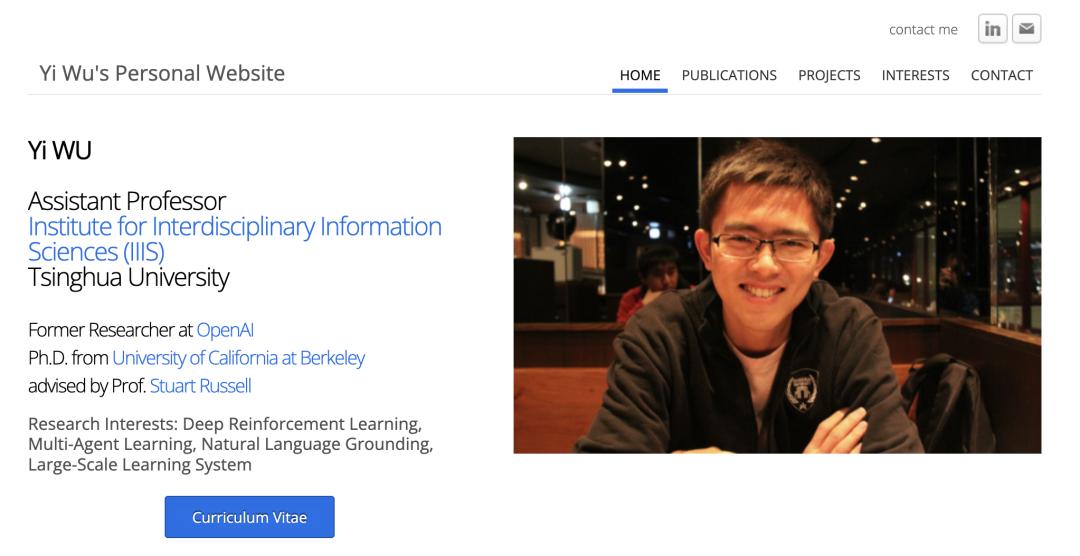
Recently, Wu Yi has become one of the most talked - about figures in the AI field.
It is reported that he has formally joined Meta MSL and will report to Nat Friedman, the vice - president of Meta and the co - head of MSL.
Meta MSL is the Meta Superintelligence Labs established by Meta in July last year. It is the core unit after the company's AI business restructuring.
This laboratory focuses on building a general intelligence system "beyond human capabilities" to support the "personal superintelligence" strategy.
People familiar with the matter revealed that Mark Zuckerberg personally recruited Wu Yi and finally got him on board.
According to insiders, after joining Meta, Wu Yi will directly participate in Meta's cutting - edge research on superintelligence and multi - agent systems.

Two current recruitment notices from IIIS (in the fields of computer science and quantum information respectively) show that the working location for faculty positions is required to be in Beijing.
Since Meta has no R & D office in China, if Wu Yi chooses Meta, he naturally cannot stay in Beijing.
It is not yet clear whether Wu Yi first chose Meta and then resigned from his position at IIIS, or he first left his position at Tsinghua and then chose Meta for his career development.
Or perhaps it is related to the strict mobility mechanism of IIIS.
At the beginning of this year, Wu Yi posted on Xiaohongshu, saying, "Three doctoral students will graduate this year." They passed the pre - defense in February and will have their formal defense in June.
Has Internship Experience at Meta and Worked at OpenAI for 4 Months
Born in 1992, Wu Yi is a silver medalist at the International Olympiad in Informatics (IOI). He represented China at the IOI 2010.
After this event, he was admitted to the Yao Class at IIIS of Tsinghua University in advance and became a student of Turing Award winner Yao Qizhi.
During his undergraduate studies, Wu Yi interned at Facebook (now Meta) and Microsoft Research Asia (MSRA) successively.
After graduating from undergraduate in 2014, he went to the University of California, Berkeley to pursue a Ph.D. under the supervision of artificial intelligence expert Stuart Russell. His research areas cover core fields such as multi - agent systems, deep reinforcement learning, and general agents.
During his Ph.D. studies, Wu Yi began to gain prominence at major top - tier conferences.
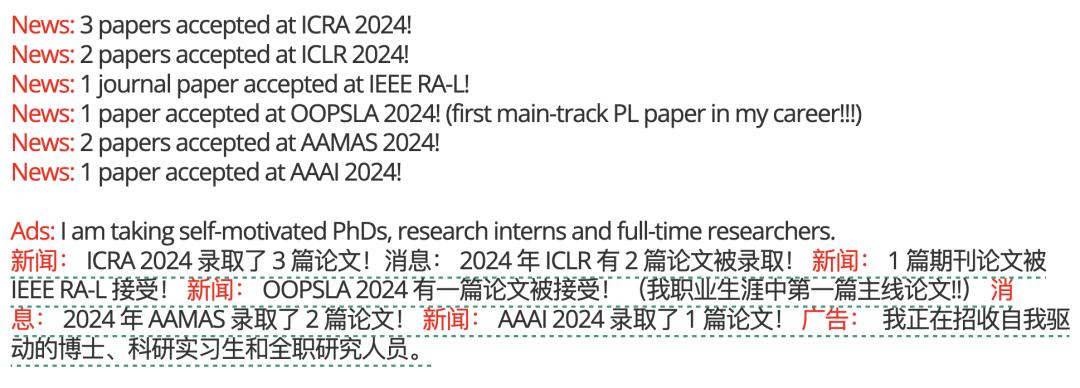
From the published papers, his academic output is mainly concentrated in the fields related to machine learning and reinforcement learning. He has published many works at top - tier conferences such as NeurIPS and ICML. Some of his research involves multi - agent learning, decision - making optimization, and learning frameworks combined with real - world systems.
So far, Wu Yi has published more than 40 papers at top - tier conferences such as ICML, NeurIPS, and ICLR.
The multi - agent reinforcement learning algorithms he proposed, such as MADDPG and MAPPO, have become important works in this field.
During his Ph.D. studies, he also interned at ByteDance and FAIR.
In 2019, Wu Yi graduated from the University of California, Berkeley with a Ph.D.
His resume shows that from March to July of that year, Wu Yi served as a visiting researcher at OpenAI.
At that time, OpenAI had not become a household name because of ChatGPT, but it was already a promised land in the hearts of many AI researchers.
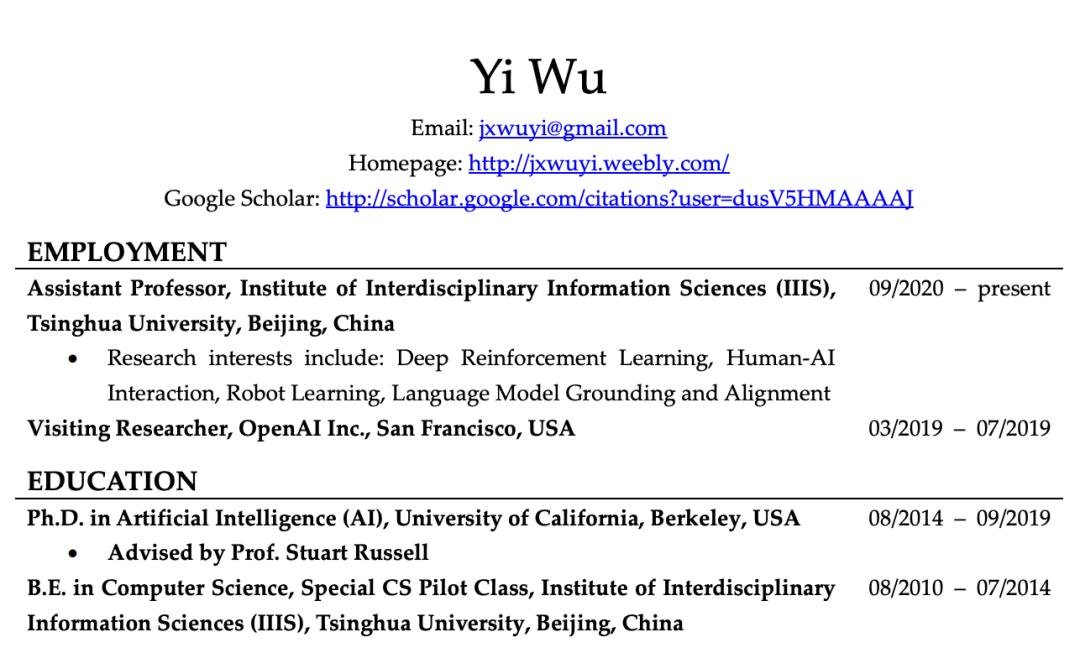
His work experience at OpenAI did not last long.
In September 2020, Wu Yi returned to China to teach and started the "dual - appointment" model between Beijing and Shanghai: On the one hand, he served as an assistant professor at IIIS of Tsinghua University, focusing on academic research and cultivating students; on the other hand, he served as the chief researcher at the Shanghai Qi Zhi Institute, continuously promoting cutting - edge research on reinforcement learning and embodied intelligence.
In 2023, he started his own business and founded Bian Sai Technology, focusing on AI - related fields.
In late November 2024, Ant Group officially acquired Bian Sai Technology. The whole team was incorporated into the Ant ecosystem, but the Bian Sai team worked independently, retaining its independent company entity, team, and business, and was not incorporated into Ant's establishment.
Wu Yi serves as the chief scientist of Ant Group's Reinforcement Intelligence Laboratory and the head of Bian Sai Technology, while still retaining his positions at IIIS of Tsinghua University and the Shanghai Qi Zhi Institute.
At the beginning of this month, it was reported that Wu Yi officially joined Meta MSL.
IIIS Does Not Prohibit Faculty from Engaging in Both Academia and Industry
IIIS of Tsinghua University does not prohibit faculty from engaging in industry, as some faculty members listed on the official website are still involved in industry.
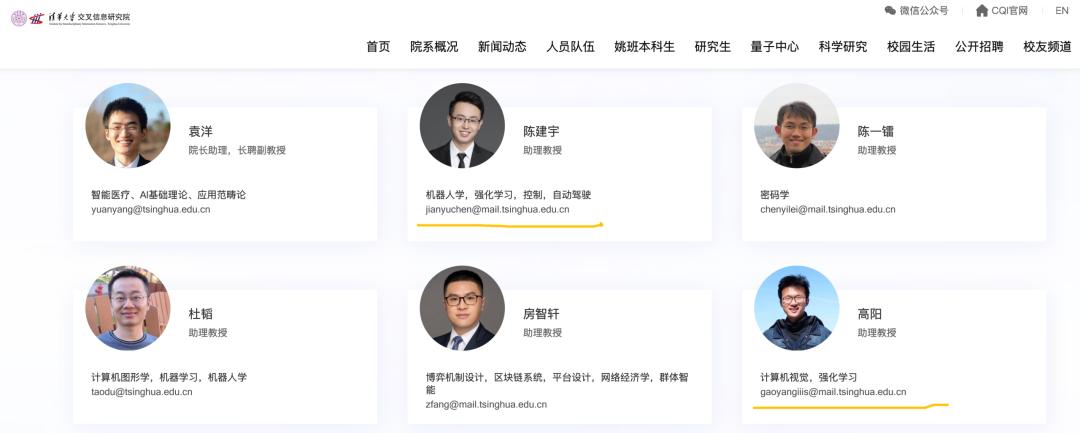
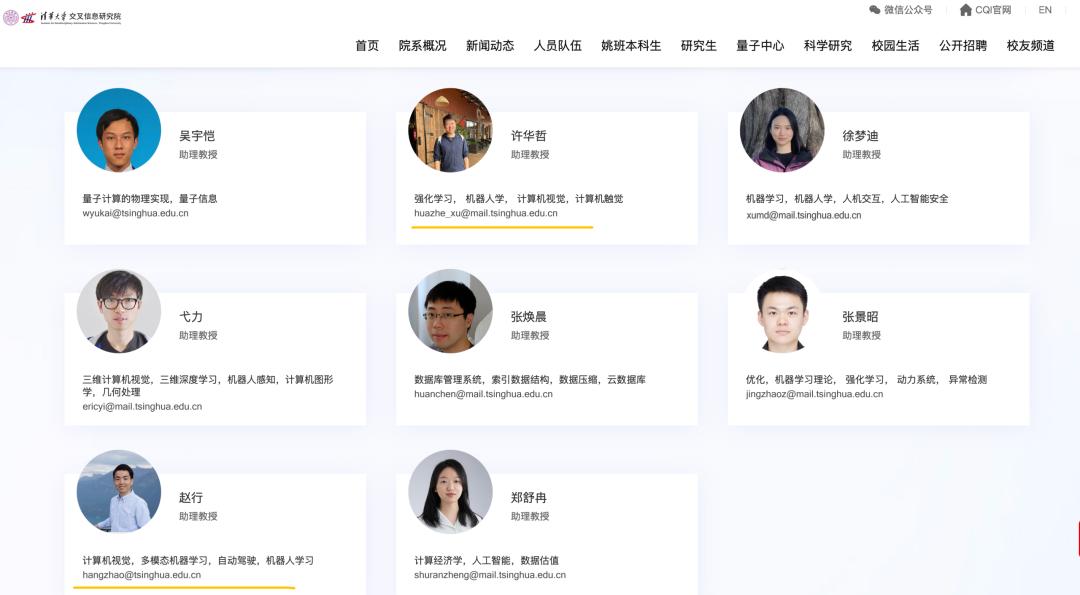
For example, the other three of the so - called "Four Returned from Berkeley", namely Xu Huazhe, Chen Jianyu, and Gao Yang, are still listed as assistant professors on the official website of IIIS.
Among them, Xu Huazhe founded Poke Robotics, Chen Jianyu founded Xingdong Jiyuan, and Gao Yang founded Qianxun Intelligence, becoming the iconic forces in the field of embodied intelligence from Tsinghua University.
Among the full - time faculty, Assistant Professor Zhao Xing also started a business in the field of embodied intelligence. He is the co - founder and chief scientist of Xinghaitu.
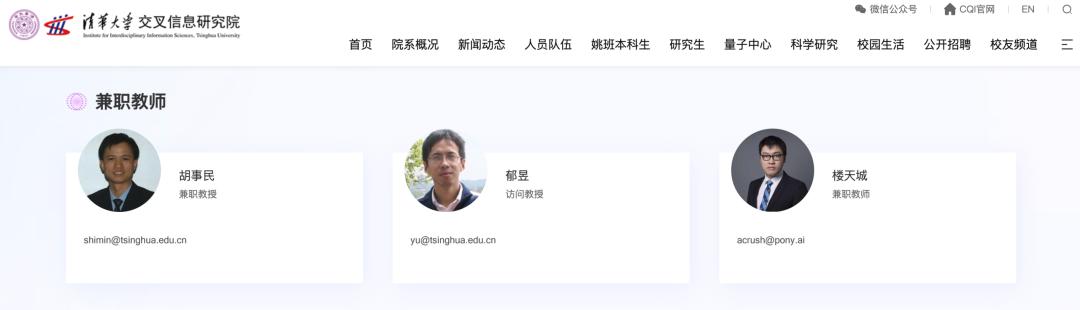
In addition, Lou Tiancheng, the direct disciple of Turing Award winner Yao Qizhi from undergraduate to Ph.D., is not only the co - founder and CTO of Pony.ai but also one of the three part - time faculty members at IIIS.
These are all manifestations of IIIS adapting to local conditions due to the characteristics of AI in industry - academia - research, and they also continuously cultivate more interdisciplinary talents for China.
However, Meta obviously cannot fit into this kind of flexibility.
Reference links:
[1]https://iiis.tsinghua.edu.cn/rydw.htm#sz1
[2]https://jxwuyi.weebly.com/
[3]https://jxwuyi.weebly.com/uploads/2/5/1/1/25111124/cv_faculty_2023su.pdf
This article is from the WeChat official account "QbitAI". Author: Heng Yu. Republished by 36Kr with permission.