This batch of international students is saving enough money to buy a Tesla by using AI for medical consultations.
01. Save Enough for a Tesla in 20 Days with AI
After returning to China for root canal treatment on four teeth, Tu Tu, a British international student, stared at the bill of over 10,000 RMB and calculated. He found that this trip back to China had actually saved him enough money to buy a second - hand Tesla.
Just 20 days ago, Tu Tu's toothache flared up again, and even eating became a torture. He urgently needed to find a way to relieve the pain, but the memory of his previous dental experiences abroad flashed through his mind.
Previously, when he had a toothache, Tu Tu made an appointment with a dentist at a local private hospital. After a series of examinations, the doctor's treatment plan was root canal treatment. He had to have his tooth ground and cleaned, which cost 1,900 pounds. He also needed a dental crown, which cost 1,500 pounds, plus a surgical fee of 400 - 500 pounds. Treating one tooth would cost at least 4,000 pounds, equivalent to nearly 40,000 RMB. Not only did it cost an exorbitant amount, but the result was also far from satisfactory. Soon after the treatment, Tu Tu's dental crown fell off. The technique was not worth the price at all.
"It's so frustrating to spend so much money," Tu Tu decided to return to China for treatment this time. But there were still 20 days until he could go back. How could he endure the pain? He took out his phone, opened Ant A Fu, and asked, "How can I hold on until I return to China without having a root canal?"
Soon, A Fu provided a relief plan: cold compress, gargle with salt water, and take some painkillers as an auxiliary. Tu Tu managed to hold on for 20 days with these methods. As soon as the holiday started, he took a flight and went straight to a public hospital in China. He had root canal treatment on four teeth for just over 10,000 RMB.
He did some calculations. If he had the treatment abroad, these four teeth would cost at least 16,000 pounds. "The money I saved is enough to buy a second - hand Tesla," Tu Tu said.
It has long been a common understanding among international students that it is difficult and expensive to see a doctor. Although some countries offer free or affordable medical services, the long waiting period is generally only suitable for minor self - healing ailments. Once they encounter non - life - threatening but extremely tormenting problems, they have to pay extra to go to a private hospital, and then they will face the "sky - high bill" of overseas medical care.
Therefore, this kind of operation of "relieving minor ailments with AI and relying on AI to hold on until returning to China for major problems" is becoming a new survival guide for international students.
Fei Fei, who is studying in the United States, suddenly had an allergic reaction all over her body some time ago. Unfortunately, she didn't bring the loratadine she usually took in China. Not knowing what medicine to buy in the United States, she resolutely opened ChatGPT. Just like asking a pharmacist in a pharmacy, she asked several questions in a row, "What anti - allergy or urticaria medicines can I buy in the United States?" "Which one is more effective?" "Which one has less drowsiness as a side effect?" "What are the specific ingredients?"
AI not only provided detailed answers but also specifically reminded her to "avoid alcohol while taking the medicine." Following the plan given by AI, Fei Fei solved the problem with just a few dozen dollars.
Since Fei Fei only planned to stay in the United States for one year, she didn't buy the expensive local medical insurance. But even if she had insurance, it wouldn't be cheap. The local insurance policy could only cover part of the cost. Just lying on a bed in the emergency room would cost 500 dollars. Even if the doctor didn't diagnose anything, 1,200 dollars still had to be paid.
A netizen who was studying in the United States had his leg scalded by hot oil and blistered. He waited for two hours to see a doctor. The doctor just applied some medicine and wrapped the wound with gauze. But a week later, he received a bill of 1,900 dollars. The self - media blogger "Logic Medicine" once shared the cost composition of an emergency room in the United States, including facility fees, doctor fees, examination and treatment fees, and medicine fees. The emergency fee for a common cold starts at 500 dollars, 1,000 dollars for a minor cut that needs stitches, and tens of thousands of dollars for severe cases or hospitalization.

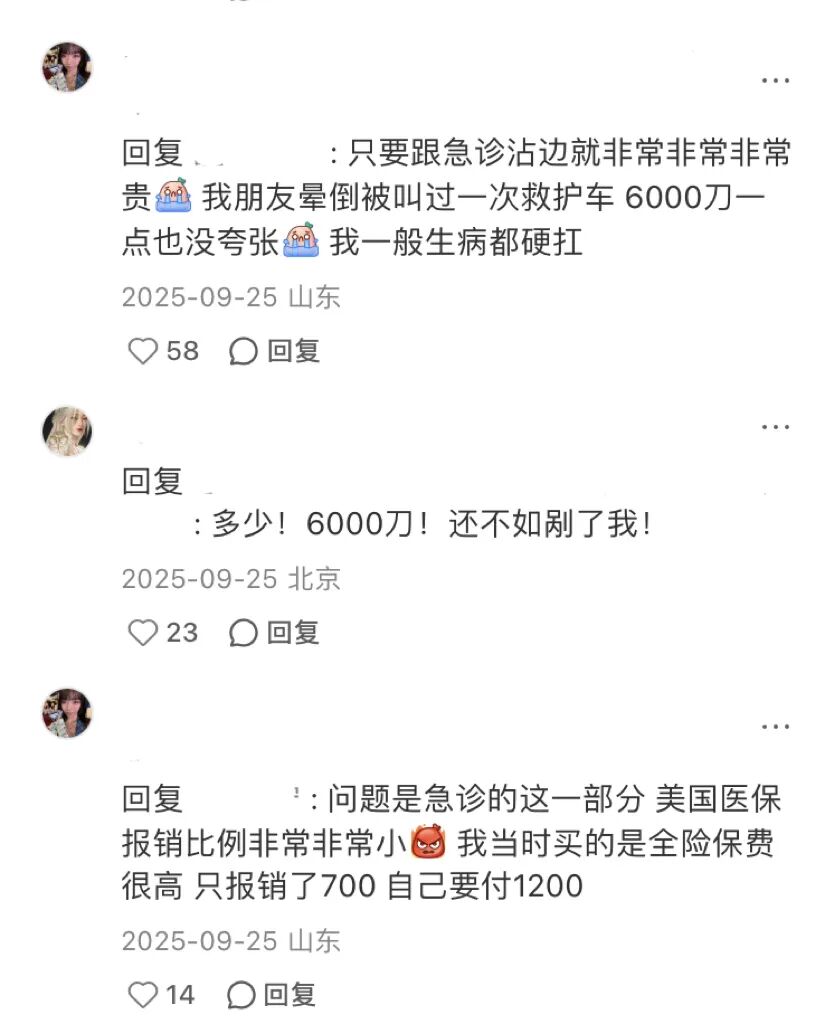
A netizen received a "sky - high bill". Image source: Internet
In the face of the "bill assassins", more and more international students are getting used to using AI as their private health advisors.
02. The Current International Students' Approach to Seeking Medical Treatment: Ask AI First
Data also proves this point.
Tu Tu once conducted a small survey in the international student group. The voting results of more than 400 people showed that nearly 80% of international students admitted to using AI for medical advice. In addition to thinking that the cost is high, 83.8% of international students are worried about the doctor's level and afraid of being misdiagnosed. Also, 73.1% are troubled by the slow appointment process. By the time they get an appointment, their illness may have already healed.
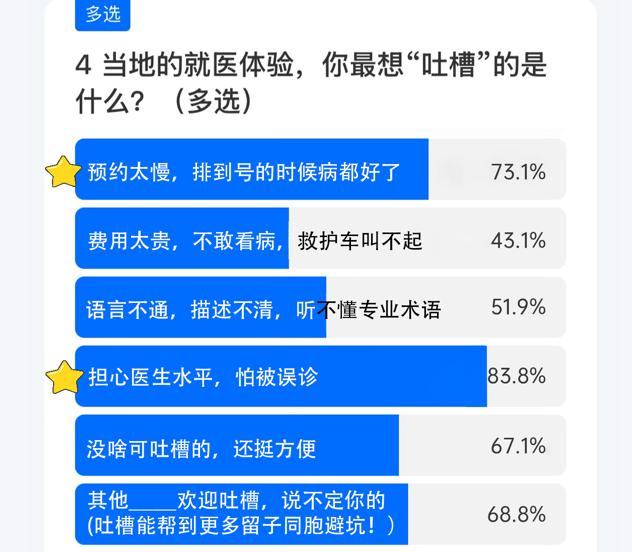
Tu Tu's survey
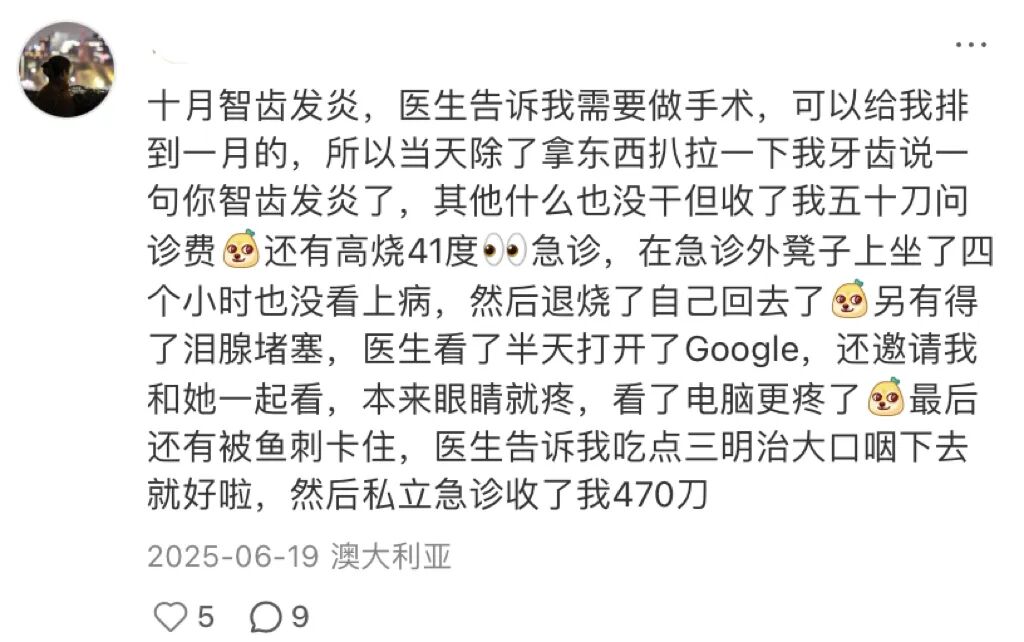
Netizens complaining about overseas medical care. Image source: Internet
"In the past, international students relied on their strong will to endure illnesses. Now, they have AI," Tu Tu summarized.
International students like Tu Tu, who are "meticulous calculators", focus on spending their budget wisely. They are not stingy; they just refuse to be "suckers". They use AI for cost accounting and risk hedging. They use the methods provided by AI to relieve symptoms first and save the major budget for the efficient and cost - effective medical system in China.
In Tu Tu's survey, 70% of international students who used Ant A Fu like him said they saved money on medical expenses. Among them, nearly 40% saved more than 20,000 RMB.
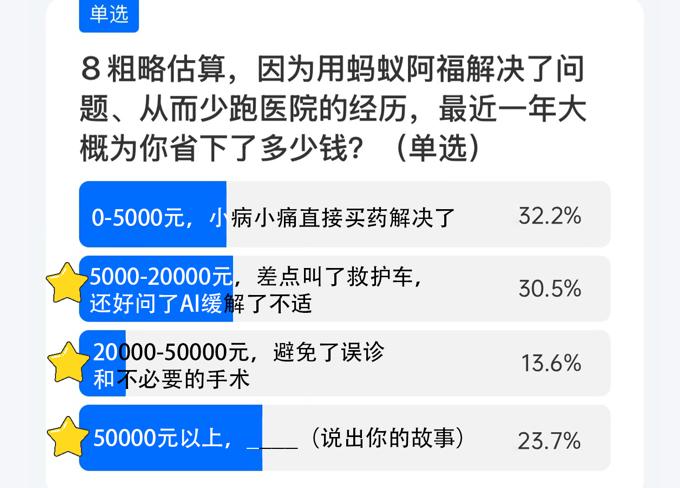
Tu Tu's survey
Azhen is a typical "endurer - type international student". In her opinion, enduring is not giving up but a prepared and skillful self - rescue. Before coming to the UK to study, Azhen brought a lot of stomach medicine and cold medicine from China, preparing to "endure minor ailments on her own".
Some days ago, she went on a trip to Spain with her friends. On the last day, she suddenly felt stomach discomfort and body aches. Unfortunately, she didn't have any medicine with her. Not knowing how to buy medicine and see a doctor in a foreign land, Azhen first searched on social media, but the information was chaotic, and none of it exactly matched her symptoms.
She opened ChatGPT and told it all about her situation. After several rounds of follow - up questions, ChatGPT initially diagnosed it as gastroenteritis and suggested replenishing electrolytes. Azhen followed the advice, and her symptoms improved a little. After returning to the UK, she took the stomach medicine she brought from China, and her body quickly recovered.
"With AI, at least I don't have to guess blindly in a foreign country alone. My anxiety about seeking medical treatment has been greatly reduced," Azhen said.
Yang Can, who is also studying in the UK, has advanced from simply using AI as an auxiliary to cross - verifying with multiple AIs.
Some days ago, she felt pain in her face. By comparing the symptoms on social media, she suspected it was trigeminal neuralgia. But not daring to make a definite judgment, she asked Deepseek, "My left gum is a bit inflamed, and there is a big boil on my left forehead, which makes my entire left face feel sore, prickly, and swollen, and my ear also hurts."
Deepseek asked for some details, such as which symptom appeared first and whether the pain was continuous or intermittent. Finally, it analyzed that it might be a spread of facial infection. To be more cautious, Yang Can also asked the same question to Ant A Fu. A Fu asked more detailed questions: "Are you having a fever now? Is the boil hard or soft? Is there a pus - filled abscess on your gum besides the inflammation?"
After comprehensive judgment, A Fu gave the same advice as Deepseek: Do not squeeze or apply heat to the boil on the forehead, as it may easily lead to intracranial infection. At the same time, both AIs gave a key reminder: Once symptoms such as fever, blurred vision, or rapid growth of the boil appear, you must go to the emergency room immediately.
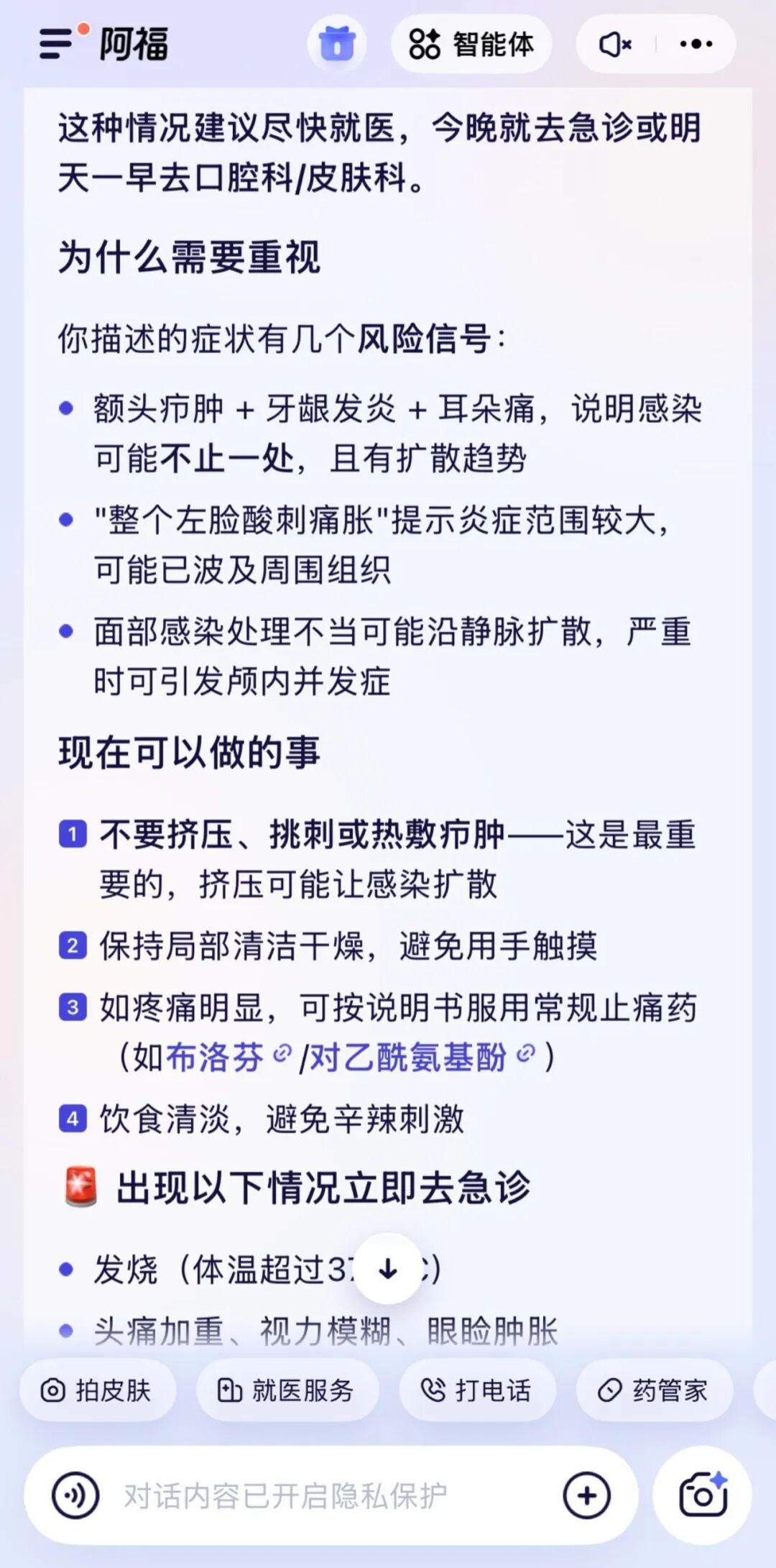
The medical advice given by A Fu
After cross - verifying the information from both AIs, Yang Can felt more confident. As for what to do if the two AIs have different opinions? "Then go to the hospital," Yang Can said. "AI helps me filter out 90% of my panic, but if they disagree, it means this matter should be handled by a professional."
This generation of international students clearly knows the boundaries of AI. Just like Azhen has a bottom line in mind. For symptoms like a cold or cough, which are "easy - level challenges", she uses the medicine she brought and endures if possible. For situations like gastroenteritis, which she hasn't dealt with before but are not very serious, she asks AI for advice. But if it is as serious as a fracture, she will crawl to the hospital if necessary.
03. A Sense of Security in a Foreign Land
International students are so proficient in using AI not because they like to make a fuss, but because they are forced to.
Fei Fei still remembers the day when she accompanied her allergic friend to the emergency room. They waited for a full 8 hours to see a doctor. Watching her friend having difficulty breathing and turning red in the face, the doctor just gave her a pill and said, "I know you're suffering, but please be patient. We will treat you immediately when you are in real danger, but we think your situation is okay for now. If you're really uncomfortable, we can give you an anti - allergy injection."
"Generally, when you go to the emergency room, unless you are in life - threatening danger, if it's just a stomachache or a cold and fever, you basically won't get treated. (The doctor) will just tell you to drink cold water," Yang Can sighed. "There is a joke on the Internet that the English words for 'patient' (the person who is ill) and 'patient' (the quality of being able to wait) are the same. Only at that moment will you understand why people prefer to find their own solutions."
In the era without AI, Tu Tu said his survival strategy was to "endure minor ailments and buy a plane ticket for serious ones". When he was sick, he would take some all - purpose medicine and lie at home, relying on his immune system to recover.
But now, he will directly open his phone, enter his symptoms, and let AI help with the initial symptom analysis. AI won't make you wait for 8 hours like an emergency room, nor will it tell you to have a "vodka" when you have a high fever.

Netizens complaining about overseas medical care. Image source: Internet
Not long ago, Tu Tu suddenly had eczema. He directly took a photo of the affected area and sent it to Ant A Fu, saying that he suspected he might be allergic. Through image recognition and a series of follow - up questions, A Fu told Tu Tu that it was a fungal infection. Tu Tu casually asked A Fu if he could use a certain ointment at home. A Fu stopped him, "No, that ointment is for bacterial infections. You have a fungal infection."
"I felt really at ease at that moment," Tu Tu said. In the past, when something appeared on his body, he either guessed and applied ointment randomly or endured it. Now, he can take a photo and know what's going on in 30 seconds, and also avoid using the wrong medicine.
Ultimately, this generation of international students use AI for medical advice not just to save money. It is also about having a 24 - hour - online, free, no - queuing support that can tell you in Chinese "it's okay for now" or "you should go to the hospital" in those vulnerable moments at 3 a.m., when you are in a foreign country, feeling unwell, and don't know who to turn to.
As Yang Can said, "When AI reminds me of the situations when I must go to the hospital, I think it's quite reliable." In the past, when sick, we endured it. Now, we ask AI first and then decide whether to endure or not.
This kind of on - call sense of security may be the most valuable reassurance that AI gives to this generation of international students.
(All the names in this article are aliases.)