Whether it's a mule or a horse, let's see after running these 21 kilometers.
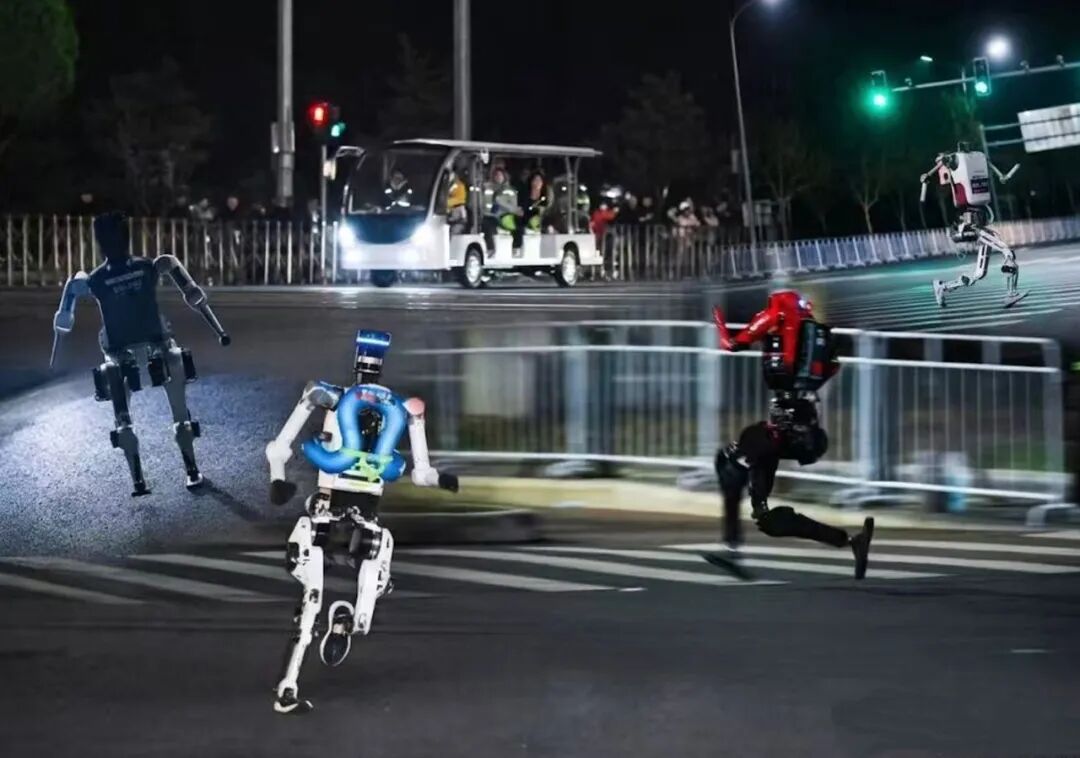
At the moment when the starting gun was fired in Yizhuang on April 19th, the countdown to the large - scale leap of embodied intelligence from "1 to 10" to "10 to 100" officially began.
Late at night on April 11th, under the streetlights in Beijing's Yizhuang, more than 70 teams completed a full - process closed - beta test a week before the official starting gun. According to the on - site situation, the most significant change this year is that the proportion of autonomous navigation has soared from almost none last year to nearly 40%.
Leading players such as Unitree, Zhipu, and Tianggong have all "thrown away the remote controls". More than 100 competing teams and about 26 participating brands' hardware will be officially intertwined on the 21.0975 - kilometer track.
This will be the most convincing collective stress test in the "Year of Delivery" for humanoid robots in 2026.
01 The Watershed of Autonomous Navigation: Nearly 40% Threw Away the "Crutches"
In last year's first - ever event, "Tiangong" won the championship in 2 hours, 40 minutes, and 42 seconds, but it relied on a semi - autonomous solution, that is, a navigator running alongside to guide. This year, the "Tiangong" team publicly announced a shift to full autonomy and has been preparing for nearly half a year.
There are dozens of teams like "Tiangong".
It is revealed that in this year's robot marathon, among more than 100 participating teams covering 13 provinces (including Hong Kong) across the country, the proportion of autonomous navigation has soared to about 40%.
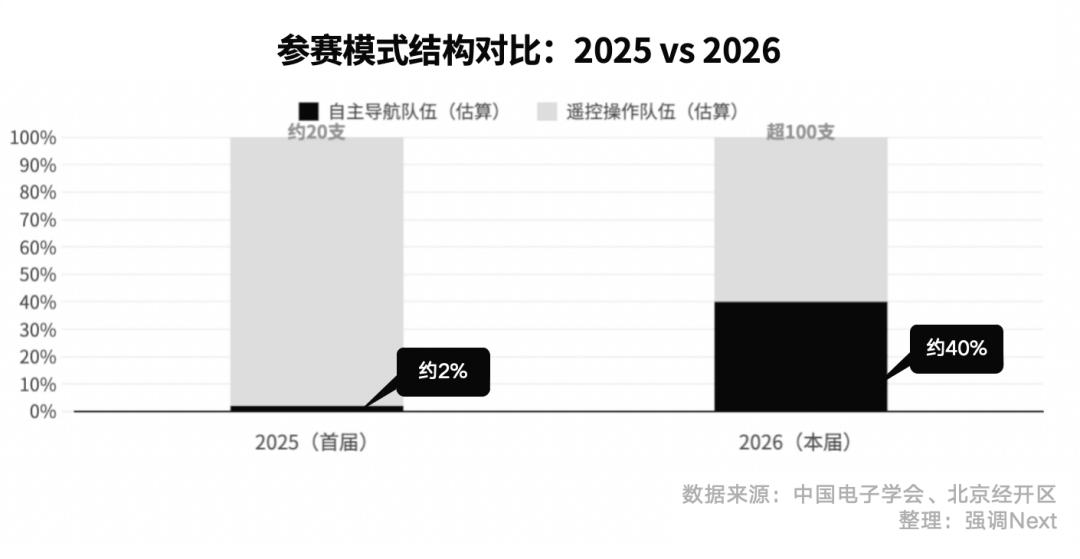
The test results early in the morning on the 12th showed that during the 21.0975 - kilometer journey, these robots not only had to deal with long - distance running but also independently complete path planning, obstacle recognition, and real - time decision - making. Except for sudden malfunctions, human intervention was minimized.
"Autonomous navigation poses a huge challenge to robots, but in aspects such as map construction and autonomous recognition, we have seen excellent phased results," said Liang Liang, the deputy secretary - general of the China Electronics Society, after observing at the test site.
This is the first large - scale verification of end - to - end algorithms moving from the laboratory to complex urban road conditions. The Yizhuang track covers urban ramps, park paths, and undulating roads. The complex environment is forcing the perception model to handle "edge cases" not covered in the training set.
To promote this evolution, the organizers specifically set a rule: The results of teams that complete the race autonomously will be weighted by a factor of 1.2. This is equivalent to giving a high - value reward coupon to the teams that "throw away the crutches". The intention is obvious, which is to "domesticate" the technical direction through actual combat.
02 21 Kilometers: The Supply Chain Undergoes a "Physical Examination" on the Track
For human runners, a half - marathon is a test of physical fitness; for humanoid robots, it is a high - frequency mechanical fatigue test lasting 2 - 3 hours. Every aspect, including joints, thermal control, and battery life, exposes real risks in mass production.
Joint wear resistance. The current mainstream QDD quasi - direct - drive joints and planetary reducers perform stably in short - term laboratory tests, but heat accumulation and metal fatigue under continuous high - frequency motion are another matter. It is revealed that the Tiangong team has made targeted upgrades to the robot's joints and heat dissipation modules this year, and the training data for the jumping and kicking actions of Unitree's H2 series have also been available.
Battery life efficiency. The event rules encourage reducing the frequency of battery replacement. The team that can complete the whole journey with a smaller battery pack will hold the core ticket to enter factories and households : energy - to - power consumption ratio. This indicator corresponds to the future product's hourly operating cost.
Terrain adaptation. The track combines urban main roads, F1 sections, and park ecological paths, with the ground friction coefficient and slope continuously changing. Whether the dynamic balance control can seamlessly switch between different road surfaces is the most direct measurement of the model's generalization ability.
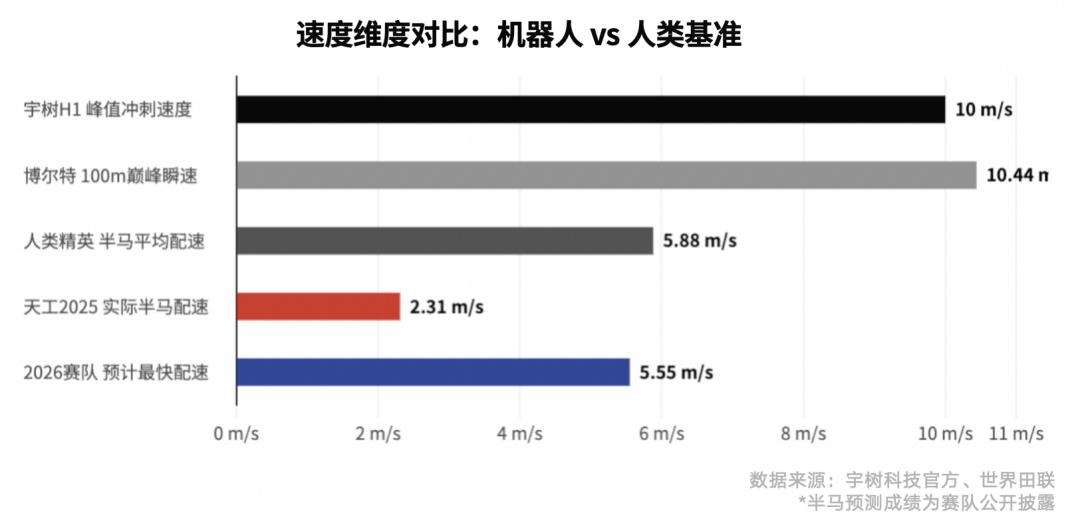
Unitree Technology released a video during the test, showing that the measured peak speed of its H1 reached 10m/s, approaching Bolt's peak instantaneous speed (10.44m/s). However, the market director of Unitree also admitted that sprinting is fundamentally different from a half - marathon. Long - distance road conditions, slopes, and night visibility will all affect the pacing strategy.
What's more noteworthy is that a new "Batulu" challenge has been added to the event: 17 obstacles simulating real disaster scenarios. This is the most brutal assessment of robustness.
Netizens who watched last year's race may have an impression that it is common for robots to fall and have accidents on the track. Therefore, in the marathon, not only speed but also whether the robot can stand up autonomously after falling, re - position itself, and then continue to perform the task should be considered.
03 Business Logic: Why 2026 Is the Year of Delivery
Standing beside the track are not only spectators but also purchasers and investors from the upstream and downstream of the industrial chain, as well as an order list being quietly filled out.
Take Songyan Power as an example. After winning the second place in 2025, its intended orders exceeded 2,000 units within a month, and its valuation soared from 500 million to 2 billion. Every step on the track is simultaneously translated into confidence in the capital market and the supply chain.
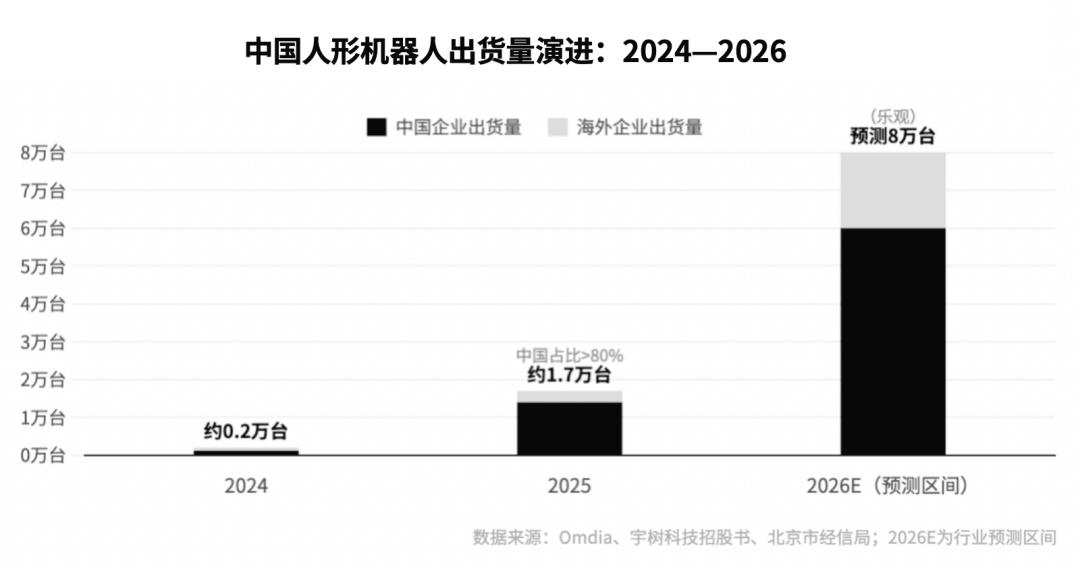
According to data from the GGII, the domestic shipment volume of humanoid robots was about 17,000 units in 2025; by 2026, this figure is expected to climb to 62,500 units, and in an optimistic estimate, it may even reach the range of 200,000 units. A report from TrendForce in April shows that the production volume of Chinese humanoid robots will increase by 94% in 2026, with the combined share of the two leading enterprises, Unitree and Zhipu, approaching 80%.
This marathon has gathered 26 brands and more than 300 robots. This high - density competition is rapidly driving down the cost of core components. The cost of UBTECH's Walker series has decreased by 25% compared to 2024, which is due to the increasing localization rate of key components such as planetary roller screws and harmonic reducers. Xiaxia Precision has reduced the cost of reverse planetary roller screws to the thousand - yuan level, which was almost unimaginable two years ago.
The track forces the supply chain to improve, the supply chain promotes mass production, mass production reduces prices, and lower prices open up application scenarios. As the starting price of Unitree's R1 is set at 29,900 yuan and Songyan Power's robot Xiaobu has dropped below 10,000 yuan, the consumer - level market has been opened. For purchasers in fields such as automobile manufacturing, logistics, elderly care, and family companionship, these 21 kilometers are a more convincing roadshow than any PPT.
04 What Do Forward - Looking People Focus On: Three "Atypical" Moments
In addition to the lively scene, professionals pay more attention to the following three aspects:
Autonomous recovery after falling: The ability to stand up autonomously and re - position itself means that its robustness is one generation higher. This "fault - tolerance ability" is a hard indicator for industrial scenarios.
Autonomous "left - side overtaking" and obstacle - avoidance decision - making: How to avoid pedestrians and maintain a safe distance in crowded road conditions? This is the most realistic preview of future human - robot collaboration. Behind this is the real - time reasoning speed of the perception model and the generalization ability of the planning algorithm for dynamic obstacles.
Can the "elite results" be achieved: Some teams' predicted results are close to those of elite human athletes. However, what is more worthy of attention behind this figure is the "energy management strategy". The engineering convergence ability of the algorithm is the real judge of which team can achieve the goal with the fewest battery replacements and the optimal combination of stride frequency and stride length. Can the Tiangong team's championship result of 2 hours and 40 minutes last year be surpassed in the full - autonomous mode this year?
Meanwhile, 50 service robots have been deployed outside the track to undertake support tasks: robotic dogs act as pacing assistants, cleaning robots handle track garbage, and catering robots supply coffee... The nine major service scenarios created around the event are also a concentrated real - scenario drill, and their value is no less than the results on the track.
05 A Bigger Game: From the Event to the Industrial Foundation
The intention of holding this marathon is not just to watch robots run. The Beijing Municipal Bureau of Economy and Information Technology has a clear idea: guide the breakthrough of bottlenecks in chips, joints, etc. through the "open - call - for - solutions" approach; set up "showrooms" in automobile manufacturing, biomedicine, and smart cities; and provide risk - compensation support for innovative products through the "first - trial - first - use" policy.
Yizhuang itself has established the Beijing Humanoid Robot Innovation Center, gathering nearly 300 ecological enterprises such as UBTECH, Xinghaitu, and Yunji. It has built a robot training ground of over 18,000 square meters, and high - quality data of hundreds of thousands of hours are collected annually. Liang Hongjun, the deputy director of the Intelligent Manufacturing and Equipment Industry Department of the Beijing Municipal Bureau of Economy and Information Technology, once said a very practical thing: "The problems exposed in the competition are the most real, and the iteration directions found are the most accurate."
This marathon is using the event to standardize battery interfaces, weight limits, operating specifications, etc., to reverse - push the incubation process of industrial standards.
The end of the marathon may be the starting point of the industrial explosion.
The champion last year completed the whole journey in 2 hours and 40 minutes, and the goal this year is to finish within 1 hour. This improvement in speed relies on the high - speed iteration of the entire industry in terms of algorithms, hardware, and data infrastructure throughout the year. On this Yizhuang track in 2026, the real route coordinates for embodied intelligence to enter the physical world will be run out.
Taking autonomous driving as a reference, it took nearly a decade from the first Waymo vehicle on the road to the large - scale commercialization of robotaxis. For humanoid robots this time, the cycle may be shorter. However, it definitely requires countless such "public stress tests" to force the confidence out of the laboratory and into every uncertainty in the real world.
This article is from the WeChat official account "Emphasize Next" (ID: leo89203898), written by Xin Jian, and published by 36Kr with authorization.