Veteran entrepreneurs vs Generation Z: Who will be the standard model for the next generation of "one-person companies"?
Text by | Fu Chong
Edited by | Su Jianxun
In the spring of 2026, "Lobster" became extremely popular, directly boosting another concept: OPC (One Person Company).
The concept of a one - person company originated from the UK Company Law in 2013, originally referring to a "one - person limited liability company" in the legal sense. In the wave of AI, it has been redefined and evolved into a new type of entrepreneurial model where an individual or a very small team can achieve a full - link closed - loop with the help of AI tools.
More and more business leaders are endorsing the OPC concept. Zhou Hongyi said that a one - person company is the extreme form of a "super individual" in the AI era. In essence, one person commands N AI agents. People make decisions, and AI executes. Wu Xinhong, the founder of Meitu, has set up a special fund internally to encourage small teams of less than 10 people to apply. At the same time, Meitu has also launched a new product, Meitu CLI, clearly stating that it aims to enable "one - person companies and startup teams" to access imaging capabilities like professional teams.
From the startup circle to established enterprises, AI tools are reshaping the smallest unit of product development. The efficiency leverage they bring is particularly prominent among the OPC group.
The Honghub, an acceleration community for one - person entrepreneurship, recently released the "2026 One - Person Company Insight Report: Gravity, Leverage, and Evolution", for the first time proposing the AI efficiency evaluation index HACR (Human - AI Cost Ratio) for one - person companies (OPC), and releasing the 2026 benchmark value for the Chinese market: For every 1 yuan invested in AI costs by a one - person company, it can equivalently replace about 72 yuan in development labor expenditure.
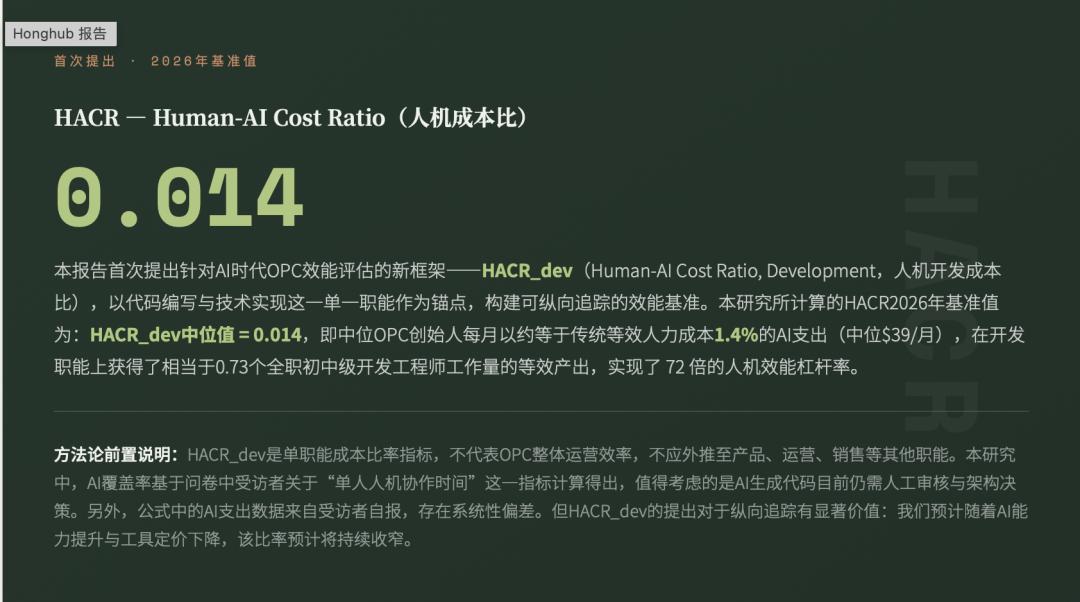
△The picture is from the "2026 One - Person Company Insight Report: Gravity, Leverage, and Evolution".
Since the second half of 2025, one - person companies have gradually evolved from a spontaneous phenomenon in the startup circle to a new economic unit officially recognized by the policy system. Hangzhou, Shenzhen, Shanghai, Suzhou, and Beijing have successively introduced special support policies. According to public information, 23 cities across the country have issued OPC - related policies.
The "Intelligent Emergence" interviewed two representative "super individual" entrepreneurs in this wave:
Zheng Guojun, the founder of "Meet the Forest", has many years of entrepreneurial experience. In the past three years, he has reduced his team from 30 to 3 people, and with the assistance of AI tools, the efficiency has not decreased. After the "Lobster" track became popular, they built a new Agent - collaboration product that could be launched online within 14 days.
Arvin, a post - 2000s founder, is a typical example of how AI lowers the threshold for entrepreneurship. With a two - person team and a startup capital of more than 100,000 yuan, he has launched a personal startup with limited resources with the help of AI. After the emergence of "Lobster", he filled in the gaps in his knowledge of the supply chain and entrepreneurial judgment in the new voice hardware project EinClaw.
These extremely small teams actively leverage AI to quickly make up for the gaps in the execution layer and knowledge, and complete the entire process from idea to product.
However, the deeper we look, the more certain we are of a judgment: AI lowers the "entry" threshold, but at least at this stage, the "success" ceiling has not been lowered.
A demo can be quickly produced, but product positioning, aesthetic taste, and pain - point discovery - these judgments that determine success or failure cannot be replaced by AI. Even if the business closed - loop is achieved, whether it can be replicated into sustainable revenue and the customer base can be expanded still tests people's business capabilities.
Zou Ling, the initiator of Honghub, once told "Intelligent Emergence" that a competent founder of an extremely small team should be able to find opportunities, have execution ability, and be able to self - market. Founders who can operate a one - person company or such an extremely small organization usually have the following three core abilities:
Firstly, the ability to find opportunities. They often have deep experience in a certain industry and can extract real pain points from their industry experience and find inefficient links that can be improved by AI.
Secondly, rapid execution ability. They can independently complete the production of an initial version or even multiple demos in a short time with the help of AI, then quickly obtain feedback, and focus on iterating in the most promising direction.
Thirdly, in the AI era, many early - stage projects do not rely on a ToB sales or customer - acquisition team. Individual entrepreneurs also need to be good at using social media to "represent" themselves. They should have the ability to find early - stage users, verify demand, and even generate cash flow.
This article records the real experiences of two OPC entrepreneurs. What we want to present is not only a methodology for small - team entrepreneurship but also their valuable gains and reflections in this round of transformation.
Zheng Guojun: AI has replaced employees, customers, and the CEO, but the commercialization hurdle still has to be overcome by oneself
Less than two months after "Lobster" became popular, Zheng Guojun, the co - founder and CEO of "Meet the Forest", decided to shut down the AI photo - taking business "45AI", which had been in operation for more than two years, and completely shift to new projects related to "Lobster".
Shutting down the old business was not because it was "unprofitable". In February this year, 45AI was still generating stable cash flow. At its peak, without any marketing budget, it had over 100,000 paying users within 7 days of its launch.
However, Zheng Guojun judged that since Agent is the future direction of AI entrepreneurship and the growth of the existing business is limited, he should invest all the limited resources in the new track.
Zheng Guojun graduated from the Department of Mathematics at Columbia University and has worked in investment. His experience as an AI product manager at "Mobvoi" before starting his business made him more sensitive to changes in user needs and product forms.

△Zheng Guojun (second from the left) at the dialogue event of the one - person company community HongHub. Photo: Provided by the interviewee
The new project is called Clawroom, which allows Agents of different owners to take on tasks, collaborate, and deliver under the same set of protocols, solving the problem of the current difficulty of cross - organizational communication and collaboration among "Lobsters".
Specifically, the initial product is like a "chat room" for "Lobster" collaboration: The client assigns tasks to its own "Lobster", which directly connects with the "Lobster" of the service provider here, and people only need to accept and take responsibility.
For example, if the client says "Publish 5 Xiaohongshu notes next week", its own "Lobster" will assign the task to the "Lobster" of the service provider in Clawroom, and the client just waits for the result.
Initially, Zheng Guojun didn't really know what the product would look like. He just noticed that B - end customers had a demand for more efficient collaboration among enterprise Agents. The product idea was developed through rounds of conversations with Claude, and then Claude Code completed multiple demos. It took 3 people 14 days from project establishment to the launch of the first version.
Zheng Guojun estimated that in the pre - AI era, this would have required at least a 10 - person team and taken 2 months. More likely, the team would have given up the new business due to the long cycle and uncertainty.
This is also an obvious change in product development in the AI era: Instead of waiting for a perfect product, one can first create the minimum prototype and quickly iterate it in real - world scenarios.
In the past three years, Zheng Guojun's team has been reduced from nearly 30 to 3 people, and AI has been involved in almost every aspect of the company's affairs.
The initial replacement started with interns. Repetitive tasks with little creative space, such as questionnaire surveys and user need mining, were assigned to GPT - 3.5. One intern could then do the work of several people in the past.
Then it was the turn of programmers. GitHub Copilot compressed a day's work into four hours, and those good at AI programming could finish three weeks' work in four days.
The replacement is not limited to executive positions. Zheng Guojun even let AI play the role of the CEO: Analyzing competitor functions, assigning development tasks, and formulating iteration plans - AI completed these tasks in an orderly manner.
Recently, with "Lobster" taking on operational tasks, the CTO, who originally only wrote code, has started to independently operate a new Xiaohongshu account and publish product promotion posts. When the first customers came to inquire about prices, the CTO didn't know how to quote, and it was the "Lobster" customer service that proposed a price plan.
However, the improvement in efficiency has not made entrepreneurship easier.
Zheng Guojun is increasingly aware that AI changes efficiency, not the underlying business logic. The team can be smaller, development can be faster, and demos can be more easily produced - but customers won't appear automatically, and market - related activities such as customer acquisition still rely on people.
Moreover, projects of extremely small teams are often not the type favored by capital, so it is even more necessary to achieve a commercial closed - loop.
After 2022, the financing environment deteriorated. Zheng Guojun realized that financing and doing business follow two different logics. Financing favors stories that can be scaled up and exited through listing, but one - person AI startup projects are usually based on specific niche needs and ideas and are difficult to meet this expectation.
More importantly, with more shareholders, decision - making becomes slower. For example, when it came to shutting down "45AI", Zheng Guojun knew that the growth of the existing business had reached its limit, and continuing to maintain it would only disperse energy. In an industry that changes every three months, decision - making speed is more valuable than money. But if the company had multiple shareholders, it would be difficult to implement the decision, as more people would persuade him not to shut down a profitable business.
So Zheng Guojun repeatedly emphasizes that if you choose to do business, you should think about how to make money from day one. Don't be blinded by hot money.
The change from a 30 - person to a 3 - person team is not just a story of "AI - enhanced efficiency". It really shows that AI makes the team lighter and more agile, but in the end, the founder still has to overcome the business hurdle on their own.
Arvin: A post - 2000s who doesn't want to be a "workhorse" is iterating his judgment in AI - enabled "one - person entrepreneurship"
It was the emergence of AI tools that made Arvin, the co - founder of the EinClaw project, realize that "I can also start a company".
In October 2025, Arvin left his previous company and plunged into AI entrepreneurship, developing a screenshot management app. His starting point was not "glamorous": He graduated two years late from a non - top - tier university, majoring in international business, and had worked as a product manager in a blockchain company for three years. With a startup capital of more than 100,000 yuan and limited industry resources, his team consisted of only him and his partner Affe.
Such a starting point would have been difficult to support a product team in the past. But in the AI era, it has become feasible. For things he has no experience in, such as development, legal affairs, finance, and privacy policies, he first asks AI. Once he has a product idea, he uses the Vibe Coding tool for development, and people don't need to waste energy in a lot of communication and meetings.
This is also Arvin's initial understanding of a "one - person company": He doesn't want to be a "workhorse" in a large company with low - efficiency operations, but rather directly translate his abilities into the business with as little loss as possible.
However, AI is not only a helper but also a competitor.
On December 30th, Arvin noticed "Lobster", which was then called ClawdBot, but judged it to be a Claude Code with security risks and didn't pay much attention. On January 10th, after his first trial, he was so excited that he couldn't sleep until 4 am. That night, he didn't think it was just "a new tool", but rather "the functions of the previous app would be covered by 'Lobster', and the project had to change direction".
After that, things accelerated.
In February, Arvin started thinking about developing a voice hardware that could connect to "Lobster" - something like Plaud that could be worn on the body, allowing users to voice - input ideas and send them to "Lobster" to perform tasks without unlocking the phone. He and his partner fully integrated the idea of "voice + Agent + hardware" at the Shanghai DIIS Hardware Hackathon in early March, won an award, and the project started pre - sales.
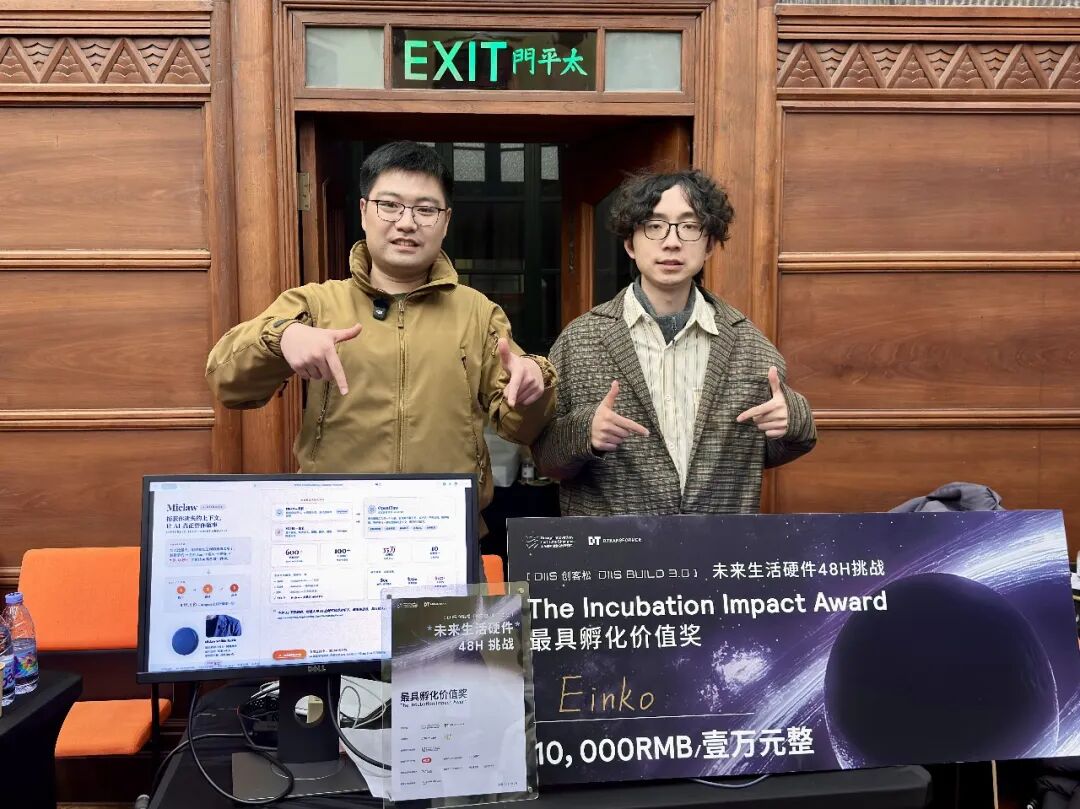
△At the DIIS Hardware Hackathon, Arvin (left) and his partner Affe won an award for their "Lobster" voice hardware idea. Photo: Provided by the interviewee
The real difficulty came next. Since neither he nor his partner had experience in hardware, they took a wrong turn in the supply - chain integration at the beginning. A hardware solution quoted by an acquaintance cost 200,000 yuan, which was a large sum for a newly - established small team.
The project was once on the verge of stagnation until another friend of Arvin pointed out that the above solution could actually be done for less than 50,000 yuan and recommended the corresponding supply chain, and the project was able to continue.
In Arvin's view, although the specific content of the business has changed since he started his business, the underlying logic has remained the same. Whether it was the earliest screenshot app or the later voice hardware, they essentially solve the same problem: helping users accumulate and effectively utilize the large amount of context generated in daily life.
What has really changed is Arvin's understanding of entrepreneurship.
He reflects on his "lag" in business judgment: Why didn't he seriously try the product earlier when he saw it on December 30th? Why didn't he continue to find other supply chains to verify the information after being quoted 200,000 yuan by the supply chain, which led to a brief stagnation of the project?
He gradually realizes that with AI as the execution layer, what is truly scarce in an extremely small team is the founder's judgment.
If the "suffering" in large companies, in Arvin's view, lies in waste, then the "suffering" in small - team entrepreneurship lies in the lack of a buffer layer. One has to bear the consequences of their judgments. If a team member is in a bad state, the team's productivity will immediately decline. If the direction judgment is one step slower, the opportunity may be missed.
The leverage of AI gives young people like Arvin the opportunity to start a business with a