Smartphones are hard to sell, while the prices of computers are still rising.
In Q1 of this year, the consumer electronics markets for computers and mobile phones, which have entered the stock era, have shown completely different trends.
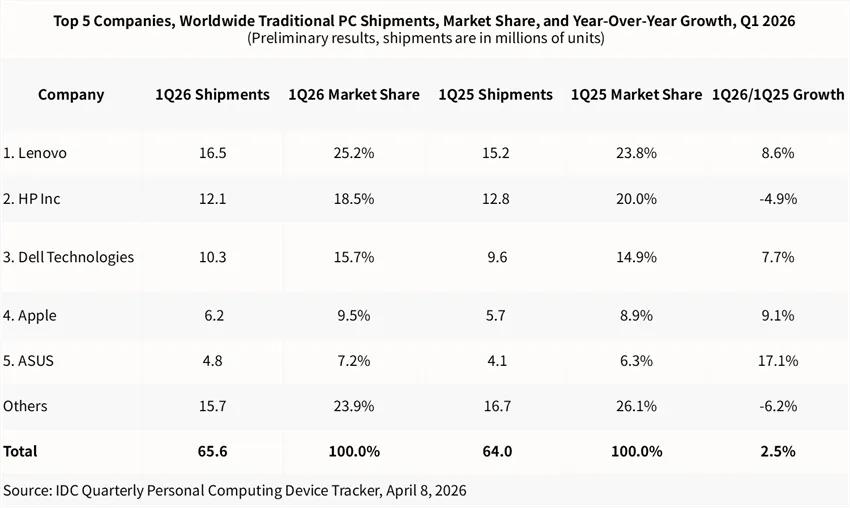
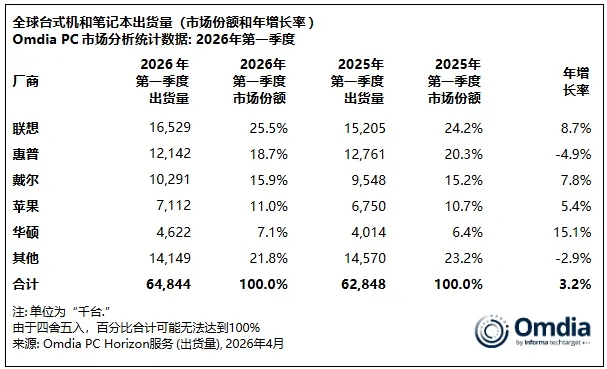
Data released by IDC on April 8th showed that in Q1 of 2026, the global PC shipments were approximately 65.6 million units, a year-on-year increase of 2.5%. Meanwhile, Omdia reported a growth rate of 3.2%, corresponding to shipments of about 64.8 million units. Although the figures from the two institutions differ slightly, the conclusion is the same: the PC market has seen another growth at the beginning of the year.
After a downward cycle from 2022 to 2024, the PC market has maintained growth for several consecutive quarters. The growth rate increased from 6.5% in Q2 of 2025 to 9.4% in Q3 and was close to 10% in Q4.
However, this round of "recovery" at the beginning of this year was not evenly distributed. According to the statistics of IDC and Omdia, the growth rates of Lenovo and Dell were much higher than the market average. Apple maintained growth, while HP was the only one among the top five that declined.
While the PC market is continuously growing, the situation for mobile phones is getting more and more difficult. Old issues such as channel inventory, price pressure, and replacement cycles are frequently mentioned. An IDC report showed that in Q1 of 2026, the global smartphone shipments were approximately 290 million units, a year-on-year decrease of 6.8%. More seriously, IDC significantly lowered its full-year shipment forecast for 2026 to about 1.1 billion units, a year-on-year decline of about 13%. This figure represents the largest decline in the past decade.
Both PCs and mobile phones are core categories in consumer electronics and face the same upstream cost pressure. Why do their trends differ so much? Where did this slight growth of PCs come from? What strategies are major PC manufacturers adopting?
01. Stockpiling, Replacement, and New Products Supported PC's Q1
To answer this question, we need to first understand the background of the consecutive growth of the PC market in the past few quarters.
In Q3 of 2025, the growth rate of the global PC market was already quite high. "There were factors of 'low base' and 'concentrated replacement'," according to Li Ze, a PC industry insider. On the one hand, the replacement demand overdrafted during the pandemic led to a relatively low base previously. On the other hand, the schedule for Windows 10 to stop support forced many institutions to update their devices in a concentrated manner.
In Q4, manufacturers and channels placed orders in advance to lock in the production capacity and cost of storage, pushing a part of the demand that was originally supposed to be released in the first half of 2026 to the end of the year. This boosted the shipments at the end of 2025 and naturally squeezed the space in Q1 of this year.
Against this background, it is worth analyzing that there was still a growth rate of 2% - 3% in Q1 of 2026.
The primary factor is channel stockpiling.
Since the second half of 2025, the global wave of AI data center construction has made storage giants such as Samsung, SK Hynix, and Micron smell the business opportunity of HBM (High Bandwidth Memory) with higher profits. They began to shift advanced production capacity on a large scale to the production of AI - specific memory. With the contraction of the supply side and strong demand, the price of storage chips soared.
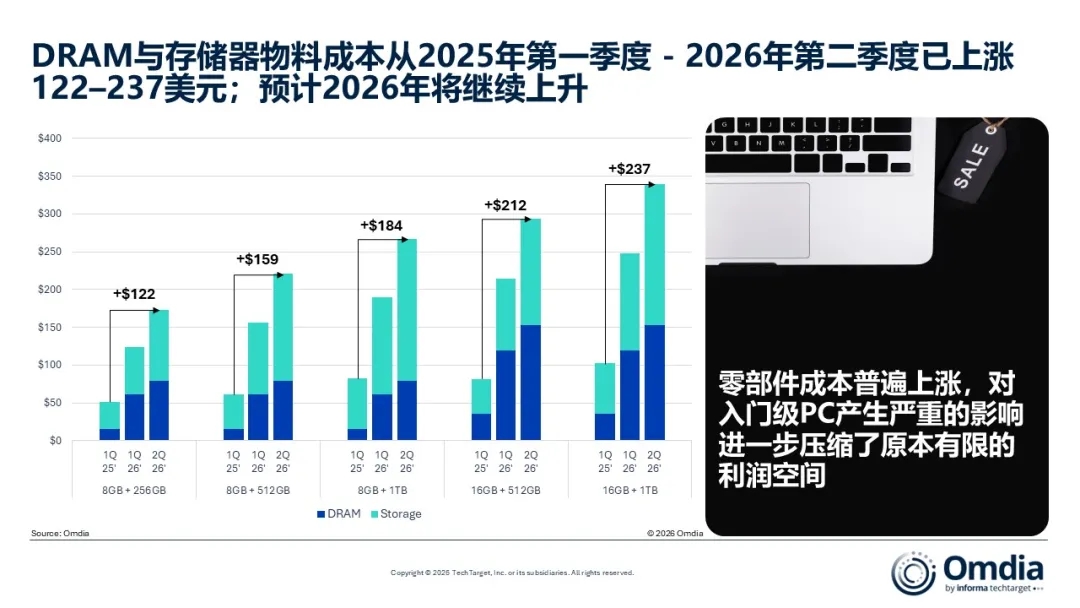
Omdia data showed that the material costs of DRAM (Dynamic Random - Access Memory) and storage for mainstream PCs increased by a cumulative of $122 - 237 from Q1 of 2025 to Q2 of 2026. Ye Maosheng, the chief analyst at Omdia, said when releasing the Q1 data that the memory and storage costs in Q1 showed moderate growth, and a larger increase was expected to start from Q2.
Facing such a situation where the price changes every day, manufacturers and channels all wanted to stockpile more and accelerate shipments before the price fully increased. By Q1 of 2026, this "defensive stockpiling" was still continuing.
This means that part of the shipments is actually "padding inventory" for sales in subsequent quarters. The Q1 data includes the component of channel stockpiling and cannot be fully interpreted as a significant recovery in terminal demand.
The second factor is the end of the Windows 10 replacement wave.
Microsoft officially stopped supporting Windows 10 in October 2025, and devices running the old system no longer receive security updates. For enterprise IT departments, this means compliance risks and security vulnerabilities. So, since Q3 of 2025, global enterprises have been accelerating device replacement. As of Q1 of this year, more than a quarter of Windows 10 users have not completed the migration. These users, especially enterprise users, continued to replace their devices in Q1 of this year, contributing a considerable part of the shipments.
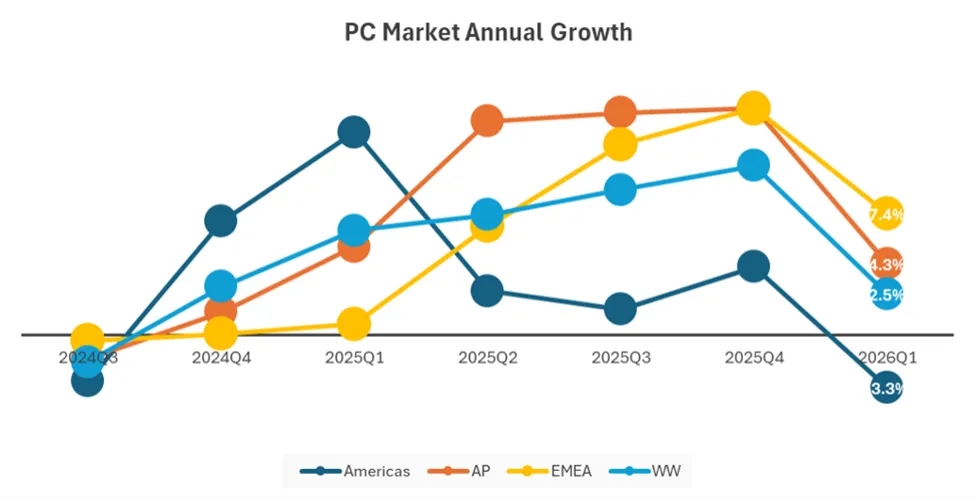
Evidence can be found in regional markets. Omdia's regional data showed that the shipment growth rate in EMEA (Europe, the Middle East, and Africa) in Q1 reached 7.4%, and in the Asia - Pacific region it was 4.3%. There was still relatively strong replacement demand in these two regions.
The third factor is the concentrated release of new products by manufacturers.
This spring, mainstream manufacturers such as Lenovo, HP, Dell, and ASUS concentrated on updating a round of new products. The prices of models with local AI acceleration units continued to decline, which objectively stimulated part of the consumer - side demand.
Overall, the growth in Q1 was the result of channel merchants stockpiling before the price increase, enterprises replacing devices due to the end of Windows support, and consumers making purchases before the price became higher. Also, because this part of the demand was overdrawn in advance, institutions lowered their full - year PC shipment forecast for 2026 to a year - on - year decline of 11.3% while announcing the Q1 data.
In the context of the entire consumer electronics industry, the rhythm of PCs is different from that of smartphones. Smartphones neither have the limitation of a Windows replacement nor sufficient large - scale enterprise and education orders to support them. Therefore, in the face of the same memory crisis, PCs can hold on for one or two more quarters, while smartphones enter the downward cycle earlier.
02. Lenovo Wins Easily, HP Under Pressure, Apple is Conservative
The 2% - 3% growth of the PC market in Q1 this season did not evenly benefit the leading manufacturers.
Lenovo and Dell "reap the benefits" by relying on their supply chains, commercial, and small - and medium - sized enterprise customers. HP faces pressure on the consumer side, indicating that this round of supply and cost shocks is less friendly to brands targeting the mass market. Apple has the strongest pricing power but cannot escape the influence of this cycle. Second - tier manufacturers are trying to pull themselves out of the pure price - performance competition by targeting niche groups and scenarios.
In this round of rebound, Lenovo is still the biggest beneficiary. In Q1 of 2026, it shipped about 16.5 million units, a year - on - year increase of 9%, and its global market share exceeded 25%.
Behind this, on the one hand, Lenovo has stronger supply - chain capabilities. Chen Jing, an industry insider who has long tracked the hardware industry, said that Lenovo's supply - chain control ability on a global scale is ahead of most manufacturers. When memory and storage prices rise and there are local shortages, it can lock in production capacity and prices earlier.
On the other hand, Lenovo shifted its focus to the enterprise and commercial markets earlier and adopted the model of "devices + services + solutions" to meet the demand for Windows replacement and local computing power.
IDC's research on the Chinese market showed that since 2025, the demand for PCs from small - and medium - sized enterprises and professional workstations has had a year - on - year growth rate of more than 30% for several consecutive quarters. Scenarios such as engineering design, video editing, and local AI inference have driven the shipments of high - end models. This market is less sensitive to the selling price and has higher requirements for stability. Lenovo concentrated its resources on these customers in advance.
In contrast, HP, the world's second - largest PC manufacturer, is clearly under pressure.
In 2025, HP had a relatively good year. It benefited from the Windows 10 replacement wave, and its shipments in Q4 of 2025 still had double - digit growth. However, in Q1 of 2026, its shipments (12.1 million units) decreased by 4.9% year - on - year, and its market share fell back to about 19%.
In Li Ze's view, HP highly depends on the consumer market in Europe, the United States, especially in the Americas. These users "are not in a hurry to replace their devices", and HP's ability to transfer costs is limited, so the sales pressure is naturally greater. IDC data showed that the Americas was the only market with a negative overall shipment growth in Q1 of 2026.
Source: IDC
More importantly, it is the rhythm of the strategy. Li Ze added that in the past two years, Lenovo had a clear roadmap for AI PCs and hybrid AI, and Dell also had a clear overall solution on the enterprise side. HP was in a CEO transition period, relying on cost - cutting in the short term, and its long - term strategy seemed rather vague to the outside world. "When enterprises are all calculating, this can easily be magnified by investors and large customers."
Dell, ranked third, had an unexpected performance this season.
Dell went from a year - on - year decline of 3% in Q2 of 2025 to a year - on - year increase of 18% in Q4. In Q1 of 2026, it still maintained a growth rate of 7.8% (shipments of about 10.3 million units), and its market share returned to nearly 16%. This trend shows that Dell is not simply following the market recovery.
Li Ze analyzed that at the underlying level, it is Dell's foundation as an "old - school PC manufacturer" that is playing a role. It is a major buyer in the supply chain and has the ability to pass on costs. So, after the end of 2025, it was able to increase the prices of some enterprise customers and high - end models.
On this basis, the more obvious change in Dell this round is its product structure. After 2025, it no longer only relied on traditional large commercial customers but focused on promoting high - end ultra - thin laptops, creator laptops, and mobile workstations. These models can meet the budgets of enterprises and professional users and also cover the demand for "local computing power, AI applications, and content production". In essence, it is focusing on high - price and high - performance products for growth.
Apple, ranked fourth, adopted a conservative approach in this "AI PC wave", mainly integrating computing power and local capabilities into its existing product lines. Its shipments in Q1 of 2026 (7.11 million units) had a single - digit growth rate, and its market share increased to 11%, mainly driven by the MacBook Pro with the M5 chip released at the end of 2025. The newly launched MacBook Air and MacBook Neo contributed limitedly to Q1 due to their late launch.
For Apple, the PC is just one part of its entire device and service ecosystem. It is more concerned about the combination of "high price + high stickiness".
It should be noted that in the first quarter of fiscal year 2026 (corresponding to Q4 of 2025), the shipments of Apple's Mac business increased, but the revenue decreased. This shows that in the current PC environment, Apple chose to sacrifice part of its profit to expand the number of active devices, hoping to make money gradually through iCloud and subscriptions later.
Looking further down, second - tier manufacturers such as ASUS are also accelerating shipments during this round of market trends.
In Q1 of 2026, ASUS shipped about 4.6 million units, with the fastest growth rate among the top five manufacturers, and its market share increased to about 7%. Behind this, part of the reason is the recovery of the demand for gaming laptops and creator laptops. Another factor is that it launched new products with NVIDIA and AMD in the mid - to high - end price range and took the opportunity to increase the unit price through configuration upgrades.
03. AI PC: A Lifesaver or a Bubble?
If we look at global shipments, the keyword for the PC industry in 2026 is still decline. In the face of this round of impact, manufacturers have grasped the same lifesaver: AI PCs, by labeling the machines with AI and selling them at a higher price than "ordinary laptops".
Lenovo has singled out an AI series in its product line, and AI models already account for more than 30% of the overall shipments. HP has made Copilot + adaptation on commercial laptops (the official certification standard set by Microsoft for AI PCs) and is more cautious on the consumer side. Dell promotes "AI - Ready" workstations and commercial AI PCs, selling a "whole - set IT refresh experience". ASUS promotes local AI on gaming laptops and creator laptops. Apple does some "edge - side AI" work through its M - series chips and Apple Intelligence, just not using the term "AI PC".
However, it is not easy to make a useful and good - performing AI PC.
On the one hand, AI PCs have higher requirements for memory and storage. Taking the official statement of Microsoft Copilot + as an example, a "qualified" AI PC should have at least 16GB of memory, a storage capacity starting from 256GB, and an NPU with a computing power of over 40 TOPS to fully run a system - level AI assistant, real - time translation, background removal, multi - modal search, and other functions.
In this round of price - increase cycle of memory (DRAM) and flash memory (NAND), large - capacity memory and SSDs (Solid - State Drives) are the parts with the fastest - rising costs. Manufacturers either maintain the configuration and pass on the cost to users or reduce the configuration and use smaller - capacity hard drives to reduce the BOM (Bill of Materials). However, this kind of operation will inevitably greatly reduce the experience of AI PCs.
On the other hand, there is still a long way to go for AI PCs to achieve the "disruptive change" mentioned in the publicity.
From a functional perspective, the differences between current AI PCs and ordinary PCs are mainly concentrated in three aspects. First, there is an additional dedicated computing power for running AI, making tasks such as voice transcription, image generation, and local small - model operations run more smoothly. Second, a complete set of AI functions is built into the system, and functions such as meeting minutes, document summaries, and intelligent screenshots can be called with one click. Third, peripherals