Wu Xiaqing, a former NVIDIA executive, founded a robot data service company. Calder aims at the world model base.
On April 10th, "Power Plant" exclusively learned that James Wu, the former vice president and general manager of NVIDIA's DRIVE Sim & DeepMap business, has launched a new round of entrepreneurship. The project is named "Calder" and is positioned as an embodied intelligent spatial data service.
This is also a key topic under the current concepts of spatial intelligence, embodied intelligence, and world models. The scarcity of high-quality training data has become a key barrier "holding back" the development of the embodied intelligence industry, and the acquisition and utilization of high-quality data have also become a popular research direction in the industry.
It is worth mentioning that Calder's logo is taken from the works of sculptor Alexander Calder. Alexander Calder is known as the "pioneer of kinetic sculpture" and is famous for his style of integrating movement and environmental interaction.
Currently, Calder's official website only has a simple slogan: "The Foundation of Spatial Intelligence" and briefly states that "currently we are working with a small number of laboratories and robot teams." More information is yet to be released.
According to an entrepreneur in the relevant field who told "Power Plant", Calder is currently in an active recruitment phase.
We verified the relevant information with Calder, but as of the time of publication, we have not received a response.
The Next Stop for a Chinese Map "Veteran": From Autonomous Driving to Spatial Data
According to James Wu's LinkedIn profile, his work experience at NVIDIA ended in December 2025. And Calder will be James Wu's latest stop after leaving NVIDIA.
In 2016, James Wu founded the high-precision mapping company DeepMap, which received investment from NVIDIA and was later acquired by NVIDIA in 2021. James Wu then served as the vice president and general manager of the DRIVE Sim & DeepMap business at NVIDIA and left at the end of 2025.
At that time, what NVIDIA valued was the know-how that James Wu had accumulated in the high-precision mapping market.
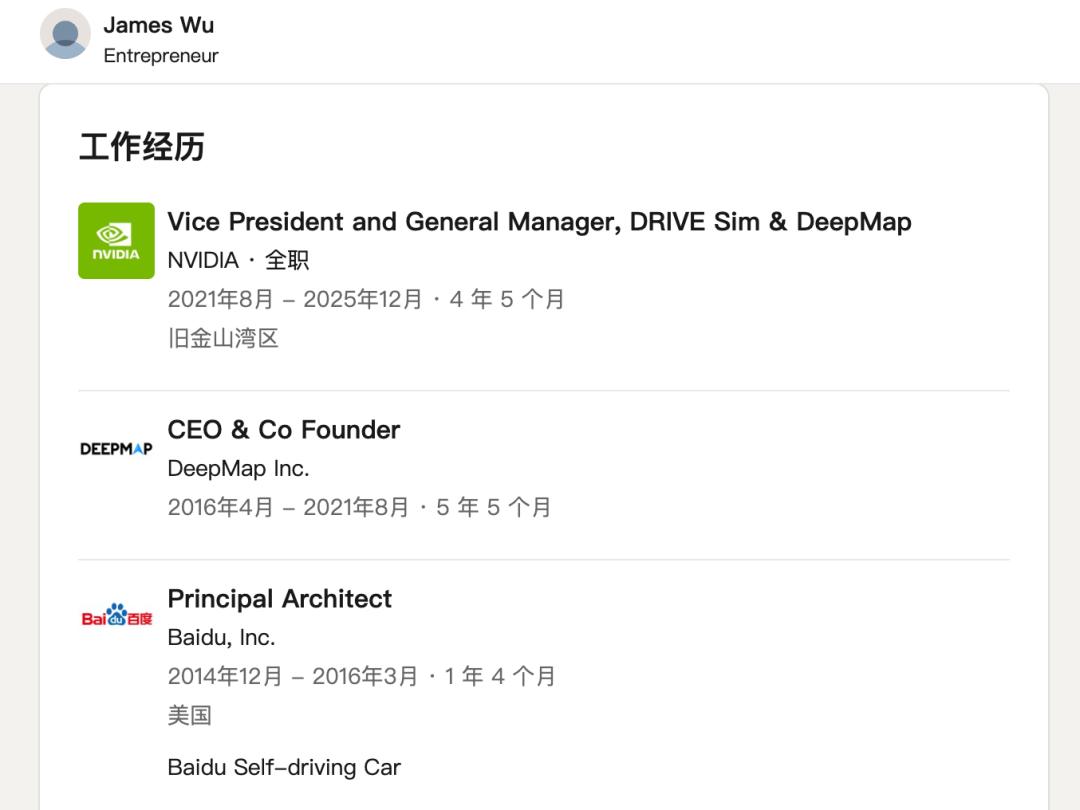
James Wu's work experience, Image/LinkedIn
According to public information, James Wu was recommended to the Department of Computer Science at Tianjin University for his undergraduate studies and then pursued a doctoral degree at the University of Alabama at Birmingham in the United States.
Since 2006, James Wu has worked at Google, Apple, the personal cloud storage company Upthere, and Baidu USA Research Institute. During this period, he was deeply involved in the key processes of the digital mapping businesses of various large companies and witnessed the development of businesses such as Google Earth, Google Maps, Apple Maps, and Baidu's autonomous driving.
In 2016, the DeepMap founded by James Wu also focused on this field. It built a high-definition mapping platform for highly automated unmanned driving and smart city services, received investments from institutions such as GSR Ventures, a16z, and NVIDIA, and quickly attracted customers such as Ford, Honda, SAIC, and Bosch.
In 2021, in NVIDIA's official announcement of the acquisition of DeepMap, it was written that "DeepMap's technology will enhance the mapping and positioning functions on NVIDIA DRIVE, ensuring that autonomous vehicles always know exactly where they are and where they are going." NVIDIA DRIVE is a full-stack solution developed by NVIDIA for autonomous vehicles (AVs) and is also an important tool for NVIDIA to bet on the intelligent driving market.
James Wu's latest entrepreneurial project, Calder, targets spatial data services and faces a different target market from DeepMap. However, whether it is spatial intelligence, autonomous driving, or digital mapping, they all highly depend on the collection, use, and delivery of high-quality data.
Data Becomes the Focus of Embodied Intelligence Competition, and the Market Sees Multiple Rounds of Financing
Spatial intelligence is a concept proposed and clarified in recent years by Fei-Fei Li, a top AI scholar, the first Sequoia Chair Professor at Stanford University, and a member of the National Academy of Engineering of the United States.
Fei-Fei Li defines spatial intelligence as the ability of machines to understand, reason, perceive, and act in the three-dimensional physical world; the technical path to achieve spatial intelligence is to build a world model with generative, multimodal, and interactive capabilities.
This is the next peak in AI development after the large language model (LLM), and the World Labs founded by her is also involved in this field.
Different from large language models that can rely on the corpus data accumulated on the Internet over the decades for training, spatial intelligence faces a blank in data.
In an interview with "TMTPost" at the end of 2025, Fei-Fei Li also mentioned the data collection barrier in the robotics field: "Robotics research is still in its early stage, and there is really a lack of data... It basically has no commercial application scenarios, especially in daily use. So it is difficult to collect data."
Looking further, the scarcity of high-quality data has become a kind of consensus in the industry.
For example, Wang Xingxing, the founder of Unitree Robotics, pointed out at the NVIDIA GTC 2026, an industry event, that "the dependence on real machine data and the scarcity of real robot data" have become one of the three major difficulties restricting the development of the embodied intelligence industry.
Against this background, new projects focusing on solving the data barrier are emerging intensively, and many of them have received capital support.
For example, on March 16th, JD.com officially announced that to promote the healthy and rapid development of the industry, it will rely on its core advantages of the super supply chain and the massive real business scenarios in retail, logistics, health, industry, takeout, and housekeeping to build the world's largest and most comprehensive embodied intelligence data collection center. It will accumulate more than 10 million hours of high-quality data within two years to help the embodied intelligence industry move from algorithm simulation to a new stage driven by real data.
In the same month, the data infrastructure service provider "Ropedia" officially announced the completion of a seed round of financing worth tens of millions of US dollars. It was established in 2025 and is committed to providing a new generation of data collection and solutions for fields such as robotics, space, and physical intelligence.
On April 7th, Qianxun Intelligence announced the completion of a new round of financing of 1 billion yuan jointly led by Shunwei Capital and Yunfeng Fund. According to official information, Qianxun Intelligence's self-developed wearable data collection device has been iterated to the fifth generation, which can significantly reduce the collection cost to 1/10 of the traditional method.
All of these are just a microcosm of the market. According to the research data of market institution QYResearch, the global market size of embodied intelligence data collection factories was approximately $753 million in 2024 and is expected to reach $6.752 billion in 2031, with a compound annual growth rate (CAGR) of 36.8% from 2025 to 2031.
When "data" becomes the key point that can determine the upper limit of robot intelligence, the market is seeing an accelerated influx of talents and capital. For players in the embodied intelligence field, how to collect and utilize enough data during this window of industrial explosion will be the key point.
This article is from the WeChat official account "Power Plant", author: Dong Wenshu. It is published by 36Kr with authorization.