The hourglass curve of Industry 4.0: The traditional value pyramid of industrial automation is collapsing.
For decades, the industrial automation field has followed a development rule: by continuously increasing the complexity of control systems, the efficiency of production and manufacturing is improved, and the quality and safety level of products are enhanced. Based on this model, value seems to naturally converge into high - performance proprietary controllers and tightly integrated systems, like a stable pyramid. However, this "value pyramid" is quietly loosening, and the way the entire market creates value is also undergoing earth - shattering changes.
Just before the Hannover Messe, Bain & Company released a detailed report, proposing the hourglass curve of Industry 4.0 - that is, the value distribution of the "pyramid structure" that was once centered around control hardware and systems is evolving into a shape more like an "hourglass" with a "contracted middle and expanded ends". The profit pool is shifting towards the top (software, data, artificial intelligence) and the bottom (intelligent devices) of the technology stack, putting pressure on the core control technology in the middle.
I believe this view is very inspiring, so I will share the core information of this report in this article.
The transformation of the technology stack structure from pyramid - shaped to hourglass - shaped
Bain & Company vividly demonstrated the process of the technology stack shape transforming from a pyramid to an hourglass with the following picture -
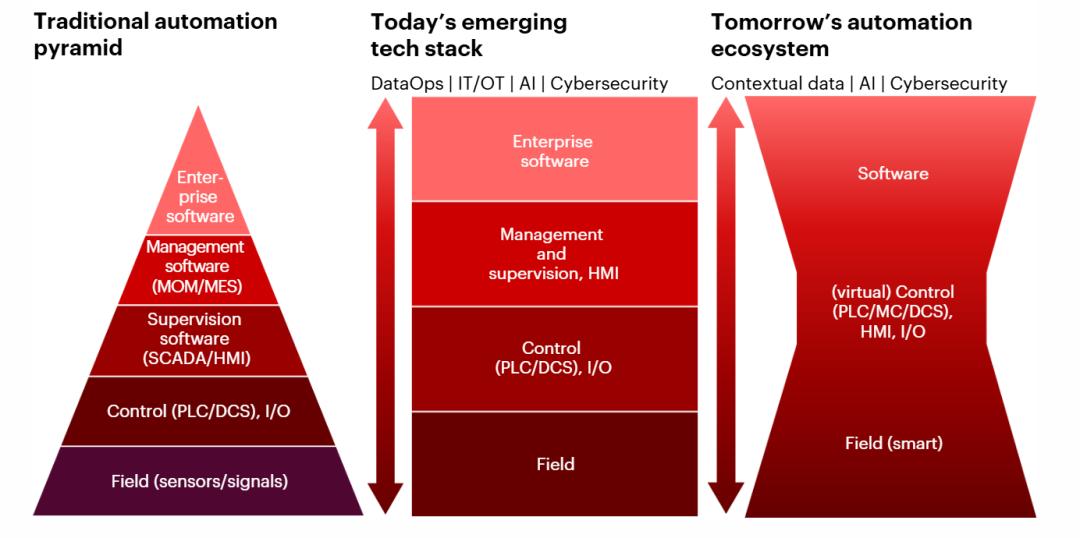
Figure: As the role of software increases, the technology stack shape is transforming from a "pyramid" to an "hourglass" (Source: Bain & Company)
At the top of the technology stack: Value is accelerating towards software, data platforms, and AI - driven workflows. These levels have stronger scalability, higher profit margins, and will achieve continuous compound growth of value with the accumulation of data and application scenarios. They are increasingly becoming the "central brain" of industrial operations, converting raw signals into decisions and results.
At the bottom of the technology stack: Value is flowing back to intelligent field devices. Sensors (such as machine vision technology) and actuators (such as frequency converters) are no longer passive terminal nodes. With embedded intelligence, connectivity, and edge computing, they can generate data, execute decisions, and continuously optimize performance.
In the middle of the technology stack: The traditional control layer in the middle - including programmable logic controllers (PLCs), distributed control systems (DCSs), input/output modules (I/O), supervisory control and data acquisition systems (SCADA), and their related proprietary software... Although still indispensable, it is becoming increasingly difficult to achieve large - scale expansion and differentiation. New entrants are compressing their profit margins by diverting value from these core control links.
According to Bain & Company's analysis, by the end of this decade, it is expected that more than 80% of the industry's profit pool (enterprise investment/supplier profit) will be concentrated at the two ends of the hourglass. Among them, the upper layer centered around software and data - driven will contribute more than half of the industry's total profit, while intelligent field devices will further account for about 25% to 30% of the share, as shown in the following figure:
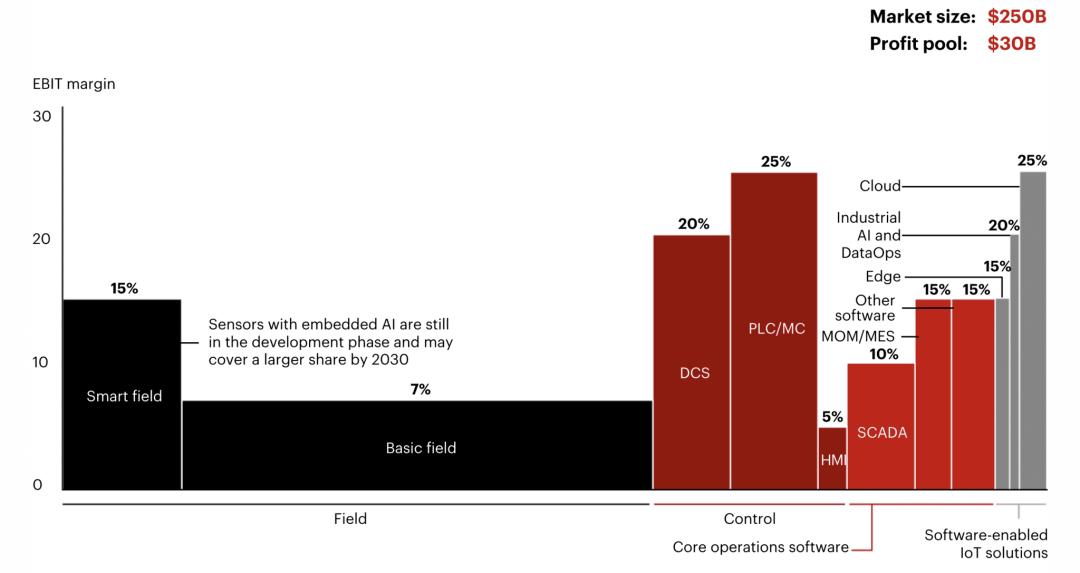
Figure: New technologies will significantly change the industry's profit pool, shifting it towards software and digital solutions (Source: Bain & Company) [2025 - Today's emerging technology stack]
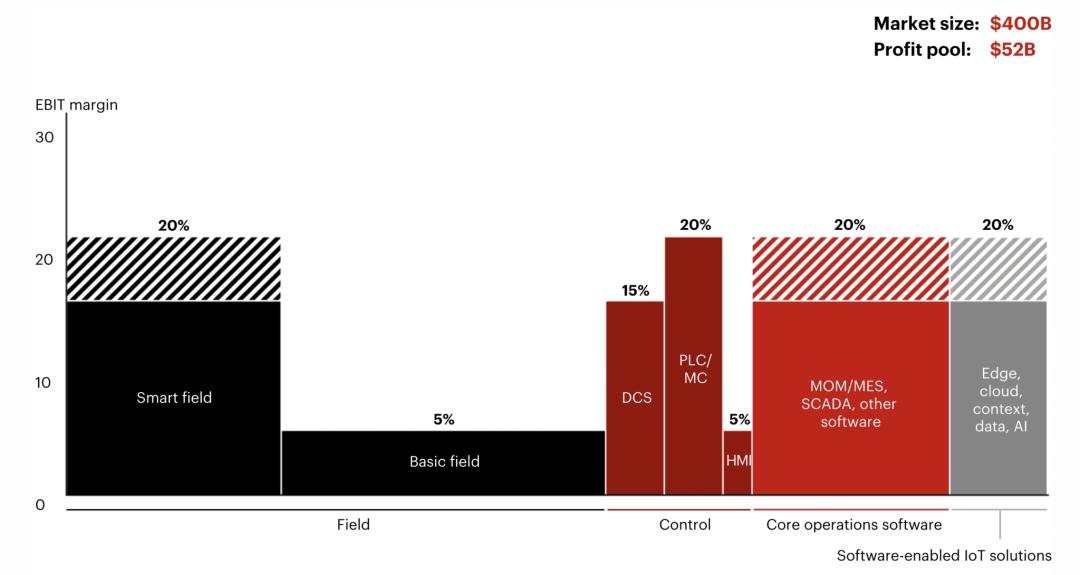
Figure: New technologies will significantly change the industry's profit pool, shifting it towards software and digital solutions (Source: Bain & Company) [2030 - Future automation ecosystem]
Note: The report provides a percentage breakdown of all elements in the industrial chain. These percentage shares seem to be only rough estimates and do not add up to 100% obviously. However, the message conveyed is consistent: the share of industrial control hardware drops significantly in the middle, while the shares on both sides rise spirally.
The profound meaning behind this transformation is very clear: Control is still important, but it is no longer the most profitable core of the industrial automation industry. Nowadays, this transformation is clearly visible in hybrid industries such as pharmaceuticals, food and beverages, and will soon spread to discrete industries (such as automotive) and process industries (such as chemicals).
In addition, the report also makes another prediction: By 2030, nearly half of the industry's revenue will depend on AI - based solutions, which further highlights the migration of value towards "intelligence". According to the "2026 Industrial Automation Executive Survey" (see the figure below), AI - driven solutions alone are expected to unlock up to $70 billion in new market value by 2030.
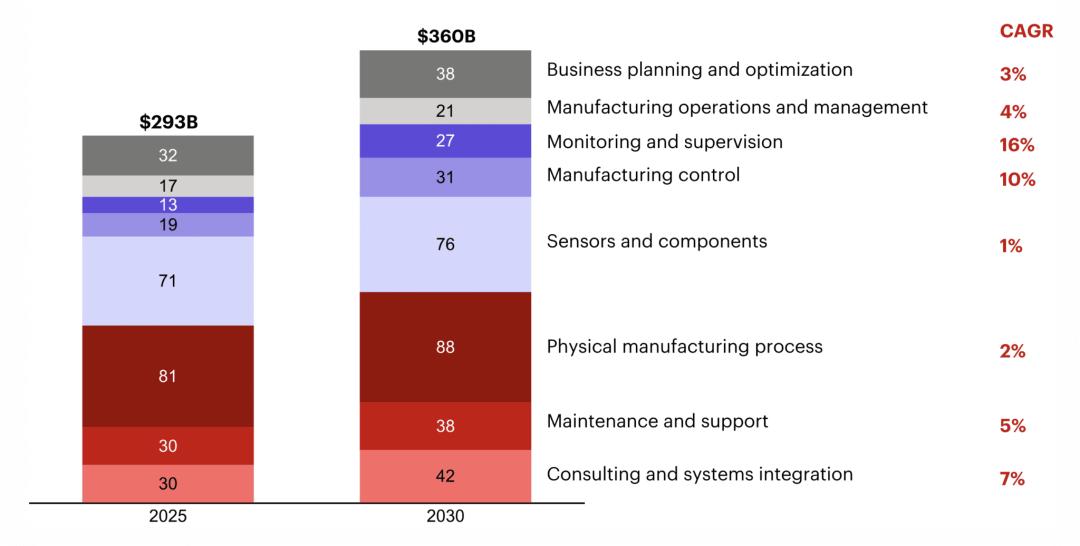
Figure: Artificial intelligence will create nearly $7 billion in new industrial market value in the next five years (Source: Bain & Company Industrial Automation Executive Survey 2026 (n = 26))
Why is this transformation happening?
Although most traditional manufacturers have realized that the industry is moving towards digitalization, few truly understand how quickly this transformation will erode the differentiation advantages they have built over the decades. Value is quietly flowing in new directions, and three forces are accelerating this change:
First, the operating environment has undergone fundamental changes. The manufacturing workforce in developed markets is rapidly aging. In the US manufacturing industry, more than 40% of employment is concentrated in enterprises where at least a quarter of employees are over 55 years old, which limits the industry's ability to rely on human experience. At the same time, the supply chain is shifting from simply pursuing efficiency to emphasizing resilience; the requirements for sustainability, cybersecurity, and traceability are also increasing. The traditional automation architecture designed with stability and cost optimization as the core has never been built for such a high degree of uncertainty.
Second, the source of differentiation is shifting from hardware. Control performance is gradually becoming a "basic threshold". Manufacturers are more expecting the system to have the ability to continuously adapt, optimize, and learn - especially they hope that production automation technology can connect the design, engineering, and simulation links upstream and the supply chain and distribution system downstream. Therefore, procurement decisions are increasingly turning towards software, data, and application scenario capabilities outside of manufacturing. Relying solely on the existing installed base of control systems is difficult to form an effective moat.
Third, the competition from both ends of the technology stack is intensifying. On the one hand, hyperscalers and native AI enterprises are accelerating their entry into the field of industrial software and data platforms; on the other hand, aggressive hardware competitors represented by Chinese manufacturers are compressing the profit margins of controllers and basic automation components (including various types of sensors and industrial cameras). This puts the existing automation manufacturers under "attack from both above and below". As software and hardware are decoupled and interoperability is improved, the switching cost is decreasing; when customer demand shifts from periodic upgrades to continuous optimization, the services attached to traditional systems are also becoming more difficult to defend.
For existing manufacturers, the real risk is not being disrupted overnight, but gradually becoming "irrelevant" - even if the revenue remains stable on the surface, their role is quietly slipping from the most strategic manufacturing partner to an ordinary component supplier. This is exactly why this transformation is so disturbing~
Competitive advantages in the next stage
Since the industry is undergoing such a drastic change, where will the competitive advantages of future industrial automation enterprises focus?
Bain & Company proposes: In the next stage of industrial automation, leaders will no longer just deploy more technologies, but "orchestrate intelligence". The key lies in how software, data, and intelligent devices are vertically integrated (rather than horizontally stacked) to jointly solve practical operational problems. As the industry evolves towards software - based, intelligent device - based, and vertical deepening, three major trends are particularly prominent.
First, software and data are becoming the dual engines of value. Operating platforms, workflow applications, and AI - driven optimization tools are moving from the edge to the core of industrial systems. They can give context to data, coordinate decisions, and convert complexity into actions. Crucially, they can expand across functions and sites over time, thus creating economic benefits that hardware alone cannot match.
It should be emphasized that this advantage does not come from the technological milestone of "the integration of IT and OT" itself. Most enterprises already have the ability to interconnect systems, although the cost is often high when promoting on a large scale, especially when measured by a single application scenario. What is truly scarce is the ability to convert the integrated data into faster and better operational decisions. The difference among leaders lies in "operational - level integration" - designing data systems, governance mechanisms, and workflows with the goal of cross - production, quality, maintenance, planning, and energy management, and gradually connecting the design link (such as the product lifecycle management system) upstream and the distribution system (such as the supply chain management system) downstream. When insights can directly drive execution, enterprises shift from "reporting performance" to "shaping performance". For management, this is not only an architectural issue but also a challenge to the operating model.
Second, intelligent devices have become part of the decision - making process. Intelligent devices are being integrated into the decision - making chain. Intelligence is moving forward to the physical process: machines and sensors are increasingly undertaking data pre - processing, local decision - making, and working in coordination with upper - layer systems. This not only reduces latency, improves system resilience but also unlocks new application scenarios - from predictive quality control to autonomous maintenance.
Third, vertical domain depth has become a new source of differentiation. Industry - specific solutions embedded with process knowledge, data semantics, and regulatory requirements will drive future growth. It is expected that by 2030, nearly 60% of the industry's incremental growth will come from vertical - specific products rather than horizontal platforms (see the figure below). Food and beverage enterprises focus on traceability and hygiene standards; battery and automotive manufacturers focus on yield, production capacity, and rapid reconfiguration ability; the life - science field regards verification and compliance as core functions rather than additional functions.
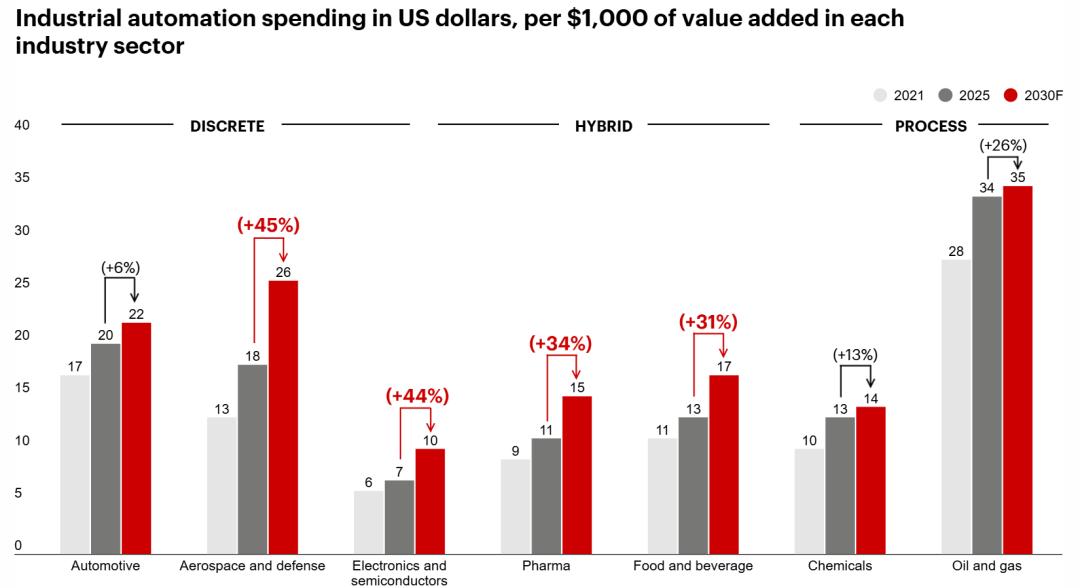
Figure: It is expected that the hybrid manufacturing industry will allocate a higher proportion of expenditure to the automation field (Source: Bain & Company)
Therefore, growth and value are concentrating on the "vertical technology stack" - a solution that integrates software, data, and devices. Competitive advantages increasingly depend on the understanding of the actual operation mode of the industry, rather than just the mastery of device control methods. At the same time, the business model is also changing. Recurring revenue, result - based contracts, and full - lifecycle value are becoming more important than one - time sales. Service providers that can quantify performance, share risks, and be deeply embedded in the customer's operation process will obtain more substantial value returns.
Overall, traditional automation is good at executing predefined instructions in a stable environment. The next wave of value creation comes from systems that can make continuous decisions - weighing the pros and cons, adapting to changes, and optimizing results in terms of time and assets. Native AI workflows are penetrating from the analysis layer to the core of operations, directly influencing decisions on throughput, quality, energy consumption, and maintenance in real - time. As profit margins narrow, value will flow to the decision - making layer, rather than just systems that execute instructions. This marks a significant break from the past: future competitiveness will no longer depend on the efficiency of process automation, but more on how operations make intelligent responses when the environment changes - this is the core transformation from control logic to decision - making logic.
Conclusion
The first wave of AI's impact will be more time - pressing than many managers expect. Bain & Company says that only a few application scenarios will contribute most of the AI value, represented by adaptive robots, predictive maintenance, and knowledge - based systems.
By 2030, it is expected that nearly half of the industry's revenue will depend on AI - enabled products and services. In multiple core application scenarios, the substitution pressure will exceed 50% (see the figure below). In these fields, AI is no longer a differentiating option but an "entry threshold" for entering the market.
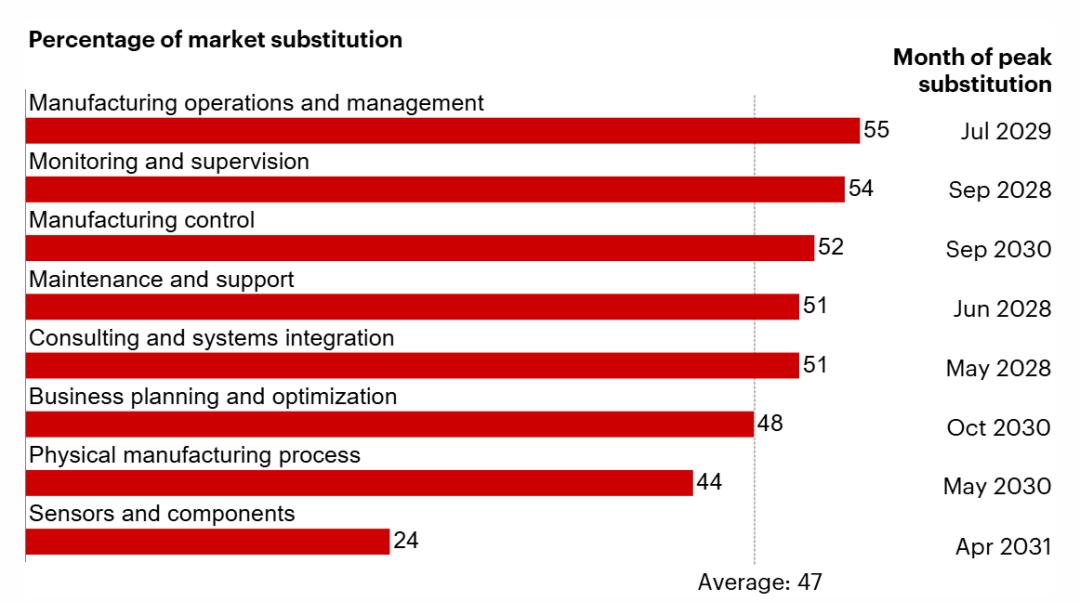
Figure: By 2030, AI - based solutions are expected to contribute half of the industrial automation revenue (Source: Bain & Company Industrial Automation Executive Survey 2026 (n = 26))
The "peak of substitution" is expected to occur in the mid - to - late 2028 (consulting and integration, maintenance and support, monitoring and management), mid - 2029 (manufacturing operations), and mid - to - late 2030 (physical manufacturing, manufacturing control, business optimization), while the popularization of IoT - related sensors and components is expected to be achieved in mid - 2031.
In the next stage of industrial automation, winners will be able to coordinate intelligence among partners as efficiently as they coordinate machines. Early leaders have begun to see results. Experience shows that enterprises that can orchestrate data, software, and intelligent devices on a large scale can increase productivity by 30% to 50%, reduce maintenance costs by up to 35%, and significantly extend the service life of equipment.
Reference materials: Industrial Automation: From Control to Intelligence — BAIN Industry 4.0’s hourglass figure – AI and IoT put squeeze on OT hardware spend — rcrwireless
This article is from the WeChat official account "Internet of Things Think Tank" (ID: iot101), author: Sophia, published by 36Kr with authorization.