With 47,000 stars in just two months, will the popular Hermes Agent be the next Lobster or tell another story?
In recent weeks, an open-source project named Hermes Agent has become popular on X and GitHub.
From surpassing 22,000 stars in the first month after its open-source release at the end of February to gaining over 6,400 stars in a single day after the release of version v0.8.0 on April 8th, Hermes Agent has exceeded 47,000 stars on GitHub in less than two months and has topped the global open-source list for many days.
What is Hermes Agent?
Simply put, it is a personal AI agent that can "grow on its own": it has a built-in learning loop, can automatically extract skills from tasks, permanently remember user preferences, and accurately recall information across sessions. The more you use it, the better it understands you. It supports 6 deployment methods such as $5 VPS, Docker, and Serverless, is compatible with over 200 large models and allows one-click switching. It can be accessed on platforms like Weibo, Telegram, Discord, and Slack, and can be installed and run with a single command.
Some people say it is a substitute for OpenClaw, while others say it is more user-friendly than OpenClaw. In a very short period of time, it has not only received tens of thousands of stars but also made developers exclaim that AI can "become more and more like a part of oneself" with use.
01 What exactly is Hermes Agent?
Hermes Agent is a free, MIT-licensed autonomous AI framework developed by Nous Research. Its core positioning is an "self-evolving agent" that grows as it is used.
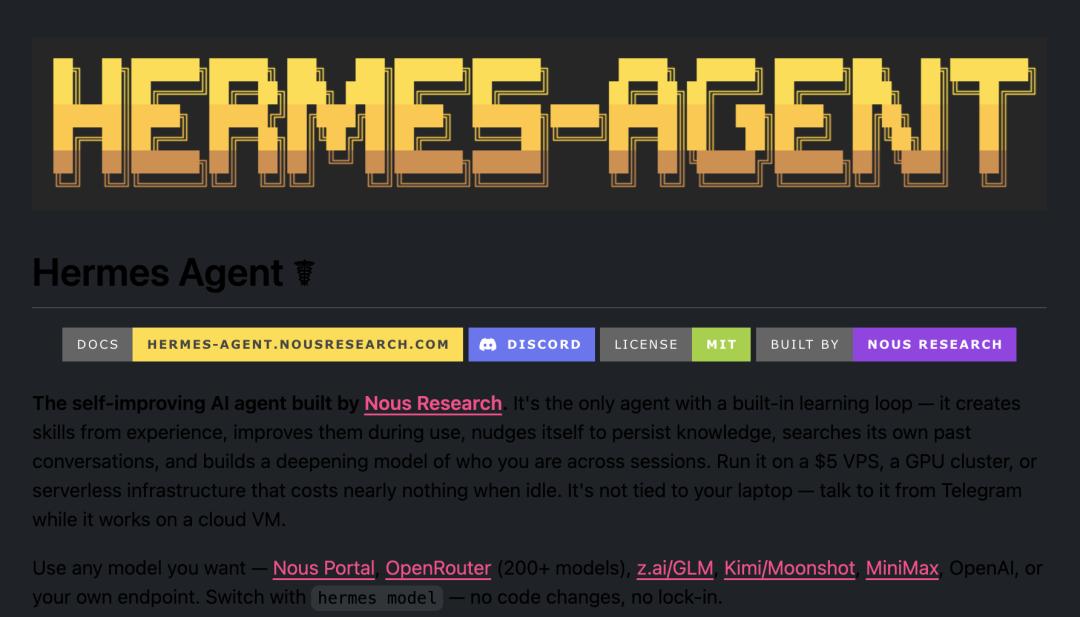
Image source: GitHub
Different from traditional agents, Hermes aims to be a long-term system that can continuously accumulate experience: it learns from completed tasks, retains memories across different sessions and platforms, and gradually forms a set of ability structures unique to the user.
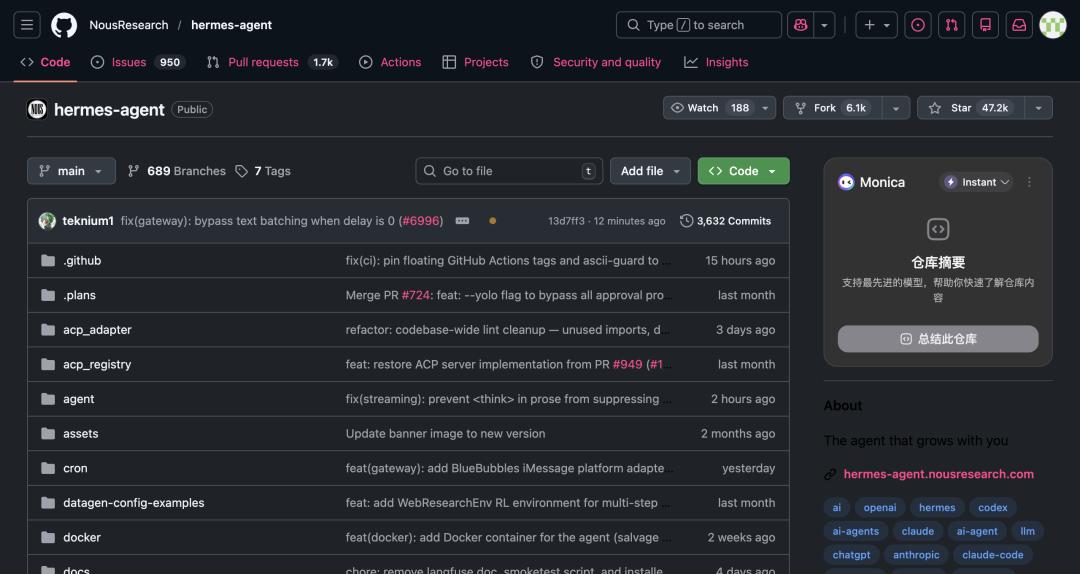
Image source: GitHub
Since its release in February 2026, it has gained over 22,000 GitHub stars in just a few weeks and currently has over 47,000 stars, with hundreds of contributors. Judging from the community feedback, this setting precisely addresses a long-standing need - developers are increasingly concerned about whether an agent can "remember" and "become stronger".
In the discussions on X and in the developer community, what is impressive is that Hermes significantly reduces its reliance on prompts in complex tasks.
Some developers mentioned during tests using the gemma 26B or Hermes series models that even when given a relatively vague instruction, such as "write a script to crawl data and generate visualizations", the agent can complete the entire process from task decomposition to code generation.
During the execution process, it continuously adjusts its approach based on the execution feedback - including reading error messages, attempting to fix problems, and even forming reusable solutions through multiple attempts.
This experience does not mean that Hermes has a stable "fully automated development ability", but it at least makes developers feel that an agent can advance complex tasks under vague goals without completely relying on precise prompts.
What is more worthy of attention about Hermes Agent is actually its underlying architecture.
In terms of architecture, it takes almost the opposite path to OpenClaw: the former emphasizes the breadth of connection capabilities, while the latter is more focused on the depth of learning capabilities. Hermes' slogan - "the agent that grows with you" - points to an entire set of underlying designs built around a "learning loop".
This loop is roughly composed of three parts.
Firstly, persistent memory. Hermes stores all historical sessions in a local database and reorganizes them through full-text search and model summaries. It can not only recall conversations from weeks ago but also establish associations between different tasks, gradually forming an understanding of the user's work style. This memory is no longer dependent on manual maintenance but is autonomously organized and updated by the agent, more like a continuously evolving cognitive structure.
Secondly, the automatic generation and reuse of skills. After Hermes completes a complex task, it does not simply end but abstracts the entire process into a structured skill - including steps, key judgments, potential pitfalls, and verification methods. The next time it encounters a similar problem, it will give priority to using these existing experiences rather than reasoning from scratch. As the number of uses increases, these skills will be continuously corrected and optimized, forming truly reusable ability assets.
Thirdly, the prototype of self-training ability. Hermes can generate a large number of tool call trajectories during operation and export this data for subsequent model fine-tuning. This means that it is not only "using the model" but also continuously producing training data that can feed back into the model. This ability already clearly bears the characteristics of a research-oriented system rather than a simple application-level product.
For this reason, the overall form of Hermes is more like an "experimental operating system". This tendency has become more obvious in recent versions. For example, the introduction of multi-instance configuration allows developers to run multiple isolated agents in the same environment, each with independent memory, skills, and configurations. This evolves Hermes from a "personal assistant" to a reusable agent infrastructure.
Another example is the support for MCP, which can expose its sessions and memories to IDE tools, allowing developers to directly search and call them in Claude Desktop, Cursor, or VS Code. This design essentially breaks down the boundary between the "resident agent" and the "development environment".
In terms of security, Hermes appears relatively restrained. It uses mechanisms such as container isolation, read-only file systems, and pre-execution scanning to constrain potential risks. This design does not pursue extreme openness but seeks a balance between "evolvability" and "controllability".
Overall, Hermes is not a project that has an advantage in terms of scale or ecosystem. Whether it is the number of GitHub stars or the maturity of the skill market, it is still in a relatively early stage.
What is truly worthy of attention is the direction it is betting on, that is, how to make the agent become stronger over time.
02 The "Similarities and Differences" between Hermes and Openclaw
When Hermes Agent became popular on X, developers inevitably compared it with another phenomenon-level project in the open-source community at the beginning of this year - OpenClaw.
OpenClaw is also a locally prioritized personal AI assistant framework. Both it and Hermes Agent attempt to solve the privacy and control problems of traditional SaaS-based AI, but they have different underlying philosophies.
The similarity between the two lies in "digital sovereignty".
Both Hermes and OpenClaw had the same underlying genes at the beginning:
Local priority and privacy first: Data is not uploaded to uncontrollable commercial clouds. All memories, code execution processes, and even file and directory-level authorizations are kept on the user's local device or in a private environment as much as possible.
Interaction based on message channels: They both abandon the cumbersome Web UI and embrace instant messaging tools such as Telegram and WhatsApp, allowing AI to truly integrate into the daily communication links of humans.
24/7 automation: They support scheduled tasks and can run silently in the background without the need for humans to monitor constantly.
This emphasis on "digital sovereignty" is essentially a choice at the infrastructure level. Behind this, the differences between Hermes and OpenClaw have already begun to emerge. Nous Research positions itself as a "decentralized AI research laboratory". They not only develop agents but also promote a decentralized training network called Psyche - attempting to use blockchain to coordinate idle GPUs around the world to train large models.
Therefore, Hermes Agent is not only a local tool but also the most user-friendly entry point in this entire set of "AI decentralized infrastructure".
The difference between the two lies in the path of ability growth. If OpenClaw represents a more "deterministic" path, then Hermes is closer to an "evolutionary" system.
Firstly, there is a difference in the way of skill acquisition (Human-authored vs. Autonomous). The ability boundaries of OpenClaw are mainly determined by "human presets". OpenClaw tends to let developers write skills through clear code or prompts. It is a perfect control surface, and once the user defines what it can do, it will execute with high stability and certainty.
The abilities of Hermes Agent emerge through "experience". After completing a complex task, it automatically abstracts the methodology and precipitates it into reusable skills, which are continuously iterated and optimized in subsequent tasks. This makes its ability boundaries not pre-defined but gradually expand during use.
Secondly, there is a difference in the memory mechanism.
OpenClaw is more inclined to explicit memory and retrieval mechanisms, which is essentially a typical RAG approach - it knows "where the information is" and retrieves it when needed.
Hermes Agent uses a hierarchical memory system. In addition to explicit memory, the most core part is that it builds a "model about you". It gradually understands the user's code style, tolerance for errors, and preferred technology stack through cross-session interactions. It even regularly "nudges" itself to organize and solidify this knowledge.
There are also differences in the applicable scenarios.
If users need an extremely secure, clearly - stepped solution for tasks such as processing batch data or financial transactions with extremely low tolerance for errors, OpenClaw's permission control (latest version) is stricter and its behavior is more predictable. If users are engaged in exploratory programming, creative development, or dealing with complex projects with fuzzy processes that require continuous trial and error, the autonomy brought by Hermes will save users a lot of trouble.
However, the community consensus on Reddit, YouTube, and X is not that Hermes has replaced OpenClaw, but that they are complementary.
OpenClaw is responsible for "doing the work" - handling multi-channel interactions, team workflows, and complex ecosystem connections; while Hermes is responsible for "thinking" - focusing on persistent memory, automatic skill generation, and high-dimensional model reasoning.
A common setup is to run Hermes as a high-level planner on top of OpenClaw tools. By running the hermes claw migrate command, existing OpenClaw skills, memories, and settings can be smoothly migrated to Hermes with a single click.
03 "The Evolving Agent"
Hermes Agent is trying to turn "AI capabilities" from one-time use into assets that can be continuously accumulated.
An agent should not just be a temporarily called interface but a long - standing system - it is private, runs continuously, and can continuously accumulate capabilities during use, ultimately affecting the model itself.
The data, memories, and behavior trajectories of mainstream products mostly accumulate on the platform side, while what Hermes wants to do is to keep these capabilities in the user's own system as much as possible.
This means that AI capabilities are no longer just "being called" but can be "owned". In the open-source community, the popularity of Hermes Agent largely comes from the fact that it has actually realized part of this path.
It is trying to connect a more complete chain: from task execution to skill precipitation, then to memory accumulation, and even further, to become part of the training data.
When an agent starts to have such a cyclic ability - solving problems by itself → recording experiences → reusing experiences → optimizing methods → feeding back to itself - it begins to approach a sustainable evolutionary system.
Currently, this path is still in its early stages. Problems such as memory noise, skill quality, and the stability of the training loop still need to be refined. There are still deployment thresholds, and there is still a long way to go before "ordinary users can use it without awareness".
But the direction is clear. Hermes at least makes one thing concrete: private AI is not just a usage form but may be an asset form that can continuously evolve.
If this path is established, the way we evaluate an agent in the future may change: from looking at "what it can do at present" to looking at "what it has become over time". Whoever can accumulate more capabilities over time will have a higher ceiling.
04 Is the Hottest Agent Project after "OpenClaw" a Scam?
The popularity of Hermes is not accidental. It is an open-source project with real technological output, but the project itself is not without controversy. The biggest point of controversy lies in the team itself.
Many of the core members of Nous Research come from the Web3 field. Reports say that its CEO, Jeffrey Quesnelle, was previously the chief engineer of the Ethereum MEV infrastructure project Eden Network.
The team's financing path also has obvious characteristics of the cryptocurrency industry - as of April 2026, Nous Research has completed 2 rounds of public financing, with a total financing amount of approximately $70 million. The investors are all leading institutions in the cryptocurrency field. The financing path has distinct Web3 characteristics - priced in tokens rather than traditional equity, and the funds are mainly used for computing power reserves and team expansion.
Different sources of capital also lead to different methodologies.
From the very beginning, Nous Research is a Web3-native AI laboratory: it emphasizes decentralization in the governance structure, distributed training in the technical path, and "open-source first + community-driven" in the product strategy.
If we consider this background in relation to Hermes Agent, it is more like transplanting the methodology of the Web3 community to the infrastructure layer of AI agents.
For this reason, a question that is repeatedly discussed in the community emerges:
Does the "long-term operation + continuous accumulation" agent form built by Hermes also have the potential to become a "Web3 cold-start infrastructure"?
Currently, Nous Research is still in the state of "not issuing tokens", and no token distribution mechanism has been clearly announced. But in the peripheral ecosystem, some typical "expected behaviors" can already be seen: for example, some cryptocurrency communities have started discussions about airdrop expectations around the project, and some third-party platforms are guiding users to participate in community interactions and task completion with "potential rewards" as incentives.
Meanwhile, there has also been an unofficial token named "NOUS" on the blockchain. This type of asset has no direct connection with the project itself, but it is often over - interpreted when market sentiment fluctuates.
These phenomena do not directly indicate the project's future, but at least they show one thing: the market is already "understanding" this project in advance using Web3 logic.
Structurally, the product form of Hermes Agent does have some characteristics commonly seen in the cryptocurrency world: it runs locally on the user's device, is online for a long time, continuously generates behavior data and interaction trajectories, and continuously accumulates "contributions" during use.
In the context of traditional software, these are just part of the "product experience"; but in the Web3 context, such behaviors are often regarded as a "measurable participation".
This also puts Hermes in a relatively delicate position: on the one hand, it is a real, usable, and rapidly iterating open-source agent framework; on the other hand, its technical path and community structure also naturally have the possibility of extending to a "tokenized incentive system".
For developers, the value of Hermes Agent still mainly comes from its capabilities as an agent system itself. But for ordinary users, this means a more practical judgment criterion: Any transactions, investments, or promises directly linked to the "NOUS token" need to be treated with sufficient caution - especially the assets with the same name that have appeared on the blockchain or high - return promotions.
This article is from the WeChat official account “GeekPark” (ID: geekpark), author: Lian Ran. Republished by 36Kr with permission.