The most highly-valued robotics company has never appeared on the Spring Festival Gala.
A robotics company that has never performed a "group dance" on the Spring Festival Gala stage is tearing open the valuation ceiling of the embodied intelligence track at an almost savage pace.
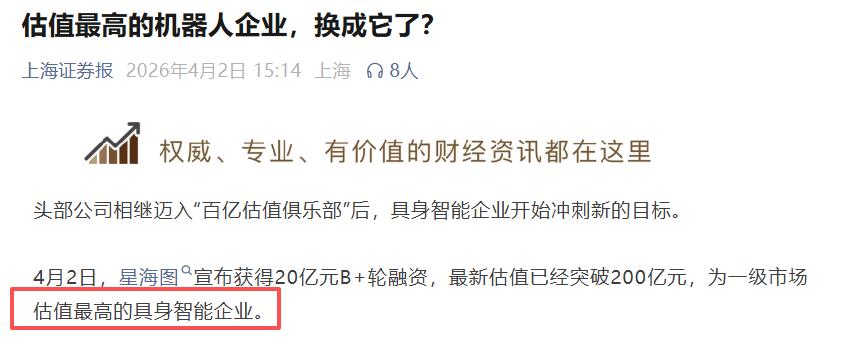
Xinghaitu has just announced the completion of a 2 billion yuan Series B+ financing round, and its latest valuation has soared to 20 billion yuan. Just less than two months ago, on February 11, its value was still in the tens of billions.
In just two months, its valuation has doubled, so much so that Shanghai Securities News directly labeled it "the embodied intelligence enterprise with the highest valuation in the primary market."
In the increasingly noisy robotics circle, Xinghaitu seems a bit "reclusive."
It didn't gain popularity by performing a group dance on the Spring Festival Gala, nor did it use a robot that can do backflips to grab traffic on short - video platforms. Instead of letting the outside world first see "what the robot looks like," founder Gao Jiyang is more concerned about the soul behind the robot: the model, data, development platform, and their collaborative capabilities.
What Xinghaitu really wants to do is not to create a popular robot, but an entire set of underlying infrastructure for robot training and development.
This is a path with greater imagination, but it is also a path that burns more money, takes longer, and is more likely to be questioned.
The more aggressively capital is invested, the more fiercely money is being burned. Company executives said bluntly that they are directly competing with giants like ByteDance for talent, offering top - level doctoral candidates an annual salary of 5 million yuan.
On the embodied intelligence table, the flames of war have burned through the skin and reached the bone marrow.
The "Tsinghua Brain" Pushed to the Altar by Capital
The story of Xinghaitu, starting from its founder, is easily appealing to capital.
Founder Gao Jiyang was born in 1992. He graduated from the Department of Electronic Engineering at Tsinghua University as an undergraduate and then went to the University of Southern California to pursue a doctorate in computer vision. He completed his studies in just three and a half years, setting the fastest graduation record in the laboratory.
After graduating with his doctorate, he worked on autonomous driving at Waymo and Momenta.
This is a rather "standard" resume path in the technology entrepreneurship circle: a top - notch science and engineering background, experience in autonomous driving, and then entering the next - generation track that combines AI and robotics.
In September 2023, Gao Jiyang founded Xinghaitu with a team with a strong academic background. The company entered the then - emerging embodied intelligence track, focusing on a route called "one brain, multiple forms":
Use the unified capabilities of a large - scale model to drive robots of different forms.
The direction is attractive enough, and the team's resume is impressive enough. Xinghaitu has almost been in the spotlight of capital from the very beginning.
Just two months after its establishment, Xinghaitu completed the first round of angel - round financing. Since then, it has been on a fierce financing spree, attracting IDG Capital, BV Baidu Ventures, Hillhouse Capital, and Ant Group as lead investors, as well as other investors such as Mihoyo.
In 2025, Xinghaitu completed five rounds of Series A financing in one go. Among the new investors were well - known institutions such as Lenovo Capital and Haier Capital, and Meituan Longzhu.
On February 11 this year, Xinghaitu completed a 1 billion yuan Series B financing. The investors included Jinding Capital and BAIC Capital. At the same time, old shareholders such as Cathay Capital, Meituan Longzhu, Capital Today, Xianghe Capital, and Hillhouse Capital over - subscribed or fully subscribed. After this round of financing, Xinghaitu's cumulative financing amount was nearly 3 billion yuan, and its valuation reached tens of billions.
But it doesn't end there.
On April 2, Xinghaitu announced the completion of a 2 billion yuan Series B+ financing round, and its valuation directly soared above 20 billion yuan. Nearly 20 institutions participated in the investment, including industrial capital such as Walden International and Lens Technology. It's worth noting that Lens Technology is not only an investor but also plays an important role in Xinghaitu's hardware supply chain and large - scale mass production.
Why are investors willing to pay such a high premium for a brand that has never been on the Spring Festival Gala and has relatively low public recognition in such a short period of time?
On the one hand, the capital sentiment in the entire industry has been completely ignited.
In the past six months, funds in the humanoid robot track have been clearly concentrating on leading players.
Companies such as Paxini, Qianxun Intelligence, Zhujidongli, Leju Robotics, Xingdong Jiyuan, Zhongqing, Yinhe Tongyong, Zibianliang, and Zhipingfang have all completed financings in the 1 - billion - yuan range. It is reported that the valuations of companies such as Xingdong Jiyuan, Paxini, Zibianliang, and Zhipingfang have also exceeded the 10 - billion - yuan mark.
"Everyone is chasing scarcity and hopes to seize the opportunity of the first - wave leading companies," a venture capitalist in the industry summarized directly. What capital is screening for is not who is doing the best today, but who may become a leading platform - type company in three to five years.
Another wave of sentiment comes from the large - scale model industry. At the beginning of this year, Zhipu and MiniMax were listed on the Hong Kong Stock Exchange one after another and performed well in the secondary market. This sentiment quickly spread back to the primary market.
Thus, a new logic began to prevail in the investment circle: If large - scale model companies can be worth so much, then the embodied large - scale models that can manipulate the physical world should theoretically be worth even more.
Xinghaitu happens to be on the crucial point of this narrative chain.
Offering 5 - million - yuan Annual Salaries to Recruit Talent
In the past two years, when it comes to embodied intelligence, many people's first reaction is often companies like Unitree and Zhiyuan.
Because in the public's perception, these popular robotics companies are more visible. Their products can walk, run, and display actions. The product form is right there, and the dissemination pictures are strong enough. Even a person who knows nothing about technology can roughly understand what these companies are doing.
But Xinghaitu has taken a completely different path. It is of course also working on the robot body, but what it really focuses on is the collaborative capabilities between the model, data, development platform, and the body.
Over the past year or so, Xinghaitu has successively open - sourced several key models.
In August 2025, the company open - sourced the G0VLA large - scale model, which once exceeded the state - of - the - art (SOTA) at that time. In January 2026, it released the world's first out - of - the - box VLA model, G0Plus. In February 2026, the team further launched a vertical model for the clothing - folding scenario and simultaneously released the G0Tiny small model that supports lightweight deployment on the edge side.
Recently, Xinghaitu also launched the world's fastest world model, Fast - WAM. At the same time, the company's self - developed EDP embodied intelligence development platform also aims to connect the most critical links in the robot training process: from real - world data collection and annotation to model training and then to deployment and implementation, achieving a complete closed - loop.
This also explains a seemingly counter - intuitive phenomenon: Xinghaitu neither has a Spring Festival Gala robot nor a particularly "internet - famous" product, but it can still become the embodied intelligence company with the highest valuation in the primary market. Because what capital really values may not be just whether this robot can perform today, but whether this company has the opportunity to define the training method, development method, and even the industrial cooperation method of robots in the future.
But the problem lies right here. The greatest appeal of this route is that the imagination space is large enough, but its shortcoming is also obvious: It's not intuitive enough.
For people in the industry, the model capabilities, data system, and development platform of a robotics company are of course crucial, because these are what really determine whether robots can be deployed on a large scale.
But for people outside the industry, these concepts are not easy to perceive. How powerful the model is, how critical the platform is, and what the data closed - loop means are far less intuitive than a robot that can run, jump, and perform.
Thus, a sharp contrast is formed: when the sentiment is high, it is given super imagination; once the sentiment subsides, it is the first to be questioned. Because what it talks about is the underlying capabilities, long - term value, and future barriers, but these things are precisely the most difficult to be verified by the outside world with the naked eye in a short time.
What's even more important is that Xinghaitu is not taking a "light - weight route."
It has a very wide front: it has to work on the robot body, pursue model development, build a development platform, and continuously accumulate a data system. The longer the front, the heavier the investment, and the higher the requirements for organizational capabilities and resource - scheduling capabilities.
The financing rhythm itself is proof. Completing multiple rounds of large - scale financing in a short period of time certainly shows that capital recognizes the company and is willing to continue to invest; but on the other hand, it also shows that the company has extremely high requirements for the speed of capital consumption and the efficiency of resource allocation.
The most direct manifestation of this pressure is talent. CFO Luo Tianqi once said that Xinghaitu is in a battle to directly compete with giants like ByteDance for top - level talent, and the company has issued multiple offers with an annual salary of 5 million yuan to top - level doctoral candidates.
This is not common among Chinese technology start - ups, but it is becoming more and more common in the embodied intelligence track.
On the path of embodied intelligence, the scarcest resource has never been money, but the few brains that can understand the secrets of algorithms.
This also means that the real risk for Xinghaitu does not lie in whether it has technology, but in whether this high - premium talent and technology layout can ultimately realize matching commercial value.
This is also the most difficult hurdle for the entire embodied intelligence industry to cross at present.
The Dilemma of the Track
After making a strong presence on the Spring Festival Gala for two consecutive years, humanoid robots have become extremely popular.
But beyond the excitement, more and more people are raising a question that the entire industry cannot avoid:
"If robots can dance, why can't they do housework?"
This question may sound like a joke, but it hits exactly the most embarrassing part of the industry at present: the performance ability has advanced by leaps and bounds, but the practical ability lags far behind.
It should be noted that whether robots can enter the consumer - grade scenario and enter households on a large scale is the real dividing line for the entire industry. And most companies today, including Xinghaitu, may still be quite far from this step.
The reason is not complicated.
Many robots today seem very "smart," but at the underlying logic level, many actions still rely on preset programs or relatively fixed algorithm frameworks to drive. The interaction ability between robots, humans, and the environment is far from as natural and flexible as the public imagines.
In other words, they are more like performing actions rather than understanding tasks.
Even in the industrial scenario, which is generally considered to have the greatest hope of being the first to succeed, the reality is still not optimistic.
Wang Qian, the founder and CEO of Zibianliang Robotics, said bluntly that in the past two years, no robot company has truly provided a positive return on investment (ROI) to customers in a single scenario: "Currently, robots deployed in factories often fail to meet the speed and accuracy requirements of customers. Some robots have even been removed from the factory because they can't meet the requirements for a long time."
What's more troublesome is that this dilemma cannot be quickly solved by just one or two companies continuing to invest more money. Because what is really holding back the entire track is a common bottleneck: There is not enough data.
The rapid rise of large - scale models in the past was based on an important premise that there was already a large amount of text, image, and video data in the Internet world, and AI could rely on this public data to continuously learn and evolve.
But the situation that robots face is completely different. What robots need to learn is not just "seeing" and "hearing," but more importantly, how to take action, how to interact with objects, and how to complete actions in the real physical space. And this data does not naturally exist on the Internet; it can only be accumulated little by little through a large number of real demonstrations, real collections, and real interactions.
"It took ten years for AI to create ChatGPT by learning from publicly available Internet data, and robots need much more data than ChatGPT," said Fu Zipeng, a computer science doctor from the Stanford AI Laboratory. He pointed out that the current mainstream training method for embodied intelligence AI is still for humans to create data through demonstrations and then let robots learn from this data. If the current data - collection speed continues, it will be difficult for robots to achieve generalization of capabilities in the next three to five years.
The existence of the difficulty in implementation will, in turn, affect the rhythm of the supply side, making the entire industrial chain reluctant to expand investment easily.
Currently, many Chinese humanoid robot companies adopt a "self - research and third - party manufacturing" model: the enterprise is responsible for core R & D and system design, hands over the manufacturing of components to the supply chain, and finally completes the assembly of the whole machine.
There is nothing wrong with this model itself, but the key is that the downstream demand has not really formed a scale. When the demand is still in a highly uncertain stage, the upstream supply chain will naturally not rashly invest in heavy - asset expansion of production lines.
Some personnel from the pilot - scale production line mentioned that just for the key component of the robot joint module, building a customized automated production line would require an investment of more than 10 million yuan.
Before the demand clearly increases, few manufacturers are willing to take such risks.
For this reason, a subtle change has begun to occur: while the primary market is continuously pushing up the valuations of robot companies, the secondary market has gradually become more calm.
UBTech, the "first humanoid robot stock," soared at the beginning of 2025, reaching a peak of HK$161 in early November. After that, it started a volatile downward trend. After rising around the 2026 Spring Festival Gala, by April 2, 2026, it had given back half of its gains and dropped to HK$102.6 per share.
Shanghai Weixing New Materials Co., Ltd., the A - share company of Zhiyuan Holdings, climbed steadily from around 7 yuan in July 2025, reaching a peak of 170.9 yuan in mid - January 2026. After that, it continued to decline and gave back some of its gains, dropping to around 119.87 yuan on April 2.
This means that the market's enthusiasm still exists, but doubts are also increasing.
Xinghaitu is still at the forefront of the trend today, but the stronger the wind, the closer it may be to the limit of its rise.
Next, it will no longer face the starry sea in the PPT, but the real - world business ledger. The story about the "soul of the robot" can of course continue, but in the end, it must prove one thing: this expensive technology system can really generate demand in the physical world.
After all, capital can pay in advance for imagination, but a company's value can ultimately only be determined by its ability to deliver results.
This article is from the WeChat official account "Jinjiao Finance." Author: Jinjiao Finance. Republished by 36Kr with permission.