Has the era of humanoid robots finally arrived?
Shen Translation is a translation team under 36Kr, focusing on technology, business, workplace, lifestyle and other fields, with a focus on introducing foreign new technologies, new perspectives and new trends.
Editor's note: As a core driving force of the DARPA Robotics Challenge, Gill Pratt has witnessed the journey of humanoid robots from the laboratory to the real world. Today, breakthroughs in AI technology are finally making it possible for the robot "brain" to catch up with the evolution of the body, and the dawn of commercial deployment is emerging. In this exclusive interview, Pratt reviews the key milestones of technological evolution, points out the core gap between pattern matching and real reasoning, and directly addresses industry pain points such as data bottlenecks and application scenario controversies. His focus on the needs of an aging society and his examination of the hype bubble bring the technical discussion back to humanistic essence. This article is translated and we hope it will be inspiring to you.
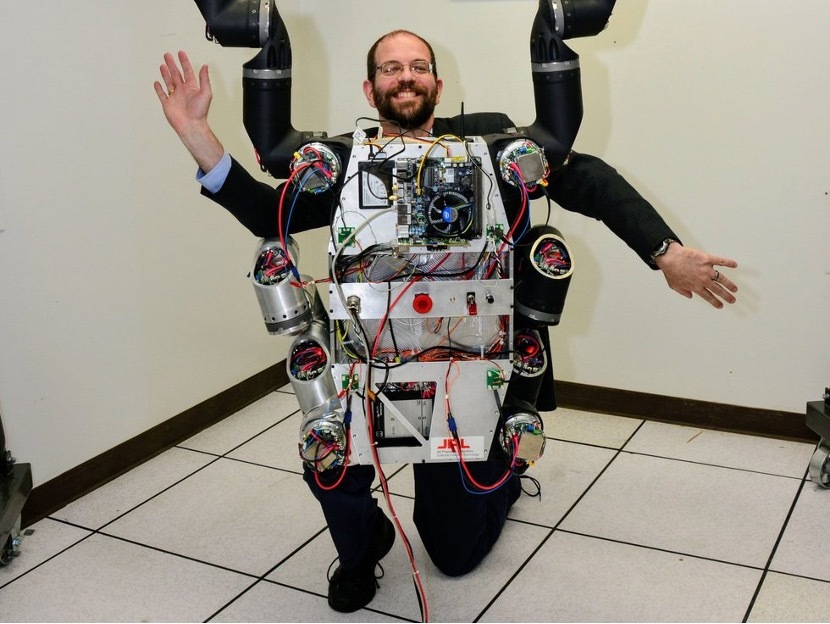
A photo of Gill Pratt with an early robot.
In 2012, the Defense Advanced Research Projects Agency announced the "DARPA Robotics Challenge" (DRC). This disaster rescue robot competition, which lasted for several years and cost millions of dollars, not only gave birth to Boston Dynamics' Atlas robot, created many amazing moments of the first generation of practical humanoid robots, but also left a funny video of mistakes that has been circulated to this day.
As the leader of the event, Gill Pratt has a clear understanding of the significance of the DARPA Robotics Challenge in the field of robotics. In 2012, he said in an interview with "IEEE Spectrum": "The original intention of holding the DARPA Robotics Challenge was actually to promote the development of this field and make this kind of robot technology truly implemented." At that time, he pointed out that before the 2004 DARPA Grand Challenge and the 2007 DARPA Urban Challenge, driverless cars suitable for complex environments basically did not exist. He believes that the DARPA Robotics Challenge will bring the same transformation to the robotics field.
Nearly ten years have passed since the DARPA Robotics Challenge concluded, and many people in the industry believe that humanoid robots are about to usher in the disruptive development moment that Pratt predicted back then. But the norm in the robotics field is that the actual difficulty is often far greater than expected. "IEEE Spectrum" interviewed Pratt, who is currently the CEO of the Toyota Research Institute, to explore the obstacles to the development of humanoid robots, his views on the application scenarios of such robots, and how to deal with the bubble problem brought about by the humanoid robot boom.
How do you view the robotics era we are currently in?
Gill Pratt: What has really changed is not the humanoid robot itself. For a long time, many researchers have been developing robots with humanoid structures. The core difference today is not the robot's body, but its "brain". There has always been such an imbalance in the robotics field: the mechanical structures we develop have extremely excellent performance, but we have never been able to make the actual utility of robots match their potential capabilities. The revolution in artificial intelligence in recent years has finally given us this capability.
Looking back ten years ago, it is easy for people to attribute many of the current developments in commercial humanoid robots directly to the DARPA Robotics Challenge. Is there anything wrong with this view?
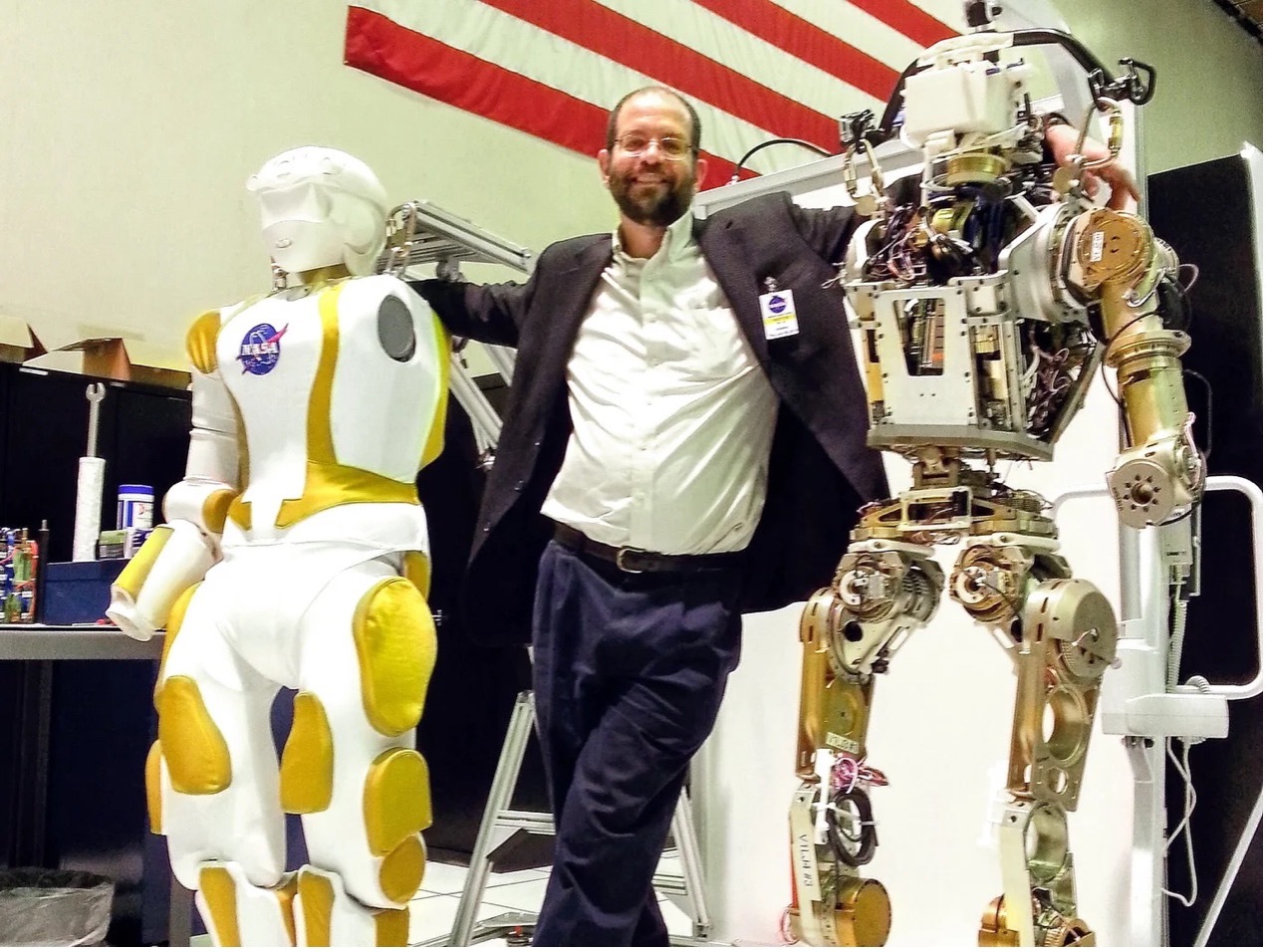
Gill Pratt poses with NASA's early version of the Valkyrie DRC robot.
Pratt: There is nothing wrong with that, but I take a humble attitude towards it. The DARPA Robotics Challenge focused on a model that combines semi-autonomous control and semi-real-time remote control, including remote supervision, and using semi-autonomous technology to enhance supervision capabilities to complete tasks in real time while remote personnel issue instructions. All of this happened before the recent breakthroughs in artificial intelligence technology.
The change today is that we have found a way to teach robots to perform tasks and give them corresponding capabilities without writing code, just by demonstrating the operation process to the robots. With sufficient demonstration data and new artificial intelligence technologies, the performance of robots can reach unprecedented heights.
But data is a development bottleneck, right? How do we determine what the data should contain and how much data is needed for the robot to complete tasks stably?
Pratt: This is the same debate as in the field of large language models. Some people believe that large language models are essentially autoregressive prediction models that can predict the next word based on the previous content. As long as we make up for their hallucination problems through various methods, we can eventually create a trustworthy artificial intelligence system. Others think this idea is unreasonable and we need to take a different approach. I agree with this view that we need to build world models to enable artificial intelligence systems to have the ability to imagine, make mistakes and perform real reasoning.
You know, what we call "reasoning" is actually the concept of pattern matching. Calling it "reasoning ability" is just a label attached to the R&D results, not real reasoning.
The Data Bottleneck in Robot Learning
This is the difference between "System 1" and "System 2" thinking, right?
Pratt: Exactly. System 1 is the fast, instinctive reactive thinking of humans, which is also the pattern matching method adopted by current large language models; System 2 is the slow reasoning that includes imagination and world models, which is an area we have not yet achieved. System 1 has made extraordinary breakthroughs, but System 2 is still in its infancy. Trying to patch System 1 to give it System 2 capabilities is like squeezing a balloon full of water: when you press one side, the water bulges out from the other. You will constantly find that after solving one problem, another problem arises, and there is no substantial improvement in overall performance.
How do you tackle this problem at the Toyota Research Institute?
Pratt: Two years ago, we proposed the diffusion policy model, and then developed a technology I call the large behavior model. This technology completes multi-task training through a single model, and practice has proved that each new training task can help the learning of other tasks, while reducing the amount of training data required to meet the established performance standards. These are major breakthroughs in the field of System 1.
The opportunity for us to achieve a key breakthrough was the discovery that diffusion technology can be applied to robot behavior control. Studies have confirmed that the behavior space operation pattern from visual input to action output has excellent effects. This discovery has promoted the development of the entire field, and almost all kinds of robot demonstrations we have seen since then have adopted some form of diffusion policy model. But in the final analysis, this is still System 1 pattern matching: "When I see such an environment, I will take such an action." Robots do not imagine, think and plan like traditional manually programmed robots, but only react reflexively.
However, just like the dilemma faced by autonomous driving technology, System 1 pattern matching often fails in real scenarios.
Pratt: When the Toyota Research Institute was first established ten years ago, almost everyone thought that autonomous driving technology was about to become widespread.
Ten years later, I think the technology is already mature, and the remaining problems are all commercial: hardware costs, insurance costs, operation and maintenance costs, and whether the application of the technology is economically feasible. We have not completely solved the autonomous driving problem, but the existing solutions are practical enough because we have introduced humans as backup support. When an autonomous vehicle gets into trouble due to a illegally parked vehicle by the roadside, it will send a request to the backend, and a human will make a System 2-level decision. I think other robots can also adopt this model: work autonomously most of the time, and occasionally actively seek human assistance.
Since autonomous driving technology has only just matured, why do we invest so much energy in developing bipedal humanoid robots?
Pratt: The real world created by humans is an environment that is adapted to the human body structure. If robots want to operate efficiently in this world, they need to take advantage of these adaptation conditions. At the same time, the humanoid structure is also more conducive to carrying out imitation learning, because the robot has the same shape as a human being. In addition, legs have significant advantages in specific environments: the balance speed when crossing obstacles is much faster than the speed of a wheeled robot moving to a new support point. But even so, the bipedal structure is not practical in all scenarios. The factory environment has a flat ground that is perfectly adapted to wheeled robots, but it is really puzzling that the industry is so focused on bipedal robots today.
Coping with the Hype of Humanoid Robots
Do you think the large influx of capital into the bipedal humanoid robot field is a good thing for the robotics industry?
Pratt: This brings both opportunities and risks. It is certainly gratifying to see a large amount of resources injected into the robotics field, and I firmly believe that the industry has reached a special development node. The industry landscape has changed. When humans can teach robots to complete various tasks through demonstration, countless possibilities will emerge.
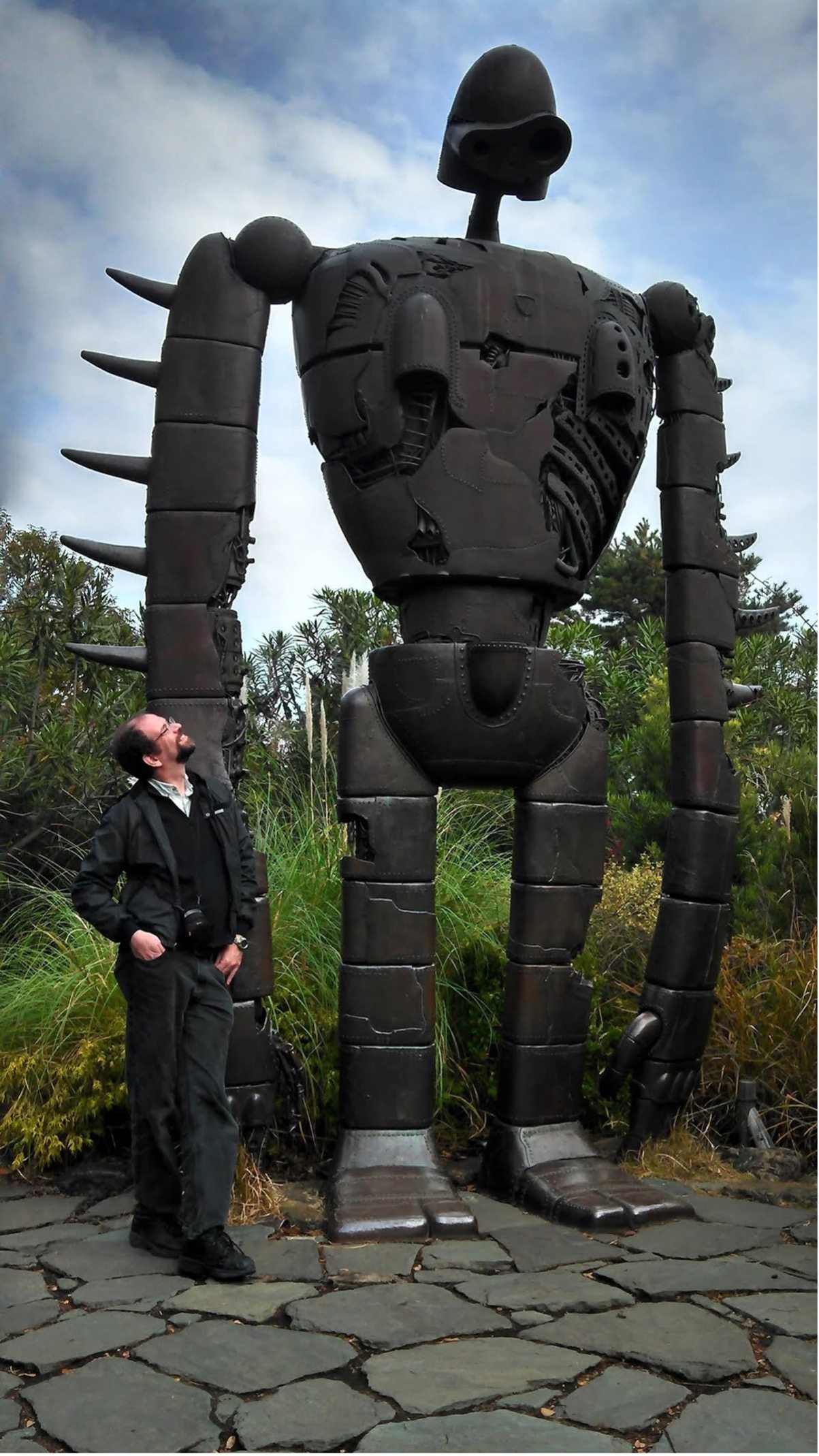
Gill Pratt admires a robot on the roof of the Ghibli Museum in Tokyo.
What kinds of things should humans teach robots to do?
Pratt: Over the past ten years, the Toyota Research Institute has been focusing on the issue of population aging. This is not only about physical mobility impairments, but also about loneliness and a lack of sense of value, which are more common and have more serious impacts. Therefore, we need to think about how to use technical means to make people feel that they are still young.
The Toyota Research Institute is developing "teachable robots", that is, robots that are taught by humans. Humans are naturally willing to give and help others. When you teach a machine to operate through demonstration, and this machine can help others, you will get a strong sense of value. We believe that robots can not only improve the quality of life at the physical level, but also play a two-way positive role at the psychological level.
Ten years ago, when you founded the Toyota Research Institute, I asked you about your research focus, and your answer impressed me deeply: you said you would focus on elderly care because "we have no other choice".
Pratt: Exactly. The demographic data continues to deteriorate, and we really have no other choice. We must realize that an aging society has a far-reaching impact on young people, which stems from the population dependency ratio, that is, the proportion of young people of working age who need to support both underage children and the elderly is constantly deteriorating.
How to solve this problem?
Pratt: We have made major breakthroughs in the field of System 1, but unless someone also achieves a breakthrough in the field of System 2, or builds a system where humans provide System 2-level supervision and control, the role that robots can play is still limited.
This human supervision and control model is just going back to the DARPA Robotics Challenge model, isn't it?
Pratt: Exactly! I won't stop everyone from praising the DARPA Robotics Challenge... Someone once called it "the Woodstock of robotics", and that statement made me feel very warm. It's really great!
Ten years later, how do you view the current hype in the humanoid robot field?
Pratt: The humanoid robot field is (I hope) reaching the peak of inflated expectations. The reason is that people have not deeply considered the essential difference between System 1 and System 2.
At present, physical artificial intelligence systems can only achieve pattern matching. Although the performance of such robots is extremely excellent, the technical achievements are amazing, and we are proud of it, and firmly believe that integrating multi-task learning through large behavior models can exert great utility, this is still not System 2. There is a lot of overpromising in the industry today, which is a pity because it will eventually lead the industry into a trough. What I am worried about is the subsequent period of disillusionment.
When the humanoid robot hype bubble bursts, how can we prevent the robotics industry from collapsing?
Pratt: At this stage, we need to introduce a damping effect. In a control system, adding damping can make an unstable system tend to be stable. The media and academia can play a role in lead compensation to remind the public that current humanoid robots do not have real reasoning capabilities.
We should also remember that the autonomous driving field also experienced a bubble burst, and only a few rational, non-hyped and persistent companies survived. I think the robotics industry will be the same.
Translator: Teresa