Li Auto's monthly sales rebound by 40,000 units, but it's still passing through the "narrow gate".
There was a time when Li Auto was the most stable among the new car - making forces.
It didn't rely on losses to boost sales. With just one model, the Li ONE, it could compete with all the models of NIO and XPeng. It was the first to achieve consecutive quarterly profits and became the first player among the new forces to cross the break - even line. Its stock price once soared to $40 in 2024, and its market value exceeded $40 billion, enjoying great glory.
Even in 2025, when challenges increased, Li Auto remained one of the few new - force enterprises that maintained annual profits. By the end of 2025, Li Auto had a cash reserve as high as 101.2 billion yuan, providing a relatively ample safety cushion for subsequent product iterations and the continuous optimization of the pure - electric platform.
However, it's undeniable that in 2025, the situation changed. With the strong rise of AITO, the cost - effective breakthrough of Leapmotor, and the cross - border entry of Xiaomi Auto, the once - impregnable extended - range market of Li Auto was breached.
In the second half of last year, combined with the investment during the pure - electric transformation period, the phased impact of the MEGA recall, and the intensification of the market price war, Li Auto's sales ranking once dropped out of the top three. The stock price was halved, and the once "most profitable new - force" fell back into the quagmire of quarterly losses.
In March just passed, Li Auto presented a warming - up report card - a delivery volume of 41,000 vehicles, a 55% month - on - month increase and an 11.9% year - on - year increase. However, beneath the surface of the recovery, looking through Li Auto's annual financial report of last year, the pressure brought by the decline in revenue and the sharp drop in profits still exists.
The outside world is carefully observing whether the rebound in March is the beginning of a revival or just a "false boom". For Li Auto, the tough days don't seem to be completely over yet.

Image source: Li Auto
01 It's getting harder to make money from selling cars
In March, Li Auto's report card of 41,000 vehicles made it second only to Leapmotor among the new forces, seemingly having emerged from the previous sales trough.
In the first quarter, Li Auto delivered a total of 95,100 vehicles, exceeding the upper limit of the previously announced delivery guidance of 90,000 vehicles.
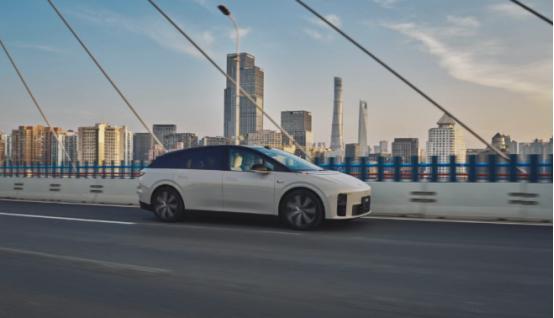
Among them, the much - anticipated pure - electric model, the Li i6, overcame the production capacity bottleneck, with monthly sales exceeding 24,000 vehicles, contributing nearly 60% to the monthly sales. However, the problem lies precisely in this "60%".
The starting price of the Li i6 dropped to the 200,000 - yuan range. Due to its focus on high cost - effectiveness, the profit margin is very limited. At the live - streaming event after the product was launched, Li Xiang revealed that "the i6 is the product with the lowest gross profit margin among Li Auto's products". According to media reports, the gross profit margin of the Li i6 in its first sales was about 10%, basically equivalent to having no net profit.
To some extent, although the Li i6 helped Li Auto regain market share, it was like a boulder, significantly pulling down the profit per vehicle.
The financial report data released not long ago may reveal the cost behind this growth from the side. In the fourth quarter of 2025, the revenue was 28.8 billion yuan, a 35.0% year - on - year decrease; the net profit was 20.2 million yuan, a 99.4% year - on - year decrease. The annual revenue in 2025 was 112.3 billion yuan, a 22.3% year - on - year decrease; the net profit was 1.139 billion yuan, an 85.8% year - on - year decrease.
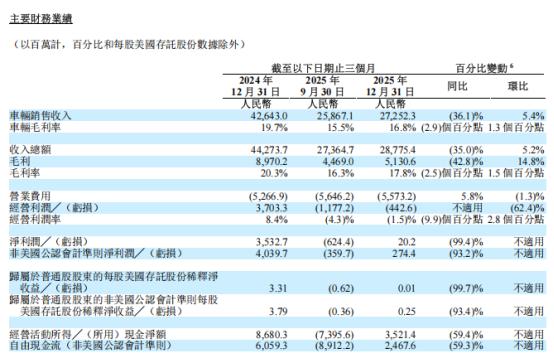
Image source: Li Auto
It should be noted that the 1.1 billion yuan net profit finally recorded by Li Auto in 2025 did not come from the main business, but mainly relied on 1.92 billion yuan in interest income and investment income.
The decline in the average price per vehicle and the loss of the gross profit margin further compressed Li Auto's profit space. Due to the continuous intensification of market competition and price war, and the low - price models becoming the sales mainstay, the average selling price per vehicle of Li Auto dropped from 278,000 yuan in the third quarter of 2025 to about 250,000 yuan in the fourth quarter.
The transmission of pressure is more clearly reflected in the gross profit margin. The gross profit margin in the third quarter was affected by the recall of the MEGA model and fluctuated. The company lost about 1.1 billion yuan due to this recall, directly resulting in a net loss of 620 million yuan in the third quarter of 2025 and ending the record of 11 consecutive quarters of profitability.
After excluding this impact, the actual gross profit margin of vehicles in the third quarter was 19.8%. However, even so, the gross profit margin of vehicles in the fourth quarter still dropped to 16.8%, a further 3 - percentage - point decline compared with the third quarter, breaking the long - standing vehicle gross profit margin level of about 20% maintained by the company.
The increase in the sales proportion of the more cost - effective i6 has a crowding - out effect on high - price models such as the MEGA and i8, causing Li Auto's vehicle model structure to continuously decline. The outside world speculates that Li Auto's average selling price is likely to continue to decline. This disguised strategy of "trading price for volume" has reduced the actual effectiveness of the delivery data in March.
For a long time, Li Auto has been telling the capital market a story of a mid - to - high - end family car brand. If its growth mainly relies on the cost - effectiveness path, it will be difficult to consolidate its existing brand positioning and is not conducive to supporting a more imaginative valuation space.
On the other side of the verge of losing the main business, Li Auto is taking a big gamble on "the next decade".
Li Xiang regards 2026 as a crucial year for Li Auto to evolve into an embodied intelligence enterprise. To tell this new story well, Li Auto still invested 11.3 billion yuan in R & D in 2025 when its profits shrank significantly, and claimed that half of it was invested in AI - related fields, and will continue this strategy in 2026.
This means that Li Auto not only has to bear the decline in profit per vehicle but also has to withstand the financial pressure during the transformation period without giving up high - investment in R & D.
02 At a crossroads
Behind the sense of contradiction between the sales recovery and the unclear future lies two major structural dilemmas faced by Li Auto.
On the one hand, the "extended - range dividend" that Li Auto relied on in the past has limited growth space. In the past, Li Auto reaped market dividends with its extended - range route of "no range anxiety" and accurate positioning of family cars. However, now this track has become a red ocean.
Currently, the AITO M7 and M9, supported by Huawei, are competing closely with Li Auto in the high - end market, while Leapmotor is replicating Li Auto's path in the low - end market with lower prices. Under the double - squeeze, the basic market of Li Auto's L - series extended - range vehicles has been greatly affected.
In order to make way for the new - model L9 to be launched in the second quarter, the old - model vehicles had to be sold at a large - scale discounted price to clear the inventory, which also directly led to the loss of the average price per vehicle in the financial report.
Secondly, the pain of the pure - electric transformation is more intense than expected. The explosion of the Li i6 in March seems to prove Li Auto's potential in the pure - electric field, but there are also hidden worries behind it.
On the one hand, the production capacity issue of the i6 still attracts attention. According to media reports, due to the battery supply bottleneck of CATL, the delivery cycle of the i6 was once as long as 19 to 22 weeks. From the latest data, this situation has improved, but the instability of the supply chain still leaves uncertainties for the future of this volume - driving model.
On the other hand, pure - electric models are diverting the market of extended - range vehicles. The hot sales of the i6 not only snatched customers from Tesla Model Y but also diverted some potential users who originally intended to buy Li Auto's L - series to some extent. There are concerns in the outside world that this "self - competition" has led to Li Auto failing to expand the incremental market through pure - electric vehicles and instead accelerating the shrinkage of the extended - range basic market.
Li i6. Image source: Li Auto
The capital market has keenly captured this notable signal. In a recent report, UBS Group maintained its "Buy" rating on Li Auto but lowered the target price from $30 to $23.
UBS believes that although the new - model L9 may be a catalyst for re - evaluating the valuation, under the challenges of the sales structure and pricing, Li Auto's net profit margin in 2026 and 2027 may remain in the low single - digits. At the same time, due to the unfavorable market dynamics for extended - range electric vehicles, the bank lowered its revenue forecast for the period by 30%.
For Li Auto at present, the logic of shifting from the extended - range dividend to the intelligent dividend is sound, but the road ahead may not be smoother.
Li Auto is trying to build a technological moat in the field of embodied intelligence. To this end, the company adjusted its organizational structure, breaking the original model divided by business units and product lines, and reconstructing it according to the logic of "brain" (data sets, chips, operating systems), "core software" (application layer, intelligent agents, skills and memory modules), and "hardware" (energy, electric drives, controllers).
Li Xiang revealed that after the adjustment, the model iteration cycle of the autonomous driving team has been shortened from two weeks to one day, with the efficiency increased by 14 times.
Regarding the commercialization path of embodied intelligence, Li Xiang said that for emerging fields such as AI glasses and robots, the startup model will be adopted to test the direction in small steps, rather than betting on an unclear track with the scale of a large enterprise. He even made an exception to invest in Xieyue Intelligence founded by a former executive, betting on consumer - grade embodied intelligence products in the family scenario.
The rebound in March is like a shot in the arm for Li Auto, temporarily stabilizing the market's confidence, but it can't cure the root cause. When competitors like Xiaomi Auto, which hold high the banner of "cost - effectiveness + intelligence", are aggressively seizing market share, if Li Auto's embodied intelligence strategy cannot be quickly transformed into user - perceivable experience premium and sales conversion, the high - amount R & D investment will instead be unfavorable to the financial report.
Currently, Li Auto still needs to rely on the mainstay of the automobile business. Li Xiang once reflected at the financial report meeting that the biggest problem in the past was managing the direct - sales system in the way of a dealership. In March this year, Li Auto launched the "store partner" plan, delegating business decision - making power and introducing profit - sharing, and adjusting the sales incentive system, hoping to cultivate store managers with an annual income of one million yuan.
However, in 2026, when the product strength is relatively fixed and competitors are launching crazy attacks, it remains to be seen how much marginal effect the channel reform can have.
It should be noted that Li Auto has a precedent for adjusting organizational efficiency. As a company well - known in the industry for its ability to reflect, in August 2025, at the risk of short - term personnel flow and execution chaos, Li Auto abolished the five major war zones, compressed middle - management positions, and changed to a four - layer flat system with the headquarters directly managing 23 regions.
At that time, the effect of the reform was evident in the figures: the turnover rate of front - line sales decreased by 50%, and a large number of experienced sales consultants were retained each year; the store operation and maintenance satisfaction rate increased from 76% to 94%, approaching the full - score range.
The outside world therefore has reason to believe that if the store partner plan can be successfully implemented in the second quarter, it may help Li Auto tap more potential in the existing market.
However, for Li Auto, the tough days may not be over yet. With the production capacity of cross - border giants like Xiaomi Auto ramping up and the full - scale counter - attack of traditional automakers in the new - energy field, the competition in the core price range of 200,000 to 300,000 yuan will reach a white - hot stage in 2026.
Li Auto has to defend the extended - range position of the L - series, break through in the pure - electric red ocean with the i6, and balance the scales between profit and sales. If it only relies on the low - gross - margin i6 to boost sales and the high - gross - margin L - series fails to open up a new situation through the upcoming model upgrades, Li Auto may face an embarrassing situation: maintaining its position in the first echelon in terms of sales but potentially falling to the second echelon financially.
If the battle in 2026 fails to meet expectations, Li Auto may lose not only market share but also the capital market's belief in it as the "most profitable new - force".
This article is from the WeChat official account "Phoenix Finance". Author: Company Research Institute. Republished by 36Kr with permission.