INAIR Completes Multi-million Dollar Financing, Portable Spatial Host Compatible with Multiple AR Glasses | Latest Frontline
Recently, Inair, a next-generation mobile computing platform company (hereinafter referred to as Inair), announced the completion of a tens of millions of US dollars Series A+ round of financing. This round of financing was jointly invested by Legend Capital, Hillhouse Ventures, and Honghui Capital. The funds will be mainly used to accelerate the ecological expansion of the Portable Space Station (PSS) product Inair Pod, the R & D of the spatial operating system, and the implementation of vertical industry applications.
Inair is a technology company focusing on spatial computing and mobile productivity. It was founded by two serial entrepreneurs in the technology field. The startup team has experience in AR hardware, software, products, and marketing, and its members are from many well - known enterprises in the Internet and technology fields.
The company uses AR glasses as an entry point and is committed to providing consumers with the next - generation All - in - one mobile office solutions. Its core product is the Inair Pod. This device is equipped with the self - developed Inair OS spatial operating system, which has the capabilities of spatial multi - screen (up to 6 virtual screens), computer remote streaming, real - time AI 2D to 3D conversion, and an AI assistant.
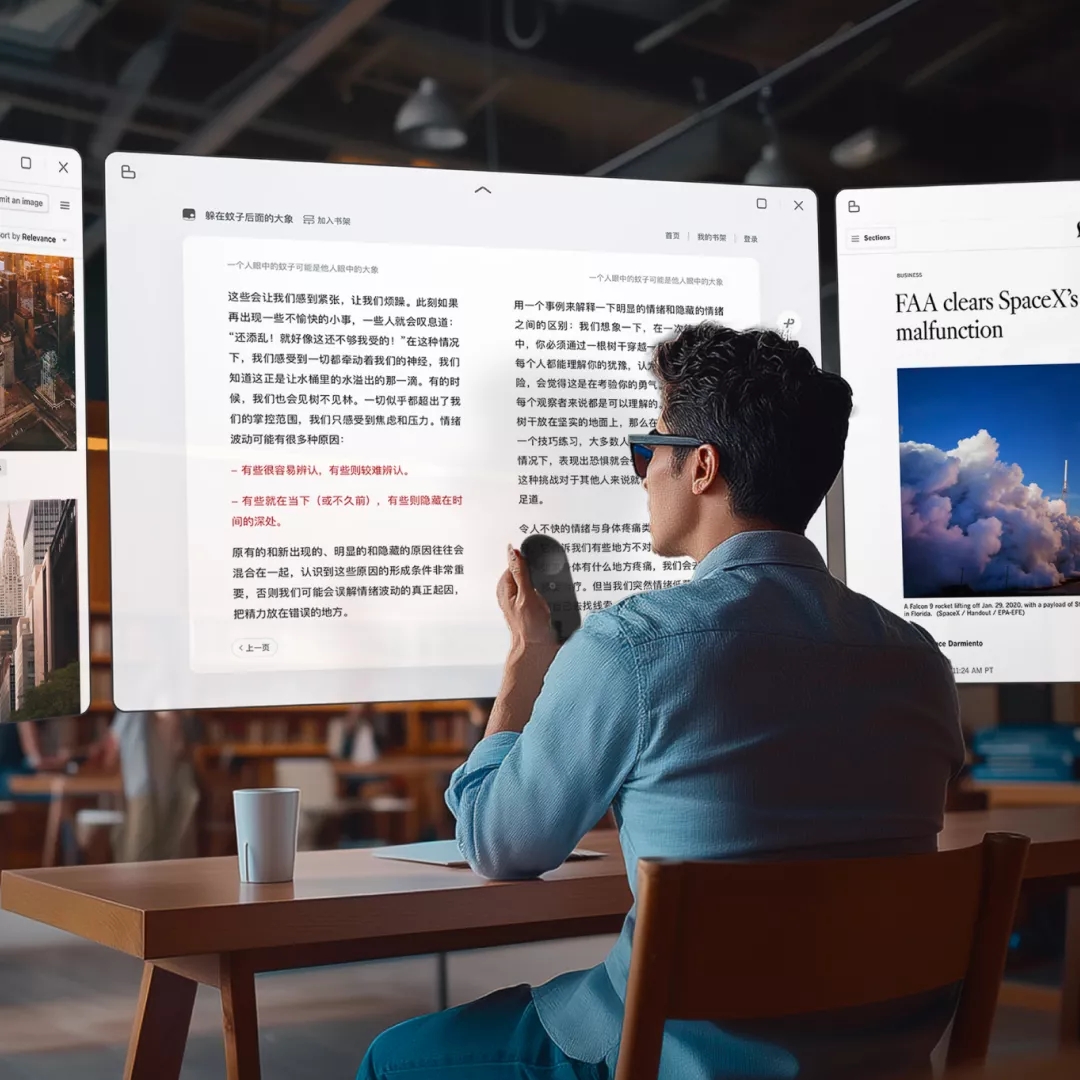
Image source: Inair
For users, the Pod serves as both a host and a mouse. Users don't need to carry a heavy PC with them. With INAIR's remote streaming technology, they can control their personal PCs in the glasses anytime and anywhere.
The InAir Pod supports 3DoF (three - degrees - of - freedom) spatial hovering technology, allowing the virtual screen to be stably "anchored" in the real space. Combined with head tracking, it provides a more natural interaction experience. Through the hardware - software integrated technical architecture, the Inair Pod aims to instantly transform any space into an efficient multi - screen mobile workstation, solving the bottleneck of traditional mobile devices in multi - task processing.
Another feature of the Inair Pod lies in its open and compatible ecological strategy. In terms of hardware, it doesn't compete with terminal devices. Instead, it serves as a "general computing power hub", deeply compatible with mainstream AR glasses such as Viture, Xreal, and Thunderbird, and also supports traditional display devices like projectors and TVs, enabling users to upgrade their computing power experience without changing their glasses.
Currently, the Pod has launched the V3.5 system version and entered overseas markets. This product integrates a large AI model and has a built - in voice assistant. With just one click, it can help users complete various tasks.
The company's other products include the INAIR AR Spatial Computer, INAIR 2 AR Glasses, Touchboard, INAIR Pro, and INAIR Glass. Multiple devices form an "external cabin" similar to a laptop, jointly realizing multiple functions including display, hosting, and input, and achieving seamless connection.
The person in charge of Legend Capital said, "The workflow in the AI era is being reconstructed. Inair not only provides screen expansion but also solves the interface bottleneck of human - machine collaboration through the spatial operating system and 3DoF interaction. Its positioning of an open ecosystem is the key to promoting the popularization of mobile workstations." A representative of Hillhouse Ventures believes that "the technology to create an efficient working environment anytime and anywhere will unleash huge productivity potential."
Huang Hai, the CEO of Inair, graduated from the School of Software Engineering of Tsinghua University. After graduation, he worked at Broadcom and Intel, responsible for the definition of multi - chip and platform R & D. He co - founded a smart wearable product company and successfully commercialized it. Huang Hai pointed out, "Our goal is to become the 'connector' in the spatial computing industry. After this round of financing, we will continue to deepen cooperation with hardware partners, establish unified standards, and make the pocket - sized workstation a daily tool for more professional users."