The real watershed for AI startups is not technological breakthroughs, but this.
Tan Lin
Chief Futurist of the Future Laboratory at Peking University HSBC Business School
As a futurist who has long studied technological evolution and business transformation, I've witnessed numerous amazing "from 0 to 1" stories and many more "from 1 to N" failure cases. John A. List's The Voltage Effect comes at the right time—it offers not only a set of business methodologies but also the scarcest cognitive calibration framework in the era of rapid technological development.
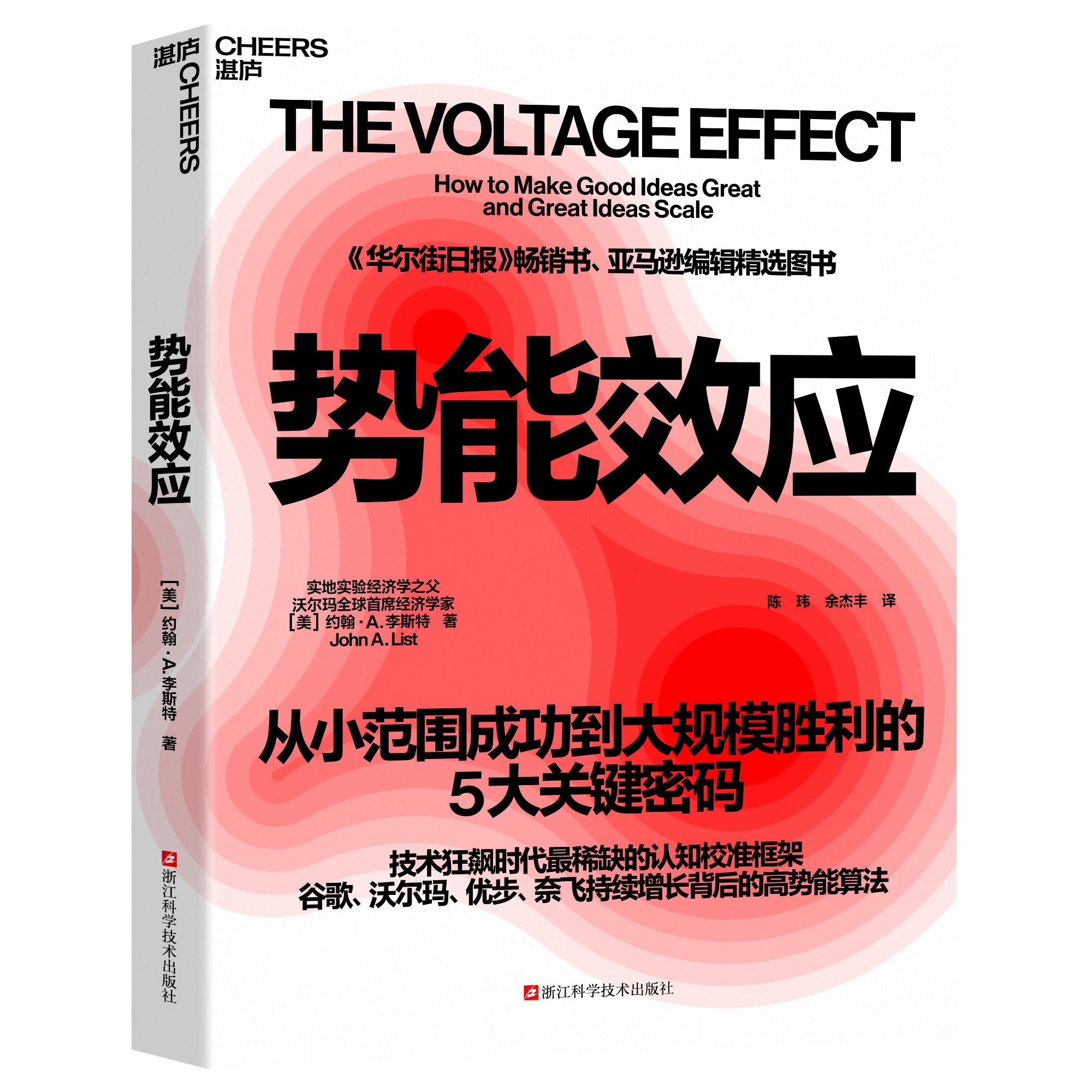
l Author: [USA] John A. List
l Translators: Chen Wei & Yu Jiefeng
l Publication Date: April 2026
l Publisher: Cheerful Reading Culture/Zhejiang Science and Technology Press
l Book Purchase Link: https://product.dangdang.com/30034109.html
The Core Proposition at the Paradigm Shift Point: From the "Innovation Myth" to "Scalability Certainty"
We are in an unprecedented window period of technological singularity. Large models have led to a sharp drop in the marginal cost of knowledge, and embodied intelligence has initiated in - depth transformation of the physical world. Every entrepreneur is chasing that moment of inspiration to "change the world". However, through his practical research at Uber and Lyft and decades - long tracking experiments at the Chicago Heights Preschool, List reveals a long - neglected scientific proposition: the certainty of scalability.
The core insight of this book is highly subversive—innovation itself is not scarce; what's scarce is scalable innovation. The concept of "Voltage Drop" proposed by List precisely hits the most dangerous cognitive blind spot in the current AI wave: a large number of cutting - edge projects perform amazingly in the laboratory or small - scale testing phase but encounter irreversible failure once they enter the mass market. We are overly infatuated with the "possibilities" of technology but systematically underestimate the gap between "possibilities" and "universality".
5 Voltage Switches: The Filter for "Real and Fake Opportunities" in the AI Era
List's unique contribution lies in injecting the rigorous thinking of experimental economics into the forefront of Silicon Valley's practical operations. The 5 voltage switches he refined provide a set of operable scientific decision - making frameworks for technology - driven enterprises.
● The first switch: Distinguishing signals from noise. In the era of data flooding, distinguishing "real user pain points" from "statistical illusions created by subsidies" is the first lesson for survival. List's "false positive" lesson in the Chrysler health plan—where two groups of workers in the same factory had completely opposite results—serves as a cross - time warning to the current bubble of large - model manufacturers blindly chasing the number of Daily Active Users (DAU). The illusion of early data growth often stems from unsustainable statistical fluctuations rather than a real fit between the product and the market.
● The second switch: Representative bias in user samples. From the debate between "Juggs (users who increase consumption due to membership) and Naggs (users who are already high - frequency users and only save money with membership)" in Lyft's membership program—where the high proportion of "Naggs" users who enjoy discounts but don't change their behavior led to model failure, to the "Hispanic family effect" at the Chicago Heights Preschool—where the multi - generational family structure made it impossible to generalize the intervention effect, List repeatedly proves that the enthusiasm of a vertical group does not automatically equate to acceptance in the mass market. This is particularly relevant to AI application enterprises breaking through from the "geek circle" to the "general public".
● The third switch: The system's de - dependence on "non - standard elements". The dialectic between the "genius chef" and the "standard recipe" points directly to the deep - seated anxiety of Chinese innovative enterprises. List's analysis of the collapse of Jamie Oliver's catering empire—over - dependence on the founder's personal charm and the non - replicability of core executives—is worth reading carefully by every founder of a "net - red brand". True transformation needs to be based on a replicable and industrialized "standard recipe" rather than non - scalable dependence on "top single - point talents".
● The fourth switch: Anticipating negative spill - over effects. The network effect of the digital ecosystem is a double - edged sword. List experienced the "uninstall movement" and the unexpected consequences of the driver tip experiment at Uber—after the tip function was launched, a large number of new drivers joined, diluting the order - taking volume of the original drivers. This case reveals the exponential destructive power of "systematic negative factors" in the platform economy. In the construction of the large - model ecosystem, how to identify and suppress these spill - over effects determines the upper limit of the platform.
● The fifth switch: The dynamic game between marginal cost and marginal revenue. The tragedy of Arivale—a company with an annual revenue of $250 million but failed before the scalability threshold, as the ever - increasing cost structure of genetic testing and personal training devoured all profits—proves the cruel reality of "diseconomies of scale". Scalability does not naturally bring economic benefits. Only when the marginal revenue outpaces the marginal cost does expansion make sense.
The Practical Transformation of Behavioral Economics: From "Loss Aversion" to "Strategic Abandonment"
As an inheritor of the academic tradition of Daniel Kahneman① and Amos Tversky, List has taken behavioral economics from the laboratory to the boardroom. The factory experiment on the "recovery mechanism" in the book—issuing bonuses first and then assessing performance, using loss aversion to improve productivity, and Virgin Atlantic's fuel - efficiency boost—saving 7,700 tons of fuel and $5.37 million in costs through social comparison and goal - setting, demonstrate how the underlying logic of human nature can be transformed into a scalable organizational lever.
What's more subversive is List's reinterpretation of "strategic abandonment". In the entrepreneurial narrative where "persistence is a virtue", he boldly proposes that giving up a hopeless dream is the ultimate accelerator for winners. From List's personal "golf abandonment" in his career—giving up the dream of becoming a professional golfer and turning to economic research, to the "marginal stop - loss" of corporate business, this evidence - based exit decision forms an interesting tension with the Silicon Valley slogan of "Fail Fast"—the former emphasizes disciplined rational calculation, while the latter often becomes an emotional excuse for stop - loss.
① Winner of the Nobel Memorial Prize in Economic Sciences, the father of behavioral economics, and widely regarded as "the greatest psychologist of our time". He co - authored the best - selling book Noise with Olivier Sibony and Cass R. Sunstein, which introduces six principles to keep us away from decision - making noise and reveals the true nature of people's wrong judgments. The Chinese simplified - character version of this book has been introduced by Cheerful Reading and published by Zhejiang Education Press in 2021. — Editor's note
Special Insights for Chinese Innovators
While reading this book, I constantly thought about the special context of the Chinese market. Our entrepreneurs have rare global execution ability and iteration speed, but they also face unique scalability challenges:
● The complexity of the sinking market: From first - and second - tier cities to third - and fourth - tier cities, the differences in user profiles far exceed the US city samples studied by List, and the risk of representative bias is exponentially magnified.
● The super - competition in the platform ecosystem: The "duopoly" of Lyft and Uber seems mild compared to the multi - polar game in the Chinese market, making the management of negative spill - over effects more urgent.
● The dynamism of the policy environment: From "develop first, then regulate" to "develop and regulate simultaneously", more sensitivity to the institutional environment is needed for forward - looking anticipation of spill - over effects.
List's methodology—causal inference based on field experiments, resource allocation based on marginal analysis, and strategic design based on backward induction—provides Chinese enterprises with a set of decision - making tools beyond empirical intuition. Especially in the current context where "cost reduction and efficiency improvement" is the main theme, the discussions in the book about the "sunk - cost fallacy" and "marginal - benefit equilibrium" have direct tactical value.
In the research of the Future Laboratory at Peking University HSBC Business School, we repeatedly emphasize that the real challenge of the technological singularity is not the technology itself but the friction coefficient at the technology - society interface. List's voltage effect is precisely an attempt to quantify this friction coefficient.
The ultimate value of this book lies in providing a set of scientific grammar for evaluating how technology can be successfully scaled. When large models attempt to penetrate all industries and embodied intelligence is ready to enter every household, what we need is not only more powerful computing power but also a calmer mindset towards scalability—maintaining the ambition to change the world while keeping a clear head based on evidence.
Professor List started from a preschool in a poor area of Chicago, trying to solve the problem of educational equity. This original intention ultimately led him to Silicon Valley's giant companies. The message he conveys in the book is eye - opening: only scalable innovation is truly meaningful innovation. This is not only about business success but also about a sense of responsibility to change the world.
In this AI - driven radical era, we need passion, but we also need this evidence - based calmness. The Voltage Effect provides us with a filter to identify high - potential opportunities in the fog, which is worth pondering for every practitioner who tries to change the world with technology.
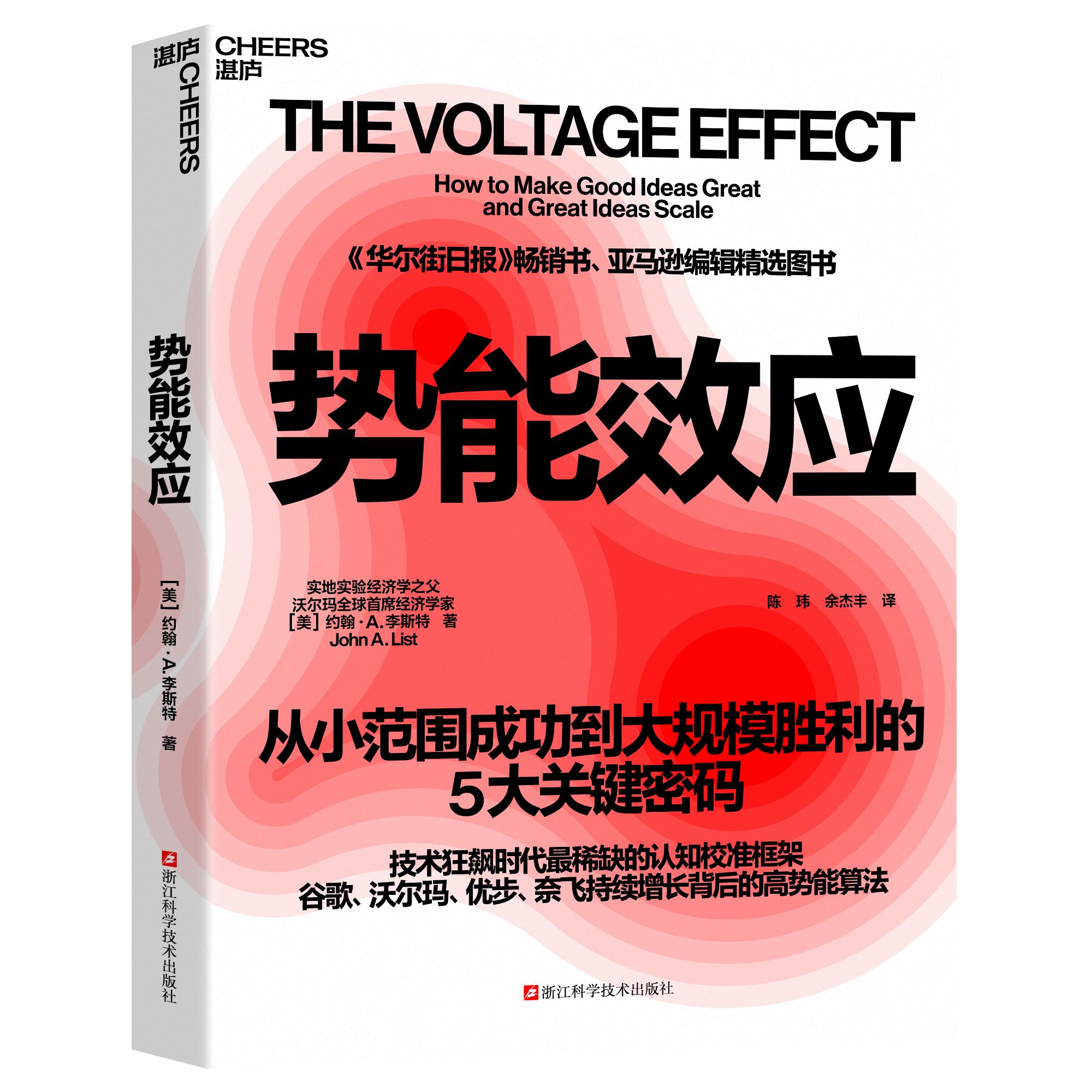
l Author: [USA] John A. List
l Translators: Chen Wei & Yu Jiefeng
l Publication Date: April 2026
l Publisher: Cheerful Reading Culture/Zhejiang Science and Technology Press
l Book Purchase Link: https://product.dangdang.com/30034109.html