I'm in Chiang Mai and have witnessed how Chinese electric vehicles have taken over the Thai county towns.
See the general trend in the details.
Even outside the Bangkok International Motor Show, the popularity of Chinese new energy vehicles still lingers.
At this Bangkok Motor Show, from BYD to Great Wall Motors, and then to XPeng Motors, the booth area, audience density, and media exposure are constantly strengthening an intuitive judgment: Chinese brands are becoming the most important variable in the Thai new energy market.
But what really made me realize that this was happening was not inside the exhibition hall, but in Chiang Mai.
During my days in Chiang Mai, I began to understand the city's automobile structure in an almost car - counting way. The streets in the old city are not very wide, but the traffic flow is well - organized. Walking along the street, you will find a very typical microcosm of the Southeast Asian automobile market: About 70% of the 4S stores are still occupied by Japanese brands such as Toyota and Honda. The storefronts are uniform, like a stable order that has lasted for decades.
But changes are also quietly taking place.
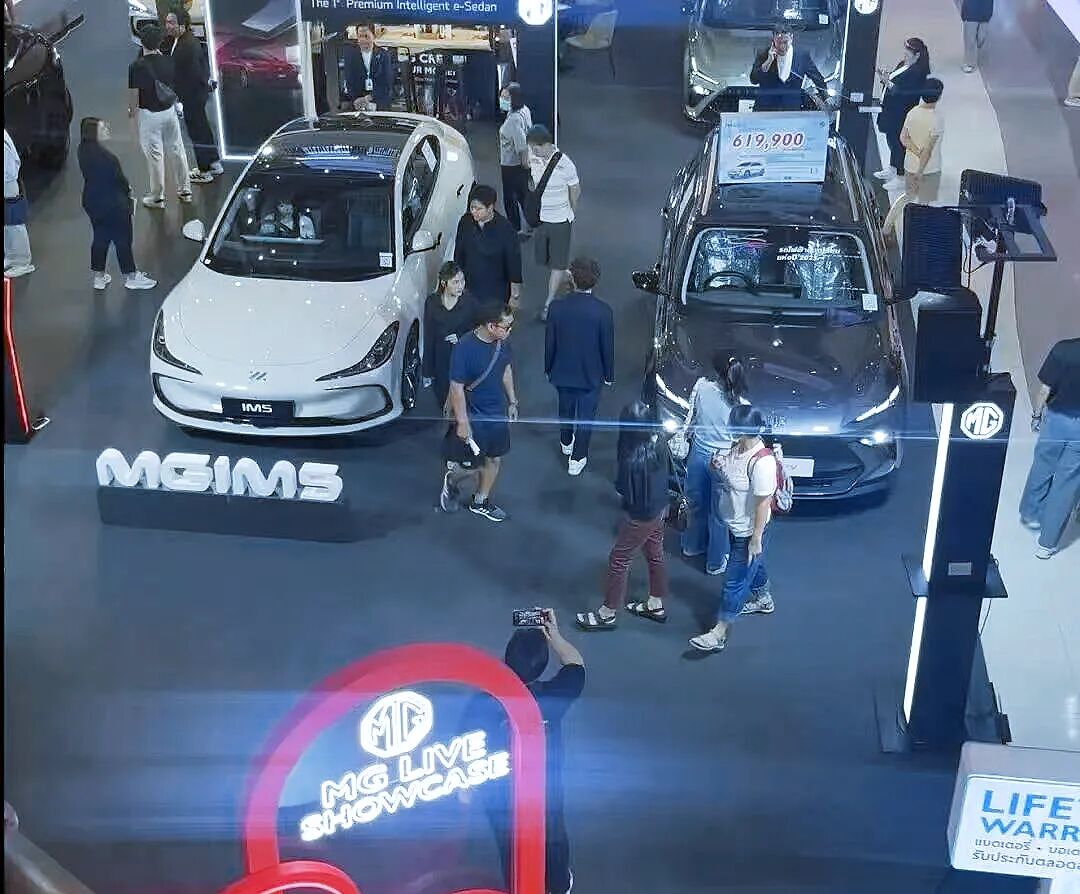
In the remaining space, Chinese new energy vehicles are gradually emerging. The first to come into view was BYD, but soon, more familiar automobile brands began to appear: The store density of MG and IM Motors is significantly higher. XPeng Motors, GAC Aion, Great Wall Motors, Avita, and ORA have each occupied a small but noticeable position.
Photographed by Zhijian autoweek
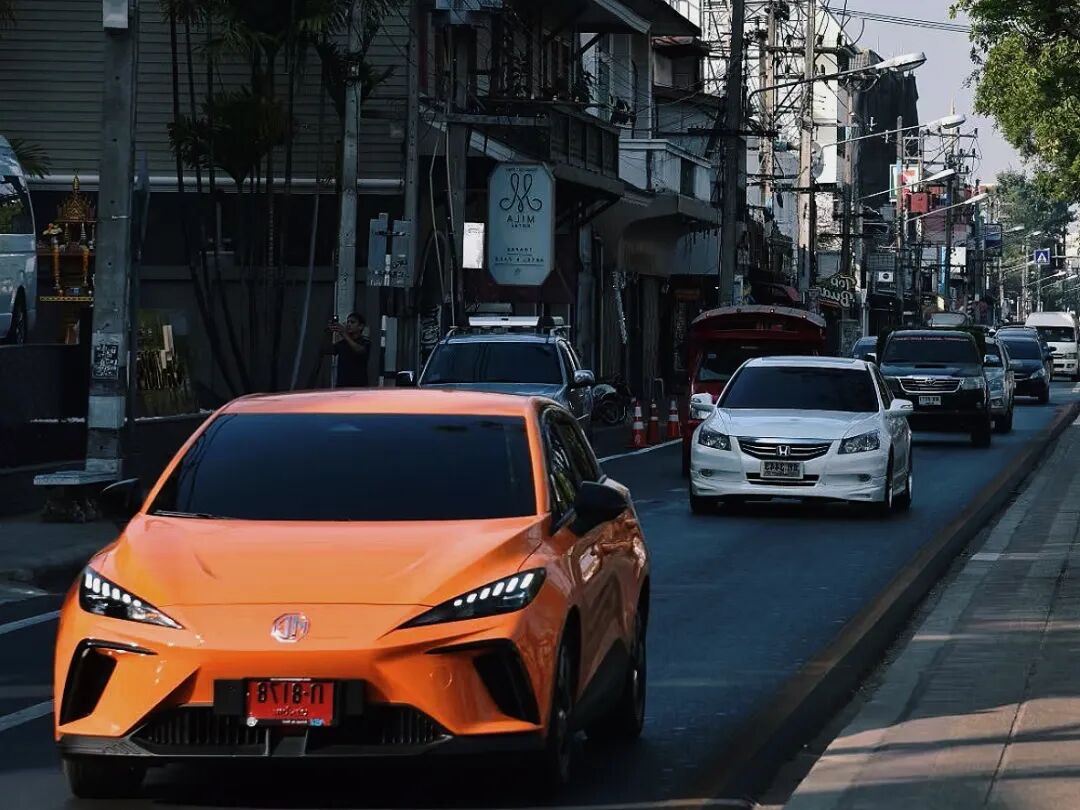
In the traffic near Thapae Gate and in front of the cafes on Nimmanhaemin Road, the most typical one is MG - this brand almost has a semi - local flavor in the local area. In Central Festival Chiang Mai, the largest shopping mall in Chiang Mai, it has long occupied a booth, and the vehicles are placed in the most prominent place, as if constantly strengthening its presence.
These changes can be intuitively felt in a sinking city like Chiang Mai.
Moreover, through conversations with local people, I found that Thais' understanding of Chinese brands is far deeper than we imagined. A local car owner in Chiang Mai told me that MG has been popular in Thailand for many years. This popularity does not entirely come from new energy, but rather seems that the brand completed market education in advance.
Why is Thailand the key?
Thailand is known as the "Detroit of the East". As the largest automobile producer in ASEAN and the third - largest automobile exporter in Asia, Thailand is the "back garden" where Japanese automobile companies have been deeply involved for 60 years. In the era of fuel vehicles, their market share has been over 90% for many years, and even century - old European and American automobile companies have difficulty entering.
More importantly, Thailand is the core hub for leveraging the entire Southeast Asian market. After the implementation of the RCEP framework, automobiles produced locally in Thailand can enjoy zero - tariff preferential treatment when exported to other ASEAN member states. This means that establishing a foothold in Thailand is equivalent to obtaining an entry ticket to the 600 - million - population market in ASEAN and even the right - hand - drive vehicle markets in Australia and South Asia.
The structural changes that subvert the industry's perception have occurred in the years from 2020 to 2025.
According to the Thai Automobile Manufacturers Association, the overall market share of Chinese automobile companies in Thailand has increased from 3.2% to 21.2%, nearly six - fold in five years. It is estimated that for every 5 new cars sold in Thailand, 1 is from a Chinese brand.
In contrast, Japanese brands are continuously losing ground: Their market share in Thailand has dropped from 76.7% in 2024 to 69.3% in 2025, reaching a critical point of falling below 70% for the first time in decades.
The more core change has occurred in the new pure - electric track. According to the Federation of Thai Industries (FTI), the sales volume of pure - electric vehicles in Thailand increased by about 80% year - on - year in 2025, becoming the only growth engine in the entire automobile market. Meanwhile, the sales volume of fuel vehicles has entered a downward channel.
Among the top 20 pure - electric vehicle models sold in Thailand in January 2026, except for Tesla, the remaining 19 models are all Chinese brands. The BYD Dolphin ranks 3rd, the BYD Yuan PLUS/ATTO 3 ranks 6th, and the MG4 also firmly ranks among the top ten, breaking the decades - long monopoly of Japanese models on the best - selling list.
The key to understanding this change lies in understanding the iterative switch of Thailand's new energy policies.
In 2022, Thailand implemented the EV3.0 Incentive Plan. Through high - value car purchase subsidies and consumption tax exemptions, this policy quickly completed the user enlightenment of the local new energy market and provided a key window period for Chinese brands to enter.
At the end of January 2026, the EV3.0 plan officially expired (the original EV 3.0 Incentive Plan, which was scheduled to expire at the end of 2025, had its final registration deadline extended to January 31, 2026 due to administrative approval and vehicle registration pressure). Starting from February, Thailand fully switched to the EV3.5 policy.
The changes reflected in the market are as follows: First, the subsidy intensity has been significantly reduced. The maximum subsidy for pure - electric vehicles has dropped sharply from 150,000 Thai baht during the EV3.0 period to 50,000 Thai baht, and the policy dividends have significantly declined.
Second, a hard threshold has been set for subsidy eligibility. Only pure - electric vehicles produced locally in Thailand can enjoy subsidies. Imported pure - electric vehicles have completely exited the scope of policy dividends. At the same time, the consumption tax on imported cars has been adjusted back, and a production capacity betting mechanism has been newly added -
For example, in 2026, for every 1 car imported by an automobile company, it must produce 2 cars locally in Thailand. This ratio will increase to 1:3 in 2027.
The direct market reaction to the policy switch was fully manifested in January 2026. Many Chinese automobile companies seized the last window period of EV3.0 to boost sales. Brands such as BYD, MG, and Great Wall all launched limited - time car purchase benefits, overdrawing the subsequent market demand in advance.
This is also an important background for the surge in pure - electric vehicle sales in Thailand in January and the fact that many Chinese brand models ranked among the top of the best - selling list.
Smart Chinese Automobile Companies: Occupy Positions First, Then Reconstruct
In this regard, smart Chinese automobile companies have already taken a step ahead of the policy through forward - looking layouts.
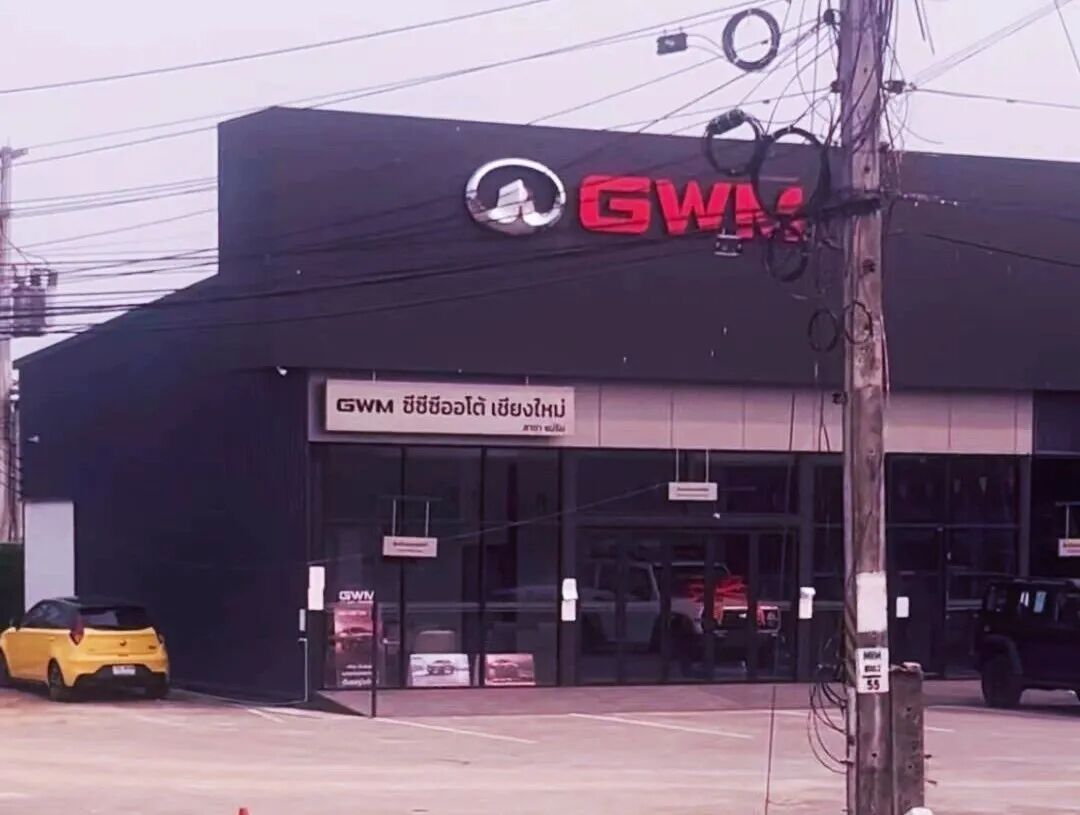
As of April 2026, 7 mainstream automobile companies, including BYD, Great Wall, Changan, SAIC MG, Chery, and GAC Aion, have built or are building production bases in Thailand, with a cumulative investment of over $3 billion and a total planned annual production capacity of over 600,000 vehicles.
Photographed by Zhijian autoweek
But what is more worthy of attention is the difference in their paths to enter Thailand.
SAIC Group was one of the first to enter. It cooperated with Thailand's Charoen Pokphand Group to build a factory in 2014 and did not launch its first EV in Thailand until 2019. In 2023, it additionally invested to expand its EV parts and battery manufacturing capabilities. This several - year time difference gradually completed the path from early entry to transformation, gradually transitioning from fuel vehicles to new energy. It has become the national brand with a semi - local flavor that I saw on the streets of Chiang Mai.
Great Wall Motors completed the acquisition of General Motors' Rayong factory in Thailand in 2020. In 2025, it achieved 100% local production of the ORA Good Cat in Thailand. Even more than 4,500 locally produced vehicles have been exported to markets such as Australia and Brazil, turning the Thai factory into a regional export hub for the right - hand - drive vehicle market.
BYD's path is the most radical. It announced the construction of a factory in 2022 and started production in 2024. From the very beginning, it regarded Thailand as a regional production and export node, rather than a single sales market.
These paths together constitute a clear change: Chinese automobile companies in Thailand are shifting from selling cars to building systems.
But this does not mean that this is an expansion without thresholds.
The experience of Nezha Automobile provides a negative example. As an early entrant into the Thai market, it once achieved good sales. However, against the background of intensified competition, price wars, and increasing localization requirements, it gradually exposed the pressure on its capital, channels, and after - sales systems.
This also precisely shows that Thailand is no longer a market where anyone can survive easily. It is a mature market that is beginning to differentiate and eliminate the unfit.
Anyway, for Chinese new energy vehicles, a new automobile industry node centered around electrification reconstruction and deeply participated in by Chinese automobile companies has begun. It also means that Chinese new energy vehicles have obtained an entry ticket to more international right - hand - drive regions.
Different from the local involution in the domestic market, Thailand has become a good place for Chinese automobile companies to undergo a more rigorous screening.

Photographed by Zhijian autoweek
In Conclusion: Rapid Growth, but Infrastructure is Still Catching Up
Different from the high - light moment of Chinese new energy vehicles under the spotlight at the Bangkok Motor Show, in a sample like Chiang Mai, which is more like a small Thai county, I can more clearly see the unaddressed short - boards and real challenges on the expansion path of Chinese new energy vehicles.
The most intuitive one is that the construction speed of charging infrastructure far lags behind the growth speed of vehicles.
During my days in Chiang Mai, I specifically paid attention. Within the entire old city area, there are no more than 10 public charging stations open to the public. Most of the charging piles are concentrated in large shopping malls such as Central Festival and Central Plaza, as well as around popular scenic spots such as Thapae Gate and Nimmanhaemin Road. Some are also embedded in the gas station system of PTT, the Thai national oil company.
According to local people, even if you find a charging station, there are usually only 2 - 4 charging piles, far from being easily accessible for charging. During peak hours, you can often see car owners queuing up. The charging resources in the suburbs and surrounding counties are almost non - existent.
For car owners who commute in the urban area on a daily basis, such facilities can barely meet their needs. However, if they want to drive to nearby provinces such as Pai and Chiang Rai, range and recharging become top priorities that must be planned several days in advance.
At the same time, there is also a gap in the sinking of channels and after - sales networks. A local car owner who drives a BYD Dolphin told me that if there is a small fault with his vehicle, he has to drive for more than half an hour to the 4S store in the main urban area for maintenance. If special parts need to be replaced, he has to wait for the goods to be transferred from the Bangkok headquarters, and the waiting period can be as short as three to five days or as long as more than a week.
But I think it is precisely in this incomplete match that the expansion of Chinese new energy vehicles seems more significant. It is not built on a mature electrification infrastructure. To a certain extent, it forces the entire market's basic facilities to gradually improve through its own market penetration.
It may still have short - boards to make up and challenges to overcome, but this penetration from core cities to sinking counties has already kicked off the prelude to globalization, which is of course the most vivid footnote.
Looking back from the streets of Chiang Mai, this change is not earth - shattering. There is no moment when I will clearly realize that the inflection point has occurred.
Photographed by Zhijian autoweek
Before this, perhaps many people, including me, had not really felt that Chinese electric vehicles are quietly infiltrating every corner of Southeast Asia.
But when I saw Chinese electric vehicles passing by me several times a day in Chiang Mai, when I repeatedly encountered the same brands in different scenarios, and when I began to subconsciously recognize those familiar car logos, I realized that a Chinese electrification force is re - participating in the construction of this market in a gentle but irreversible way.
This article is from the WeChat official account "Zhijian autoweek", author: Wang Xin, published by 36Kr with authorization.