Product Observation | Dreame Enters the Smart Mattress Market, Company Valued at $1 Billion in 3 Months
Author | Qiao Yujie
Editor | Yuan Silai
China exports mattresses worth $10 billion globally every year, but for a long time, the star companies in the smart mattress industry didn't emerge here.
The star entrepreneur in this industry is an amateur athlete from the small Italian city of Ferrara. In 2014, he founded a smart mattress company called Eight Sleep with his wife in New York. Now it sells products worth $500 million annually and has a valuation of $1.5 billion.
Not surprisingly, Eight Sleep's contract manufacturers and R & D partners are all in the Pearl River Delta. After seeing Eight Sleep's astonishing sales volume, Chinese companies finally rushed into this market.
At the beginning of this year, Stareep, a smart mattress brand under the Dreame ecosystem, announced the completion of its second - round financing of nearly 100 million yuan. After the investment, its valuation reached 1 billion yuan, and only about three months had passed since its first - round angel financing.
The rapid follow - up of capital to some extent reflects the industry's re - evaluation of the smart bed form.
Sleep monitoring has always been a major scenario. In March 2025, the "2025 China Sleep Health Survey Report" released by the Chinese Sleep Research Society showed that the sleep distress rate of people aged 18 and above in China was about 48.5%, and more than 300 million people had sleep disorders.
Atour sells 3 million pillows a year, and retail revenue already accounts for half. As a high - unit - price product, mattresses are even more attractive.
"When we surveyed the market acceptance of smart mattresses two years ago, most users were still on the sidelines. In the retail scenario, the average time from product introduction to deal closure was about 2 hours, but now it only takes half an hour," said Cai Yanming, the president of Stareep, in an interview with Yingke.
However, for a long time in the past, smart beds were almost equivalent to electric beds. The so - called "smart" mainly remained at the level of posture adjustment and was often mocked by users as "pseudo - smart".
Now, the new generation of smart beds has begun to comprehensively introduce AI technology. Through AI algorithms and continuous perception of the human body state, they can achieve adaptive adjustment to help improve sleep quality. A series of changes are making the "bed" transform from a standardized industrial product to a smart product that actively adapts to human needs.

The AI Smart Agent in the Bedroom
The "2025 China Sleep Health Research White Paper" shows that the average nighttime sleep duration of Chinese adults is only 6.85 hours. Insomnia caused by stress, "revenge staying up late" triggered by mobile phone usage, and forced late - sleeping under the highly urbanized lifestyle have compressed people's sleep time for various reasons.
In Cai Yanming's view, the shortening of sleep time is the general background. Under this reality, to help users achieve a better sleep experience, we need to start from improving sleep quality.
The scope for change in the structure and support of traditional mattresses is actually very limited. In common sleeping postures such as side - lying, the shoulders and legs are prone to excessive local pressure. If there is a slight problem with the sleeping posture, people may wake up with back pain and numb legs, which is a long - ignored pain point for users.
Stareep's solution is to regard the mattress as a continuously working perception system. Its adaptive mattress is equipped with an AI chip, which can sense the human body's pressure distribution, body curve, and changes in sleeping posture in real - time, and transmit the data to multiple independent adjustment units inside the mattress. The system will dynamically adjust the key pressure - bearing areas according to the stress conditions in different sleeping postures, so that the support state always fits the current body data.
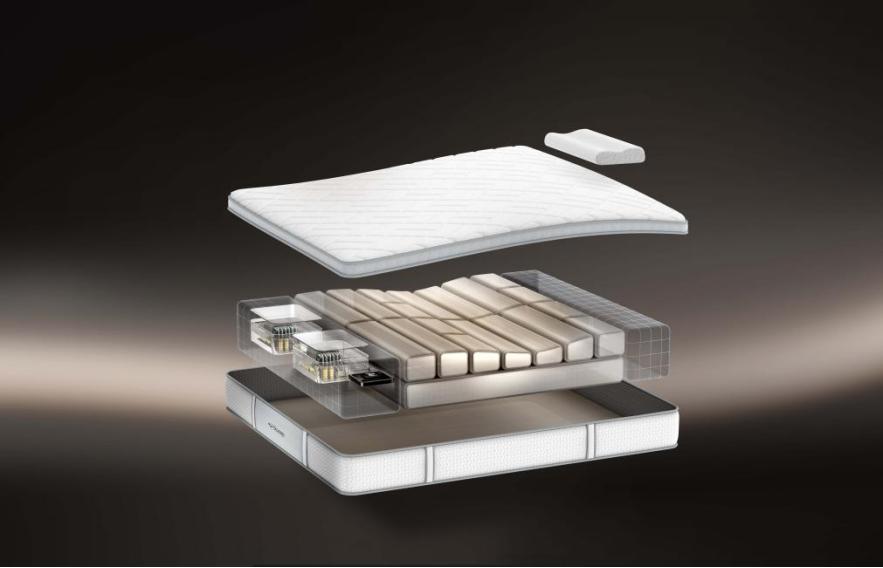
(Image source: Company)
In order to make this adjustment truly "happen during sleep" without interrupting the sleep experience, Stareep has made engineering optimizations to the underlying hardware.
The R & D team drew on Dreame's technical experience in motors, electric drives, and electronic control, and jointly developed a smart bed frame adjustment system with Dreame engineers. Through patented motors and structural design, the bed frame has almost no sense of jerks during adjustment, and the operating noise is controlled at about 20 decibels - close to the lower limit of human - perceptible sound.
Under this system, the mattress and the bed frame no longer work independently but work together to intervene in the user's sleep throughout the cycle: helping users relax and fall asleep through posture adjustment before sleep, making imperceptible adjustments for snoring or stress changes during sleep, and waking users up in a more natural way after sleep.
It is precisely under the premise of being quiet and natural enough that smart adjustment can truly play the role of "improving sleep" instead of becoming another smart device that users need to actively adapt to.

From a Bed to a 24 - Hour "Sleep Business"
Compared with pillows, a large amount of mattress consumption still occurs in offline stores.
In order to allow users to complete the experience more quickly, Stareep introduced the Matchfit matching system. After users lie on the mattress for 5 - 6 minutes, the system will combine body shape data, stress distribution, and the basic sleep model to match a more suitable mattress firmness scheme for them.
What supports this process is an AI smart agent algorithm based on millions of samples. It can serve smart mattresses with adaptive capabilities and also provide more definite selection suggestions for users of traditional mattresses.
After entering the usage stage, the mattress will continuously record the user's nightly sleep performance, generate sleep reports and scores, and constantly learn the user's long - term data, making the adaptive adjustment scheme personalized over time.
Currently, Stareep is extending the monitoring function to hardware such as smart rings, smart mood lights, smart pillows, and smart temperature - controlled mattress protectors. This means that daytime body data will be linked with nighttime mattress data. The user's daytime exercise data monitored by the smart ring will also be learned by the mattress and used to make responses at night.
The rapid rise in Stareep's valuation is not an isolated case. Eight Sleep just secured a $50 million financing at the beginning of the year. Today's Good Rest, founded by Wang Teng, a former Xiaomi executive, completed financing of tens of millions of yuan within a few days of its establishment.
Traditional home furnishing brands are also smart enough to choose to cooperate with software companies. In the past year, Simmons, in cooperation with Qiangnao Technology, launched a brain - computer interface AI mattress; Qisheng Technology released a new product of its Shufude smart bed and further deepened its collaboration with the HarmonyOS ecosystem; Qushui Technology, which has in - depth collaboration with the Xiaomi ecosystem, jointly launched professional sleep analysis services with DeepSeek.
If traced back, the smart mattress is not a new concept. When the IoT concept emerged in 2013, this category had already experienced a boom. But it was soon pushed to the corner due to poor product experience and high prices.
This time, although major brands have launched "brain - computer interfaces" and "adaptive algorithms", how to prove their intervention effects on sleep disorders from a medical and clinical perspective, rather than just being an expensive psychological suggestion, is a gap that the industry must cross to move from a "geek toy" to a "universal necessity".