The trend of power semiconductors has changed: Can BDS unlock a billion-dollar market within five years?
Since its inception, BDS (Bidirectional Switch) has shouldered the mission of revolutionizing power semiconductors. It has made possible topologies such as the Matrix Converter, Current Source Inverter (CSI), and single-stage AC/DC converters. However, due to its commercial implementation challenges, this technology has remained at the academic level.
However, since this year, the situation has completely changed. At this year's APEC (Applied Power Electronics Conference), several chip manufacturers showcased monolithic BDS (M-BDS) products: Renesas' newly launched 650V SuperGaN, Renesas/Tranphorm's 650 V GaN FQS, Infineon's 650V CoolGaN BDS, Navitas' 650 V bidirectional GaNFast, Innoscience's 30 - 120 V VGaN, and Ideal Power's 1200 V IGBT B - TRAN. STMicroelectronics (ST) and Texas Instruments (TI) also presented GaN BDS solutions in the pre - production stage at APEC, which are currently in the final stage of JEDEC qualification testing.
It can be seen that the bidirectional GaN switch (BD - GaN) has kicked off the "first year" of commercialization, and the power semiconductor industry is about to enter a new era. So, what are the benefits of the BDS technology, and which manufacturers are making arrangements? Today, EEWorld conducts a detailed inventory and analysis.
From Unidirectional to Bidirectional: Controlling Four Different States
An ideal switch should have bidirectional characteristics: it can block bidirectional voltages and conduct bidirectional currents, while having extremely low conduction and dynamic losses, efficient heat dissipation capabilities, and high power density.
However, traditional unidirectional switches (UDS) such as MOSFETs or IGBTs usually only have the ability to conduct in the forward direction and block in the reverse direction. Although the body diode of a MOSFET or the anti - parallel diode of an IGBT can be used to achieve conduction in the third quadrant, this reverse conduction process lacks gate control.
To achieve controllable bidirectional conduction, two traditional devices are generally connected back - to - back (B2B). However, this doubles the on - resistance RDS(on), so multiple devices must be connected in parallel to reach the impedance level of a unidirectional switch. Meanwhile, B2B increases system complexity, board area, and cost, and additionally introduces parasitic parameters that reduce switching performance and efficiency. More importantly, traditional three - terminal single - phase switch devices lack the flexibility to independently control bidirectional currents, which limits their application in advanced power conversion topologies.
The pursuit of higher power density, higher efficiency, and lower system cost has made these challenges even more severe. For topologies such as the Vienna rectifier, T - type converter, and HERIC architecture, the traditional solution of using discrete devices connected back - to - back can no longer meet the evolving market demands.
BDS is an almost ideal semiconductor switch: it can block in both directions and is equipped with two gates, which can very precisely control the on and off of each channel respectively, enabling the control of voltages of two polarities and currents in two directions. Therefore, it is very suitable for various topologies.
BDS no longer just controls two states of "on" and "off", but four different states: conduction (both gates are on), cutoff (both gates are off), forward blocking (gate 1 is on, gate 2 is off, current direction: drain → source), and reverse blocking (gate 2 is on, gate 1 is off, current direction: source → drain).
For this reason, the industry also calls BDS the "Four - Quadrant Switch" (FQS). As shown in the following figure, this is Infineon's analysis of the four states of BDS:
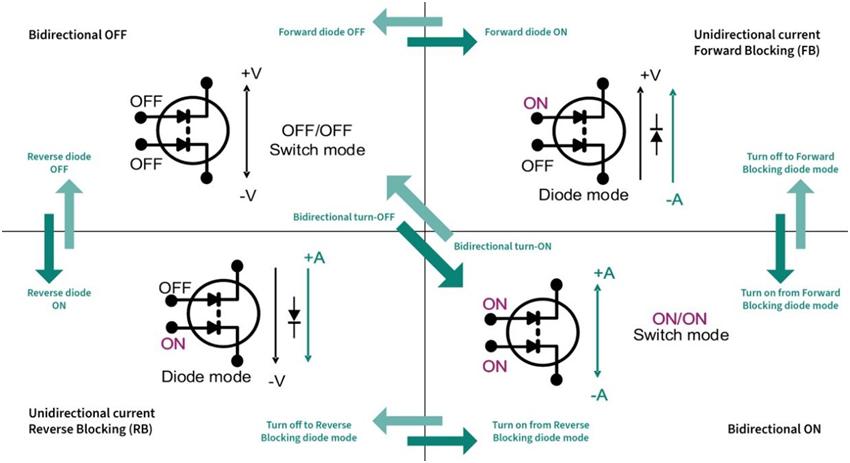
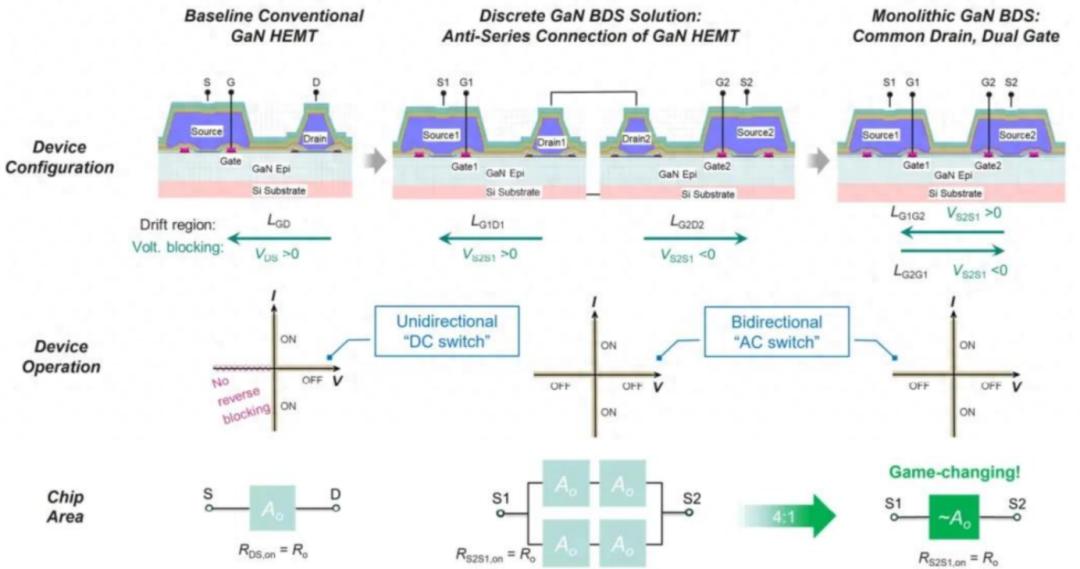
In addition, there are two configuration methods for bidirectional switches: common - source and common - drain. In the common - source topology, the two gates share the same local ground, so a single gate driver can be used. However, the on - resistance RDS(on) of this topology is relatively high. In the common - drain configuration, the two devices share the drain, and two gate drivers are required, but its RDS(on) is lower, so a better solution may be achieved. Among them, the common - drain configuration is the most mainstream method at present.
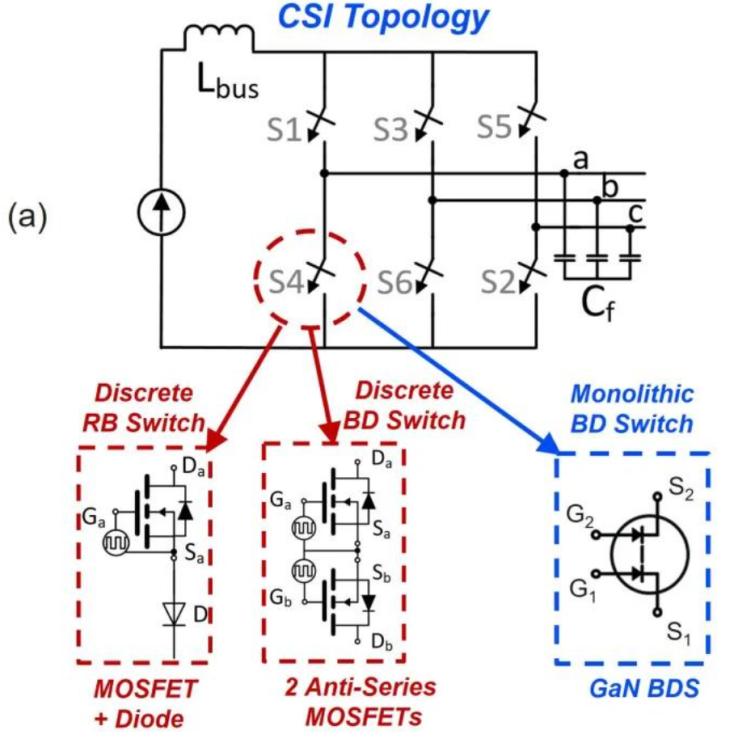
This four - quadrant characteristic means that the control method is also different from the traditional one. For example, in a Current Source Inverter (CSI), a four - step commutation sequence is used to achieve safe commutation, preventing over - voltage of the DC bus inductor (Lbus) and over - current of the DC bus capacitor (Cf).
What's the Value of BDS?
So, in specific applications, what exactly is the use of BDS?
First, it enables single - stage topology photovoltaic inverters and on - board chargers (OBCs). A typical AC/DC electric vehicle OBC first configures a PFC stage and then connects a DC/DC stage in series, with a large "DC bus" capacitor for buffering in between. The problem with this topology is that the system is bulky, has high losses, is complex in structure, and is expensive. BDS can achieve single - stage DC/AC conversion with higher efficiency.
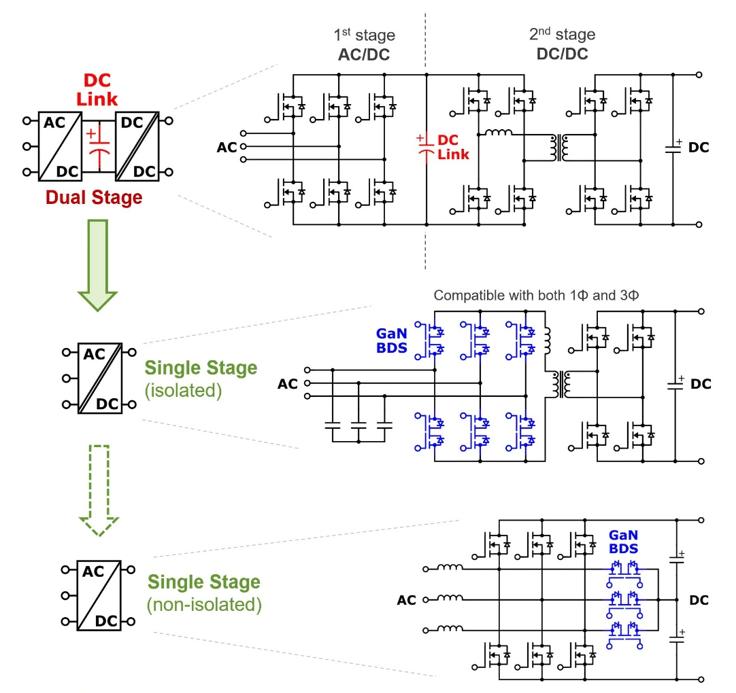
Second, it enables the Matrix Converter. Since the concept of the Matrix Converter was proposed 45 years ago, voltage, frequency, and power factor adjustment can be achieved by connecting three - phase ports through nine BDS devices. Compared with the traditional two - stage AC - DC - AC conversion scheme of a Variable Frequency Drive (VFD), the BDS scheme can eliminate harmonic interference, achieve energy feedback, and eliminate the bulky DC - link capacitor.
Third, it replaces B2B switches. In the Vienna rectifier, T - type converter, and HERIC inverter, B2B switches feed the DC mid - point back to the AC side for input inductor current compensation and harmonic suppression. After replacing B2B with monolithic GaN BDS, the number of components can be reduced, and the volume of passive components can be reduced due to the fast - switching characteristics.
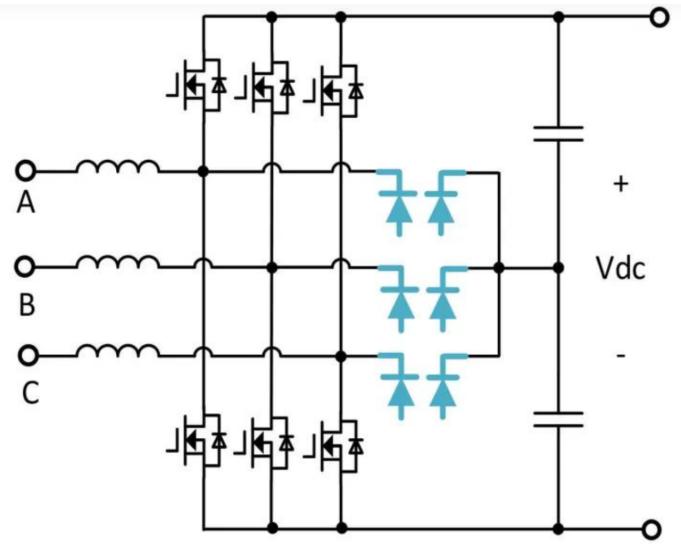
In the topology of a three - phase three - level T - type converter, GaN BDS is used as the neutral - point switch of the T - branch and only needs to withstand half of the DC output voltage under bipolar conditions.
Fourth, it is used in Current Source Inverters (CSI). The large inductor of a CSI has natural overload protection capabilities but requires a bidirectional voltage - blocking switch. Although CSIs face challenges such as complex control, they have obvious advantages in high - power motor drives, electric aircraft, and high - voltage direct - current power transmission. GaN BDS has been successfully applied in CSI design. While meeting the bidirectional blocking requirements, its unidirectional current conduction characteristics can simplify gate control.
Fifth, it is used in AC Solid - State Circuit Breakers (SCCB) and battery isolation. AC SCCBs require devices to have characteristics such as bidirectional conduction, strong over - voltage tolerance, low on - resistance, and fast response (fault clearance in μs). GaN BDS can replace mechanical circuit breakers or MOSFET/IGBT anti - series combinations, reducing the number of chips and improving efficiency. Its characteristic of having no significant Spirito effect avoids the problem of the limited Safe Operating Area (SOA) of silicon - based devices. The battery isolation switch in the charging circuit of mobile phones/laptops uses a source - merged single - gate architecture, and the on - resistance can be less than 10mΩ.
GaN BDS: The Fastest - Developing
GaN M - BDS is currently the most mature area of bidirectional switches. First, GaN is the only semiconductor that can achieve high - voltage bidirectional blocking capabilities on the same chip. Second, GaN HEMTs use a lateral structure, and all terminals are on the same side of the wafer, enabling the integration of other devices on the same substrate. Third, GaN devices based on Si substrates are compatible with CMOS manufacturing processes and can be mass - produced at a low cost in large - scale wafer fabs.
The concept of GaN BDS originates from the monolithic integration of two back - to - back unidirectional GaN HEMTs. In the common - drain structure, the two unidirectional GaN HEMTs are monolithically integrated, and the reverse drift regions of each HEMT are combined into one.
Ideally, compared with back - to - back series GaN HEMTs, GaN BDS only needs to use a quarter of the effective chip area to achieve the equivalent on - resistance, while inheriting all the advantages of GaN HEMT technology, such as zero reverse recovery, excellent switching speed, and low switching losses.
Reviewing the history of GaN BDS: In 1957, thyristors achieved bidirectional voltage blocking but could not conduct bidirectional currents. In 1958, triacs could handle bidirectional currents and voltages, but their switching speed was extremely slow (only 50/60 Hz). In 1959, MOSFETs brought a switching frequency of tens to 100 kHz, but their bidirectional versions were limited to low - power applications. In 1980, silicon - based IGBTs supported higher power, but a single device still could not handle both bidirectional voltages and currents. Although wide - bandgap semiconductors significantly improved power density, they did not initially have bidirectional capabilities. In 2007, Panasonic proposed the concept of GaN BDS based on the common - drain configuration of two GaN Gate Injection Transistors (GITs). Since 2019, with the emergence of GaN BDS engineering samples, related research activities have rapidly increased. In 2024, device manufacturers began to launch GaN BDS products one after another. In 2025, Enphase Energy first achieved the commercial application of GaN BDS in its IQ9 photovoltaic micro - inverter.
GaN BDS: Manufacturers' Layout
Currently, the main competition in GaN BDS is in the 650V field, led by three leading manufacturers: Infineon, Navitas, and Renesas.
Infineon
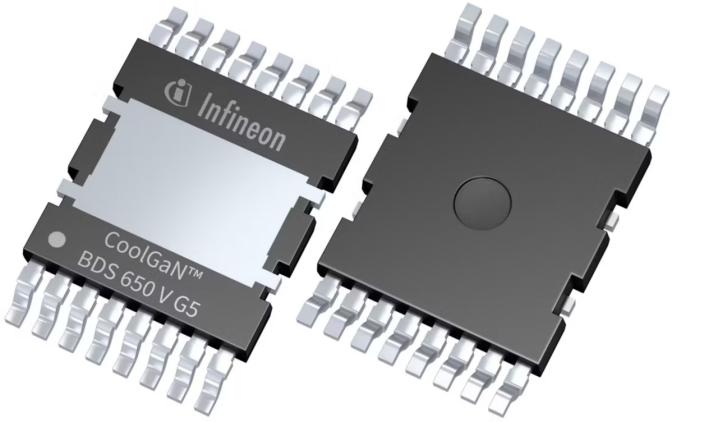
In 2024, Infineon launched the CoolGaN Bidirectional Switch (BDS) product series, offering voltage options of 40 V, 650 V, and 850 V. In 2025, it continued to launch the 650V CoolGaN G5 Bidirectional Switch (BDS). This product uses a common - drain design and a double - gate structure. It is a monolithic bidirectional switch using Infineon's powerful Gate Injection Transistor (GIT) technology and CoolGaN™ technology, which can effectively replace the traditional back - to - back switches commonly used in converters. Immediately afterwards, in November 2025, Infineon announced that the CoolGaN Bidirectional Switch (BDS) was applied in Enphase Energy's new - generation IQ9 series of micro - inverters.
Specifically, the 650V CoolGaN G5 uses a 650V bidirectional enhancement - mode transistor with a common - drain configuration. It has bidirectional blocking capabilities, low gate charge, low output charge, integrated substrate voltage control, and is certified to the JEDEC standard. The on - resistance is stable across temperature and frequency ranges and can replace the traditional back - to - back switch configuration.
Its application value lies in its compact structure, high cost - performance ratio, low conduction losses, simplified design, and accelerated time - to - market. In terms of competitive advantages, a single CoolGaN bidirectional switch can replace the four discrete switches required by the traditional back - to - back configuration, significantly simplifying the converter design, reducing the number of components, and effectively reducing the system cost. Its circuit structure has significant advantages over the traditional two - stage scheme.
Navitas
In March 2025, Navitas launched the industry's first 650V bidirectional gallium nitride power chips, NV6427 and NV6428, with typical on - resistances of 50mΩ (corresponding to a continuous current of 49A) and 100mΩ (corresponding to a continuous current of 25A) respectively. They have zero reverse recovery charge characteristics, a maximum switching frequency of 2MHz, and use a top - cooled TOLT - 16L package.
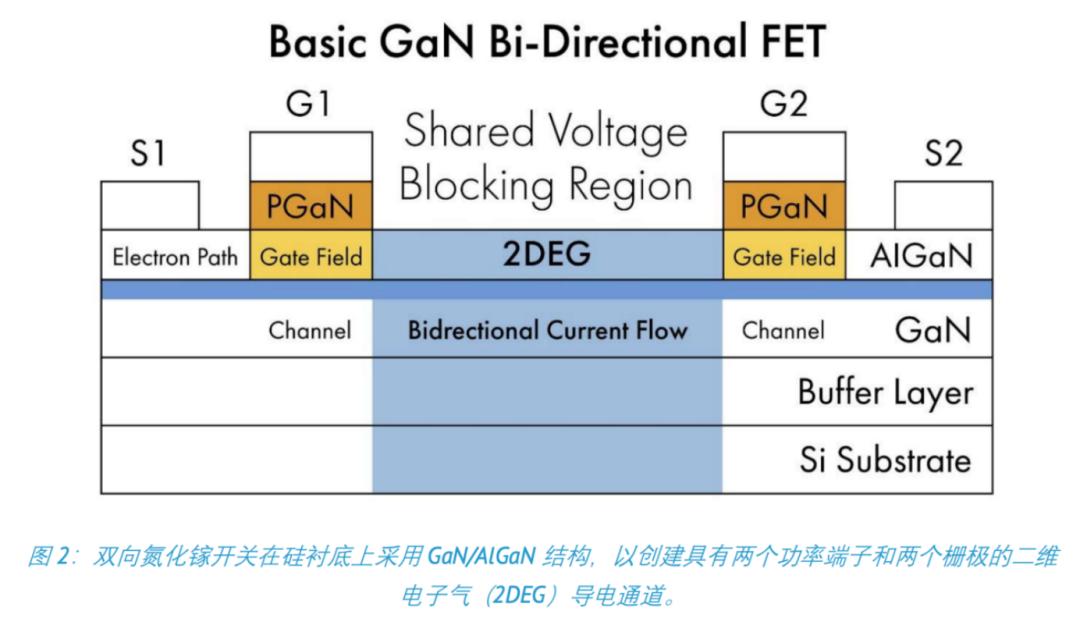
Navitas analyzed that to achieve bidirectional voltage handling and polarity - dependent current flow control, bidirectional gallium nitride switches need to have independent gates. The typical structure is to grow a GaN/AlGaN epitaxial layer on a silicon substrate to form a two - dimensional electron gas (2DEG) conductive channel, which includes two power terminals and two gates. However, if the silicon substrate is not connected to the source, the floating substrate will cause potential accumulation, reducing the 2DEG concentration through the "back - gate effect" and thus affecting device performance. For this reason, Navitas was the first to develop and launch an active substrate clamping technology, which can autonomously clamp the silicon substrate to the source at the lowest potential, ensuring the stable operation of the bidirectional gallium nitride switch with no resistance drift. Thanks to this, in many application scenarios, the operating temperature of this device is 15°C lower than that of similar non - clamped solutions.
In addition, bidirectional gallium nitride switches require a dedicated driver to control the double gates. This driver needs to be able to handle high - transient conditions, high - voltage isolation, and ensure excellent signal integrity, supporting an operating voltage of over 5kV and an extreme transient change of 200V/ns. For this reason, Navitas developed the IsoFast high - speed isolated gallium nitride driver, which is specifically designed for bidirectional gallium nitride switches, supports a frequency of over 1MHz, a 5kV isolation withstand voltage, and can transmit high - speed signals with high integrity.
Navitas said that the single - stage bidirectional gallium nitride switch converter eliminates the PFC stage, electrolytic capacitors, and DC - link capacitors, naturally supports soft switching, can fully utilize the high -