New breakthrough in Neuralink's brain chip: ALS patients can speak with their minds and communicate with others in their "original voices"
On April 1st, Neuralink, a brain-computer interface company under Elon Musk, released a video that caused a huge sensation on social networks.
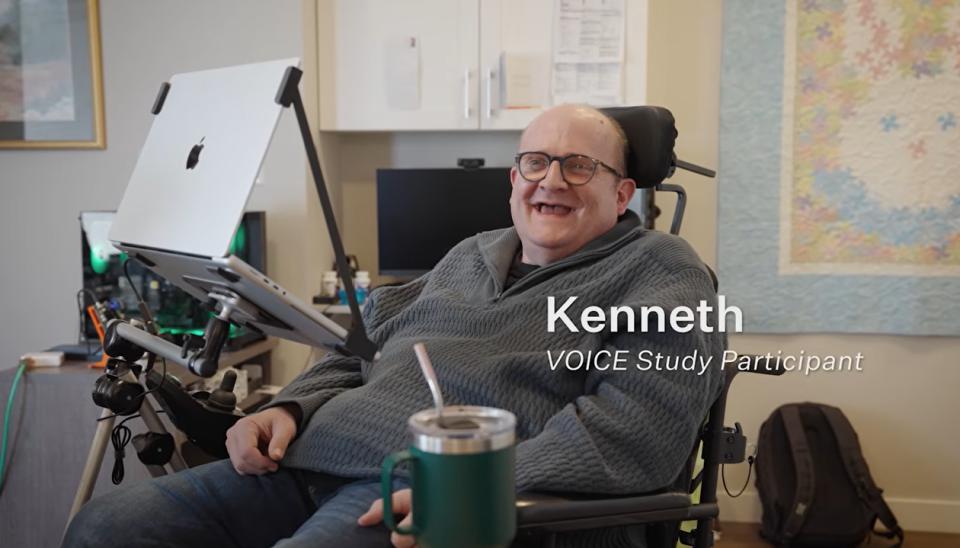
In the video, a man named Kenneth Shock sat in front of the camera. He didn't open his mouth or make any sound, but a voice clearly came from the speaker beside him: "I'm talking to you with my mind."
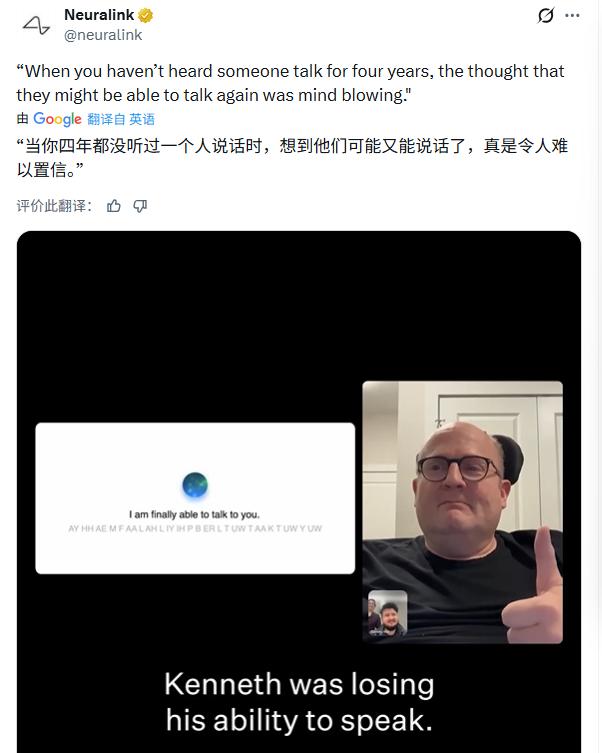
This is not a science fiction movie. It's what Shock "thought" directly through his brain. He is a patient with ALS (amyotrophic lateral sclerosis), diagnosed in 2024, and gradually lost the ability to speak. By early 2026, it was very difficult for him to have a complete conversation, and he could hardly even make a phone call.
But things changed after he received a Neuralink brain chip implant in January 2026. Through the N1 chip implanted in his brain, his neural signals are captured in real-time, decoded into phonemes, then combined into words, and finally read out by computer voice. Moreover, this voice specifically restores his voice before he got sick in 2020. His wife, Cheryl, calls this voice "Original Ken."
"When you haven't heard someone speak for four years and suddenly think he might be able to speak again, it's so amazing," Cheryl said in the video.
01 It's Not Mind Reading
When many people first saw this video, their first reaction was: Is this mind reading?
Actually, it's not. Neuralink explained that the implant doesn't directly read every thought that passes through Shock's mind. Instead, it focuses on a more specific task - capturing brain signals related to "speaking."
The company explained in a blog post: "There are specific areas in the brain that are activated and generate signals that are transmitted to the muscles of the mouth, tongue, and vocal cords." In other words, Shock can't just think randomly to output words. He needs to "intend to speak." When he wants to make the sound of a certain word, the brain sends instructions to the vocal organs, and the N1 chip intercepts these instructions.
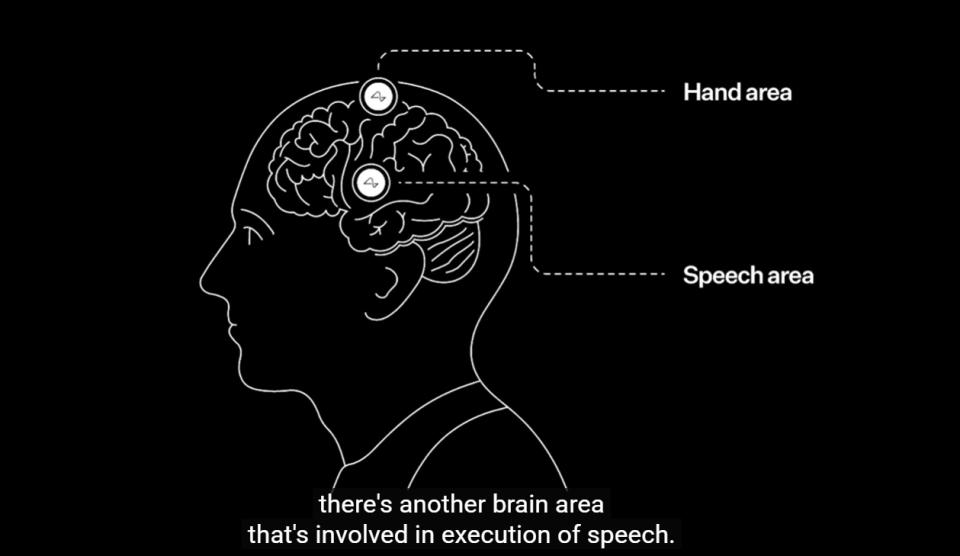
The linguistic unit used in this process is called a "phoneme," which is the smallest sound segment in speech. Neuralink's software matches neural signals to corresponding phonemes in real-time and then assembles the phonemes into complete words and sentences.
Nir Even Chen, the head of Neuralink's brain-computer interface application, gave an example: The Telepathy product mainly records the areas in the motor cortex that control hand and arm movements. If you go down about two to three inches, you'll reach the brain area responsible for speech execution.
02 Three Training Stages
This system can't be used right after installation. It needs training.
Skyler Granatir, a machine learning engineer at Neuralink, introduced the training process in detail through a video. The whole training is divided into three stages.
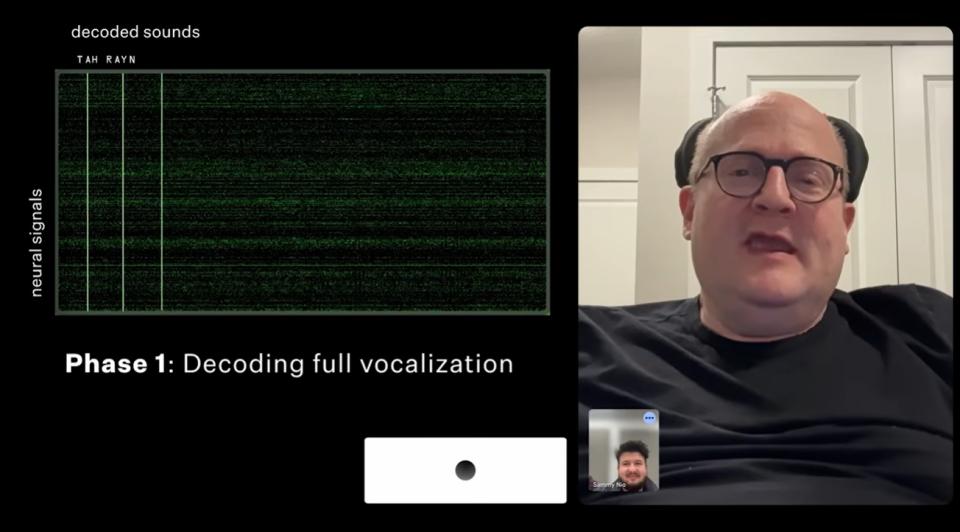
The first stage starts immediately after the surgery. Engineers guide Shock to speak some sentences out loud, and the system records the corresponding neural signals of these sentences to establish a mapping relationship between "neural intentions" and "actual words."
In the second stage, Shock no longer makes a sound but only makes the mouth shape of saying these sentences, "speaking" silently. The system needs to continue to identify his neural signals at this time and output the correct words.
In the third stage, not even the mouth shape is needed. Shock only needs to silently recite in his mind, imagining himself saying those words, and the system can capture the corresponding neural activities and complete decoding.
"Our goal is that just by intending to move his mouth, our BCI (brain-computer interface) can decode his speech," Granatir said.
The engineers also encouraged Shock to pronounce each sound more slowly and clearly during training. For a while, the system's performance suddenly improved significantly. Granatir described it as "the model performance soaring from 0 to 100." Shock happily recited a classic test sentence at that time: "The rain in Spain stays mainly in the plain."
03 Go Home the Day After Surgery
Many people's first reaction to brain surgery is: high risk and slow recovery. But Shock's experience is different.
His wife, Cheryl, recalled that the hospital let him go home the day after the surgery. "The whole process was very smooth. You wouldn't even know that it seemed like nothing had happened two days later." After the surgery, they stayed in Dallas for a short time and then entered the training stage.
Shock himself had a concern. His lung capacity is lower than normal, so he had some concerns about the surgery itself. But besides that, he said he was "going all out."
Neuralink engineers mentioned that in the week after Shock's surgery, they completed the surgery for a second voice participant. The whole process seems to be quite standardized.
04 Speak with One's Own Voice
One of the most touching details of this technology is that the voice output is not a cold machine-synthesized voice but Shock's own voice before he got sick in 2020.
Cheryl explained that they noticed the change in Shock's voice during the COVID-19 pandemic. In January 2024, they officially received the ALS diagnosis. Before that, Shock's voice was clear and normal. Neuralink found the recordings from that period and used AI to restore his timbre.

So when the device first said "I love you" in the voice of "Original Ken," Cheryl's emotions welled up.
"It's so emotional," she said. "Hearing that sentence again in the same way as I heard it on the phone all those years ago is just unparalleled."
Of course, this technology is far from perfect at present.
From the video, it can be seen that after Shock "thinks" of a sentence, the system needs a few seconds to complete the whole process of capturing, decoding, synthesizing, and reading. That is to say, there will be obvious pauses in the conversation.
Neuralink itself also admits this. The company mentioned in the description that the decoding process needs to be improved, and there is currently a delay of a few seconds. But their goal is clear. Granatir said: "We want to build a system that can directly and real-time convert brain signals into speech. At that time, Shock will be able to give instant feedback and control this voice."
The quality and quantity of sensors are also constantly improving. Granatir said that Neuralink's device can provide something that other devices can't, that is, single-neuron recording from thousands of channels simultaneously.
05 Netizens Are Amazed
After this technology was announced, it sparked a lot of discussions on social media.
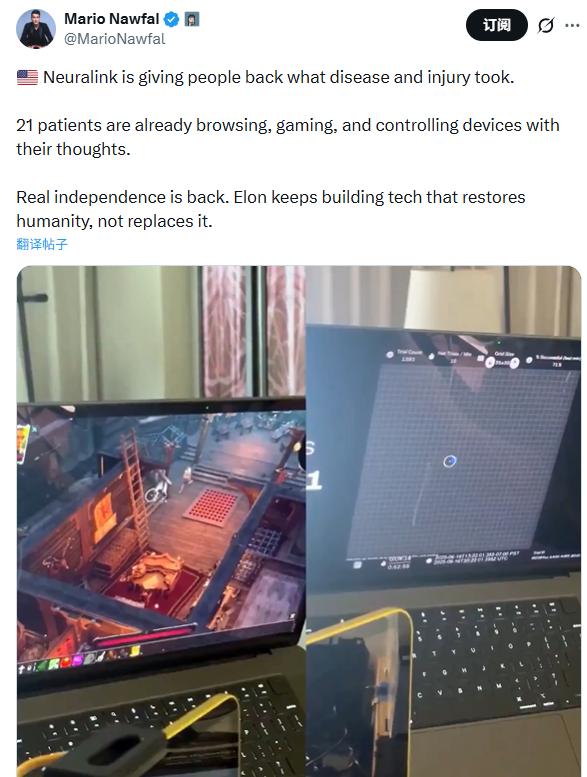
A user on X counted that Neuralink is helping people regain what they lost due to diseases and injuries. 21 patients can already use their minds to browse the web, play games, and control devices. He believes that true independence has returned, and Musk has been developing technologies that can restore humanity rather than replace it.
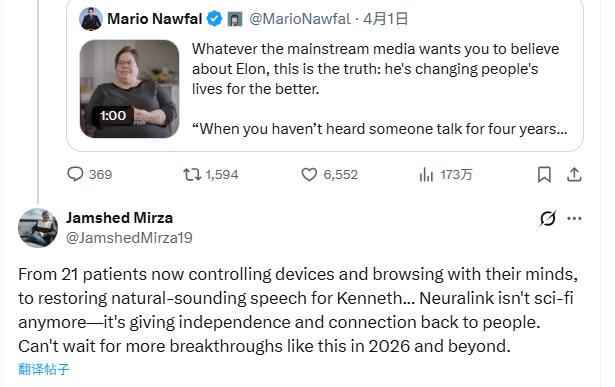
Another netizen focused on Shock's specific case. He said that from the fact that 21 patients can now use their minds to control devices and browse the web to helping Shock restore natural and fluent language expression, Neuralink is no longer a plot in a science fiction novel - it is helping people regain the ability to be independent and interact with others. He looks forward to seeing more similar breakthroughs in 2026 and beyond.
Some netizens took a broader perspective and believed that the technology being developed by Musk's Neuralink is the future we need.
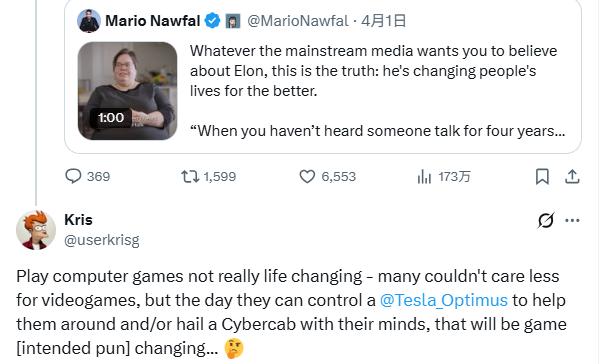
Some netizens also proposed more specific application scenarios. Some people think that playing computer games doesn't really change people's lives - many people are indifferent to video games. But when they can control a Tesla Optimus robot to help them move around or summon a ride-hailing car with their minds, it will completely change the game rules.
06 Musk: Restoring Speech Is Just the First Step
Regarding this progress, Musk himself also spoke on the X platform. He reposted the relevant video and wrote: "Neuralink is restoring the ability to speak for those who have lost it."
But obviously, he wants to do more than that.
In a previous post, Musk also announced another Neuralink project called "Blindsight." The goal of this project is to restore vision for completely blind people, including those without optic nerves and even those who are congenitally blind.
Its working principle is to bypass the eyes and directly stimulate the visual cortex of the brain. Musk said that the early version may produce low-resolution vision, but it will improve over time. Currently, this project is still in the experimental stage, and human trials are expected in the future.
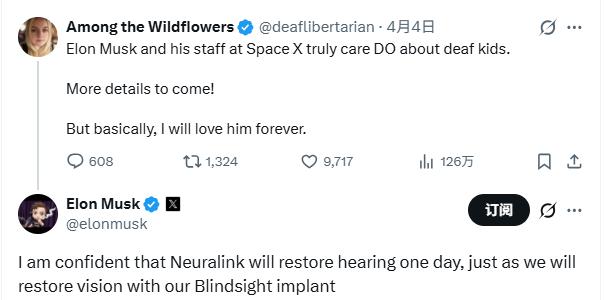
In addition, Musk also said that he believes that just like using Blindsight to restore vision, Neuralink will one day be able to help people restore their hearing.
07 The Technology Is Still in the Experimental Stage and Far from Market Launch
It should be noted that currently all of Neuralink's devices are still in the research stage, have not been approved by the FDA, and are not on the market for sale.
Neuralink's official post on the X platform also clearly states this. Although the effect shown in this video is very shocking, there is still a long way to go before large-scale application. Neuralink still faces challenges in terms of government approval, long-term safety verification, and neural data privacy.
But anyway, for Shock and his family, this matter is already significant enough.
At the end of the video, Shock said that Neuralink has given him a purpose in life. Although he can't be cured of ALS, he can help improve the technology by participating in research and providing feedback. He believes that voice is crucial and emphasizes that doing good for others to the best of his ability before the end of his life is the primary reason that drives him. He finally encouraged everyone to be the captain of their own lives and make full use of everything life has given them.
This article is from "Tencent Technology", author: Jin Lu, published by 36Kr with permission.