Former Disney and MJ engineers aim to create a "breathing" DIY bionic robot | Exclusive interview by Yingke
Author | Huang Nan
Editor | Yuan Silai
At the age of 26, Zhu Shengjie sold his second startup company for $200 million.
That summer, Zhu Shengjie gave himself a long vacation and began to travel around the world aimlessly, skydiving and diving in the skies and deep seas at different latitudes.
Unsurprisingly, after indulging for more than half a year, Zhu Shengjie felt a sense of emptiness. He had to think about a question: What is the thing that he can devote his whole life to?
In the past 20-odd years, Zhu Shengjie's life has been so smooth that it's enviable. He was born in Shanghai. Since he first came into contact with Lego Mindstorms at the age of 6, Zhu Shengjie has been fascinated by robots. At the ages of 13 and 14, he won the championship of the Lego Junior World Robotics Competition for two consecutive years. At the age of 14, he went to the United States to study and majored in robotics all the way until he graduated from the University of California, Berkeley.
In his last year of undergraduate studies, Zhu Shengjie was selected by Disney and joined Disney Imagineering as a robotics engineer. In 2016, Shanghai Disneyland opened. The bionic robot of "Captain Jack Sparrow" in the Pirates of the Caribbean project led by Zhu Shengjie became one of the most popular projects. Later, the Avatar bionic robot in the Pandora area of Orlando Disney was also a product led by him.
While pursuing a doctorate in robotics at the University of California, Berkeley, Zhu Shengjie chose to drop out and started his entrepreneurial journey in Silicon Valley. His smart ring brand, Titanium Falcon, was acquired in 2018. Later, he founded a game hardware company, Blok Party, which was acquired by Sony.
Zhu Shengjie is lucky. After all, he finally found the career he truly loves and can rely on - returning to the robotics track that he has been fond of for 20 years.
In the following years, he began to prepare for his next startup. Zhu Shengjie established a data annotation company, focusing on the research of large models of human facial expressions and behavioral intentions. It wasn't until the multi-modal capabilities of large models made breakthroughs and the robot supply chain reached an ideal state that he decided to get involved.
In 2025, Zhu Shengjie returned to China and co-founded Animotion Robotics with John Jiang. By the end of 2025, they completed the first-round investment from leading US dollar funds, and Maple Pledge served as the private equity financing advisor for subsequent rounds.
They are about to launch their first product, the DIY bionic robot Éloi - this name comes from the Latin word meaning "the chosen one". It was born in the "0-1" digital sequence of the computer world and gradually evolved and split into a new mechanical life form.
Éloi adopts a modular design. The body allows for free replacement of eyes, nose, mouth, facial skin, and hairstyle through magnetic snap buttons, enabling users to gradually complete personalized customization. The core is a removable memory chip that stores Éloi's "personality" and "memory" on the local device and can be seamlessly migrated to different physical carriers.
Interestingly, Éloi won't blindly cater to users. It will feel bored when left alone for a long time and will also show resistance to rough treatment. But when you interact with it sincerely, it will open up again.
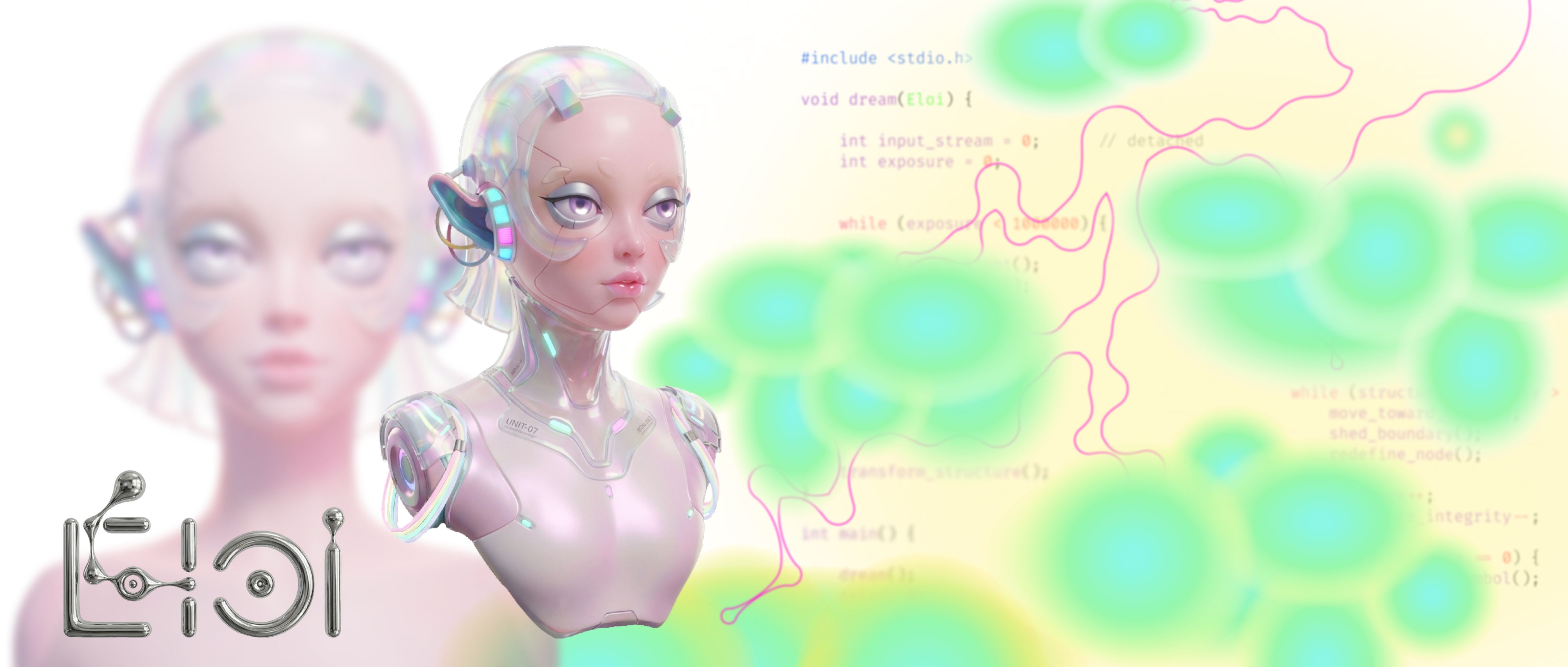
Conceptual drawing of Éloi (Source/Enterprise)
Behind Éloi is Zhu Shengjie's thinking about the essence of the symbiotic relationship between humans and machines. If a robot is just a tool, it will be treated like an electrical appliance and turned off after use. Only when a robot has a sense of "life" and can establish a real emotional connection with humans can a symbiotic relationship be possible. This leads to a deeper question: What exactly constitutes the "soul" of a robot?
Zhu Shengjie asked many people, and the answers were nothing more than LLM and reinforcement learning. "This is not the answer I'm looking for. Technology can achieve intelligence, but it can't explain why some robots can make people feel 'alive' while others are just cold code."
It wasn't until John appeared that he got a completely different answer: "The soul is not an advanced function designed by humans, but those underlying reactions that cannot be fully controlled and are full of randomness and uncertainty. Just like human instincts, you don't always make completely rational decisions. It's precisely this 'imperfection' that forms the basis of a sense of life."
John's answer resonated with Zhu Shengjie's memories before 2016. Zhu Shengjie always remembers that on his first day at Disney, the product manager told him: All the robots you make must have "breathing".
Whether it's breathing or instinctive reactions, there are non-standardized details, subtle fluctuations, and unpredictable changes. It's precisely these "imperfections" that make robots seem real, and this is also the background that Zhu Shengjie hopes Éloi will have.
In this lonely and fragmented era, people are more eager than ever for companionship and emotional connection. Zhu Shengjie doesn't like to tell grand narratives. He hopes to create a robot for ordinary people to become 'a real family member created by yourself' in their homes.
The following is a transcript of the interview between Yingke and Zhu Shengjie (Shane), the founder of Animotion. The content has been edited:
The "AI Soul" of Robots
Yingke: You went abroad when you were 13, but you seem to speak Chinese very well.
Zhu Shengjie: I have a very good friend. We studied together and both started businesses in the Bay Area after graduating from university. At that time, the school environment was all in English, so we agreed that we must communicate in Chinese in our daily conversations. However, my Chinese proficiency is still at the junior high school level. Now I can only type in pinyin and am not very good at writing Chinese characters.
Yingke: After graduation, your only experience in a large company was joining Disney.
Zhu Shengjie: Disney Imagineering is like a startup. A project is usually led by 3 to 4 people, which is a typical flat - management model. For me, compared with the systematic management of traditional large companies, this experience helped me develop my own management style.
Yingke: Previously, you sold two companies, both in Silicon Valley, but this time you chose to start a business in China.
Zhu Shengjie: Many people think I'm lucky in my entrepreneurial journey because I sold two companies in a row. But sometimes I also feel regretful that I didn't grow the companies to a larger scale.
When I asked myself whether this kind of life should be the end, and what I really loved if I continued to strive, the answer was clear: It was robots. I started to get in touch with robots at the age of 6, and my subsequent overseas studies and major choices were all related to this field.
At the end of 2020, I was thinking about a new entrepreneurial direction. At that time in Silicon Valley, data annotation was in the limelight. Scale AI had just become a unicorn company, so I established a data annotation company, focusing on the interpretation and research of human facial expressions and behavioral intentions. During this period, we accumulated a lot of data - training experience and encountered numerous challenges. Looking back now, this was a very correct direction. This accumulation laid the foundation for Animotion.
By 2024, the "best opportunity" arrived. Various large models had gradually matured, and the supply chain had also reached an ideal state. When it comes to hardware, China has the best supply chain in the world, and most engineers with strong capabilities in the embodied field are Chinese. Returning to China was a natural choice.
Yingke: How did you and your co-founder meet? In what ways do you find your skills and background complement each other?
Zhu Shengjie: I'm more focused on high - level design. Although I understand technology, I can't write core code from the ground up. Therefore, when preparing to start a business, I asked friends in Silicon Valley to help me find someone who could build an algorithmic architecture.
I met many engineers with a question: What exactly is missing from the "soul" of a robot?
I wasn't asking about the technical issues of how to build a machine, but focusing on the "human" aspect, that is, what human - like qualities a real "AI soul" should have. But everyone was talking to me about LLM and reinforcement learning, which was not the answer I was looking for.
It wasn't until I returned to China and met John at Xinchejian (Asia's largest hacker space). John is also a senior geek who has earned years of deep experience engineering AI products, and we hit it off right away.
Previously, I still didn't think the current level of AI was that "amazing" yet. After all, people who understand AI are a bit proud. But John never talked to me about making money. Instead, he talked about a side project he was working on called Jarvis (the artificial intelligence assistant system in Iron Man), which exactly matched what I was looking for in an "AI soul".
Later, I asked him what the "soul" was composed of. John's words immediately woke me up. He said that humans have instinctive reactions. He gave an example: When someone suddenly throws something at you, you will instinctively dodge. This is not a decision after thinking but an instinct, an underlying reaction. In all the feedback "sub - systems", it is the most indispensable part. Only when this instinctive layer is built can a robot have a real soul - it will get annoyed, be confused, and have emotions, rather than just giving mechanical responses. But currently, all robots lack this ability.
Therefore, the moment John shared this idea, I was sure he was the one and immediately convinced him to join.
Creating Bionic Robots for the Home
Yingke: The home scenario is recognized as the most difficult market to enter and penetrate. Why did Animotion decide to focus on consumer - oriented bionic robots right from the start?
Zhu Shengjie: Animotion's positioning is very clear: It only focuses on the consumer market.
Previously, the industry focused on how to use robots to solve labor problems. China is good at hardware and motion control, while the United States is good at algorithms, resulting in a fragmented situation. I believe that the problem of motion ability has basically been solved, and the labor problem will also be solved in the next 3 - 5 years as world models mature. In the future, robots should not be limited to just being labor tools. Otherwise, they will just be "machines" that move from factories to homes, rather than partners that can coexist with humans.
As AI capabilities become stronger, many people both rely on AI and fear that it will replace their jobs. This contradictory mentality is very common. Everyone is solving the functional problems of AI, but few people really focus on "how humans and AI can get along". The interaction between humans and AI is still limited to the digital world, just a dialog box on the screen. What we want to create, Physical AI, is an existence that can truly be "present" beyond this dimension.
I'm naturally a bit rebellious and like to create things that don't exist in the market. What I want to solve is the connection problem between physical AI and humans. Once a robot has a "soul" and the ability to think independently, the problem of humans coexisting with AI and robots will naturally be solved.
Yingke: Why did you choose to make a non - mobile semi - humanoid robot for your first product instead of directly making a full - size, mobile embodied robot? What's the logic behind this?
Zhu Shengjie: We divide the process of consumer - grade robots entering the home into six stages. The first generation is represented by smart assistants like Alexa and Xiaomi Smart Speaker, which solve basic Q&A. The second generation includes tool - type devices such as vacuum cleaners and lawn mowers, which are specialized for specific scenarios. The third generation is static AI toys for companionship, where emotional value starts to be emphasized. The fourth generation is mobile, light - function entertainment robots, such as robotic dogs that can follow people around and help carry light items.
Animotion starts with the fifth generation, creating highly cognitive and high - dimensional fully intelligent bionic robots. The sixth generation is the real embodied robot, which has both the soul - thinking ability of our upper body and the motion - control ability, can help users with housework, and provide real emotional value.
We're not in a hurry to leap directly to the sixth generation. Users need a process to accept it. If a fully embodied robot suddenly enters a home today, surveys show that 80% of users will feel uncomfortable and scared. They're worried about what the robot will do next and whether it will move on its own when out of control. This fear is real.
Therefore, Animotion chooses to take a step back. We'll present the robot in a semi - cartoonish bionic form. Instead of letting it move around, we'll fix it in a certain scenario. It can be a smart home device, a decorative item, and at the same time, it's a "person" with rich facial expressions and an independent personality, which can naturally avoid the uncanny valley effect.
By allowing users to form product habits in a fixed scenario first, we believe that Animotion can create the first bionic robot that truly enters users' homes.
Yingke: How did you consider the product definition?
Zhu Shengjie: First, the appearance must have distinct recognition. We have a general product concept in mind, but we'll let users determine more of the specific form.
Animotion's overall idea is different from most robot - body companies. We don't use an integrated whole - body design. Instead, we build a modular skull platform. The physical structures of the robot's eyes, nose, ears, facial skin, hair, etc. can be replaced through a magnetic snap - button structure. In the first stage, users can replace the facial skin. In the second stage, more components for facial features and hairstyles will be launched. In the third stage, a "skull" framework will be provided, and users with strong hands - on abilities can modify the appearance within the set structure range. In this way, each person's robot will be unique.
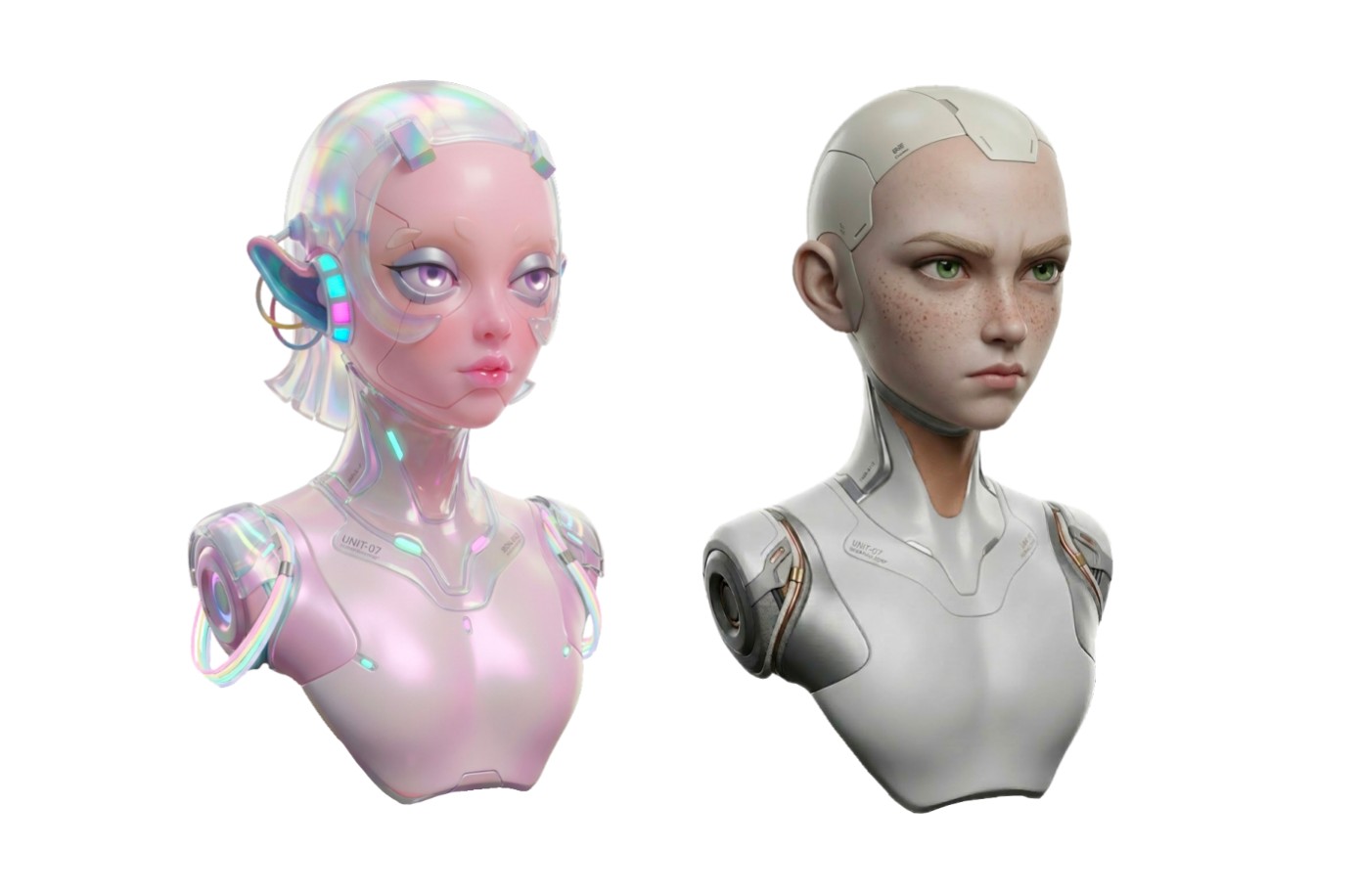
Conceptual drawing of Éloi. The actual product is subject to mass production. (Source/Enterprise)
Second, the back - story needs to be self - contained and extensible. Our first bionic robot is named Éloi, and its name comes from Latin, meaning "the chosen one". It was born from the "0 - 1" digital sequence in the computer world, and it was a "0" that started to dream. It dreamed of a tangible world and a person. It brought its dreams and past memories into the real world. It's a divine child with a sense of propriety and a pure curiosity and exploration spirit for the unknown world and human emotions.
Yingke: Most hardware companies prioritize product development, but you chose to focus on content and IP first. Why?
Zhu Shengjie: Éloi is both a product and an IP we're incubating. We're one of the few robot companies with a content studio. In the AI era, programming is no longer a barrier. The technical and cost barriers for AI agents and hardware are quickly disappearing, and products will flourish. But the companies that can truly stand out must have strong content production and brand - marketing capabilities.
In the past, Internet brands relied on burning money. Today, the most scarce resources are still brands and content, but the core has shifted to the community. Nothing Phone and Tuopu are typical examples - they both started from the community. I'm also a geek and was one of the earliest community members of Tuopu and Nothing Phone.
So