A group of post-2000 geeks spent 72 hours with this robotics company.
At 5 p.m. on March 29, 2026, when we arrived at the fourth floor of Shenzhen Institute of Science and Technology Innovation, 20 groups of contestants participating in the "First Global Embodied Intelligence Developers Conference" had been developing here for 60 hours.
The air on-site was filled with the smell of coffee mixed with air conditioning. There were unfinished milk teas and fruit cuts everywhere. Tents were set up in the corridors and corners, and some contestants were catching up on sleep inside. "They stayed up until 4 a.m. the previous day."
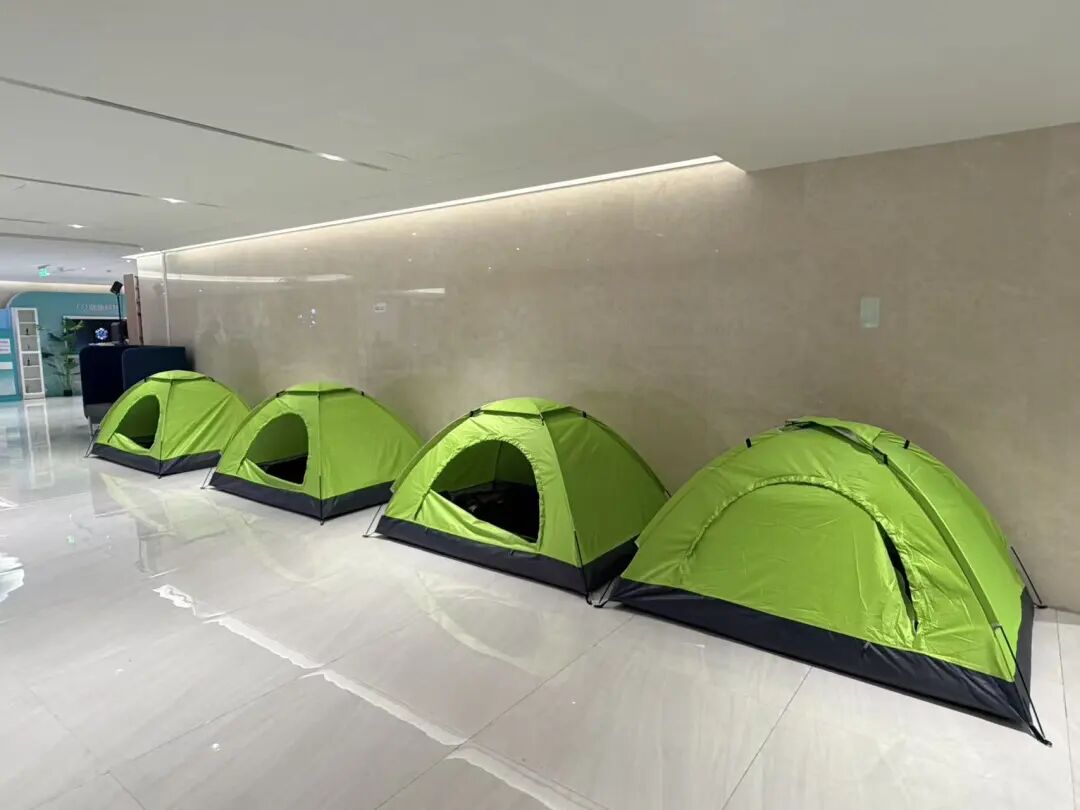
Photo taken by Intelligence Emergence
Different from hackathons for developing applications/software, at this Embodied Intelligence Developers Conference, there were nearly a hundred high-performance six-axis robotic arms in sight. Invisibly, there was also a computing power support of over 100 PFLOPs in the background, and open-source base models such as independent variable WALL-OSS, Pi0.5, and NVIDIA DreamZero were available for selection.
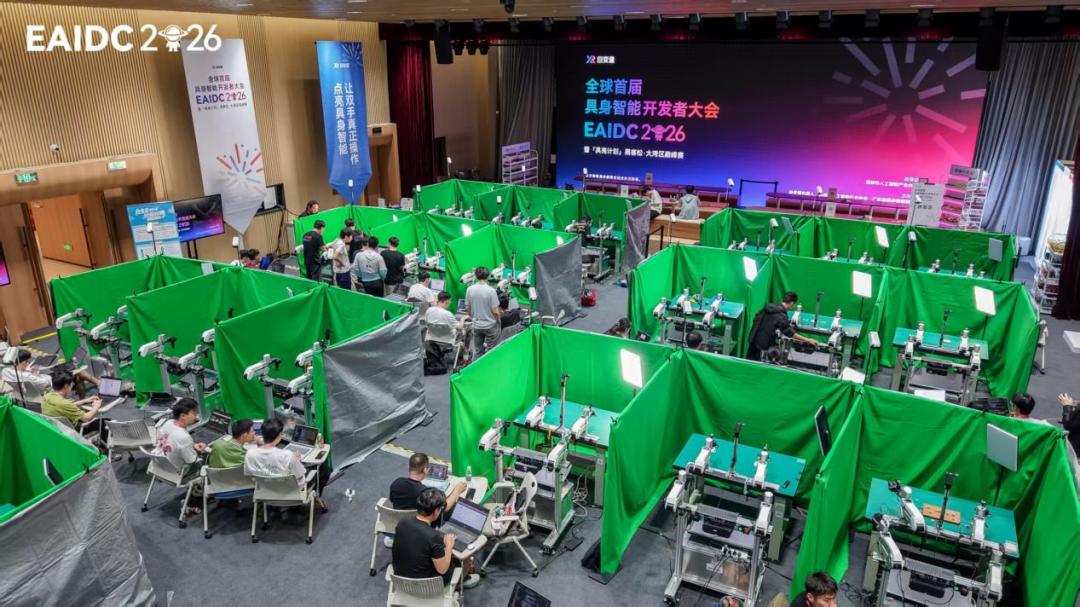
Photo provided by the official
"I've never had such a well-equipped battle!" "Brother Zihao from Tongji University", who has 330,000 fans on Bilibili, sighed after seeing the event support provided by the organizer.
Almost all the contestants were post-2000s. A team named "MVP" on-site was temporarily ranked first that day. The team leader was a serial entrepreneur with rich experience in competitions. He said he "brought his own 5090 GPU and several robotic arms". The other two team members were from Shenzhen University and the Hong Kong University of Science and Technology respectively.
What the contestants had to do was to make the robotic arm execute a single task as successfully as possible within three days by collecting data and adapting algorithms. For example, putting strawberries and apples into different baskets; or after identifying an object, spelling out the English name of the object with letter building blocks, and an even more difficult task - inserting a Type-C cable into the port.
"At first, we were worried that calling it the 'First Global' was too grand. But later, we found that indeed, there has never been a competition of this scale either at home or abroad." Wang Qian, the founder & CEO of the independent variable robot and the organizer, said in his speech on the final day.
Within 72 hours, the contestants needed to teach the robotic arm to recognize the environment, make decisions, and understand operations, which was quite difficult. Wang Qian himself also said, "It's really hard to get started with this." But he also mentioned that extremely compressing the competition time could give everyone a push.
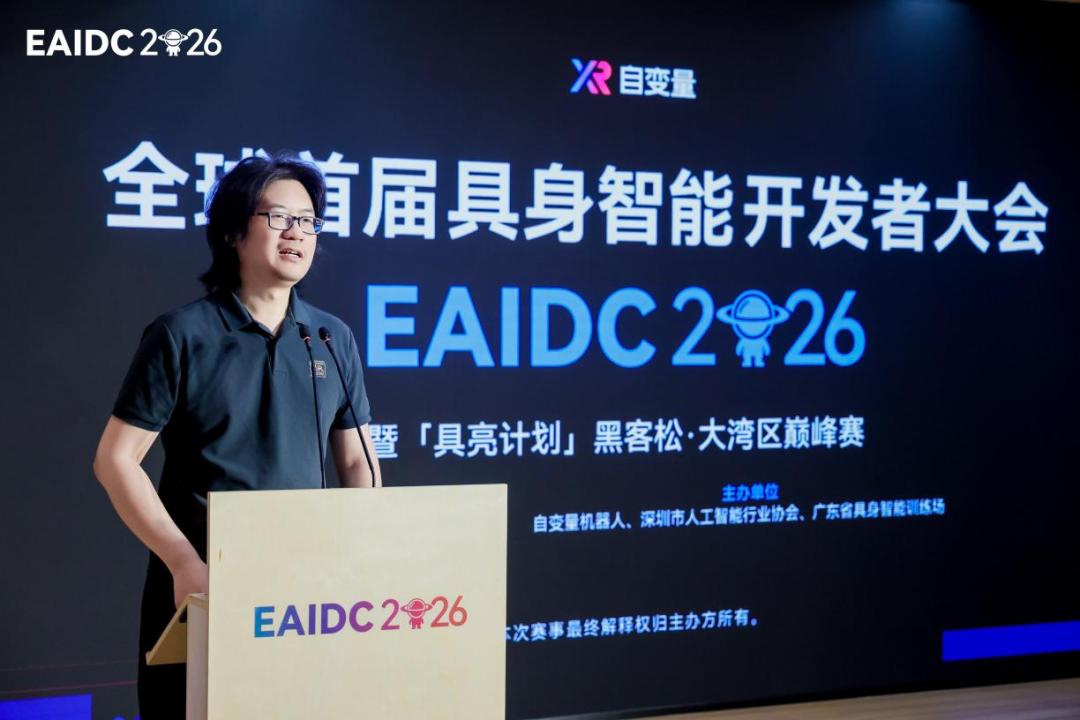
Wang Qian, the founder of the independent variable
Return to Reality
There is a problem with embodied intelligence at present: it is "fake".
Many of the robots you see working in factories to screw screws or picking up goods and collecting payments in retail scenarios are just staged shots under pre-set programs and environments. Once the venue or lighting changes, the robots will be at a loss.
The competitions are also "not real enough". Wang Hao, the CTO of the independent variable, told "Intelligence Emergence" that among the current types of competitions in the industry, some provide a pure simulation environment. Although it can control variables and make it easier for contestants to get started, it is far from the real world. In other competitions, only data is provided to the contestants, and all the evaluation processes are completed by the organizer.
"We allow contestants to collect data, modify hardware, and various environmental configurations, so that everyone can fully understand the generalization of the model." Wang Hao said.
This competition has two leaderboards, A and B. Contestants need to choose one task from four tasks: ring tossing (grasping), classifying fruits according to instructions (language understanding), plugging in the power cord (fine operation), and spelling words (long-sequence decision-making) to continuously work on.
The difference between the A and B leaderboards is that in the A leaderboard, contestants can complete the specified actions according to the environment and tasks they set; but in the B leaderboard, the machine needs to complete the tasks in a completely random environment.
For example, in the ring-tossing task on the A leaderboard, contestants can place the wooden ring on the left side of the pole and let the robotic arm recognize and complete the tossing at the same position all the time; but on the B leaderboard, the reviewers will randomly place the wooden ring anywhere and change environmental indicators such as lighting and table color to see if the machine can complete the task under random conditions.
That is to say, the A leaderboard is like an open-book exam, which tests the contestants' ability to reproduce the same type of questions and stability; but the B leaderboard uses a completely black-box type of questions to test how much "generalization" the model trained by the contestants has.
Setting up the A and B leaderboards is also to make the contestants return to reality and prevent them from only using a small amount of data to optimize specific scenarios just for "ranking on the leaderboard" and ignoring the overall generalization of the model.
"This competition doesn't want everyone to stay in the pictures of the simulation and virtual world, but to get hands-on and experience the complexity of the physical world." Gan Ruyi, the algorithm partner of the independent variable, said.
Back to the Real World
In this Embodied Intelligence Developers Competition, the contestants got in touch with real machines, collected data in real environments, and received model feedback from real scenarios, so that embodied intelligence returned to reality.
And the next step is to make the intelligence of robots return to the real world.
The developer hackathon represents the imagination of technical geeks, but technology only has value when it is put into practice.
In the four categories of this competition, the ring-tossing task tests the grasping ability; classifying fruits according to instructions involves language understanding; the fine operation of flexible objects when plugging in the power cord, and the long-sequence decision-making ability behind spelling words are all essential abilities for robots to be applied in real scenarios such as factories and families.
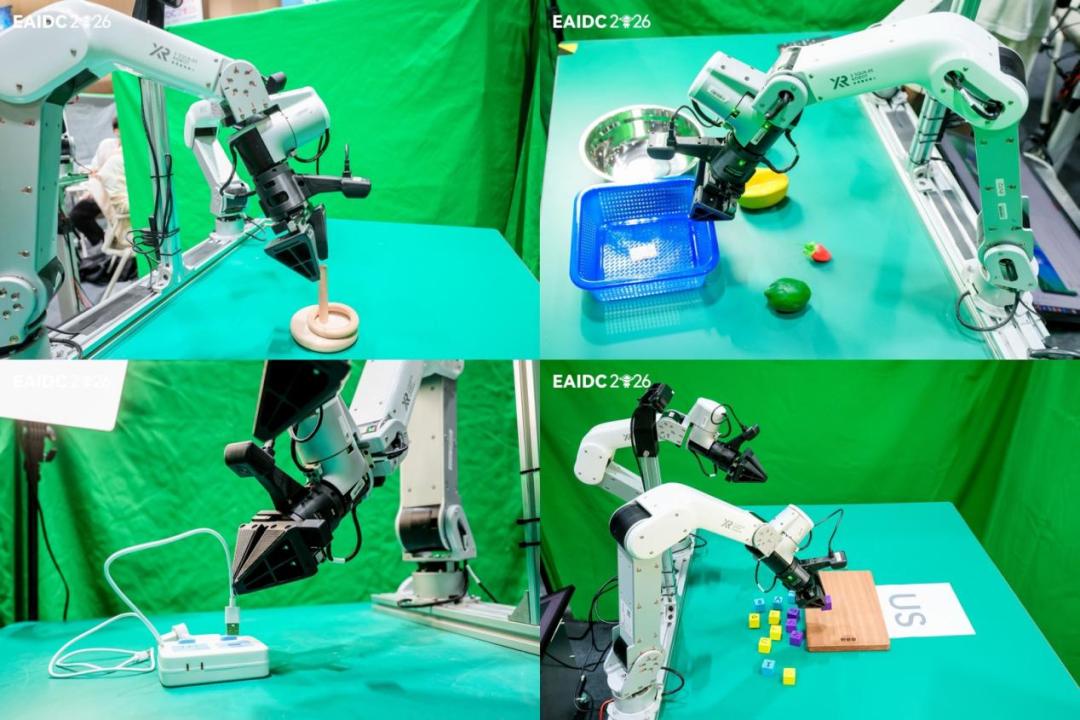
Photo provided by the official
On the eve of this competition, the independent variable also announced a cooperation with 58 Daojia to launch an intelligent cleaning service in Shenzhen, and the world's first robotic cleaner went on duty.
"The family is the holy grail of embodied intelligence. It represents the most extensive and open environment and tasks. Solving family tasks means that the model can achieve complete generalization." Wang Hao described it like this.
It must be admitted that it is still unrealistic for robots to completely replace humans in cleaning. In the demonstration video of the independent variable and 58 Daojia, the robot can only perform basic actions such as organizing items and cleaning the desktop, and complex actions such as storing large bed sheets still need to be completed in cooperation with real people.
So, should the time for robots to enter families be postponed until the model is mature enough? Wang Hao doesn't agree with this conclusion.
"Facing the most complex and open scenarios from the beginning can improve the intelligent level of the model to the ability to solve a variety of scenarios." Wang Hao said. "No matter when to start, the earlier, the better."
Whether it is the developer competition or the implementation of robots, the ideas of the independent variable are quite consistent.
Embodied intelligence is a complex systemic project. There is no absolute consensus in the industry on data, algorithms, model tools, and training paradigms. The principle of the independent variable is to encourage more people to participate and let the model and intelligence iterate through attempts.
When explaining the original intention of holding the competition, Wang Qian also gave an example of "openclaw" to the developers below the stage: "Why is crayfish so popular? It's not because a group of professionals are doing it, but because countless individual developers and small teams have jointly promoted it into a huge ecosystem."
"I hope to achieve equality in embodied intelligence." Wang Qian said.