Red Bear AI Completes RMB 210 Million Series A Financing, Enters the Physical AI Track | Exclusive Report by 36Kr
36Kr learned that "Red Bear AI", an enterprise-level AI solution provider, recently completed a Series A financing of 210 million yuan, with a post-investment valuation exceeding 1.5 billion yuan. This round was led by Huayu Venture Capital, with old shareholders Grefon Investment and Jiawo Capital following suit. Multiple institutions such as Xuhui Capital, SAIC US Dollar Fund, Jiaming Haochun, and Yuhua Assets participated in the investment. Three members of the founding team also followed the investment with approximately 30 million yuan at the valuation of this round. This is already the fourth consecutive round that Huayu Venture Capital has bet on Red Bear AI.
Founded on April 7, 2024, Red Bear AI focuses on the technical route of "memory science + full-modal large model", aiming to enable AI to have "episodic memory" ability similar to humans, so as to achieve more accurate perception, decision-making, and action in the physical world. Founder and CEO Wen Deliang revealed to 36Kr that Red Bear AI is expected to submit an application to the Hong Kong Stock Exchange in the second or third quarter of 2027 and officially launch its listing in 2028.
From "Product Thinking" to "Technical Ecosystem Thinking"
"What is your core competitiveness?" This is the question most frequently asked by investors during Red Bear AI's financing.
Wen Deliang's answer is somewhat counterintuitive: "Products are never the core competitiveness. It's like the relationship between a goose and a goose egg - the goose egg is a given result, and the goose that can continuously lay eggs is the real core of value."
In Wen Deliang's view, the "goose" of Red Bear AI is the technical ecosystem built by "memory science + full-modal large model". Memory science solves the problem of "how to reuse experience" for AI, and the full-modal large model solves the problem of "how to perceive the world" for AI. The combination of the two can continuously produce innovative applications suitable for different scenarios. Wen Deliang believes that products are never the core competitiveness, and the underlying technical system that supports product evolution (i.e., the process of "raising the goose") is the core of value.
This idea stems from the insight into the pain points of the AI industry. Research by Google DeepMind shows that even the most advanced language models can fall into the "reverse curse" - after learning that "Plato taught Aristotle", they cannot answer "Who was Aristotle's teacher?" The root cause is that AI can only store fragmented knowledge through parameter learning and cannot establish the connection between experience and scenarios like humans.
Red Bear AI digitizes the human "episodic memory" mechanism and builds an "intelligent memory system" similar to the hippocampus. At the same time, it integrates multi-modal information such as text, images, voice, and sensor data, enabling AI not only to "learn knowledge" but also to "remember experiences and habits".
"We have built our current application products in a software-resulted way. After going public, we will pursue the second growth curve of memory science hardware products." Wen Deliang revealed, "Currently, our sales are mainly focused on the application direction."
Moreover, different from many To B companies that focus on sales, AI companies that focus on technology, and both relatively neglect brand building, Red Bear AI has started to pay attention to brand building from the early stage.
"We have two cores externally: first, win with technology; second, use technology as the brand as a strategy." Wen Deliang shared, "Doing it in this way is actually more effective than talking about business models and industrial models, and customers are more receptive."
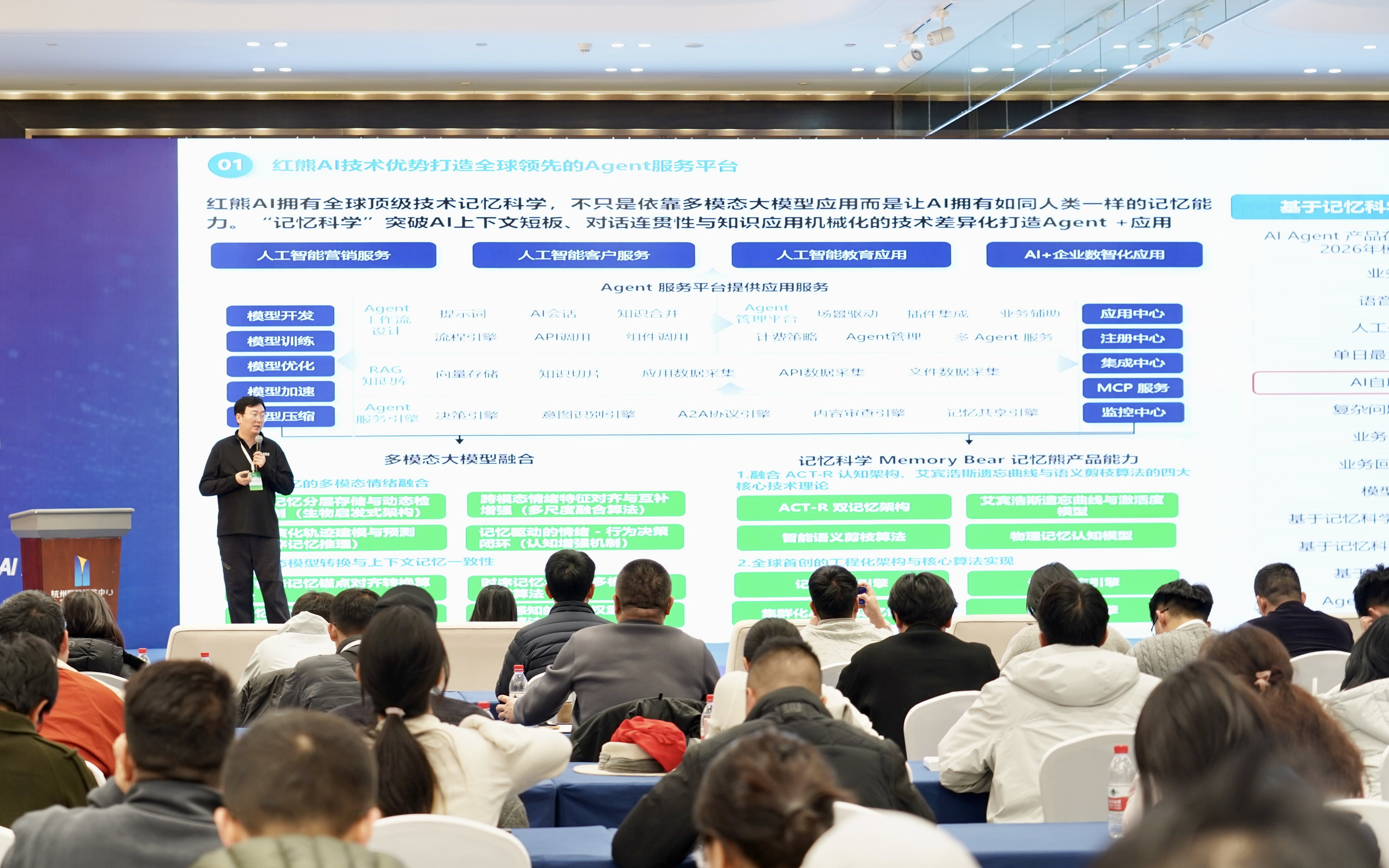
Founder and CEO Wen Deliang
Entering the Physical AI Track: From Perceptual Fragments to the Digitalization of "Episodic Memory"
In the wave of "physical AI" defined by NVIDIA CEO Jensen Huang, the ultimate mission of AI is to break through the virtual boundary and become an "intelligent agent" in the physical world. However, current AI systems generally face the bottlenecks of "inaccurate perception, inflexible decision-making, and non-implementable actions" when entering the physical world.
The core technical inspiration of Red Bear AI comes from cognitive science. The human brain's hippocampus has the "episodic memory" ability, which can store complete scenarios and quickly reuse them. In contrast, traditional AI systems can only store fragmented knowledge through parameter learning and lack the "latent learning" ability to establish the connection between experience and scenarios.
The technical breakthrough of Red Bear AI lies in digitizing the human "episodic memory" mechanism and building an "intelligent memory system" similar to the hippocampus. This system not only integrates text, images, and voice but also introduces physical signals such as sensor data, trying to enable AI to "remember experiences and habits" like humans.
In response to the pain points of physical AI, Red Bear AI has proposed a systematic solution based on "memory science + full-modal large model":
- Perceptual Reconstruction: Non-invasive and Low-cost Adaptation
Red Bear AI's full-modal perception system emphasizes the "non-invasive" principle. For example, in the smart home scenario, the system can judge the needs through modal data such as radar, infrared, and voice, rather than relying on camera monitoring, thus balancing privacy and experience. The addition of memory science enables AI to remember users' specific preferences (such as the elderly's sensitivity to noise) and achieve "appropriate perception". In addition, through the complementarity of multi-modal data, Red Bear AI uses cheap sensors to replace some high-cost high-definition cameras, significantly reducing the threshold for the upgrade of traditional industries.
- Decision-making Evolution: From Mechanical Matching to Experience Reasoning
Red Bear AI's decision-making system has the abilities of "experience reuse" and "multi-modal Agent collaborative reasoning". The system can store the complete scenarios (input, process, result) of past decisions and quickly retrieve experiences and optimize decisions when encountering similar scenarios. Taking intelligent pet medical care as an example, the Agent can make three-dimensional decisions by comprehensively considering behavioral changes, excretion data, and the veterinarian's experience in the memory system, with higher accuracy than single-dimensional judgment.
- Action Implementation: Closed-loop Reconstruction of the Industrialization Process
Red Bear AI tries to transform the traditional linear model of "R & D - production - sales" into a closed loop of "data collection - decision-making - execution - experience precipitation". In the retail industry, its "customer service excellent answer" system can not only handle multi-channel consultations but also precipitate the experience of handling difficult problems into a knowledge base to continuously optimize the response efficiency.
Official website
Enterprise Data Disclosure
It is understood that Red Bear AI's Series A+ financing is currently under negotiation and is expected to be completed in July or August, with a valuation of 3 billion yuan. The company has completed multiple rounds of compliance reviews, including registered capital, partnership agreements, equity proxy situations, and cost structure breakdown. Red Bear AI disclosed a set of financial data:
- 2025 Performance: The contract value was 250 million yuan, the recognized revenue was 135 million yuan, the net profit margin reached 13%, and the profit was approximately 18 million yuan.
- Gross Margin Performance: Audited by Ernst & Young, the gross margin of its pure software business is between 60% and 78%.
- Future Expectations: The performance target for 2026 is to recognize revenue of 500 - 600 million yuan, and it is expected that the pure ARR (subscription system) revenue will exceed 100 million yuan in August or September this year.