How does the battery energy storage system reshape the energy landscape?
God Translation Bureau is a compilation team under 36Kr, focusing on fields such as technology, business, workplace, and life, and mainly introducing new foreign technologies, new ideas, and new trends.
Editor's note: The battery energy storage system (BESS) is becoming a key force in the energy transition, realizing the storage and release of electrical energy through electrochemical reactions. This article deeply analyzes the working principle, core components, and application value of BESS, revealing how this technology promotes the renewable energy revolution. This article is a translation.
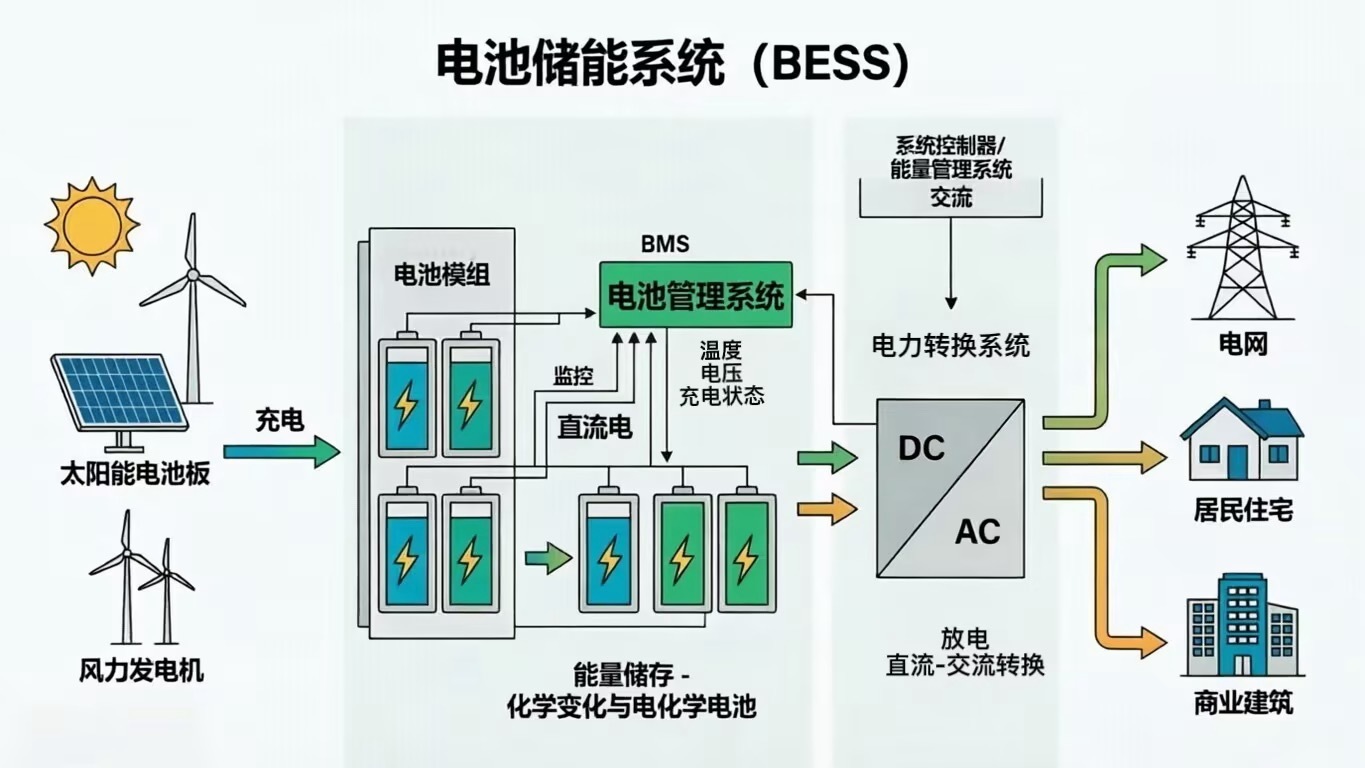
In an era when renewable energy sources such as solar and wind power are reshaping the global power grid, battery energy storage systems (BESS) have become the unsung heroes of the energy transition. They convert intermittent, weather-dependent renewable energy into reliable, on-demand power, bridging the gap between power generation and consumption and stabilizing the global power grid. But for many homeowners, business owners, and even industry professionals, the question remains: How exactly do battery energy storage systems work?
Beyond the basic concept of "storing electricity," BESS is based on a precise combination of electrochemistry, electrical engineering, and intelligent control systems. These systems work in concert to store energy when it is abundant and release it when it is most needed. In this guide, we will break down the scientific principles, components, and actual operating mechanisms of BESS in plain language, without excessive technical jargon. We will explain how these systems power homes, businesses, and entire communities, and why they are at the core of a sustainable energy future.
Fundamentally, a battery energy storage system is a scalable, modular solution designed to capture electrical energy, store it chemically in battery cells, and convert it into usable electricity during peak demand or when power generation declines. Unlike traditional on-site power generation sources, BESS acts as a "giant rechargeable battery" for the power grid, homes, or commercial facilities, capable of storing energy from solar panels, wind turbines, or the main power grid itself. The entire process is a closed loop of charging, storing, and discharging, with each step coordinated by key components to achieve a perfect synchronous conversion between electrical energy and storable energy. To understand its mechanism, one must first break down the core components of the battery energy storage system, as each component plays an indispensable role in converting raw electrical energy into storable energy and then into usable energy.
1. Core Building Blocks of BESS
BESS is built on a hierarchical, modular design, making it suitable for a variety of use cases, from compact home battery energy storage systems to 200-megawatt utility-scale power plants. Each layer of the system serves a specific electrochemical or electrical function, and all components work together to store and release energy.
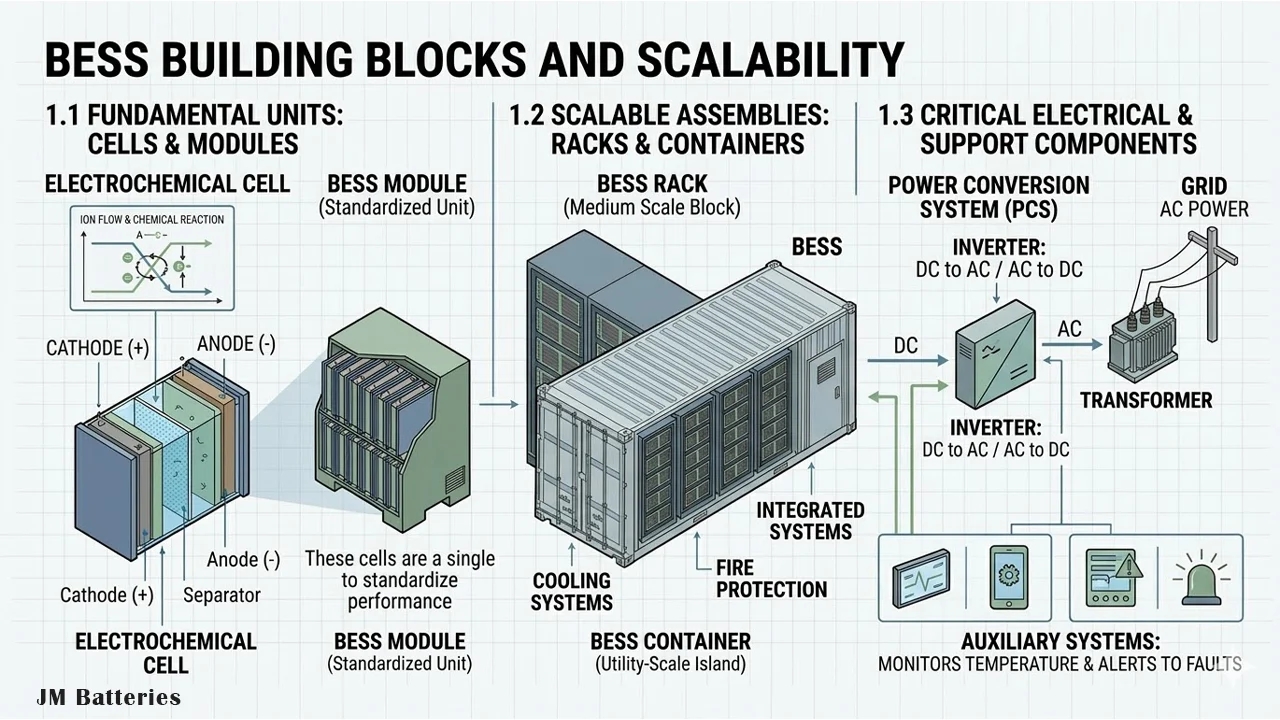
1.1 Basic Electrochemical Units: Batteries and Modules
-
Battery: The smallest functional unit of BESS, which stores and releases energy through electrochemical reactions. A battery consists of a cathode (positive electrode), an anode (negative electrode), an electrolyte (for ion flow), and a separator (to prevent short circuits). This is the core of all battery energy storage technologies, and its chemical composition varies depending on the battery type (lithium-ion, lead-acid, etc.).
-
Module: Multiple batteries are electrically connected and encapsulated in a single container. Modules standardize battery performance and make it easy to expand the BESS capacity by adding more units, which is a key advantage of electrochemical energy storage systems over other energy storage technologies.
1.2 Scalable Components: Racks and Containers
-
Rack: Interconnected modules mounted on a metal frame, designed for easy installation and thermal management. Racks are the main building blocks for medium and large BESS installations.
-
Container: A waterproof outdoor enclosure that houses multiple racks and core control and safety systems. Containers are prefabricated, meaning that BESS can be quickly deployed, which is crucial for grid operators and commercial facilities. For large-scale systems, multiple containers (known as "islands") are connected together to increase capacity.
1.3 Key Electrical and Support Components
Without these three non-battery components, no battery energy storage system can operate. They connect the system to the power grid and ensure safe and efficient operation:
-
Inverter: Converts the direct current (DC) stored in the battery into alternating current (AC) for use by the power grid/equipment (discharging) and converts AC back to DC for charging. Without an inverter, the stored battery energy is unusable for most practical applications.
-
Transformer: Adjusts the system voltage to match the requirements of the power grid or facility, ensuring safe power transmission and compliance with electrical standards.
-
Auxiliary System: Includes a cooling system (to maintain the optimal battery temperature and prevent overheating), fire protection (crucial for lithium-ion batteries), and a central monitoring system that manages charging and discharging and alerts for faults.
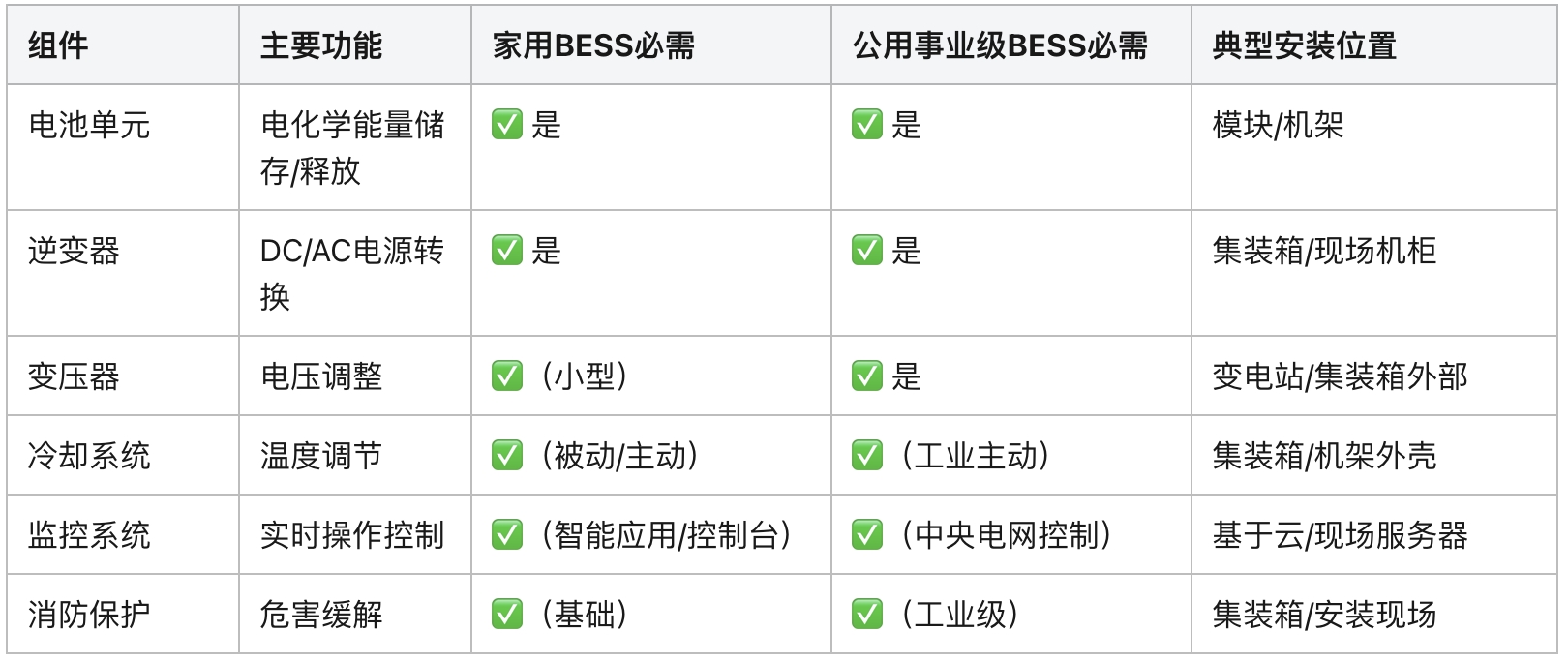
Comparison Table of Key BESS Components
2. Complete Operating Process of BESS
The operation of BESS follows a fixed three-step cycle: charging, storing, and discharging. The operating logic is basically the same for residential, commercial, and utility-scale scenarios, with only minor differences in details. The entire process is driven by the reversible electrochemical reaction of the battery cells and is precisely scheduled by the control system. Grid-level equipment can achieve millisecond-level response. The following is a breakdown of the cycle process and actual operating cases for two main application scenarios:
2.1 General BESS Cycle
-
Charging: Excess power (from solar panels, wind turbines, or the power grid during off-peak hours) is sent to the BESS. The inverter converts AC to DC (if necessary), and the DC power triggers an electrochemical reaction in the battery cells: Positively charged ions move from the cathode to the anode and are stored in chemical bonds.
-
Storing: The ions are stored in the anode until the system detects high energy demand, low renewable energy generation, or grid instability. The BESS monitoring system maintains the optimal temperature and voltage of the battery during storage to prevent degradation.
-
Discharging: When energy is needed, the electrochemical reaction is reversed: The ions flow back from the anode to the cathode, generating an electron flow (DC electricity) in the external circuit. The inverter converts this DC power into AC and then sends it to homes, businesses, or the power grid—ready for immediate use.
2.2 Practical Application of Residential BESS (Solar + Home Storage)
For homeowners with a home battery energy storage system and solar panels, this cycle is synchronized with daily solar power generation and energy use:
-
Charging: At noon, the power generated by the solar panels exceeds the home's usage; the excess power charges the BESS, reducing dependence on the power grid. Some systems also charge from the power grid at night when electricity prices are low (time-of-use pricing).
-
Discharging: At night (when solar power generation declines) or during a power outage, the BESS discharges to power the home's lighting, appliances, and electronic devices, providing energy independence and backup power.
2.3 Practical Application of Utility-Scale BESS (Wind Farm + Grid Storage)
Utility-scale battery energy storage systems are crucial for integrating renewable energy into the power grid and stabilizing power supply:
-
Charging: On windy nights (when grid demand is low), the excess power generated by the wind farm would otherwise be wasted; this power charges the BESS, storing renewable energy for later use.
-
Discharging: On weekday evenings (when grid demand peaks), the BESS releases the stored energy into the power grid to meet the demand without having to start fossil fuel "peaking power plants." These systems can also respond to grid imbalances within milliseconds, preventing power outages and voltage fluctuations (grid frequency regulation).
3. Comparison of BESS with Other Energy Storage Systems: Key Differences
For anyone learning about energy storage, the most common question is: How do energy storage systems work? How do they differ from other energy storage technologies? All energy storage systems follow the capture - store - release cycle, but they use very different methods to store energy, which determines their efficiency, scalability, and application scenarios. BESS is an electrochemical energy storage system, and its unique characteristics make it the most flexible and widely used energy storage technology today, especially in residential and utility-scale applications.
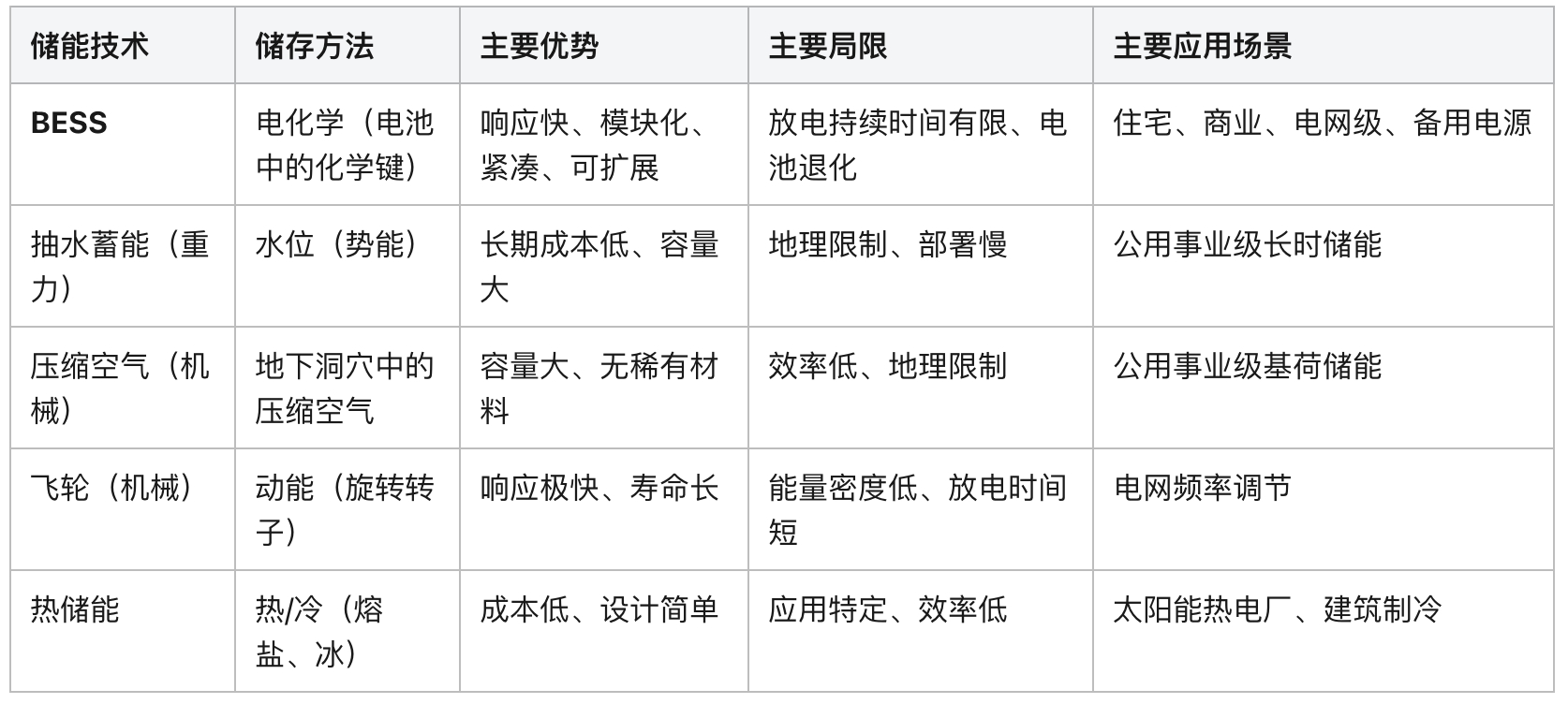
Comparison Table of BESS and Alternative Energy Storage Technologies
The greatest advantage of BESS over alternatives is its versatility: It is suitable for various scales, from small home systems to grid-level power plants, and can be deployed anywhere in the world without geographical or geological limitations. This is why lithium-ion battery energy storage systems dominate the global energy storage market today.
4. The Most Common BESS Technologies: Which Is the Best?
Not all BESS are the same. The chemical composition used in the battery cells determines the system's efficiency, lifespan, safety, and cost. Lithium-ion battery energy storage systems are the industry standard for most applications, and different lithium-ion variants offer a trade-off between performance and safety. Other chemical compositions are used for specific application scenarios, and emerging technologies are being developed to address the limitations of current options. The following is a breakdown of the most widely used and promising BESS technologies:
4.1 Lithium-Ion (Li-ion) — The Industry Standard
There is a good reason why lithium-ion batteries power 90% of battery energy storage systems (according to the International Energy Agency's energy storage report):
-
High Efficiency: 85 - 95% charge-discharge energy conversion efficiency (much higher than lead-acid batteries).
-
High Energy Density: Stores more energy in a smaller space, which is crucial for residential and compact commercial systems.
-
Cost Reduction: Mass production in the automotive industry has caused the price of lithium-ion batteries to drop by more than 80% in the past decade.
Among lithium-ion batteries, lithium iron phosphate (LFP) is the preferred choice for BESS: It does not contain cobalt/nickel (reducing material costs and ethical sourcing issues), has higher thermal stability (reducing the risk of fire), and has a longer lifespan than other lithium-ion variants (such as NMC/NCA). LFP is the gold standard for home battery energy storage systems and utility-scale BESS in 2026.
4.2 Niche BESS Chemical Compositions
-
Lead-Acid: An older, low-cost technology with low efficiency (70 - 80%) and a short lifespan (3 - 5 years). It is only used in small, low-budget residential systems or off-grid applications where cost is the main consideration.
-
Sodium-Sulfur (NaS): A high-temperature technology with high efficiency (80 - 90%) and large capacity. It is used in utility-scale systems in high-temperature regions (no cooling required), but is limited by high operating costs and safety risks (high temperature = fire hazard).
-
Flow Battery: Uses a liquid electrolyte stored in separate tanks, and the energy capacity is independent of the power output. It is suitable for long-term energy storage (more than 8 hours), and vanadium flow batteries are the most common. Limitations include high upfront costs and low energy density.
4.3 Emerging BESS Technologies
-
Solid-State Battery: Replaces the liquid electrolyte with a solid ceramic/synthetic material, providing higher efficiency, longer lifespan, and zero fire risk. Currently, it is too costly for large-scale applications, but research and development are progressing rapidly (Department of Energy's solid-state battery research).
-
Lithium-Sulfur (Li-S): Has a higher energy density and lower material cost than lithium-ion batteries. It is still in development and faces challenges such as short cycle life and electrolyte degradation.
5. The Practical Impact of BESS and Why It Matters
Battery energy storage systems are not just "energy storage solutions"; they are transformative technologies that are redefining how we produce, distribute, and use electricity across various fields. For homeowners, businesses, and grid operators, BESS addresses key energy challenges and accelerates the transition to renewable energy:
-
For Homeowners: Home battery energy storage systems provide energy independence (backup power during power outages), reduce electricity bills by storing solar/off-peak grid energy, and reduce the carbon footprint by maximizing the use of renewable energy.
-
For Businesses: BESS reduces peak energy costs (by reducing grid usage during peak hours), improves energy security, and allows businesses to participate in demand response programs to earn money by reducing grid usage during peak demand.
-
For Grid Operators and Utility Companies: BESS stabilizes the power grid, reduces dependence on fossil fuels, and enables the integration of more solar and wind energy. It also eliminates the need for expensive new grid infrastructure by addressing congestion and meeting local demand through on-site storage.