In - depth analysis of agentic AI: How can enterprises build real "digital workforce"?
God Translation Bureau is a compilation team under 36Kr, focusing on fields such as technology, business, the workplace, and life, and mainly introducing new technologies, new ideas, and new trends from abroad.
Editor's note: AI is evolving from generation to autonomy. Agentic AI no longer passively waits for instructions but can actively plan, use tools, and execute tasks in a closed - loop manner like a "digital employee". This article will break down its core logic to see how it reshapes enterprise workflows and becomes the next strategic frontier after generative AI. This article is a translation.

Image source: salesforce.com
What is Agentic AI?
Agentic AI is an intelligent system that can act autonomously, reason about multi - step problems, adjust actions in real - time, and achieve specific business goals with minimal human supervision.
AI is evolving at a rapid pace, bringing concepts that once only existed in science fiction into the real business world. Initially, enterprises used predictive AI to analyze data and relied on machine - learning algorithms to predict future trends. Later, generative AI became popular, and it is indeed good at content creation such as writing copy, drawing pictures, and writing code. Now, the industry has entered a new stage of agentic AI. This is a brand - new frontier. The capabilities of AI are no longer limited to generating content or chatting with you; it has begun to have the ability to act autonomously and adapt to changes.
The biggest difference between agentic AI and its "predecessors" is that they can not only reason based on predictions from massive data sets but also perceive the environment, take independent actions proactively, learn from feedback, and quickly adapt to environmental changes.
Agentic AI has become a top - level strategic technology trend. The core of this evolution is to emphasize autonomy and adaptability. Relying on seamless integration with data platforms and powerful workflow automation capabilities, agentic AI is ready to reshape multiple industries such as healthcare, finance, and manufacturing. Now, enterprises can imagine that AI can work like a real digital employee, make decisions, adapt to new situations, and do so with amazing efficiency.
Definition of Agentic AI
Agentic AI is a technology that empowers AI agents to work independently without human supervision. It is like an all - in - one platform that enables smooth interaction between AI agents and humans, creating a collaborative atmosphere. This platform has a set of tools and services to help AI agents learn, adapt, and cooperate to efficiently handle complex and changing tasks. This is the next frontier of AI, characterized by the ability to set goals, reason, make decisions, and handle various unexpected situations.
The highlight of agentic AI is that it simplifies the development and deployment of AI agents, making it less costly and labor - intensive for enterprises to integrate advanced AI into their daily operations. With this framework, enterprises can customize AI agents according to their needs. Whether you want to automate repetitive trivial tasks, improve customer service experience, or promote strategic decision - making, it can handle them all.
Traditional AI systems are very rigid and struggle with complex multi - step tasks. Agentic AI, on the other hand, is flexible and adaptable. This flexibility ensures that AI agents can be adapted to various industries and application scenarios. Through natural language processing, agentic AI systems like Agentforce can mimic human decision - making, making them particularly suitable for handling complex and ever - changing business situations.
What is Agentic AI?
At its core, agentic AI is a set of autonomous AI systems whose core goal is to achieve specific results by independently formulating, executing, and optimizing its own action plans. It is not just a tool for processing information but an intelligent framework that can take purposeful actions.
The three core characteristics that define agentic AI are indispensable:
Autonomy: Agents can execute tasks independently without step - by - step human supervision or guidance and can autonomously select the optimal action plan.
Adaptability: They can learn from interactions, receive feedback, and adjust decisions or plans based on what they have learned, which is what the industry often calls continuous learning.
Goal - orientation: They can undertake high - level goals and break them down into a series of smaller, actionable steps through reasoning to ultimately achieve the ultimate goal.
Agentic AI is expected to fundamentally change the way enterprises interact with technology. Currently, the foundation of autonomous agents has been laid. Their independence and adaptability will surely improve operational efficiency and release new opportunities for industry innovation.
What Agentic AI is not
To truly understand agentic AI, it is crucial to distinguish it from other forms of AI first. Many people mistakenly think that agentic AI is just a more powerful chatbot or an ordinary automation script. This is far from the truth.
It is not just a chatbot: Ordinary chatbots are passive, answering only when you ask. AI agents are proactive. They can monitor the environment, such as a customer service queue or a CRM system, identify goals, such as solving an urgent work order, and then start multi - step tasks without being prompted.
It is not simple robotic process automation (RPA): RPA is good at repetitive tasks with fixed routines. If the process changes, the RPA script becomes useless. Agentic AI relies on reasoning and learning to handle changes and unexpected situations. If a step in the plan doesn't work, the agent can stop, reflect, come up with a new idea, and find an alternative way.
It is not pure generative AI: Although generative AI models (Large Language Models, LLM) are the "brain" of AI agents, they are just one component. The core of generative AI is to generate content, while agentic AI uses this content (such as generated email drafts or code snippets) as tools to execute goal - oriented actions.
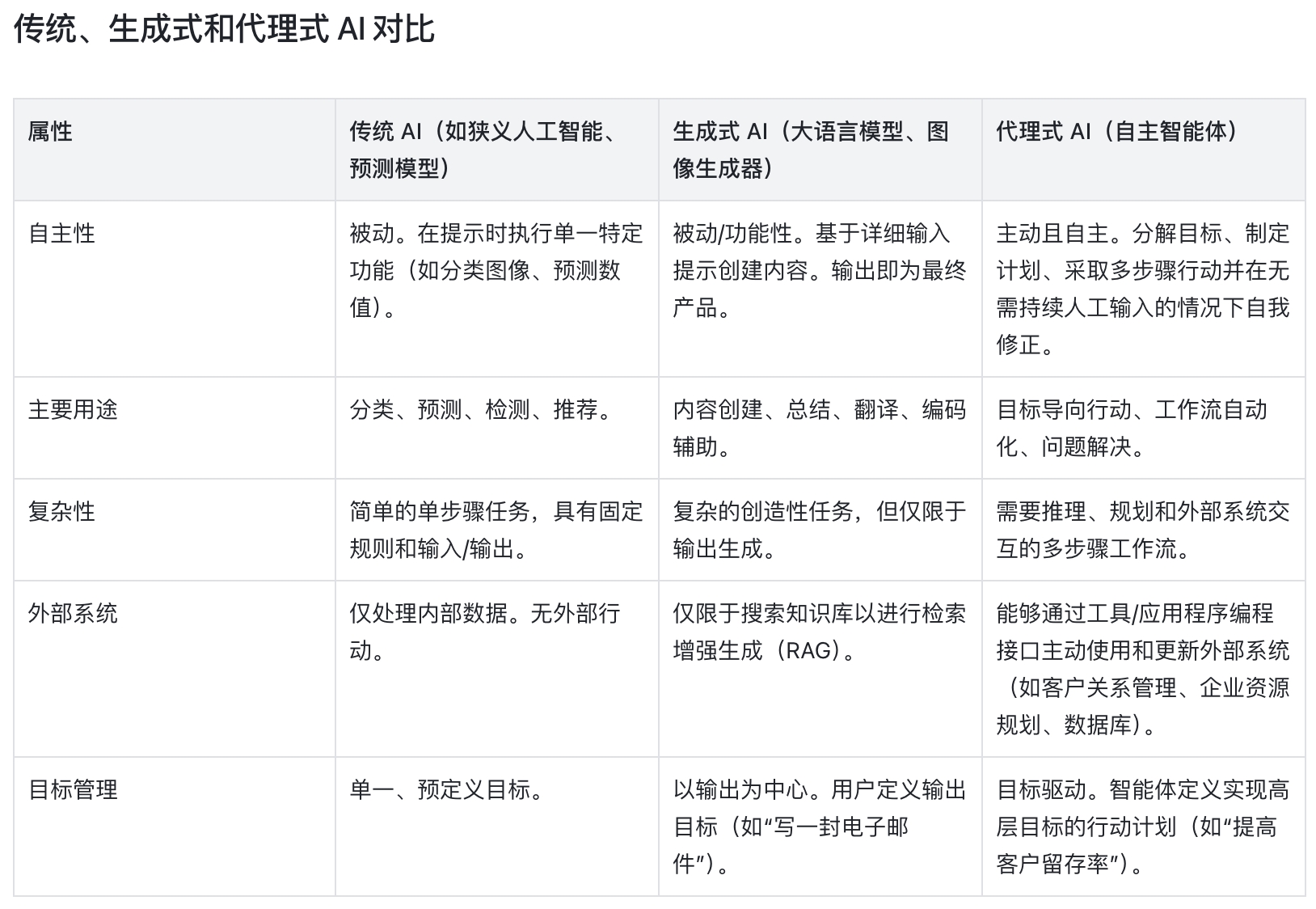
What is the difference between Agentic AI and Generative AI?
The core of generative AI is to directly generate output based on prompts, while agentic AI is an autonomous system that can independently plan and execute multi - step tasks to ultimately achieve high - level goals. The core differences between the two can be clearly understood in one article. For enterprises that want to implement AI technology, understanding the differences between different types of AI is crucial. The emergence of agentic AI marks the leap of AI from pure predictability and creativity to true autonomy and goal - orientation.
How does Agentic AI work?
Agentic AI operates through a set of core cyclic components, enabling autonomous agents to complete a goal from start to finish. Behind this is a central large language model that acts as the agent's brain, allowing it to reason, plan, and make decisions.
The operation of agentic AI relies on these basic concepts:
Planning: Break down a complex large - scale goal, such as resolving a customer billing dispute, into manageable and executable small steps, such as searching the knowledge base, checking payment records in the CRM, and writing a solution email.
Reasoning: Evaluate the current situation, understand what needs to be done, select the right tools, and then decide the best next step. The intelligence of the large language model is particularly crucial at this time.
Tool use: Agents can connect to external systems through APIs or other interfaces to perform tasks. These tools include everything from CRM systems to coding environments or data - querying engines.
Memory: The system needs to remember what it has done and seen before to ensure the coherence of multi - step workflows. This includes short - term memory and long - term memory.
Reflection: Monitor the results of actions, compare them with the goals, and adjust the plan if the results are not satisfactory. This is a key mechanism for self - correction and continuous improvement.
This process enables AI agents to solve complex problems through a five - step continuous cycle:
Perception: AI agents collect and interpret information from the environment, such as user prompts, sensor data, or database entries. They understand the current state of the goal and the environment.
Reasoning: The large language model guides the reasoning process, understands the task, formulates a preliminary solution plan, and then coordinates specialized models or tools to perform the necessary tasks.
Action: Agents connect to external systems through APIs, such as CRM, financial ledgers, or manufacturing control systems, to perform tasks. Built - in safeguards ensure security and compliance.
Learning: Agents monitor the results of their actions. They reflect on whether this step has brought them closer to the goal. If not, they learn from failure and adjust their next strategy.
Iteration and collaboration: This continuous cycle drives continuous improvement. In a multi - agent system, several specialized agents can work together, exchange information, and cooperate to solve larger, more intuitive, and more complex problems.
Advantages of Agentic AI
Agentic AI represents a leap in AI capabilities, providing enterprises with core advantages that traditional AI systems cannot match.
Enhanced adaptability and efficiency
Its most prominent advantage is the ability to learn and adapt to the dynamic business environment. By automating complex multi - step tasks and making decisions autonomously, AI agents significantly speed up operational processes. This autonomy not only saves time and reduces operating costs but also minimizes human errors in daily tasks. The core capabilities of reasoning and self - correction ensure continuous improvement in overall performance, making it an indispensable asset for enterprises to achieve full - scale workflow automation.
Improved productivity and strategic focus
Agentic AI can automate repetitive and time - consuming tasks and simplify complex workflows, providing enterprises with scalable digital labor. This relieves human teams of cumbersome administrative burdens, allowing them to focus on more valuable strategic work - areas that require creativity, empathy, and professional human insights. With real - time decision - making and continuous learning capabilities, AI agents can complete tasks faster and with higher accuracy, overall improving the work efficiency of employees and teams.
Smart real - time decision - making
Autonomous agents can process a large amount of data from various sources in real - time, much faster than any human team. By capturing subtle data patterns, integrating information across systems, and predicting results, they can provide enterprises with practical insights to help them make more informed and confident decisions. This ability ensures that enterprise business decisions are always data - driven and keep up with the market rhythm, building a core competitive advantage in a rapidly changing market environment.
Large - scale deep personalization
Agentic AI has the potential to create highly personalized and attractive interaction experiences for customers. By mimicking human decision - making and having access to the full background information of customers, including previous interactions, preferences, and intentions, AI agents can provide intuitive and smooth experiences. Whether it is personalized customer service, targeted marketing promotions, or customized financial advice, this super - personalized service ability can improve user satisfaction and enhance long - term customer loyalty.
Examples of Agentic AI: Real - world use cases
The core competitiveness of agentic AI lies in its ability to execute end - to - end, multi - step workflows across different systems, making it adaptable to almost all business functions.
Agentic AI in customer service
Intelligent customer service: AI customer service agents can manage customer support tickets from start to finish. For example, when a customer reports a product malfunction, the agent's workflow will proceed as follows:
Perception: Read the support ticket and classify it as a complex hardware problem.
Reasoning and planning: Identify the core steps - check the warranty status in the customer relationship management system, search the knowledge base for troubleshooting guides, and arrange for a technician to visit if necessary.
Action (tool use): Extract the customer's warranty information and purchase history through tools.
Resolution: If the product is still under warranty, the agent will autonomously generate and send a personalized email with an automatic return label, update the ticket status in the customer relationship management system to "resolved", and notify the warehouse. All these operations are carried out without human intervention.
Agentic AI in information technology and software development
Autonomous information technology service management (ITSM): AI agents are not just simple password - resetting robots. They can autonomously solve complex IT tickets. For example, when an employee reports an access problem to a new software platform, the agent can verify the employee's identity through the internal directory, check their role and team according to the security matrix, approve the necessary access rights in the identity management system, and finally send a confirmation email to complete the entire process.
Autonomous coding and debugging: Agents can act as self - sufficient junior software engineers. Given user requirements, they can formulate a detailed development plan, write the required code, run unit tests and integration tests to troubleshoot errors, automatically debug faults, and finally create a pull request for human developers to review.
Agentic AI in sales and marketing
Personalized marketing campaigns: Marketing agents can undertake high - level goals, such as "launch a marketing campaign to increase the sales of new products for customers in the western region". Their autonomous workflow mainly includes:
Audience identification: Use Data 360 to accurately segment the target audience.
Content generation: Use generative AI to draft customized email copy and advertising ideas for this audience group.
Execution: Deploy the marketing campaign through the marketing automation system.
Optimization: Monitor the campaign performance indicators in real - time, autonomously adjust the advertising budget or optimize the promotional content to maximize conversion efficiency.
Supply chain optimization: Agents can act as end - to - end supply chain managers. They monitor inventory levels in real - time, integrate market data and historical sales data through Data 360, predict demand fluctuations, autonomously place replenishment orders with suppliers, and negotiate the optimal purchase price based on current market conditions.
Agentic AI and data platforms: A fundamental partnership
From "knowing what" to "knowing how", enterprises must be clear that the upper limit of an AI agent's capabilities depends entirely on the data it can access and the operating platform. Agentic AI is completely reshaping the enterprise work model by leveraging, learning, and integrating enterprise knowledge to upgrade workflow automation.
The core foundation for building an efficient and secure agentic AI is a powerful and integrated data platform. This platform can integrate various types of data from different sources and present them in a unified language through a common metadata framework. This enables enterprises to fully tap the value of all data, automate complex tasks, and make real - time, data - driven decisions.
How to start using Agentic AI
For enterprises that hope to leverage the power of agentic AI, the key is to focus on platforms that provide security, governance capabilities, and seamless integration. Specifically, they can start from three aspects:
Unify data: A platform like Data 360 is a necessary starting point for enterprises to implement agentic AI. It provides a single source of truth for all structured and unstructured customer data, operational data, and financial data. AI agents need such a unified context to make informed decisions.
Implement retrieval - augmented generation for context: Combine agentic AI with the principle of retrieval - augmented generation (RAG) so that agents can not only draw on the vast general knowledge of large language models but also access the enterprise's exclusive