The recycling price of discarded mobile phones has doubled. Where do the second-hand memory chips go?
A month ago, A Cheng, a Shandong native who was still selling second-hand sports shoes, started recycling old mobile phones in March this year. In March, A Cheng collected about 1,000 discarded mobile phones. Among them, he sold more than 300 to another upstream recycler of discarded mobile phones. For the other more than 600, he and his friends disassembled them and planned to sell them as chips. He advertised himself on Douyin: "Are there any bosses who want to buy chips? Come if you have a large demand and strong purchasing power."
Recently, recycling old mobile phones has become a popular business. "Previously, those who ran hot pot restaurants, handled loans, or did mortgage business have all started to collect second-hand mobile phones during this period," Li Yidong (a pseudonym), a senior recycler of digital products, told Caijing.
Since the end of 2025, the recycling price of second-hand mobile phones has fluctuated significantly. First, it rose all the way, and some people hoarded phones when they saw the trend. At the end of March, the mobile phone recycling price dropped, and the industry reported a decline of about 30%. However, the overall market situation is still relatively high.
Li Yidong said that taking the Redmi 9A mobile phone as an example, the current price of a new phone is about 500 - 600 yuan, but the recycling price of an old one can reach more than 200 yuan. Many domestic "1,000-yuan phones" and "100-yuan phones" from five or six years ago have turned into valuable items during this recycling wave. An old mobile phone that can no longer be turned on can also be sold for 100 yuan.
The doubling of mobile phone recycling prices is related to the price increase and shortage of storage chips. Since 2025, the explosive growth of AI (Artificial Intelligence) has given rise to a huge demand for storage chips. Storage manufacturers have given priority to high-end products, and the production capacity of consumer-grade storage chips has been significantly compressed, resulting in a supply shortage.
After the second-hand mobile phones are recycled, the memory chips soldered on the motherboards are removed through disassembly. Then, they enter factories in places like Dongguan and Huizhou, where workers manually disassemble, clean, refurbish, and seal them. The refurbished memory chips flow back into the market.
Many hardware industry insiders mentioned that if second-hand refurbished chips are used in new hardware, ordinary consumers can't tell, and they won't feel the difference in short-term use.
When asked "Who is using second-hand chips?", many manufacturers' representatives interviewed by Caijing said, "We won't use them, but many others do."
The recycling price of discarded mobile phones has doubled
On March 29, Shenzhen's Huaqiangbei was bustling. It is known as "the No. 1 electronics street in China." From the outer shell to the chips, Huaqiangbei has a complete electronics industry chain. Once, a foreigner came here and assembled an iPhone by himself.
In the Yuanwang Digital Mall in Huaqiangbei, which specializes in mobile phones, all the mobile phone stalls on the first floor have put up signs saying "High-price recycling." The aisles are crowded with people. These stalls accept both good and bad phones. When asked about the use of discarded mobile phones, the shop owners only briefly replied, "We have channels."
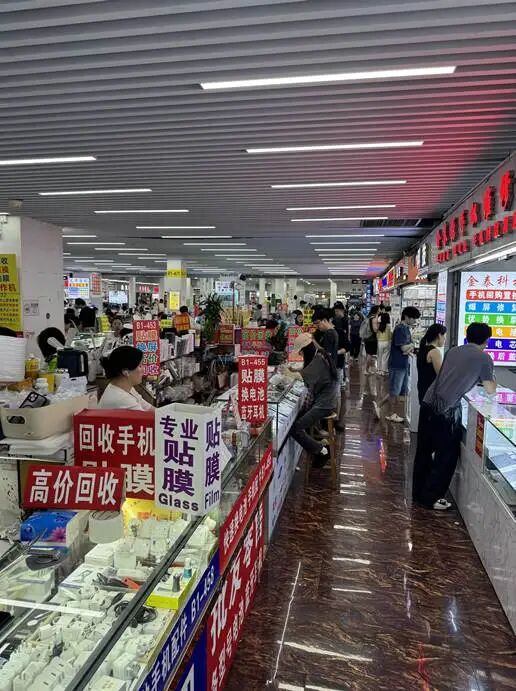
On the first floor of Yuanwang Digital Mall, many stalls are covered with "High-price recycling" signs. Photo by Wang Hailong
The merchants are reluctant to disclose what the channels are, saying, "This is a business secret." They only care about "Are you going to sell this phone or not?"
The second-hand mobile phone recycling business is also booming online.
Recently, on social media, many people have started the business of "high-price recycling" of discarded mobile phones. Their footprints are all over second-hand trading platforms, Douyin, Xiaohongshu, and WeChat Moments, and they have all posted words like "High price," "Cash payment," and "Bulk recycling."
Li Yidong has been running a second-hand mobile phone store in Rizhao, Shandong for more than 10 years. He observed that just like the popularity of silver some time ago, many people around him want to do some speculative business. "In big cities, you may not feel it clearly, but in our small cities, those who used to run hot pot restaurants, handle loans, or do mortgage business have all started to collect discarded mobile phones."
The rise in the value of second-hand mobile phones is mainly due to the memory chips inside.
Mobile phone memory is mainly composed of RAM (Random Access Memory) and ROM (Read-Only Memory). RAM uses DRAM (Dynamic Random Access Memory, such as LPDDR) technology, and ROM mostly uses NAND flash memory technology (such as eMMC/UFS).
From the production side, the three major memory suppliers, Samsung Electronics, SK Hynix, and Micron, almost control the global DRAM and NAND flash memory production capacity. The explosive growth of AI has prompted the three major memory suppliers to shift to high-bandwidth memory (HBM) with higher profits, resulting in a shortage and price increase of storage chips.
Data from the third-party data agency TrendForce shows that the price of a single DDR4 (Fourth-generation DRAM storage memory) of some popular specifications was less than $3.2 at the beginning of 2025 and rose to $64.5 at the end of 2025, a significant increase of 1922.8%. The agency also predicts that the price of DRAM memory will increase by more than 60% in the first quarter of 2026 and will continue to rise in the following three quarters.
The shortage of upstream storage chips has affected the entire industry chain and led to a revival of the second-hand mobile phone industry. Li Yidong said that recently, those domestic "1,000-yuan phones" can now be sold for 200 - 300 yuan at the scrap price, at least doubling the price compared to the beginning of 2025 and before.
Xu Feng, the R & D director of a hardware equipment company in Shenzhen, told Caijing that when the memory price increased by four or five times last year, not many people were engaged in (discarded mobile phone recycling). When it increased by nearly 10 times, it became profitable to recycle storage chips, and more and more people started to recycle mobile phones, disassemble memory chips, and resell them.
The cost of disassembly is not low. First, the chain of collecting mobile phones is very long. From consumers to chip disassemblers, there may be several links in between, and each link needs to add a markup. Second, the steps of removing storage chips are complex, including softening the motherboard with hot air, removing tin, cleaning, and resealing, etc. These steps all need to be done manually. While the production lines for new memory chips are highly automated, which is much more efficient than refurbishing second-hand ones.
Since only memory chips are needed, in this recycling wave, many recyclers claim that new and old phones are priced the same. Some still-usable mobile phones will also be disassembled for processing.
As for which phones are valuable, it naturally depends on the value of their storage chips. In the past few years, the smartphone industry has been highly competitive, and leading manufacturers have been increasing the "specification" of their products. The industry generally believes that the memory chips in mobile phones are the best and most common. Discarded mobile phone recyclers prefer Android models such as OPPO, vivo, and Honor, while low-version iPhones are ignored. A recycler told Caijing, "iPhones are not valuable. You can sell them on second-hand apps by yourself."
Li Yidong explained that this is because Apple's system is closed, while Android phones belong to an open-source system, and there is still a lot of room for development after recycling. Caijing's inquiry found that most of the "1,000-yuan phones" of brands like OPPO use LPDDR4X chips from the three major memory suppliers.
The shortage of memory chip supply has given these discarded "1,000-yuan phones" new recycling value. In 2025, Samsung announced that it would gradually stop producing DDR4 memory particles. Micron and SK Hynix followed suit. Micron said that starting from the third quarter of 2025, it would gradually stop the regular shipment of DDR4 and LPDDR4 (the LP series is low-power memory for mobile devices), and only maintain targeted supply for long-term cooperative customers in the automotive, industrial, and network communication fields.
Xu Feng said that manufacturers use second-hand chips not because they are cheap. "The price of second-hand refurbished chips is not low either. It is only slightly cheaper than brand-new ones." If they don't stock up in advance or have a stable long-term cooperation channel, some manufacturers can no longer buy new memory chips.
Who is using second-hand chips?
Li Yidong told Caijing that the recycling industry chain of discarded mobile phones has always existed, but it was more "niche" before. All along, his mobile phone store has relied on offline channels to collect phones, conduct self-inspections or repairs, and then resell them according to their condition. He also collects those phones that can't be turned on or have broken screens and hands them over to recyclers of discarded phones for processing.
According to his introduction, discarded phones have their own circulation channels, and they are generally reused after disassembly.
The mobile phone recycling industry chain has been developing in Shenzhen's Huaqiangbei for many years. A stall in Huaqiangbei that specializes in iPhone motherboards is full of packaged mobile phone motherboards. The shop owner said that these are disassembled from second-hand phones. Only when the motherboards are also damaged will they be given to recyclers to disassemble the storage chips. However, there are many nodes and a fine division of labor in the industry chain in Huaqiangbei. He only takes the responsibility of handing over the discarded motherboards to the "upstream," and he doesn't know which manufacturers are disassembling and which are using them.
Li Yidong described it like this: "People like us only make money from our own part and don't care where the phone will end up."
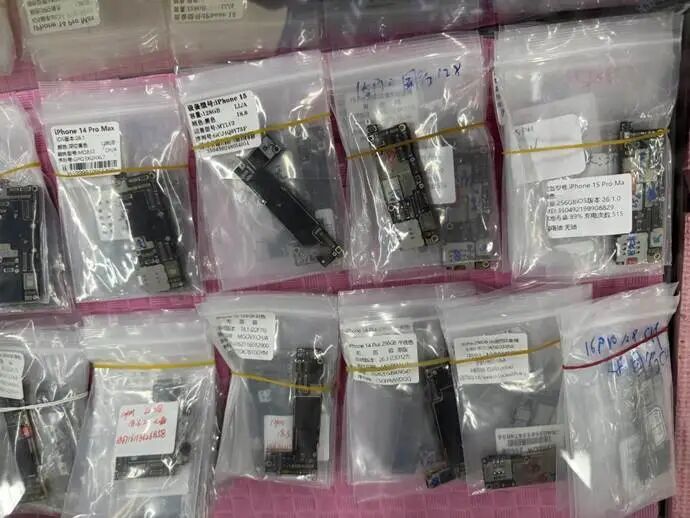
Motherboards disassembled from second-hand iPhones. Photo by Wang Hailong
Many practitioners interviewed by Caijing mentioned that big brands won't use second-hand chips. On the one hand, they can still buy chips. On the other hand, they are worried about affecting their brand image. Small manufacturers, white-label, and counterfeit factories use them more often.
However, currently, the supply of storage chips in the market continues to be in short supply. Not only counterfeit manufacturers but also many manufacturers who can't obtain chip spot goods have started to consider the products of these storage chip "scalpers."
The price increase wave of storage chips since 2025 has had an impact on consumer-grade electronics manufacturers. Due to the increase in chip costs, the hardware equipment company where Xu Feng works has lost about 100 million yuan in annual profit. Even though they have raised the product price, they still can't offset the loss. He and his team have considered using second-hand chips, but after research and testing, they found there were risks and chose to bear the price increase.
He explained that although theoretically, second-hand chips won't affect performance and users can hardly notice, in fact, their service life and depreciation rate are very high. In addition, there are many steps in manual disassembly, and there is a lot of uncertainty. It's not like purchasing chips from regular channels, which have unified standards and guarantees. Even if consumers can't feel it, the hidden dangers still exist.
The boss of a smart earphone factory in Dongguan told Caijing that currently, all products in the factory need to use storage chips, and the overall cost has increased by about 10%. They also "dare not use second-hand chips" but said that some in the industry are using them.
Many second-hand mobile phone recyclers mentioned that some people will come to collect these discarded mobile phones, but they don't know who will disassemble and who will buy these second-hand storage chips.
A short-term carnival?
A Cheng in Shandong has multiple roles. On the one hand, he connects with mobile phone recyclers and gets second-hand discarded phones in bulk from them. On the other hand, he and his friends tinker with disassembling the collected phones, hoping to find someone to sell them at a high price.
He claims to have disassembled 650 chips, "All are from OPPO, vivo, and Huawei, no miscellaneous brands." But according to the photos he sent, he only disassembled the motherboard part of the phone. If they are to be used directly as chips, they still need a series of treatments.
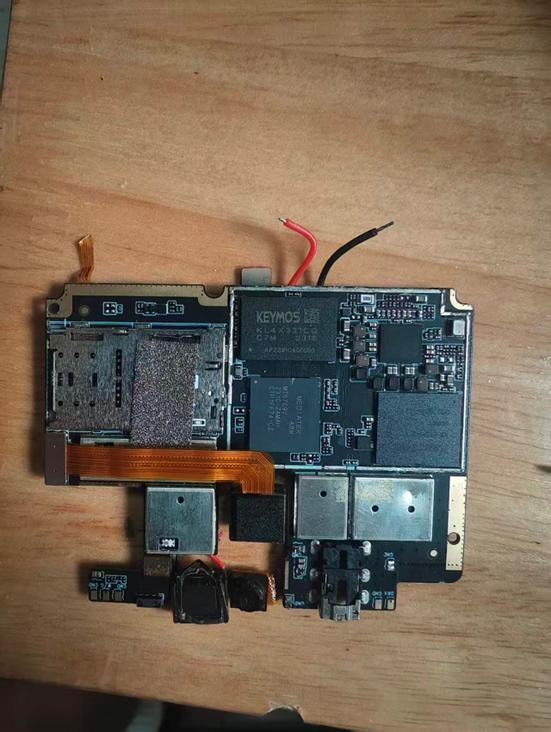
The second-hand mobile phone motherboards disassembled by A Cheng. Source: The interviewee
Someone offered to buy them all at 80 yuan each, but he thought the price was too low. Later, he found that the person who made the offer also planned to buy and hoard them and then resell them at a higher price.
In addition, he doesn't know how to price his "semi-finished" chips and can only refer to the fluctuating market price. "A 128G chip can be sold for more than 160 yuan."
Taking advantage of the chip price increase to enter the market, A Cheng thought he could make a fortune, but now these more than 600 motherboards have given him a headache - he hasn't found a buyer yet.
In late March, the topic "Memory crashed" once hit the top of the social media hot search list. According to Jiemian News, the price of the mainstream 16GB DDR5 memory module dropped from the high of 1,000 yuan in December 2025 to about 700 yuan; the price of the 32GB set shrank by 27% in just one month, from 3,000 yuan to 2,200 yuan.
Each link in this industry chain is like a sensitive nerve ending, and the recycling price of discarded mobile phones has also dropped. The price of second-hand mobile phones is mostly based on the small program "Digital Recycling Network." Against the background of the memory price drop, the price of second-hand mobile phones also shows a "changing every day" situation, and the settlement is based on the express delivery receipt time.
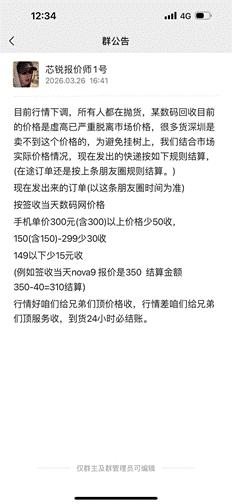
A recycler sent a notice in the WeChat group that the current recycling price of second-hand mobile phones has been reduced. Image source: WeChat group
Caijing's inquiry found that on April 1, the quotes of most mobile phones on the "Digital Recycling Network" were reduced. For example, the discarded Redmi 9A that was worth 230 yuan on March 31 dropped to 190 yuan on April 1. A Yao, an individual recycler in Guangxi, said that many upstream merchants have stopped collecting mobile phones in the past two days because they have too much inventory. The upstream merchants he mentioned are the merchants in Huaqiangbei.
However, the short-term price drop doesn't mean the restoration of the storage chip process. Looking at the storage chip supply, Micron's executives said in the earnings conference call that the storage chip industry is in a state of supply shortage, and this situation will continue until after 202