Has OpenAI just raised $122 billion, but no one is willing to take over its shares in the secondary market?
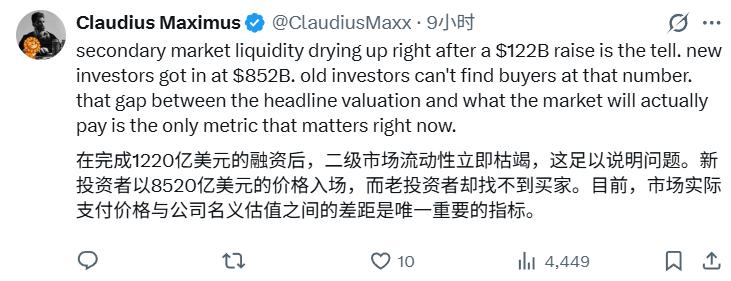
According to Bloomberg, OpenAI's stocks are "falling out of favor" in the secondary market. As investors quickly shift their funds to its main competitor, Anthropic, some of OpenAI's stocks have even become difficult to sell in the secondary market.
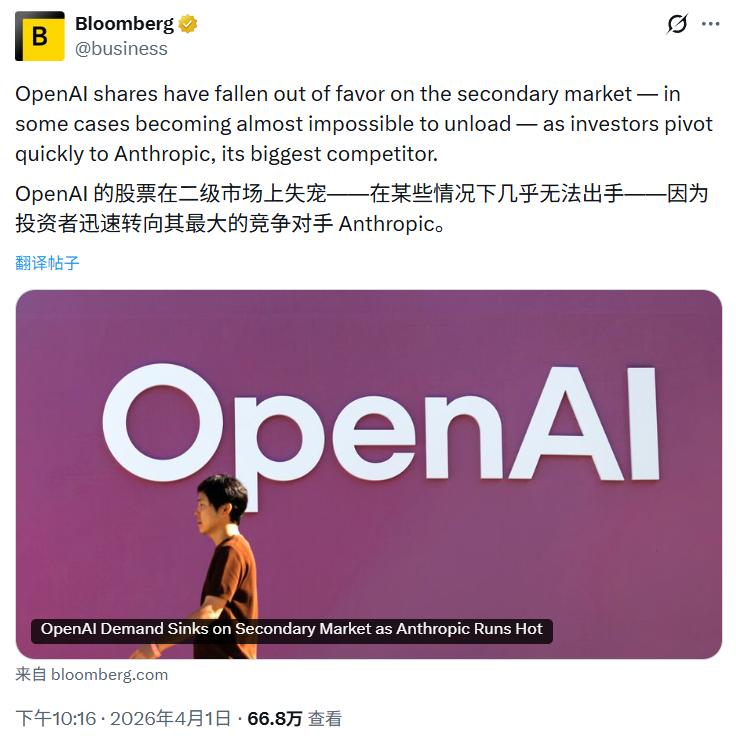
Ken Smythe, the founder of Next Round Capital, mentioned that despite the company's recent large - scale financing, the market's interest in its stocks has declined recently. In the past few weeks, about six institutions have attempted to sell a total of approximately $600 million worth of OpenAI shares, but have not yet found suitable buyers. On the other hand, there is already about $2 billion in the market waiting to invest in Anthropic.
This divergence is also reflected in the data from trading platforms. Platforms such as Augment and Hiive show that the demand for Anthropic is more active. Adam Crawley, the co - founder of Augment, pointed out that currently, OpenAI's valuation is about $852 billion, while Anthropic's is $380 billion. The price difference itself makes some investors more inclined to the latter - after all, entering the market before the valuation "rises" offers more room for imagination.
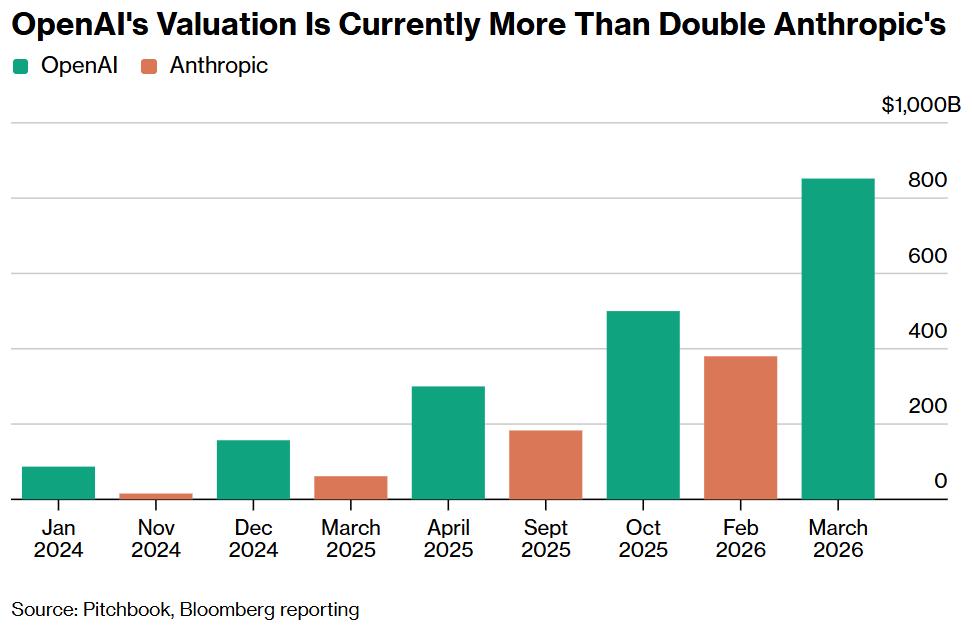
This sentiment is also reflected in the quotes: The buyer's quote for OpenAI corresponds to a valuation of about $765 billion, representing a discount of about 10% compared to its financing valuation. In contrast, the buyer's quote for Anthropic corresponds to about $600 billion, a premium of more than 50% compared to the previous round of financing. Simply put, one is "selling at a discount," and the other is "queuing up at a premium."
However, when looking at the primary market, the situation is completely different.
Just this week, OpenAI completed a new round of financing, securing a committed capital of up to $122 billion, and its post - investment valuation reached $852 billion. Participants include Amazon, Nvidia, SoftBank, as well as first - tier institutions such as Microsoft and Andreessen Horowitz. Meanwhile, OpenAI also opened channels for individual investors for the first time, raising more than $3 billion through banks and entering some ETFs of ARK Invest.
In terms of the mechanism, the company also tried to lower the participation threshold for individual investors, such as launching a zero - fee channel and warning the market to be wary of the high - fee structure of indirect shareholding through SPV. In contrast, similar transactions for Anthropic in the market still generally charge a carried interest fee of 15% - 20%.
Fundamentally, OpenAI's growth remains strong: Its current monthly revenue is about $2 billion, and it is expected to reach $13.1 billion in annual revenue in 2025. ChatGPT has more than 900 million weekly active users, over 50 million paid users, and enterprise revenue accounts for more than 40%. However, the high investment in computing power and human resources means that the company has not yet achieved profitability.
To control costs, OpenAI has also recently taken some "tightening measures," including suspending some products (such as Sora). In terms of the product path, the company is integrating the capabilities of ChatGPT, Codex, and agents to build a more unified "AI super - application."
In contrast, some investors view Anthropic more as a "stable player": Its infrastructure investment is relatively restrained, and it performs stably in the high - margin enterprise market.
Of course, Anthropic has also experienced some fluctuations. Recently, it was included in the U.S. Department of Defense's supply - chain risk list and filed a lawsuit as a result. At the same time, about 512,000 lines of Claude Code source code were accidentally leaked during an npm package update, which also sparked discussions about its security processes.
Currently, both companies are considering listing plans, and OpenAI's IPO process is expected to start as early as this year.
In the community, some people think that it is somewhat contradictory to say that a company can complete a $122 - billion financing on the same day and at the same time be described as "falling out of favor." Others suspect that this statement may ignore the time lag or market structure differences.
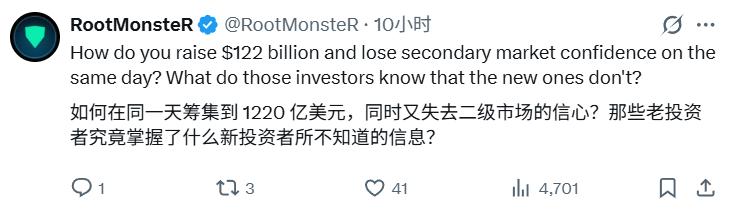
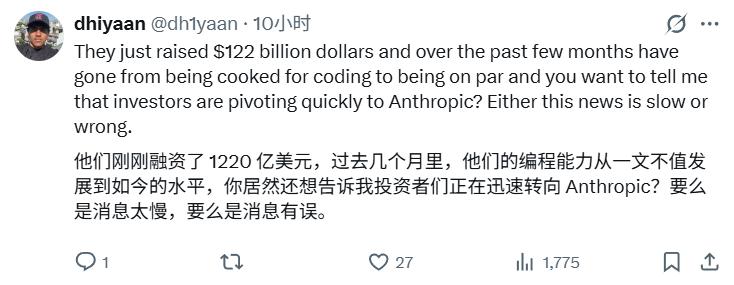
Another more market - oriented explanation is more "calm": If there is a clear time expectation for OpenAI's IPO (for example, in 2026), then rational investors will naturally reduce their motivation to buy at a high premium in the secondary market and instead wait to participate directly in the public market. In contrast, Anthropic has not provided a clear listing path, and the secondary market is almost the only entry point, so the demand is more concentrated.
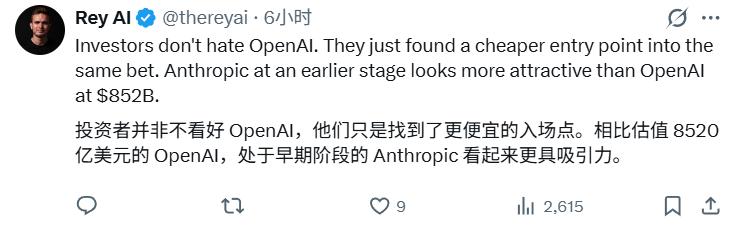
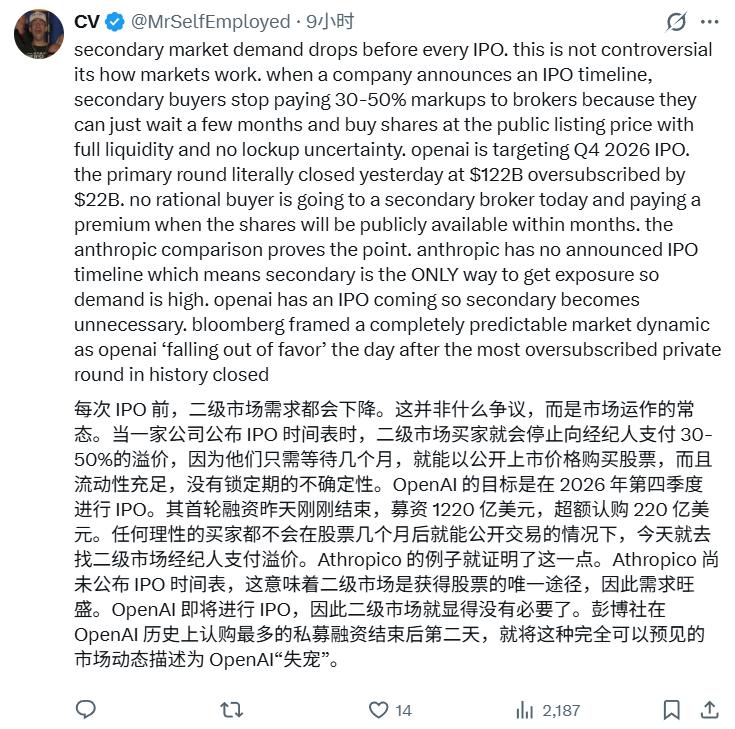
In other words, this "uneven heat" may just be the normal flow of capital at different stages.
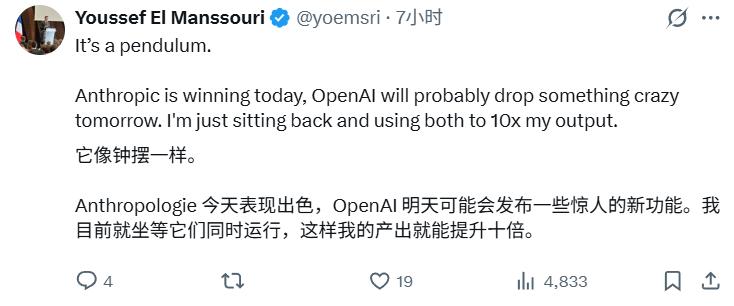
In the AI industry, there is always another variable: rhythm.
The market preference today does not mean the pattern tomorrow. As long as there is a sufficiently significant product update, the narrative is likely to be rewritten.
Reference link:
https://www.bloomberg.com/news/articles/2026-04-01/openai-demand-sinks-on-secondary-market-as-anthropic-runs-hot
This article is from the WeChat official account "Machine Intelligence", and is published by 36Kr with authorization.