It's a bit of a blow to my self-esteem, but it's totally worth it. Karpathy: When AI takes over 80% of the code, I see the magic of AGI.
Just in the past one or two months, a silent but significant change has taken place in Andrej Karpathy, the former head of AI at Tesla and a founding member of OpenAI.
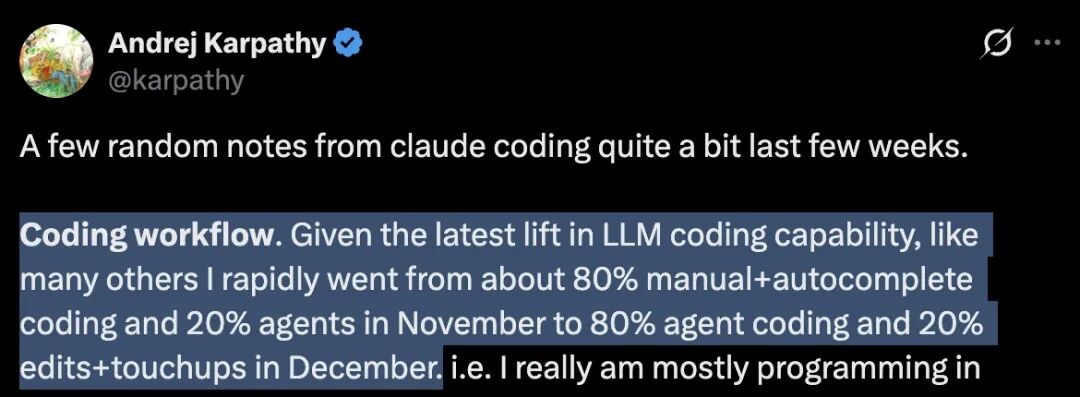
In November last year, 80% of his workflow involved writing code manually, while 20% was done by AI.
Just a few weeks later, the ratio was completely reversed!
AI took over 80% of the code - writing work, and he was only responsible for the remaining 20% of symbolic fine - tuning work.
In Karpathy's words: "I'm basically programming in English now. Although it sometimes hurts my pride a bit, it's totally worth it."
While the public's perception of AI coding is still stuck at the stage of "AI - written code has bugs", Karpathy has declared that "the hottest new programming language is English"!

He abandoned his once - proud skill of writing code manually and replaced it with a new programming method of "commanding AI to write code in English".
Karpathy said in a tweet that this is the biggest change in the basic coding workflow in his 20 - year programming career, and these changes occurred within just a few weeks:
I expect that double - digit percentages of engineers are experiencing similar transformations, while the general public's awareness of this is still at a single - digit low level.
This shows that this epic transformation of AI coding is not just a game for genius programmers. It also happens to many ordinary programmers and even non - coding engineers.
Almost everyone has felt a powerful sense of reshaping their careers in the wave triggered by Claude.
When Programming Becomes an "Embarrassing" Conversation
Karpathy used very subtle words when describing this drastic change.
He said that the current programming process sometimes makes him feel a bit "hurt in pride".
An architecture that used to take a team a week to complete can now be generated like a tide of code just by him chatting with AI in English.
Perhaps before November last year, he thought AI was his co - pilot, and 80% of the work still had to be done by writing code manually.
But by December, in just a few weeks, he suddenly found that AI had taken over the driver's seat, and he was sitting in the co - pilot position, with only 20% of the patching work left for him.
The impact brought by this "role - reversal" is unprecedented. With his senior coding experience, he even feels "a bit embarrassed" about this sense of "getting something for nothing".
However, this transformation is irreversible.
Especially after the programming abilities of models like Claude and Codex crossed the "consistency" threshold around December last year, it triggered a major change in software engineering.
When the quality of the conversation (prompt engineering) determines the quality of the code, this "English programming" has become a new hardcore skill.
IDE / Agent Swarms / Error - Prone: Some Exaggerated Statements
In this tweet, Karpathy also talked about his views on the role and limitations of current generative AI in programming.
He thought some statements were too exaggerated, such as "With AI coming, there's no need for IDE (Integrated Development Environment, like code editors such as VS Code)", or the hype about "agent swarms" (AI agents collaborating in programming like a swarm of bees).
He admitted that AI is a huge improvement, but the models are still error - prone and not omnipotent.
1. Don't Trust AI Too Much. Keep an Eye on Important Code Yourself
For truly important code, Karpathy suggested not to abandon the IDE. Instead, use a large - screen and comfortable IDE to monitor the AI's output, just like an eagle eyeing its prey.
The types of errors have obviously changed. They are no longer simple syntax errors, but more like the conceptual errors that a slightly careless and rushed junior engineer would make.
2. The Most Common Problem of AI: Making Wrong Assumptions and Going Wrong All the Way
AI will "imagine" some wrong assumptions (such as misunderstanding your requirements) and then continue writing code without checking, leading to the collapse of the whole thing.
It doesn't stop like a human and ask, "I'm not sure about this. Can you clarify?" Nor will it point out contradictions in the code, compare the advantages and disadvantages of different solutions, or "disagree" with you when your idea is wrong.
Instead, it is still a bit overly accommodating. Karpathy thought that entering the "plan mode" (letting AI plan first and then execute) would be better, but a simpler and lightweight version of the plan mode that can be inserted at any time is needed.
3. AI Tends to Complicate Simple Things
When writing code, AI tends to over - abstract (add too many levels), make the structure bloated (the code becomes bulky), and often doesn't clean up the dead code (abandoned parts) it leaves behind.
It may spit out a large amount of inefficient and bug - prone code with thousands of lines. When you ask it to simplify, it may immediately streamline it to 100 lines.
It sometimes "meddles in other people's business". Even if it has nothing to do with the current task, it will modify or delete comments and code it doesn't like or fully understand.
Even when trying to impose some simple instructions in CLAUDE.md, these problems still exist.
Nevertheless, Karpathy still thought that overall it has been a revolutionary improvement, and it's hard to imagine going back to the era of pure manual coding.
Once a person gets used to AI helping to write code, going back to pure manual coding may feel like going back to the Stone Age, extremely uncomfortable.
This shows that although AI is powerful, humans need to use it smartly to achieve super - effective results.
The Truth of AGI Magic
Beyond Speed - Up
It's the Expansion of Ability Boundaries
It's not easy to quantify how much "acceleration" AI assistance has brought to programming. But Karpathy's feeling is that he can complete the things he originally planned to do much faster.
Moreover, there is a more important change. He can do things far beyond the original plan:
He can write a lot of code that was not worth spending time on before;
He can handle code that he didn't dare to touch before due to lack of knowledge or skills.
Therefore, in addition to speed - up, a more important change that AI coding brings to Karpathy is the expansion of ability boundaries.
AI Tenacity
The Real Magic Comes from "Closed - Loop Attempts"
The reason why AI agents can amaze a great programmer like Karpathy is that it has a trait that humans are extremely lacking in: tenacity.
Karpathy observed that when a code bug troubles humans for more than 30 minutes, most people will become irritable, anxious, and even want to give up.
But AI won't.
It will be like a tireless repeater, struggling to the end for a logical loophole. It can try 50 solutions in a row, maintaining the initial enthusiasm every time.
Endurance is a core bottleneck in human work, and with large models, this bottleneck has been greatly relaxed.
Therefore, while many people think that the power of AI lies in its "omniscience", Karpathy pointed out that its real magic comes from "closed - loop attempts".
Large models are very good at continuously trying in a loop until clear target conditions are met. Karpathy thought that this is the source of most of the "AGI experience" magic.
The limitation of humans is that when writing code, once an error occurs, the mental burden will increase rapidly.
But the advantage of AI is that it never gets tired. If you give it a clear goal (for example: this web page must have a working login box), it can try 100 times in a loop.
This ability of "continuously trying until success" is very close to human intelligence (AGI experience) in terms of perception.
Declarative Instructions
Give the "End Point", Not the "Roadmap"
This trait of AI of "closed - loop attempts" until success means that we need to switch our thinking from "imperative" to "declarative".
Don't tell it the specific steps. Give it the success criteria and then watch it work.
Imperative Programming (Old Thinking): Tell AI to open a file in the first step, parse the string in the second step, filter the spaces in the third step... If one step is wrong, everything goes wrong.
Declarative Programming (New Thinking): Tell AI "I need a script that can process this CSV format and output a chart. Here are its specifications."
As long as you clearly define the "success criteria", AI will use its "closed - loop attempt" ability to break through every door.
Test - Driven Development (TDD) and Tool Integration (MCP)
Karpathy also mentioned specific practical strategies.
1. Write Tests First, Then Pass the Tests
Karpathy thought this is the smartest approach.
First, let AI write a piece of code (test cases) to "verify whether the program is correct".
As long as the test fails, AI has to keep modifying the code in the loop. The test is AI's "invigilator".
2. Introduce MCP (Model Context Protocol)
For example, integrate browser capabilities into the loop.
After AI writes the code, it automatically opens the browser to run. If it finds a white screen or an error on the page, it will see the error message itself and then go back to the loop to fix the bug.
The whole process doesn't require human intervention.
3. Leverage Effect: Exchange "AI's Time" for "Human Freedom"
The so - called leverage effect is to let the agent loop for a longer time.
Don't let AI write the most complex architecture right away. First, let it write a "stupid but definitely correct" version.
With this correct benchmark, then let it optimize the performance.
In this way, each person's programming cost becomes the few minutes of writing the "specifications". And AI may be silently looping, trying, reporting errors, and restarting in the background for a whole hour.
Our leverage lies in: the shorter the "instruction time" you invest, the longer the "loop time" AI runs, and the higher the productivity multiplier you get.
The Fun of AI Programming and "Disuse Atrophy"
AI programming brought fun to Karpathy, which he didn't expect beforehand.
He thought programming with agents is actually more fun than before:
When a large amount of fill - in - the - blank hard work is removed, what remains is more of the creative part, and he gets stuck less often (Karpathy thought this experience of getting stuck is not fun at all).
Moreover, with AI, Karpathy has become more courageous when facing problems because he can almost always find a way to fight side by side with it and move forward.
Karpathy thought that AI programming will probably divide engineers into two categories: one group mainly likes "writing code", and the other group mainly likes "creating things".
In addition to these fun and positive changes, Karpathy also saw a disturbing change brought by AI programming.
He issued a warning: Disuse Atrophy.
"I've clearly felt that my ability to write code manually is slowly degenerating."
Karpathy thought that when we get used to only being responsible for judgment and not for generation (these are two different abilities in the human brain), our brains are like muscles that start to degenerate due to long - term disuse. That is to say, human manual programming ability is experiencing an irreversible degeneration.
This is not only the loss of skills but also a deep - seated "downgrade".
If one day AI removes its ladder, what should those programmers who are used to floating in the cloud and have lost the ability to climb do?
Karpathy's 2026 Prediction
The Outbreak of Junk Content and the Shuffle of Talent Structure
Since the emergence of ChatGPT at the end of 2022, the explosion of generative AI has entered its fourth year.
Karpathy said that he has mentally prepared for 2026, which may be an "outbreak of junk content" on GitHub, Substack, arXiv, X/Instagram, and almost all digital media, as well as some hype about the AI productivity revolution.
Of course, this process will also be accompanied by real and solid progress.
Some questions he has been constantly thinking about recently are:
What will happen to "10X engineers"?
Will the productivity gap between average engineers and top - notch engineers be further widened?
With the support of large models, will generalists increasingly outperform specialists? After all, large models are very strong in filling in details but not so strong in macro - strategy.
What will the future large - model programming experience be like? Will it be like playing "StarCraft"? Will it be like playing "Factorio"? Or will it be like playing music?
How many problems in society are essentially stuck by the bottlenecks of digital knowledge work?
Karpathy mentioned that the capabilities of AI agents such as Claude and Codex crossed a certain consistency threshold around December 2025. Suddenly, they seemed to be far ahead of everything else: whether it's integration (tools, knowledge), new organizational workflows and processes, or wider dissemination.
Therefore, he thought 2026 will be a high - energy year, and the whole industry will be digesting and absorbing this brand - new ability.
In this chaos, the structure of talent will undergo a large - scale shuffle.
Those who have insights in macro - strategy and can think across domains will have their productivity magnified hundreds or thousands of times because they have AI, an all - powerful execution tool. Maybe the spring of generalists is coming.
On the contrary, those "specialists" who only master a single field and can only perform mechanically will face cruel squeezing.
What's even more heartbreaking is that AI hasn't narrowed the gap as people expected.
A possible reality is that the energy burst out by a top - notch developer using AI will be more than 10 times greater than that of an ordinary developer.
Reference Materials:
https://x.com/karpathy/status/2015887154132746653
This article is from the WeChat official account "New Intelligence Yuan". Author: New Intelligence Yuan, Editor: Yuan Yu. Republished by 36Kr with authorization.