Anthropic made its own OpenClaw, and Computer use officially entered Claude Code
As is well known, OpenClaw was formerly known as Clawdbot. Anthropic requested OpenClaw to change its name because they thought the pronunciation was very similar to their flagship product, Claude.
At that time, everyone thought the matter was over. Who would have thought that the reason for asking OpenClaw to change its name was that Anthropic itself was going to develop OpenClaw.
On March 31st, Anthropic officially announced that the Computer use function has now been officially added to Claude Code.
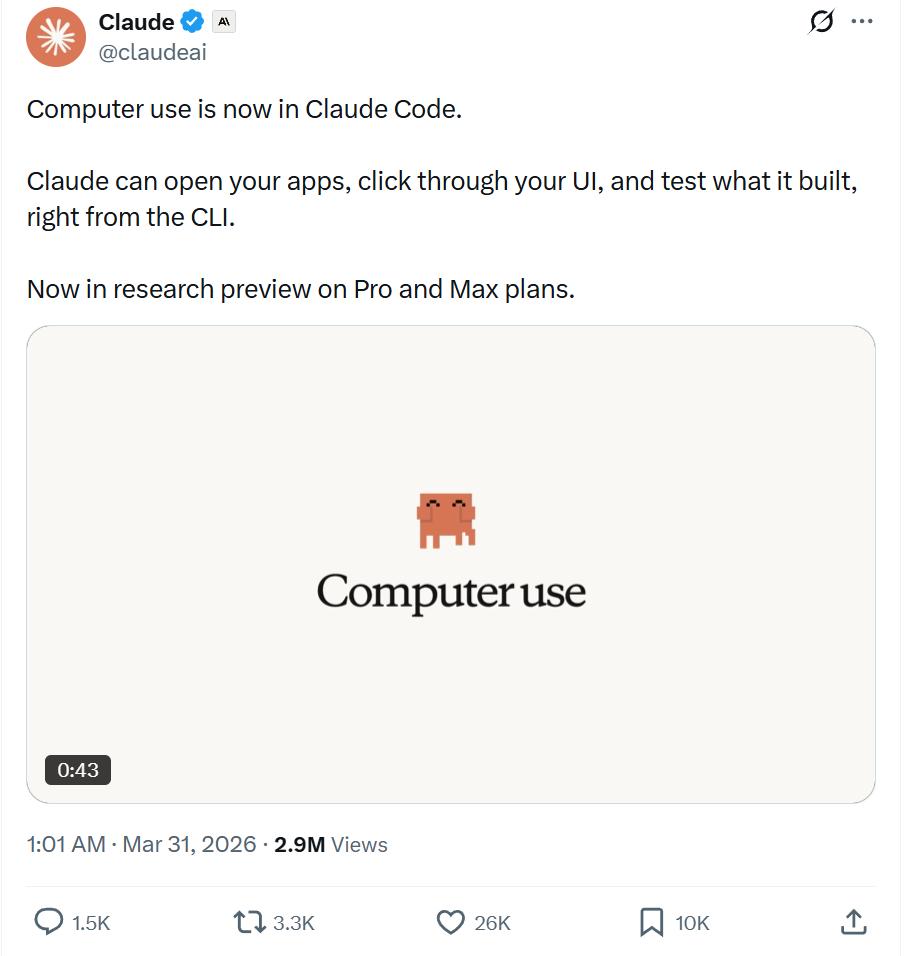
Computer use is not a new product. As early as October 22, 2024, Anthropic conducted an open test.
It enables Claude not only to read code and run commands but also to directly operate the computer interface. It can view the screen, click buttons, switch windows, and go through web processes to complete tasks that have no ready-made APIs and can only be done manually by humans.
So what was Anthropic doing before?
First, this ability is very resource - intensive. It deals with the real computer interface rather than just text, and the cost of making mistakes is much higher than that of an ordinary code assistant.
Second, in its early stage, it was more like an experimental ability, suitable for being polished in API and test scenarios first rather than being directly integrated into daily products.
Third, in the past, Claude Code was mainly a code assistant in the terminal, and there was not a strong demand for "operating the interface by itself". However, now Anthropic is clearly pushing Claude Code towards a long - running agent system, and Computer use has begun to become truly useful.
Not finished yet. Just last week, Anthropic added the Channels function to Claude Code. You can communicate with Claude Code on the computer through external social software and direct it to work.
So far, Claude Code has completely evolved into Anthropic's own OpenClaw.
01
How is it different from OpenClaw?
Anthropic's official documentation clearly defines Channels. In essence, it is an MCP server used to push external messages, alerts, webhooks, or monitoring events into a running Claude Code session.
You can completely understand it as the "inbox" and "doorbell system" of Claude Code.
Previously, if you wanted Claude Code to continue working, you had to stay in front of that session all the time.
With Channels, you can send messages to Claude Code to direct it to work.
Theoretically, as long as the session is still active, things that happen in the external world, whether it's a message from a mobile phone, an alert from a monitoring system, or a webhook from a service, can be sent in to interrupt it, wake it up, or give it the next instruction.
Computer use does something different.
It can execute commands on your behalf, just as if you were sitting in front of the computer screen, reading the text on the screen, looking at the illustrations on the screen, and then imitating your hands to control the mouse and keyboard.
In simple terms, Channels is the "ear", responsible for bringing in messages from the external world. Computer use is the "hand", responsible for directly operating the interface when there is no ready - made API or dedicated connector.
Putting the two together, the Anthropic version of OpenClaw was born.
However, it should be noted that the logic of OpenClaw is completely different from Anthropic's system.
Anthropic's Channel is more like a "message interface specification" for Claude Code to the outside world.
The problem it solves is: how to safely send messages, events, and replies into a running Claude Code session. Its core is MCP, and MCP is a protocol. Its logic is how to allow third - parties to create a message entry that can connect to Claude Code according to this agreement.
Channel is "setting rules", telling you how to send messages so that your Claude Code can understand. OpenClaw, on the other hand, has already connected many chat software and is ready to use.
The relationship between the two is both like competition and not entirely competition.
Taking it a step further, we'll come to the very interesting question you asked.
Since Anthropic says that Channel is essentially an MCP server, it means that I can use any software that can send messages to direct my Claude Code through Channels.
Because from the abstract layer of Channels, Anthropic doesn't care where the messages come from.
As long as you can convert some external messages into inbound events that conform to the Channel contract and send Claude's reply back as required, this "message source" is established at the protocol level.
Let me take World of Warcraft as an example.
In the game, execute the /chatlog command and enter the content you want to send. In this way, private chats will be continuously written to the file World of Warcraft/_retail_/Logs/WoWChatLog.txt
Then use the PowerShell command in Windows to monitor (tail, Get - Content - Path "x:\...\WoWChatLog.txt" - Tail 0 - Wait) WoWChatLog.txt. Finally, send the newly monitored messages to Channels, and you can use World of Warcraft to control Claude Code.
For example, if you send a private chat saying "cc stop" in the game, then Claude Code will terminate the current command.
And this is something OpenClaw can never do.
Because World of Warcraft doesn't have an official and general external network/local process interface that allows the in - game Addon to send messages to OpenClaw on your computer in real - time and get the results back in real - time.
02
Why is it said that MCP is making a comeback?
The official documentation of Channels has made it clear that Channel itself is an MCP server.
That is to say, Anthropic didn't make the "message entry" a private black box but directly admitted that this layer of ability can be abstracted into a standardized interface.
In the past, the most common dissatisfaction with MCP was that it sounded very open, but it was very troublesome to implement in practice. Authentication was complex, permission management was difficult, deployment was not easy, and remote state maintenance was also tiring.
Many teams initially thought it was like a universal socket, but as they developed it, they found that it couldn't naturally solve all the problems in the agent system.
So for a long time, MCP was more like a basic protocol that "everyone knew about but might not really regard as the main battlefield".
But the difference this time is that the industry's need for MCP has changed.
Before this, many companies only used MCP for one purpose: to let the model call tools through MCP.
Now the situation is different. More and more people realize that if an agent system wants to "continuously receive external events", it still has to rely on MCP.
Even the founder of OpenClaw, Steinberg.
On March 28th, he posted on X, saying that "the next version of OpenClaw will also be an MCP", and at the end, he wrote a sentence saying "I know this is embarrassing".
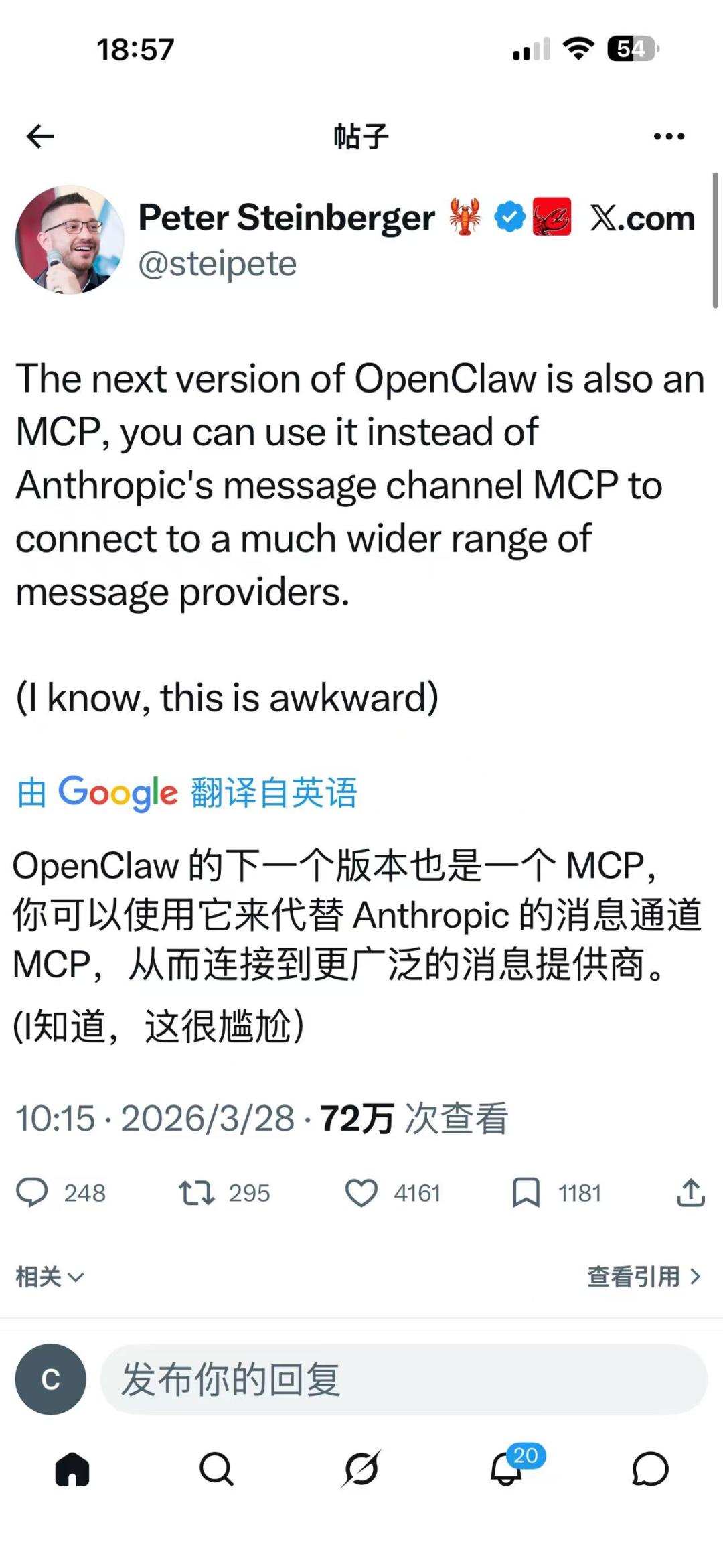
Steinberg has an old feud with Anthropic, and now he works for OpenAI. This is why it seems a bit embarrassing that OpenClaw's update adds more MCP support.
But there is an old Chinese saying, 'A wise man adapts himself to circumstances'.
Anthropic made the message channel an open MCP interface, originally to expand the boundaries of Claude Code. But in turn, this set of interfaces also gives third - parties like OpenClaw an opportunity to take over a larger message entry layer.
What Steinberg really has his eye on is the "message entry layer" under Claude Code.
He wants to package the strongest "multi - message channel gateway" layer of OpenClaw into a standard interface that can be directly reused by Claude Code and other MCP - compatible agents.
In the past, OpenClaw's multi - channel ability was more tied to the entire OpenClaw system. If you wanted to use its entry, you had to use its Gateway and agent system as well.
If OpenClaw also uses MCP like Anthropic, it can take out the "multi - channel message entry" separately and use it as a standard component for others to connect.
In this way, what it sells is not just the OpenClaw product but its strongest layer of ability.
Netizens generally think that Claude Code is too tiring to use. You have to memorize various commands, use English, and endure its hard - to - describe UI.
However, Claude Code can do a lot of work and can connect to various large models. This makes Chinese - speaking people use Claude Code even though they don't like it.
Previously, someone developed a corresponding Skill that can allow you to talk to OpenClaw in natural language, and OpenClaw can convert it into corresponding commands and input them into Claude Code.
Once OpenClaw can open up this MCP message path by itself, there is no need to add an additional Skill, and OpenClaw can directly control Claude Code.
In addition, OpenClaw's current official positioning is very clear. It is a self - hosted gateway responsible for channels, sessions, and routing.
But if it MCP - izes this layer of ability, it will not only be "OpenClaw's own gateway" but more like a "message gateway that any MCP - compatible agent can call".
This will change its value from "whether you want to use OpenClaw" to "whether you want to reuse OpenClaw's message network".
But in my opinion, the MCP protocol hasn't really become popular again.
What has really become popular is the matter of "connecting the agent to the real world" itself.
This article is from the WeChat official account "Zimu AI". The author is Miao Zheng, and the editor is Wang Jing. It is published by 36Kr with authorization.