841.7 billion. The largest financing in history has been born.
According to a report by Zhidx on April 1st, this morning, OpenAI announced the completion of its latest round of financing, raising a total of $122 billion (approximately RMB 841.678 billion). After the investment, its valuation reached $852 billion (approximately RMB 5,877.948 billion), making it the largest single private equity financing in global history.
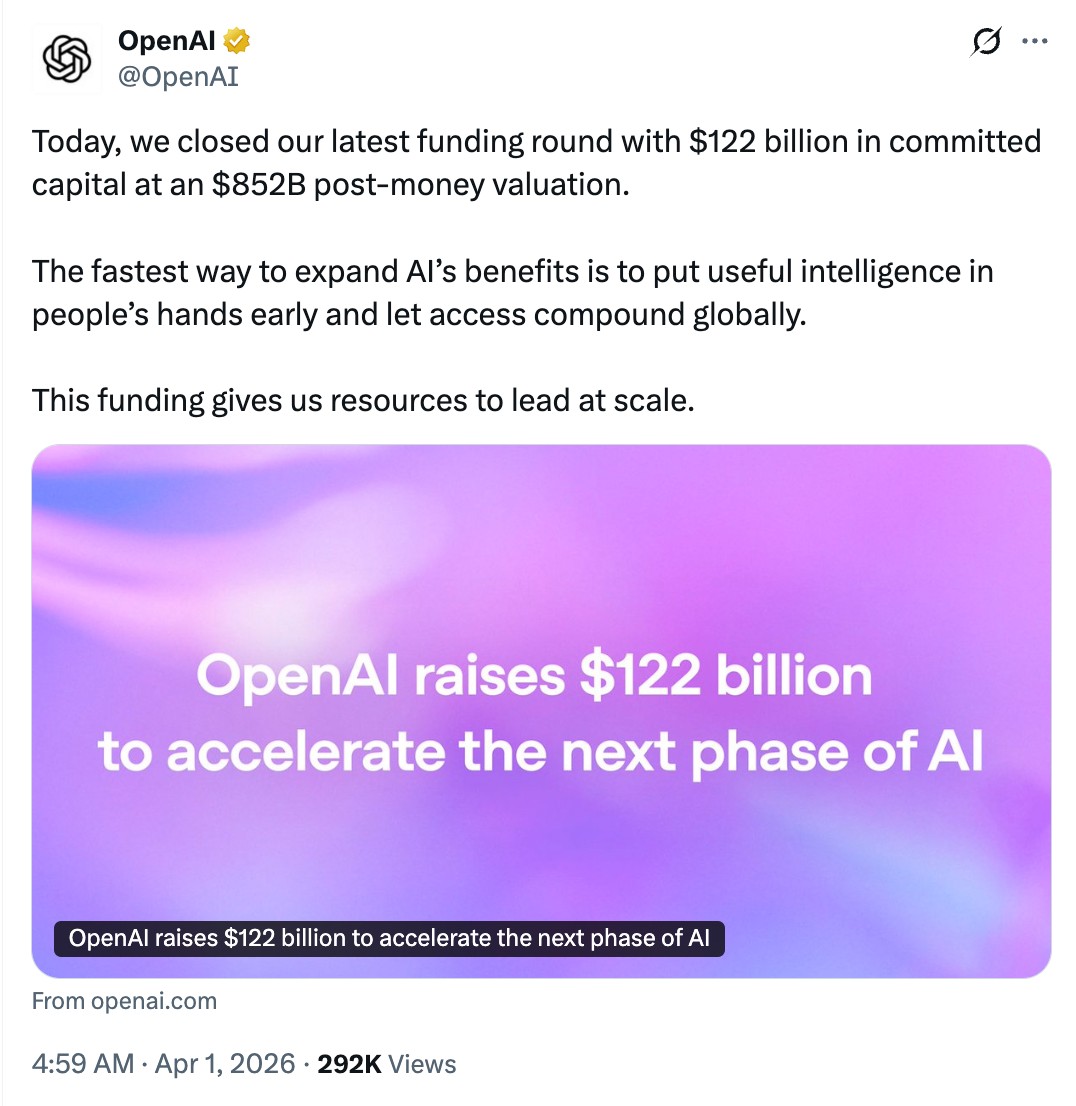
▲ OpenAI announces new financing (Source: Social media X)
OpenAI's latest valuation is comparable to the combined market capitalization of "Tencent + Alibaba". As of yesterday's close, Alibaba's Hong Kong stock market value was HK$2.27 trillion, and Tencent's Hong Kong stock market value was HK$4.42 trillion, with a total of HK$6.69 trillion (approximately RMB 5.88 trillion).
The financing announced this morning was led by heavyweight investors Amazon, NVIDIA, and SoftBank. Long - term partner Microsoft also continued to participate. SoftBank, along with a16z, D. E. Shaw Ventures, MGX, TPG, and institutions under T. Rowe Price Associates co - led this round of financing.
Since its establishment in 2015, OpenAI has completed approximately 12 rounds of financing, with a total financing amount of about $168 billion (approximately RMB 1,159.032 billion). Last month, OpenAI initially announced a $110 billion financing, with Amazon investing $50 billion, NVIDIA investing $30 billion, and SoftBank investing $30 billion, which was increased to about $122 billion today.
According to official data from OpenAI, ChatGPT's monthly active users exceeded 100 million two months after its release at the end of January 2023, and its weekly active users are about to exceed 1 billion. Within one year of ChatGPT's release, its revenue reached $1 billion (approximately RMB 6.899 billion). By the end of 2024, its quarterly revenue reached $1 billion.
Earlier in early March, according to foreign media The Information, citing sources, as of the end of February, OpenAI's annualized revenue had exceeded $25 billion (approximately RMB 172.4 billion), a 17% increase from the company's annualized revenue of $21.4 billion at the end of last year.
According to The Information, OpenAI recently raised its revenue forecast for the next five years, planning to achieve revenue of up to $284 billion (approximately RMB 1.96 trillion) by 2030.
Foreign media predict that in the next few years, OpenAI will consume tens of billions of dollars as it needs to invest more funds in renting cloud servers and chips for technology development. The surge in revenue may prompt them to conduct an IPO as early as this year.
This financing represents a further expansion of OpenAI's business scale and will provide sufficient "ammunition" for its plan to build an AI super - application.
01.
Monthly revenue reaches $2 billion,
Annualized revenue exceeds $25 billion
OpenAI's official announcement states that its monthly revenue has reached $2 billion (approximately RMB 13.798 billion). At this stage, its revenue growth rate is four times that of Internet giants such as Google and Meta.
ChatGPT contributes most of OpenAI's revenue, but the company expects that in the future, more and more revenue will come from enterprise customers and new products such as advertising.
Previously, according to foreign media The Information, citing sources, OpenAI calculates its annualized revenue by multiplying the revenue of the past four weeks by 12. In 2026, its annualized revenue exceeded $25 billion (approximately RMB 172.4 billion). If OpenAI calculates this indicator based only on the revenue peak of the last week, then OpenAI's annualized revenue is about $30 billion (approximately RMB 206.8 billion).
OpenAI's revenue is still higher than that of its competitor Anthropic, but the gap between the two is narrowing: Anthropic's annualized revenue recently exceeded $19 billion (approximately RMB 131 billion).
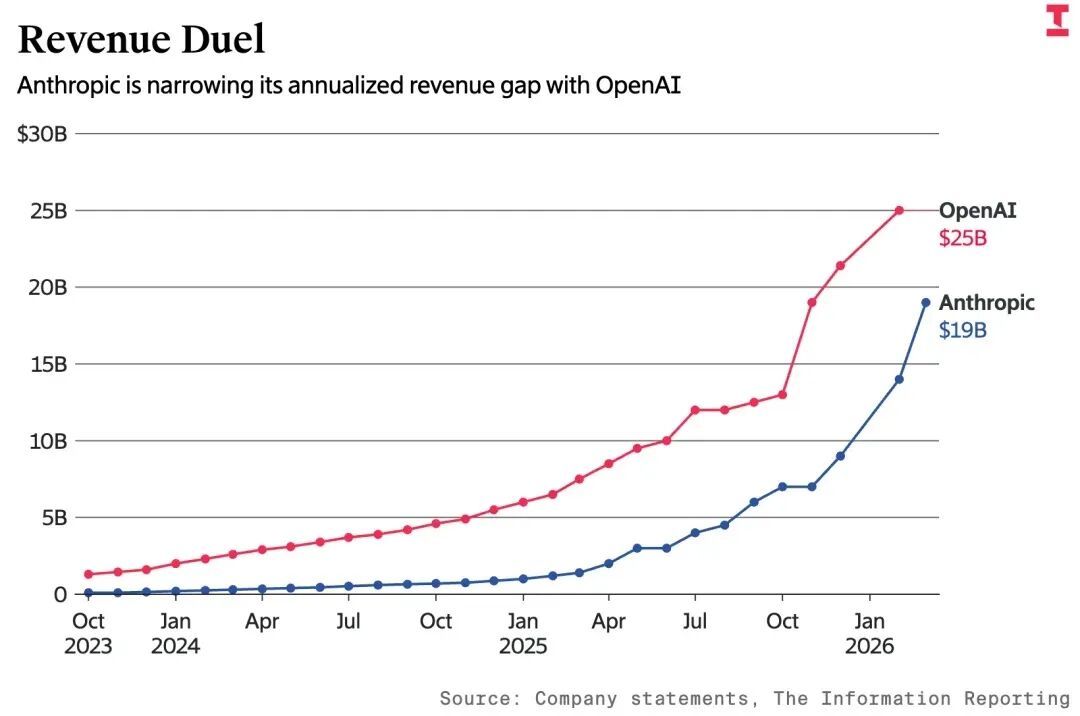
▲ Performance trends of OpenAI and Anthropic (Source: The Information)
According to The Information, OpenAI recently raised its revenue forecast for the next five years - planning to achieve revenue of up to $284 billion (approximately RMB 1.96 trillion) by 2030. At the same time, it also raised its forecast for cash consumption, expecting that by the end of this decade, its server - related costs will reach $665 billion (approximately RMB 4.59 trillion).
02.
ChatGPT users approach 1 billion,
Codex's weekly active users increase 5 - fold, and it will layout AI super - applications
Let's take a look at OpenAI's business distribution pattern.
Recently, OpenAI has just launched its most powerful GPT - 5.4 model to date and expanded Codex into a flagship coding Agent, significantly improving in memory, search, personalization, and multimodal interaction.
According to OpenAI's official announcement, some of the milestones achieved on the application product side are as follows: ChatGPT has more than 900 million weekly active users and more than 50 million subscribed users in the consumer AI field. ChatGPT's monthly web visits and mobile sessions are six times that of the second - ranked AI application, and the total time users spend on AI is four times that of the second - ranked AI application, and four times the sum of all other AI applications. Search usage has nearly tripled in one year, and its advertising pilot project achieved more than $100 million in annual recurring revenue (ARR) in less than six weeks.
Just last week, OpenAI announced the shutdown of the AI video - generation tool Sora. This once - popular phenomenon - level product was regarded as a "side mission" by the senior management, and the company will concentrate its resources on more commercially valuable directions.
It is reported that OpenAI is focusing on building an AI super - application, which will integrate ChatGPT, Codex, browsing functions, and its broader agent functions to create a user experience centered on agents.
Looking at the enterprise business, it currently accounts for more than 40% of OpenAI's total revenue and is expected to be on par with the consumer business by the end of 2026. Driven by GPT - 5.4, its API can currently process more than 150 billion tokens per minute. Codex's weekly active users have exceeded 2 million, an increase of 5 times in the past three months, with a month - on - month growth rate of more than 70%.
In March, OpenAI signed a major cooperation deal with the US Pentagon after the cooperation between Anthropic and the Pentagon broke down.
In terms of computing, it has expanded its infrastructure strategy beyond a few core suppliers such as NVIDIA, through cloud services provided by Microsoft, Oracle, AWS, CoreWeave, and Google Cloud; silicon chips provided by NVIDIA, AMD, AWS Trainium, Cerebras, and chips developed in cooperation with Broadcom; and data center services provided in cooperation with Oracle, SBE, and SoftBank.
03.
NVIDIA participates in leading the investment,
OpenAI is also included in multiple ETFs
This round of financing was led by heavyweight investors Amazon, NVIDIA, and SoftBank. Long - term partner Microsoft also continued to participate. SoftBank, along with a16z, D. E. Shaw Ventures, MGX, TPG, and institutions under T. Rowe Price Associates co - led this round of financing.
Many top global investment institutions have also participated in this round of investment, including: Altimeter, Appaloosa Management, ARK Investment, BlackRock, Blackstone Group, Coatue, D1 Capital Partners, Dragoneer, Fidelity Investments, Goanna Capital, Insight Partners, The Paragon Group, Sands Capital, Sequoia Capital, Sound Ventures, Temasek, Thrive Capital, the investment office of the University of California, and affiliated funds under Winslow Capital.
OpenAI has for the first time opened a participation channel for investors through the bank channel, raising more than $3 billion from individual investors. The company also announced that it will be included in multiple exchange - traded funds (ETFs) managed by ARK Invest, allowing more people to have the opportunity to participate in the investment.
In addition, OpenAI has expanded its existing revolving credit line to approximately $4.7 billion. This credit line is supported by a global syndicate of banks including JPMorgan Chase, Citigroup, Goldman Sachs, Morgan Stanley, Wells Fargo, Mizuho Bank, Royal Bank of Canada, Sumitomo Mitsui Banking Corporation, UBS Group, HSBC, and Santander Bank. As of the completion of the transaction, this credit line has not been used.
04.
Conclusion: The AI competition is accelerating into
the commercialization and scaling stage
The AI competition is accelerating into the commercialization and scaling stage. The heavy - weight entry of industrial giants such as Amazon and NVIDIA provides strong computing power and cloud resource support for OpenAI, highlighting the deep bundling and strategic bets of top technology companies in the field of AI infrastructure.
A valuation of up to $852 billion has raised the industry entry threshold to an unprecedented height. At the same time, the tens - of - billions - level financing and the aggressive revenue forecast also reveal the current core contradiction in the AI industry: the race between huge capital investment and commercialization.
OpenAI's concentration of resources on AI super - applications indicates that the industry is moving from a multi - pronged approach to convergence, pursuing core products that can generate continuous cash flow. In the next few years, whether it can meet the revenue target as scheduled while consuming tens of billions of dollars will be the key measure of whether this round of AI enthusiasm can continue.
This article is from the WeChat official account "Zhidx" (ID: zhidxcom), written by Li Shuiqing and edited by Xin Yuan, and is published by 36Kr with authorization.