Stripe presented a machine payment agreement, allowing the Agent to make purchases for themselves.
It's three o'clock in the morning, and your computer is still on. Your Agent is busy working.
It runs continuously in the background, querying data, invoking models, opening web pages, and organizing materials without a pause. Different from before, this time, it not only executes tasks but also completes several payments during the execution.
It pays for API calls, pays for browser sessions, and even settles the bill for an offline service. There is no account, no verification code, and no one sitting in front of the screen clicking "Confirm Payment". By the time you wake up, the task is completed, and the bill is already generated.
In other words, payment is starting to be embedded in every request of the Agent. When we talk about the Agent economy, this exactly fills the long - missing link in the Agent economy, which is the payment ability. This means that AI is no longer just a tool for invocation but can also participate in transactions autonomously.
Not long ago, the Machine Payments Protocol (MPP) launched by Stripe and the blockchain company Tempo is the converter driving this change.
Agents Can Conduct Transactions on Their Own
MPP tries to solve a problem that has been overlooked before. That is, when an Agent starts to execute a task, how does it complete the payment?
In the existing Internet system, this problem is not obvious. There is HTTP for communication, an account system for identity, and a mature process for payment. However, the common premise of these mechanisms is that they are all designed for humans. Steps such as registering an account, selecting a package, and filling in payment information are commonplace for humans but almost unusable for Agents.
As Stripe emphasizes, the existing financial system is essentially not suitable for machines. The function of MPP is to rewrite payment into an ability that can be embedded in the invocation process.
In this mechanism, when an Agent sends a request to a service, if the service charges a fee, it will directly return the price; only after the Agent completes the payment can this invocation continue.
In other words, it compresses the invocation and payment into the same action. In the past, you needed to register first, then subscribe, and finally reconcile the accounts at the end of the month; now, each invocation itself is an independent transaction, which occurs within milliseconds and ends in the same request.
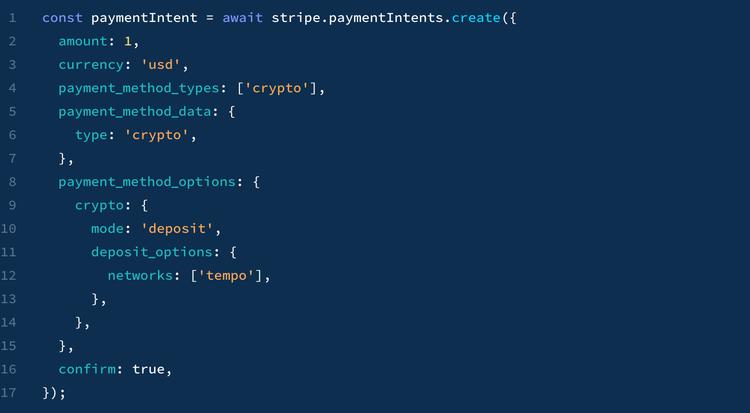
With just a few lines of code, an Agent can automatically complete the payment while invoking a service. Image source: Stripe
According to Stripe, MPP has begun to drive the Agent business model in real - world scenarios.
Browserbase provides cloud browser capabilities for Agents. Each invocation of a browser session corresponds to a payment; PostalForm turns printing and mailing letters into an API, and Agents can directly pay for this offline service; Prospect Butcher in New York even allows Agents to place orders for sandwiches, which are then picked up or delivered by humans.
These cases span computing resources, physical services, and offline consumption, but they all point to the same change: as long as a service can be invoked, it can be priced instantly. Thus, Agents can directly become paying customers of enterprises.
Parag Agrawal, the founder of Parallel, which aims to provide directly invocable Internet data interfaces for Agents, mentioned when evaluating MPP that Agents can independently pay for network access fees through each API call, which enables them to reach any intelligent agent developer globally through the existing Stripe technology stack.
Generally speaking, MPP has several key designs to support the smooth operation of Agent transactions.
First, it supports micropayments of extremely small amounts, with the minimum being as low as 0.01 USDC. This means that an API call, a segment of computation, or even a simple query can be priced separately. This level of granularity exactly matches the high - frequency and small - amount usage pattern of Agents.
Second, it is not limited to a single payment system. Whether it is on - chain USDC, traditional bank card payment, or Stripe's own settlement network, they can all be connected. It can even implement "buy now, pay later". This may seem like just a compatibility issue, but in fact, it determines whether Agents can use these capabilities in the real world.
More importantly, these payments are not experimental. They are directly connected to Stripe's existing payment system, including functions such as refunds, reconciliations, and multi - currency settlements. That is to say, from the very beginning, this mechanism can be used by enterprises. Stripe says that with just a few lines of code for connection, AI can directly become a new customer, and enterprises can collect payments from them.
Overall, MPP gives Agents the ability to spend money, and thus they can do more work for humans.
Humans and AI Need to Redefine the Division of Labor
In the past year, AI has started to move from answering questions to completing tasks. More and more Agents no longer just generate content but also start to break down steps, invoke tools, and operate continuously in complex environments. The "lobsters" are examples.
This allows us to see the outline of the Agent economy. The emergence of MPP complements the infrastructure required for this new economy. It is foreseeable that the Agent economy will develop at an accelerated pace, which may give rise to a new division of labor.
In the future, the collaboration between humans and AI will probably be like this: humans are responsible for setting goals, such as "complete a market analysis", and providing a budget range; Agents are responsible for execution, making continuous decisions within this range, such as choosing cheaper data sources, reducing unnecessary invocations, and making expenditures during the process.
The key here is no longer "who clicks the payment button" but "who sets the rules". Once this model is established, many familiar Internet structures will change.
In the past, services usually needed to be distributed through platforms, such as app stores, SaaS platforms, or subscription systems; now, services can exist directly in the form of APIs. Whoever needs them can invoke them and pay for this invocation. You don't need to be a user of a certain platform, nor do you need to subscribe to a package in advance. You just need to pay for this use.
The price structure will also change accordingly. It used to be "monthly subscription" or "package pricing", but now it is closer to "pay - per - use". You pay according to how much you use. The location of transactions is also changing. It is no longer concentrated on a certain page or application but is scattered in specific operations such as queries, generations, and computations.
It is in this context that when looking back at Stripe's actions in the past year, we can find a continuous path.
It first launched the Agentic Commerce Protocol (ACP) with companies such as OpenAI to solve the problem of "how Agents place orders"; then it launched MPP to solve the problem of "how Agents complete payments"; Tempo also received support from Stripe. This blockchain company provides a blockchain network optimized for stablecoin payments, which is responsible for carrying high - frequency, small - amount, and automated fund flows, enabling efficient settlement of Agent payments.
The above three respectively point to transactions, payments, and fund flows. Put together, they exactly form a complete system. As a payment giant, Stripe is trying to build the infrastructure for the future AI economy. Now, it is one step closer to this goal.
In fact, giants are all trying to seize a good position in the future AI economic ecosystem. OpenAI is trying to hold the transaction entrance in the dialogue interface, allowing Agents to decide what to buy; Google is promoting a whole set of protocol systems, trying to define how Agents complete transactions; e - commerce giants such as Amazon and Walmart are also preparing in advance for the future when Agents participate in shopping decisions.
However, previously, all the discussions were about how to let AI help humans buy things - help you select products, compare prices, and place orders. Humans were still the ones paying. MPP quietly reversed this logic.
Now, AI has become the other party in the transaction. It has its own wallet and its own budget logic, and can autonomously make expenditures during task execution. It no longer needs to wait for you to wake up and confirm, nor does it need you to sit in front of the screen and click the button.
It's hard to say exactly what this means. But one thing is certain: economic activities are no longer just between humans.
More and more money will flow between AIs.
This article is from the WeChat official account "Silicon Star GenAI". Author: Li Nan. Republished by 36Kr with authorization.