Enduring for 15 years with only one server and 8GB of memory: He used a bunch of "obsolete" technologies to enable over 500,000 people to type their first Linux command in their lives.
The "standard answer" for the current mainstream Internet architecture is probably something like this: Kubernetes + Microservices + Automatic Scaling + Cloud Native + Front - Back Separation + React/Vue + Distributed Database...
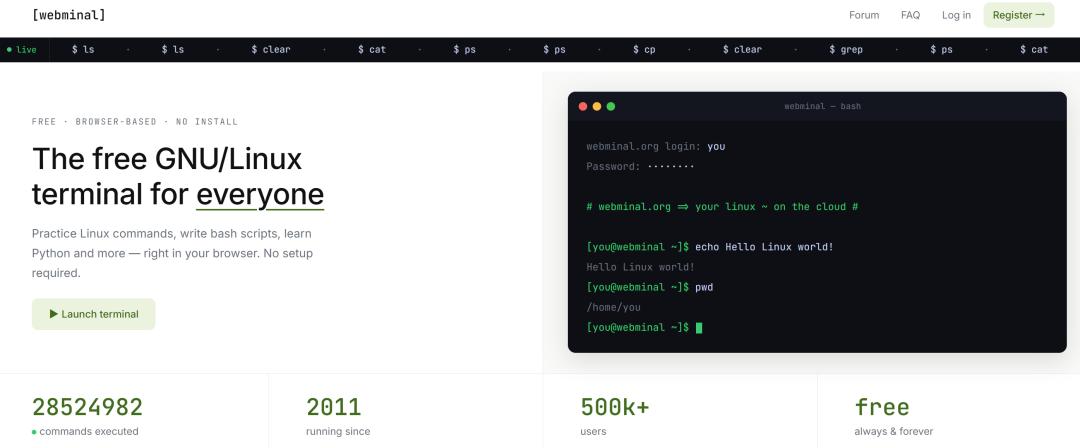
However, there is a project that has survived for 15 years with the most "anti - trend" architecture. It's called Webminal, a free online Linux learning platform. It still runs on a single CentOS server with 8GB of memory in a minimalist configuration. Yet, it has served over 500,000 users globally and has withstood data center fires, multiple power outages, and traffic surges.
An International Team: Developing a Product via SSH Without Meeting for Five Years
The story dates back to around 2010. At that time, Lakshmipathi was just an ordinary Indian developer working in a Windows environment but wanted to systematically learn Linux.
However, the problems were quite real: setting up a local environment was troublesome, configuring virtual machines was complex, and most online tutorials were just "pseudo - terminals". Especially in many Linux teaching materials on websites, it was basically just "clicking the Run button", not a real Shell experience.
So, Lakshmipathi had a seemingly simple but extremely crucial idea:
Could a "real Linux terminal" be opened directly in the browser?
There would be no "run button" and no "execution prompts", just a pure command - line environment. Every command typed in it would be like being executed on a real server. In this way, when users really face a Linux machine, they won't be nervous or tentative because they have "practiced many times".
The prototype of Webminal was born in this way.
Webminal wasn't developed by Lakshmipathi alone. He had a co - developer, Freston, an engineer from the Netherlands. They met on a forum, LinuxForums.org, in 2010.
In the following years, they did something almost unimaginable today: they cooperated to develop an online platform without Slack, Zoom, or video conferences.
They had only one "communication tool":
- $ screen -x chat
- $ cat > /dev/null
- hey, should we add MySQL support?
Yes, they directly chatted in the server's terminal. It wasn't until 2015 that they saw each other's faces for the first time. Before that, they were just "a username in each other's SSH".
However, it was this minimalist and even somewhat "primitive" way of collaboration that built the core of Webminal.
One 8GB Server Has Lasted for 15 Years
First, let's introduce Webminal's infrastructure: a CentOS Linux server with 8GB of memory. There is no container orchestration, no cluster, and no automatic scaling.
Since its launch in 2011, this architecture has hardly changed in essence, but it has withstood many "disaster moments":
● In 2017, a Spanish technology blog brought a surge of 10,000 users in a single day;
● In 2021, there was a fire in the data center, resulting in the direct loss of 150,000 user accounts;
● There were multiple power outages in the Netherlands, which once interrupted the service;
● Coupled with the continuously growing user base - Webminal has served over 500,000 users in total.
In other words, this 8GB - memory machine has carried the entry - level experience of hundreds of thousands of Linux beginners.
If you list Webminal's technology stack, most engineers' first reaction might be: "Can this even work?"
● Python 2.7 (yes, it's that old)
● Framework: Flask 0.12.5
● Terminal: Shellinabox (maintenance stopped as early as 2017)
● Root experimental environment: User Mode Linux (an old technology from 2001)
● Monitoring: eBPF/execsnoop (the only relatively new component in the entire stack)
● Database: MySQL, running on the server that withstood the fire
● Front - end: No React, no Vue, no npm, just pure HTML + inline CSS
This combination almost goes against all the "best practices" of the past decade. But Lakshmipathi confidently said: "All technology conference presentations will tell you that this stack is 'completely unreasonable', but it has served 500,000 users and run stably for 15 years."
Why Choose "Antiques" Instead of New Technologies?
Perhaps many people will ask: since it's an online Linux environment, why not use Docker? Lakshmipathi's answer is straightforward: because Docker isn't'real' enough.
In Webminal, users don't just type basic commands like ls and cd; they need to perform more low - level system operations, such as disk partitioning (fdisk), LVM management, RAID configuration, and file system creation (mkfs). These operations require "real block devices".
So, Lakshmipathi chose a technology that has almost been forgotten: User Mode Linux (UML) - a technology developed by Jeff Dike in 2001 that can run a complete Linux kernel in user mode.
Simply put, UML allows each user to start not a container but a "complete Linux kernel": each user has an independent Linux kernel, 4 virtual block devices (64MB each) for practicing LVM, RAID, and fdisk, 256MB of memory, and a shared image based on copy - on - write (COW).
When the user types poweroff, the UML instance exits directly and returns to the normal shell, completely isolated and risk - free. And the COW technology ensures controllable costs - even if 100 users operate simultaneously, it only adds about 2GB of storage, and the base image is shared globally.
Of course, Webminal has also tried modernization. Lakshmipathi admitted that they once tried to replace Shellinabox with a modern WebSocket terminal. However, just a few hours after the launch, users reported problems such as white screens and Firefox compatibility issues.
Shellinabox was born in 2005. Although it's old, slow, and ugly, it has a key advantage: it can almost penetrate all firewalls, proxies, and corporate intranets. So, Lakshmipathi finally switched back to Shellinabox: "Sometimes, old things are actually the right choice."
In the entire project, the only technology that can be called "modern" is eBPF. Webminal uses it to track system command executions in real - time and displays a scrolling "command stream" on the home page: ls, gcc, vim... These are not simulated data; they all come from the current real users' input and have been anonymized, showing only the commands themselves, no parameters, no paths, and no passwords.

According to Lakshmipathi, as of now, this scrolling real - time command stream on the home page has recorded over 28 million commands.
Why Has a Project That "Doesn't Make Money" Survived for 15 Years?
In fact, Webminal's biggest "counter - intuitive" aspect is not only its technology but also its business model - no ads, no user tracking, no venture capital, and no subscription revenue. All server costs are borne by Lakshmipathi himself.
"The cost of this project even exceeds my personal and family's daily expenses . I've thought about shutting it down more than once. 15 years is really a long time." Lakshmipathi admitted that during the months when he was unemployed, as his savings decreased and the server bills arrived on time every month, he would wonder: should I shut down the server this month?
But every time he found a new job, this thought disappeared, and Webminal survived for another year.
Over the years, Lakshmipathi has also tried some monetization methods, but he was rejected by YC, failed to promote paid subscriptions, and couldn't find sponsors. The reason is simple: the core users of Webminal are students, and many of them can't even afford $4 per month. So, this project finally chose the most 'foolish' method - to remain free.
"Over 500,000 people have typed their first ls command on Webminal. Some of them have become system administrators, some are running their own servers, and some are managing infrastructure on a much larger scale than me." Despite this, Lakshmipathi is still firm: "As long as it can help even one student, Webminal will keep running."
However, he also admitted that the 8GB of memory has now become a bottleneck for Webminal, and the number of concurrent users in the Root experimental environment is also limited. He hopes to upgrade the server's memory to 128GB so that more students can use the Root environment simultaneously. So, he opened a sponsorship channel on GitHub Sponsors (https://github.com/sponsors/Lakshmipathihmipathi): "Even a small amount of help is very meaningful."
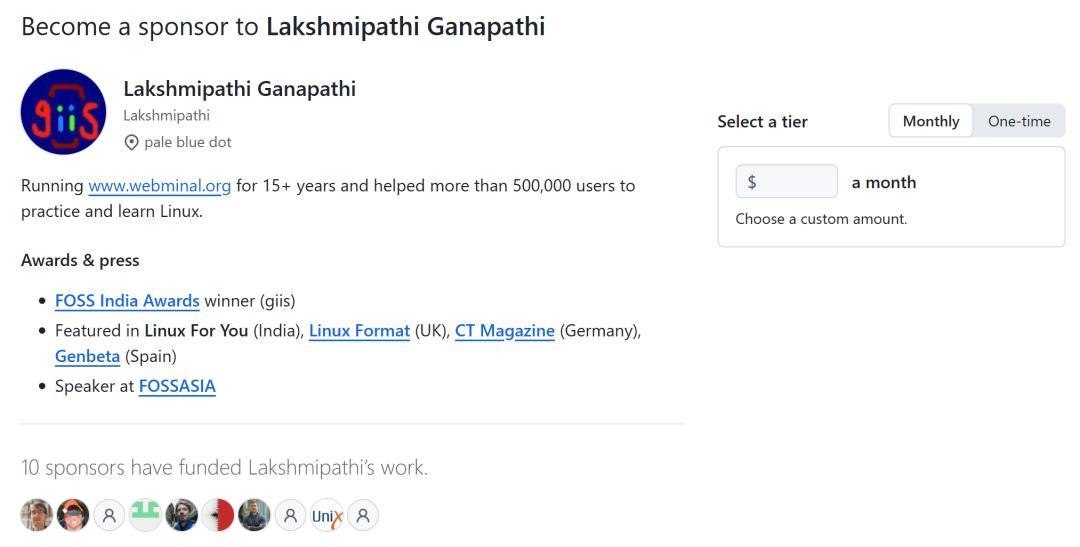
As he said, from the user reviews of Webminal, we can see many sincere feedbacks:
● "I'm a Windows administrator and don't have much free time. This website helped me quickly get familiar with Linux. I even use it on my tablet. The tutorials are also great. Thank you for your efforts."
● "I'm a Korean student majoring in electronic engineering. I've learned a lot from your website about Linux!"
● "The tutorials are great, and some parts are even interesting. The website is amazing. I hope you'll add more content and keep it up!"
In this era that emphasizes efficiency, scale, and capital return, Webminal's story seems a bit "out of place" - but that's exactly why it's precious: 15 years, one server, 8GB of memory, 500,000 users. Behind Webminal's refusal to die is a developer's ultimate protection of the original intention of technology.
Reference link: https://community.webminal.org/t/15-years-one-server-8gb-ram-and-500k-users-how-webminal-refuses-to-die/8803
This article is from the WeChat official account "CSDN". Compiled by Zheng Liyuan. Republished by 36Kr with authorization.