In Silicon Valley, if you don't understand Chinese, what's the point of doing AI?
In the spring of 2026, beneath the chill in Silicon Valley across the ocean, an undercurrent was surging.
In the past few weeks, several seemingly isolated but actually interconnected news items have been quietly changing the world's outdated perception of "AI hegemony."
First, in February, DeepSeek, the company that once made Wall Street tremble, was reported to have not provided its latest flagship model to NVIDIA and AMD for adaptation. Instead, it gave preferential treatment to domestic chip manufacturers such as Huawei.
Then, in early March, several well - known domestic and international technology forums frequently spread the joke that "if the open - source DeepSeek V4 doesn't update, no large - scale models in the world can be updated."
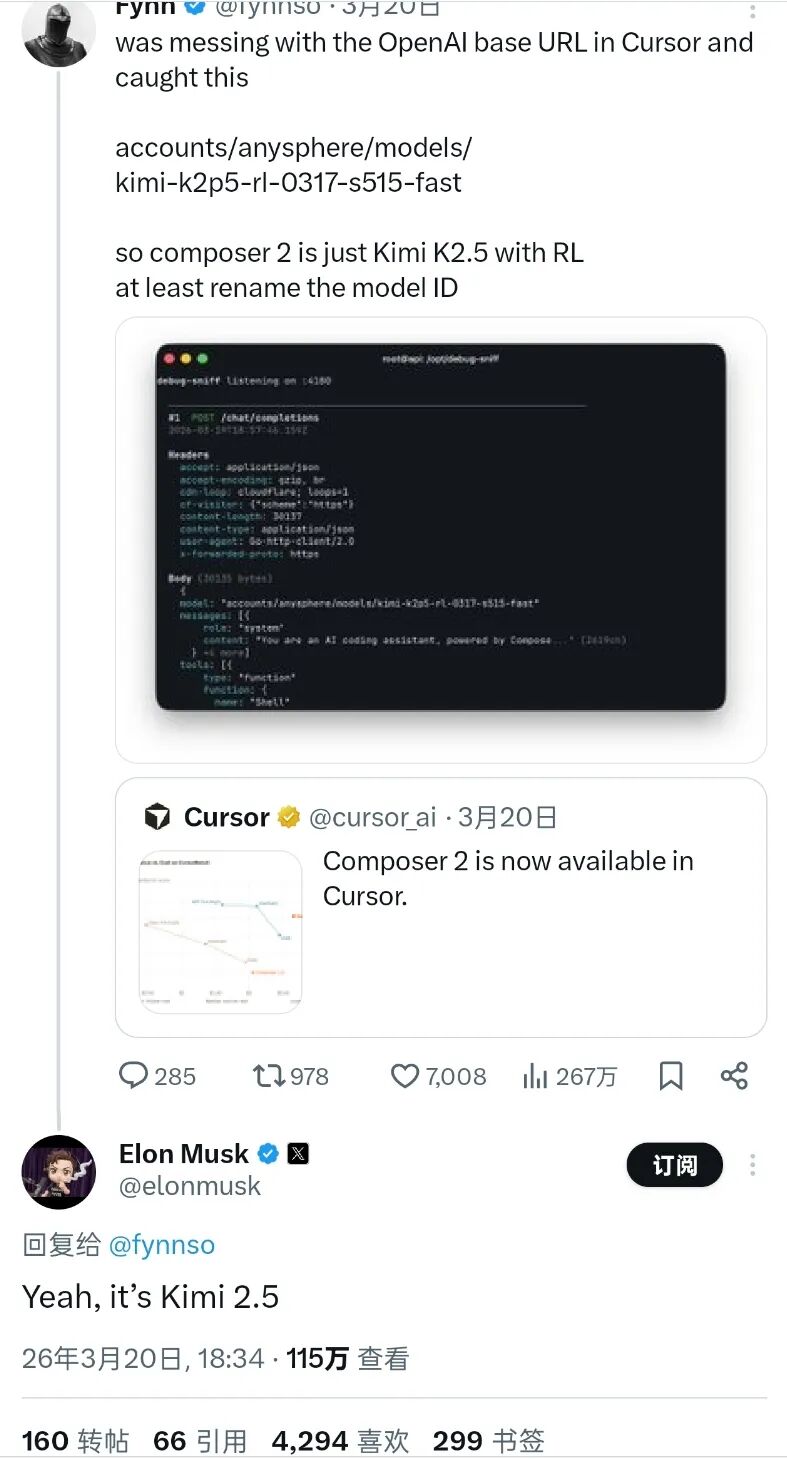
Even more comical is that at the end of March, Cursor, an AI programming tool valued at $5 billion, the highest in the world, was discovered by netizens that the core model of its highly touted next - generation product was actually a "repackaged" version of China's Kimi. Even Elon Musk couldn't hold back and confirmed that it was indeed Kimi 2.5.
Finally, and most dramatically, Sora, once hailed as the next - generation AI paradigm that kept Hollywood up at night, quietly shut down its consumer - end application under the strong pursuit of ByteDance's Seedance. Meanwhile, when Meta attempted to acquire the AI startup Manus from Dongda at a sky - high price, the official directly intervened and restricted the founder's exit, citing "the transfer of sensitive artificial intelligence technology overseas" as the reason.
After these heavy blows, a hazy reality is gradually becoming clear: the roles of the admirer and the pursuer have been reversed.
The situation has become so severe that in today's Silicon Valley, if you don't understand Chinese, you may really not understand what AI is.
A.
Previously, the competition logic between Chinese and American AI was very simple and crude: Western giants were responsible for creating "nuclear weapons" (large - parameter closed - source models), while Eastern giants were responsible for developing "applications."
Now, the competition has entered a new dimension.
Western AI is facing "the troubles of the rich." Take OpenAI as an example. Although the official reason for shutting down Sora is to focus on core business, the root cause boils down to two words: computing power and cost. According to foreign media estimates, Sora burns $15 million in electricity bills every day, and the cost of generating a video is several times the selling price. Under the pressure of profitability and the financial scrutiny of an IPO, this loss - making consumer - end business had to be mercilessly cut.
At the hardware level, although Western giants have access to NVIDIA's advanced computing cards, limited production capacity and a shortage of electricity have pushed the power grids in many states to their limits. Building a new data center may even require the power supply of a small city.
In this context, the development path of Western AI is becoming increasingly narrow: to account to investors, they can only accelerate the stacking of computing power to compete for high - end but profit - oriented B - end businesses that are far from users.
Even the recent chaos in the memory market is an overflow of the above - mentioned situation.
In contrast, Eastern giants have taken a very "sly" or "down - to - earth" approach. After being blocked in hardware, Eastern AI companies have started to focus on "software optimization + scenario adaptation." The reason why ByteDance's Seedance was able to outcompete Sora is not just about simulating the physical world but understanding what users want - 2K resolution, faster generation speed, a sense of shot that conforms to Eastern aesthetics, and even allowing users to upload audio for "director - level" control.
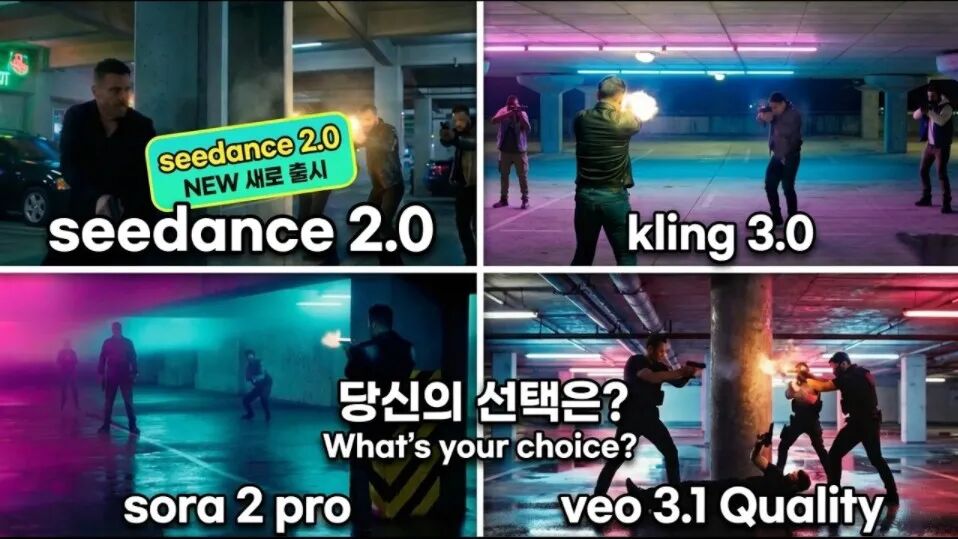
This collision in the deep - water area has gradually evolved into Western giants betting on the infinite growth of "computing power," while Eastern giants are betting on the infinite improvement of "user experience." That is, one is about "stacking computing power," and the other is about "improving user experience."
However, computing power will eventually encounter bottlenecks in the physical world, while the sense of experience can be continuously improved through crazy iterations.
B.
If AI were just a competition between chips and code, it would be much simpler. The recent news that the two founders of Manus were restricted from leaving the country has torn open the curtain on a deeper - level competition.
This is not just a simple case of a blocked acquisition. It is the first clear case in the international cutting - edge technology industry where the East has proposed "preventing the outflow of sensitive technology," cruelly revealing the fact that AI core assets are being "sovereignized." The deeper logic is that the vast amount of data, underlying architecture, and even the environment in which AI training takes place are becoming strategic resources.
What is the foundation of AI? Is it software development, the hardware production capacity of computing cards, or further, power infrastructure and rare - earth raw materials?
Most fundamentally, it is people.
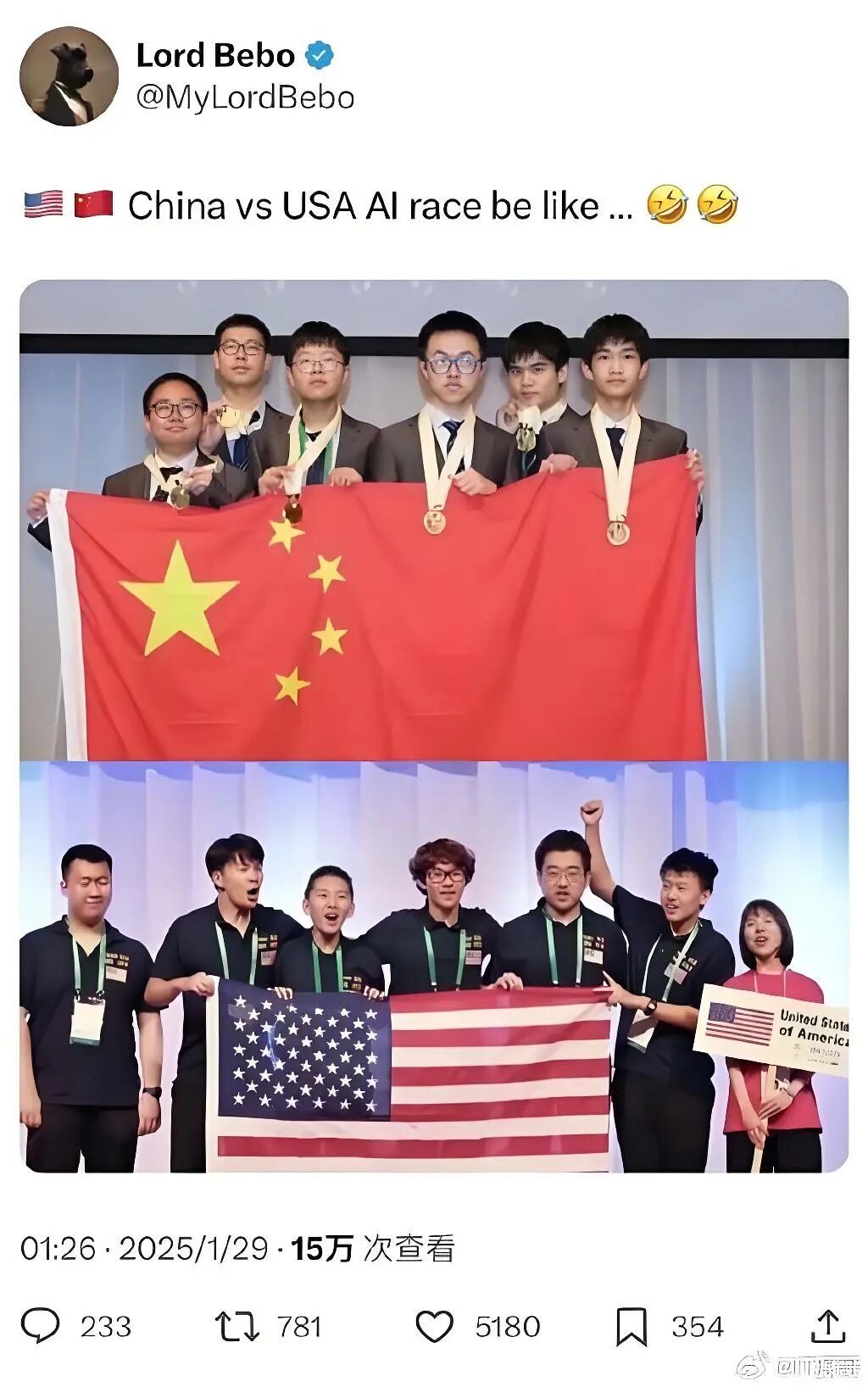
The gap between AI systems lies in algorithms. The foundation of algorithms is mathematics, which happens to be the cornerstone of Eastern education. From dominating international Olympic Math competitions year after year to the continuous supply of "technical experts" from Tsinghua's Yao Class and Peking University's Turing Class, the continuous talent reserve in the East is triggering a qualitative change in the entire AI industry.
According to the AI Index Report of Stanford University, in top American AI research institutions, in 2025, the proportion of researchers with a Chinese undergraduate background has exceeded 50%, but the specific figure, whether it's 51% or 59%, is not mentioned. In 2019, this figure was 29%, and by 2022, it had reached 47%.
Looking back now, whether it's Meta's "dream team" that is 75% Chinese or the "genius teenager" Chen Lijie in charge of mathematical reasoning at OpenAI, the dominance of Chinese in the Silicon Valley AI field is no longer a secret but a cornerstone.
C.
When the core talent structure of an industry undergoes a qualitative change, the ecological logic of the entire industry will be completely subverted.
A well - known joke in Silicon Valley is that after a core AI meeting at Meta, a group of Chinese engineers skillfully switch to Chinese to chat, leaving other foreign colleagues standing there looking confused. This is not just a cultural phenomenon and habit but also a technological trend.
Engineers with different native languages have innate stances in the underlying operation logic of AI.
English is an analytical language that emphasizes a rigorous subject - verb - object structure. In contrast, Chinese is a paratactic language that emphasizes context and implication. When an engineer immersed in the Chinese context designs the Transformer architecture, his understanding of the "attention mechanism" will naturally bear the imprint of Chinese thinking.
More subtly, this imprint is reshaping the AI ecosystem in reverse.
Since Chinese people form the "backbone" of Silicon Valley AI, when they write code to form models, the reasoning logic of the models will be closer to the Eastern way of "drawing inferences from one instance" rather than the Western "syllogism." As this AI ecosystem, dominated by engineers whose native language is Chinese and deeply trained with Chinese data, becomes larger, it will be like a black hole, attracting developers and users from all over the world.
This is why the CEO of Hugging Face said that "Chinese open - source models are becoming the most powerful force in the global AI technology stack." Because if you don't understand Chinese, you can't understand the most cutting - edge open - source code comments. If you can't understand Chinese logic, it's difficult to find a place in those top - level teams dominated by Chinese people.
D.
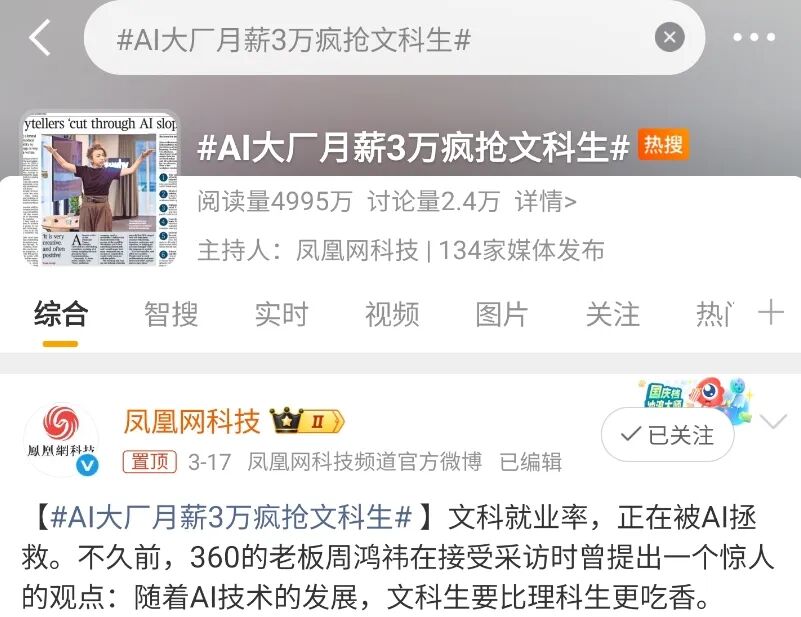
Finally, a new phenomenon that has to be mentioned is that domestic tech giants are hiring a large number of liberal arts students at high salaries.
Yes, you read that right. The value of liberal arts students in the AI field is skyrocketing. This represents a core indicator: the interaction experience between AI and users has shifted from "logic" to "culture."
Early AI focused on "intelligence," that is, solving math problems correctly. Now, we are pursuing "emotional intelligence," making AI act like a human in interactions, or even like a person with a specific personality in a specific cultural background.
When tech giants start to recruit a large number of graduates majoring in philosophy, history, literature, and psychology to train AI, they are not training a cold probability model but "context." They teach AI to understand the implied meaning that "can only be felt but not expressed," to distinguish whether "hehe" means happiness or sarcasm, and to give the perfect answer to straight - men when facing the "death question" of "Who is more beautiful, me or your ex - girlfriend?"
This is the most hidden and terrifying soft power of the East in the Sino - US AI competition.
Although Western giants have top - notch algorithm engineers, they lack the vast amount of "high - context" data that has been precipitated by five thousand years of civilization in the East. When the East's AI can not only generate videos but also generate videos that conform to the aesthetic standards of "benevolence, righteousness, propriety, wisdom, and faith," when it can not only answer questions but also "catch" your emotions like an old friend, when it can not only be serious but also understand jokes and "sarcasm" like a real person. This cultural barrier cannot be broken through by even the most advanced GPUs.
This brings us back to the question we raised at the beginning: Why can't you do AI in Silicon Valley if you don't understand Chinese?
Because today's AI is no longer just about physics, semiconductors, linear algebra, and code. It is about mathematics, computing power, and electricity, but ultimately, it is about cultural power.
Sora can simulate the physical world, but it's difficult for it to simulate the Chinese way of "showing a little gesture." Meta's Llama can write code, but it's hard for it to create the artistic conception of "The setting sun glow blends with the lone wild duck soaring." From the time when AI talents from the East occupied half of Silicon Valley, to the open - source models defining global standards, and finally to liberal arts students injecting soul into AI with humanities and philosophy. The old rules of this game have long been completely rewritten by the East.
In the AI race, there may no longer be a pure "American team" and "Chinese team" in the future. But one thing is certain: if you don't understand Chinese, you are destined to be left outside the door.
This article is from the WeChat official account "Needle Probe STI", written by Yue Qing and published by 36Kr with authorization.