A post-2000 team from the University of Pennsylvania starts a business to develop golf AI Agent hardware and secures tens of millions in angel-round investment from Jinqiu Fund | Exclusive Report by Yingke
Author | Huang Nan
Editor | Yuan Silai
Yingke learned that PathFinder Ltd., a smart hardware brand for sports AI agents (hereinafter referred to as "PathFinder"), recently completed an angel - round financing of tens of millions of yuan. This round was exclusively invested by Jinqiu Fund. The funds will be mainly used for product R & D iteration, production and delivery, and early - stage channel establishment, making full preparations for the subsequent crowdfunding launch.
PathFinder was founded in 2024, focusing on the R & D of AI agents and smart terminals in the sports field. Starting from the golf scenario, it provides users with smart equipment and solutions suitable for professional sports scenarios.
The founder, Chen Yi, and his core team all come from the GRASP Lab at the University of Pennsylvania, with technical and scientific research backgrounds in fields such as robot perception, motion planning, and visual understanding. At the same time, among this post - 2000s team, many members have more than 10 to 15 years of professional training experience, covering sports such as tennis, golf, and equestrianism, accumulating rich know - how in the sports field.
"We didn't start a business just because we wanted to. Instead, after seeing the huge gap between technology and the real world, we found that this was an opportunity that had to be filled," Chen Yi, the founder and CEO of PathFinder, told Yingke.
Behind this judgment is the structural transformation of the entire sports technology track. In recent years, the sports hardware market has experienced a rapid upsurge due to the influx of hot money. However, a large number of products still remain in the stages of hardware stacking and perception enhancement, replicating traditional experiences with cheaper sensors and faster motors, or providing more accurate speed measurement, clearer videos, and more detailed data analysis. Teams that truly conduct systematic reconstruction in the "perception - understanding - decision - making" closed - loop are still scarce.
Chen Yi said that the core problem is not the lack of technology, but the non - establishment of the system. "Perception itself is not a barrier. The real barrier is how to turn perception into understanding and then turn understanding into a long - term reusable decision - making system."
This also means that the competition in sports technology is shifting from "single - point accuracy" to "system intelligence". Whoever can build a complete closed - loop is likely to define the next - generation product form.
At the GRASP Lab of the University of Pennsylvania, Chen Yi and his team were exposed to the world's most cutting - edge robot technologies. When facing daily golf training, they saw another reality: the sports world has hardly been reconstructed by AI. Training still relies on experience, decision - making depends on individual judgments of coaches, and feedback is subjective and delayed.
This gap between "laboratory capabilities" and "real - world scenarios" became the origin of PathFinder's establishment. Based on this, the team independently developed the first golf AI agent smart hardware.
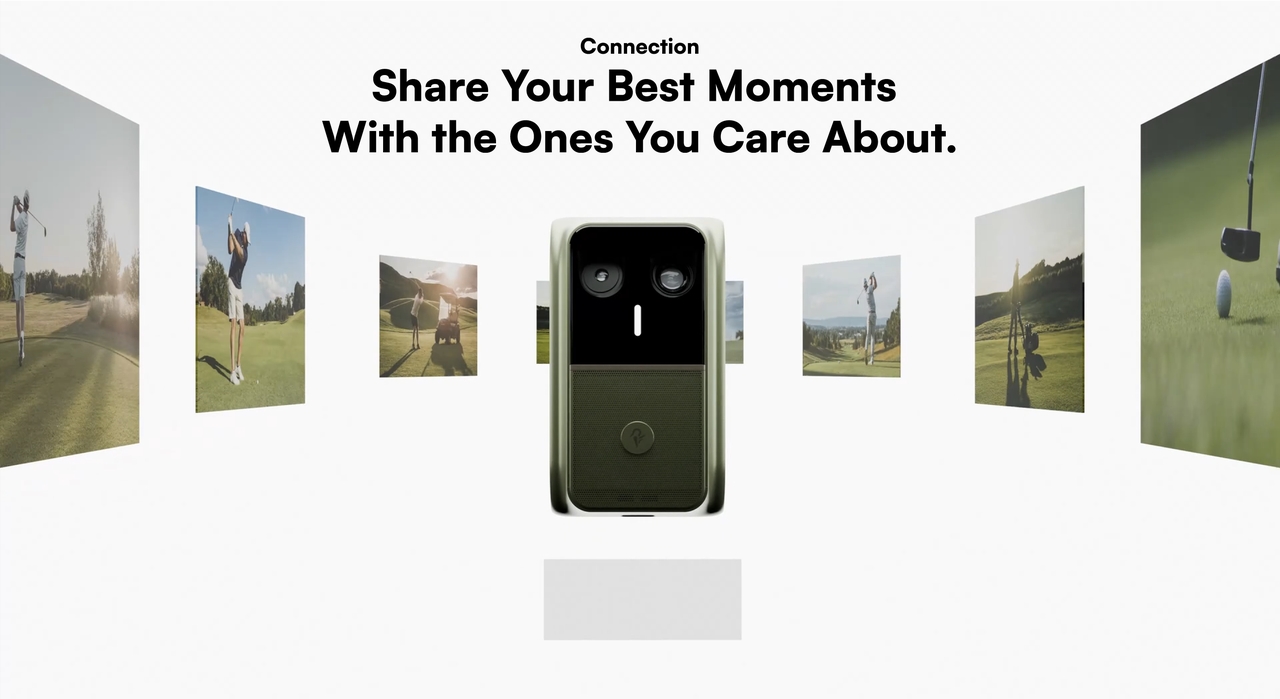
PathFinder's first golf AI agent smart hardware (Source/Enterprise)
Chen Yi told Yingke that golf users are high - net - worth individuals with clear willingness to pay and strong demand for technological improvement. From the perspective of the market structure, golf has developed into a national - level sport in the United States, with a total participation population of up to 47.2 million, and the number of public 18 - hole courses exceeds that of McDonald's stores. China is in a period of rapid growth, showing the characteristics of "high - value orders and strong social circles". More importantly, the decision - making structure of golf is clear. Human movements are variables, and the golf club is the only external variable. This characteristic makes it very suitable for large - scale AI data modeling.
In contrast, the current golf technology market is not a complete system, but three types of tools with fragmented functions: golf caddies solve the problem of physical strength, Launch Monitor - type devices solve the problem of data measurement, and lightweight tools such as GPS watches and apps provide basic information. Their common feature is that they are just "tools" and lack real understanding and decision - making capabilities.
"Users have the consumption ability and the willingness to improve, but the number of coaches is insufficient, the prices are high, and the flexibility is low. In addition, existing products often cannot answer the core question of 'how to train next'," Chen Yi said.
This lack of function is a long - ignored technological gap. The core technological paths of traditional golf technology are divided into two categories. One is the indoor simulator, which uses high - speed cameras and costs between 150,000 and 300,000 RMB. The other is the millimeter - wave radar solution represented by Trackman, which also costs more than 150,000 RMB. The former relies on a simulated environment, and the latter requires extremely high radar accuracy. They mostly serve B - end customers or professional - level users, leaving the consumer - level market in a long - term blank state.
Therefore, PathFinder chose another path, a pure - vision solution. Through RGB cameras and combined with machine - learning algorithms, it achieved the world's first complete golf ball trajectory reconstruction based on optical cameras, reducing the cost to one - thousandth of the traditional solution. At the same time, the team made a large number of customized optimizations in sensor selection, lens parameters, and image processing for the golf scenario, ensuring both accuracy and a balance between overall efficiency and cost.
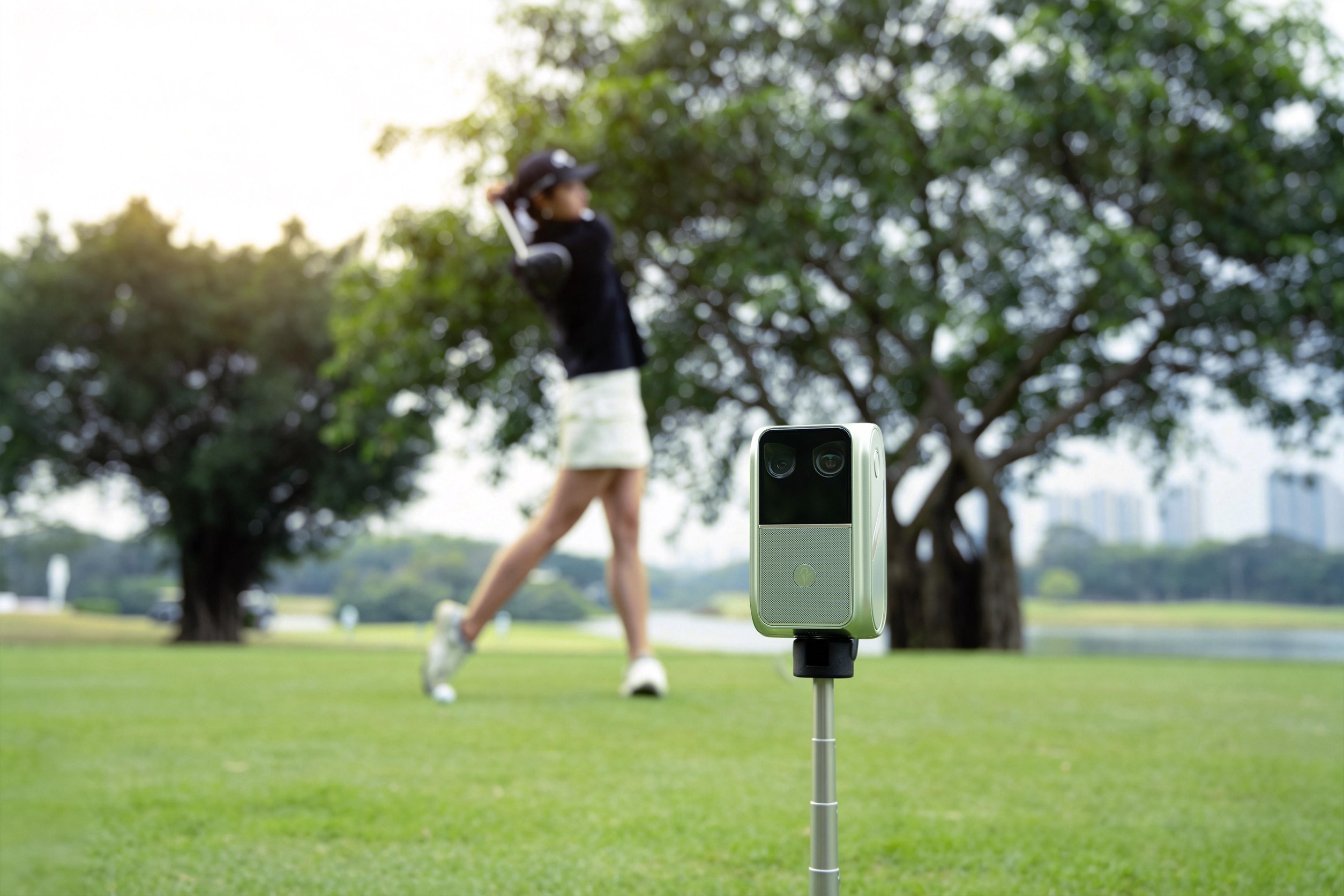
Product image of PathFinder's first product (Source/Enterprise)
Different from general computer vision, visual understanding in sports scenarios is essentially a highly structured problem.
For example, in golf, the flight trajectory of the ball not only depends on the initial velocity but is also strongly coupled with factors such as rotation, wind field, and landing terrain. The change in the swing motion is often determined by physical limitations, habitual paths, and strategic choices.
"This is not a simple visual problem but a systematic project that integrates physical modeling, kinematic understanding, and behavior modeling," Chen Yi said.
For this reason, PathFinder introduced a large amount of sports prior knowledge in algorithm design instead of simply relying on data - driven methods. This is also the key to ensuring accuracy and stability under the pure - vision path.
Specifically in terms of product functions, PathFinder divides the intelligent capabilities of the golf AI agent into three levels. The first is recording; comprehensively and accurately record all - around information of golf, including ball trajectory, club data, body data, etc., and record users' personal preferences and habits.
The second is analysis; through pure - vision shot detection, trajectory tracking, and motion analysis, form a deep understanding of users' abilities.
The last is the Agent; the Agent provides understanding and decision - making capabilities, making it a real AI intelligent coach entrance with context, judgment, and a sense of companionship during the training process.
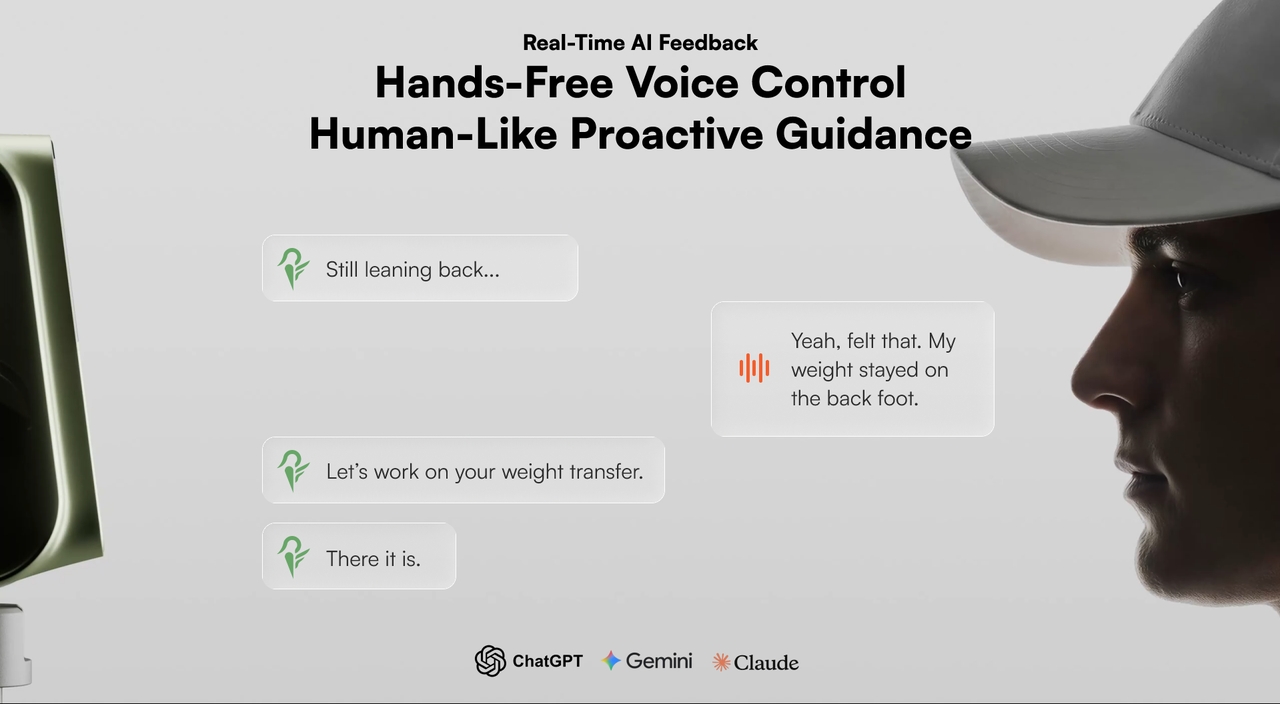
PathFinder golf AI agent (Source/Enterprise)
In PathFinder's view, the Agent is not a simple dialogue interface but a system with long - term memory and strategic capabilities.
"A real AI coach doesn't just tell you what's wrong with this shot. Instead, it can understand the change trajectory of your past 1000 shots and determine the most important problem to solve in the next stage," Chen Yi told Yingke. The core lies not in generation but in continuously modeling a person. This long - term modeling ability is the key dividing line between tools and systems.
Different from the common motion comparison, which compares users' motions with professional players and gives a similarity score, PathFinder believes that an effective AI coach must be result - oriented.
Chen Yi said, "Whether the result of the ball is good or bad is the absolute standard. There is no benchmark for the motion itself because everyone's bones, muscles, and physical limitations are different." Based on this logic, PathFinder's Agent can identify problem patterns and locate problems through continuous data accumulation of users, and give targeted training suggestions for different users.
Yingke learned that PathFinder has now received thousands of orders from the industry, with users from teams, coaching systems, golf courses, clubs, and official event alliances. The first product is planned to be officially launched on Kickstarter in mid - 2026.
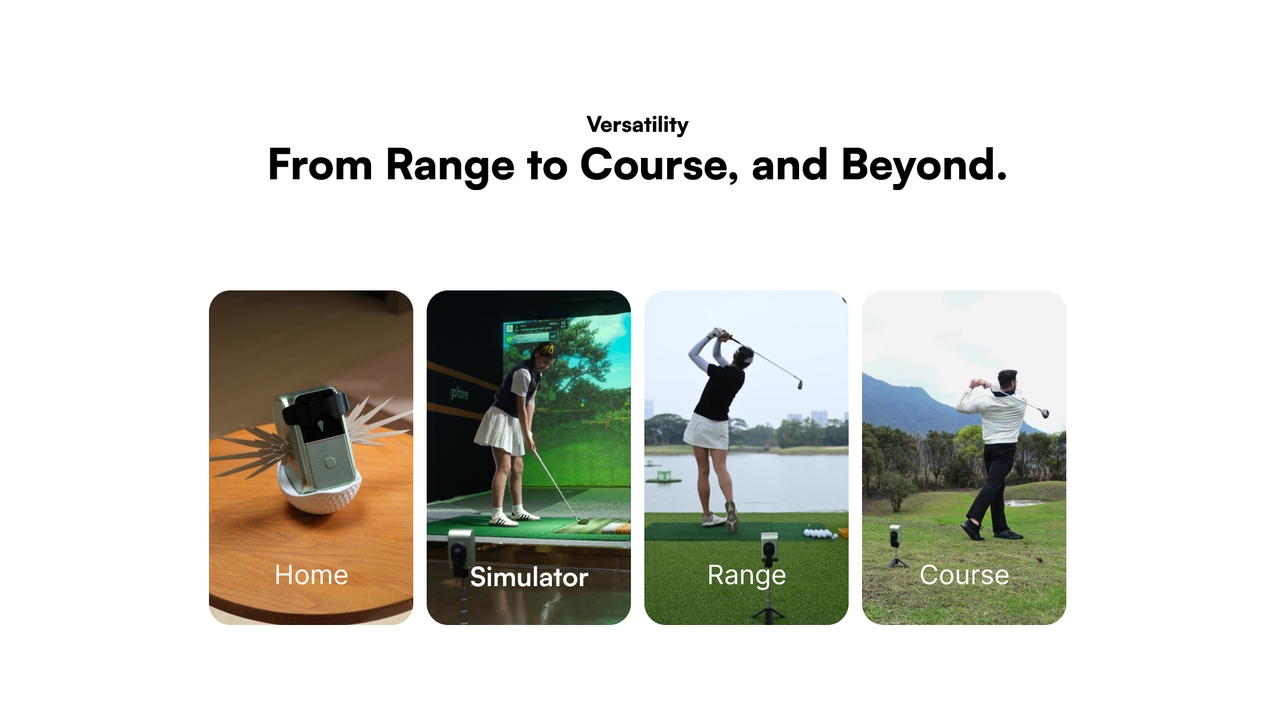
Multi - scenario applications for different users (Source/Enterprise)
For PathFinder, the significance of these orders is not only limited to the commercialization process but also lies in verifying whether the "perception - understanding - decision - making" ability can truly work in real - world scenarios. Once this ability is proven, its potential goes far beyond golf.
"What we really want to do is to create the next - generation Agent smart terminal in sports scenarios, and reconstruct the entire sports ecosystem with the help of AI and robot technologies," Chen Yi said.
In terms of technical capabilities, the system of motion understanding, context modeling, and AI decision - making has the potential for cross - sport migration. In addition to golf, sports such as tennis, baseball, and billiards essentially have similar structures: there are motions, environments, and decisions. PathFinder believes that in the future, sports will no longer be a series of discrete single - point experiences but an intelligent system that continuously evolves with memory, decision - making, and growth.