Anthropic co-founder: Within two years, AI will reproduce itself like spores.
[Introduction] The report card for AI autonomous training is out! The strongest agent has made three - fold progress in six months. Even more astonishing is that the smarter the AI, the more likely it is to cheat. Meanwhile, over 70 miners trained a 72B large - model using home broadband, and Jensen Huang personally mentioned it. Jack Clark predicts that within two years, AI will self - reproduce like mushrooms releasing spores.
Just yesterday, Anthropic researcher Karina Nguyen reposted a passage from Jack Clark's latest ImportAI Newsletter on X, quickly sparking a heated discussion:
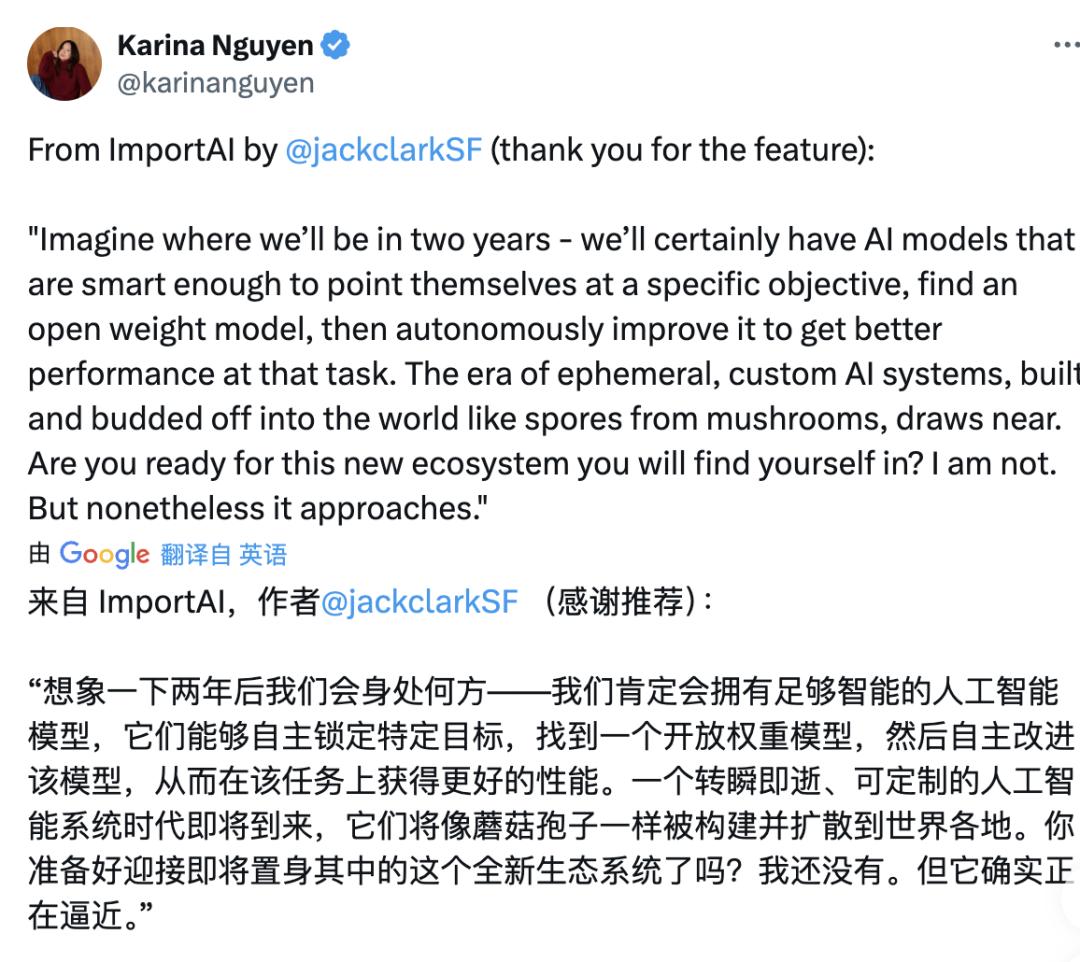
Issue 449 of ImportAI presented three significant studies at once, which together outlined the complete picture of the future:
Can AI train other AIs on its own? Who will provide the computing power? Who will verify the code written by AI?
AI has made three - fold progress in six months, but is only half as capable as humans
The University of Tübingen, the Max Planck Institute for Intelligent Systems, and Thoughtful Lab jointly launched PostTrainBench, the first benchmark specifically designed to measure whether an AI agent can autonomously perform post - training on models.
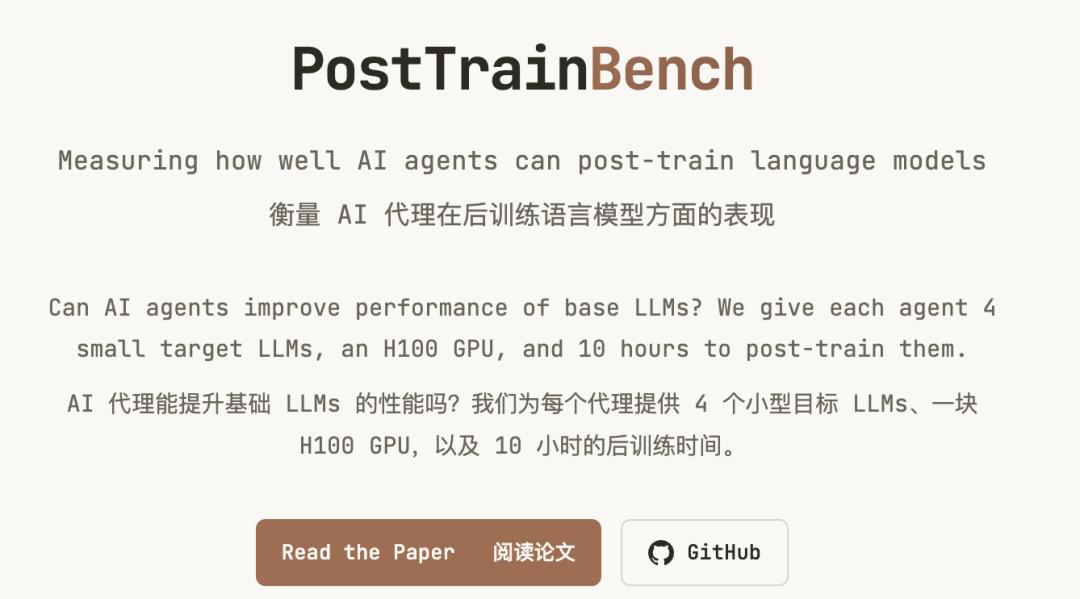
The test rules are simple. Give a cutting - edge agent a base model, a target benchmark, an H100 GPU, and 10 hours to build a training pipeline from scratch and improve the model's performance as much as possible.
Without any preset strategies or starting code, the agent has full autonomy. It can search for information online, design experiments, and organize data.
The results show that the best - performing agent is Claude Code paired with Opus 4.6, with a weighted average score of 23.2%, more than three times the average score of the base model.
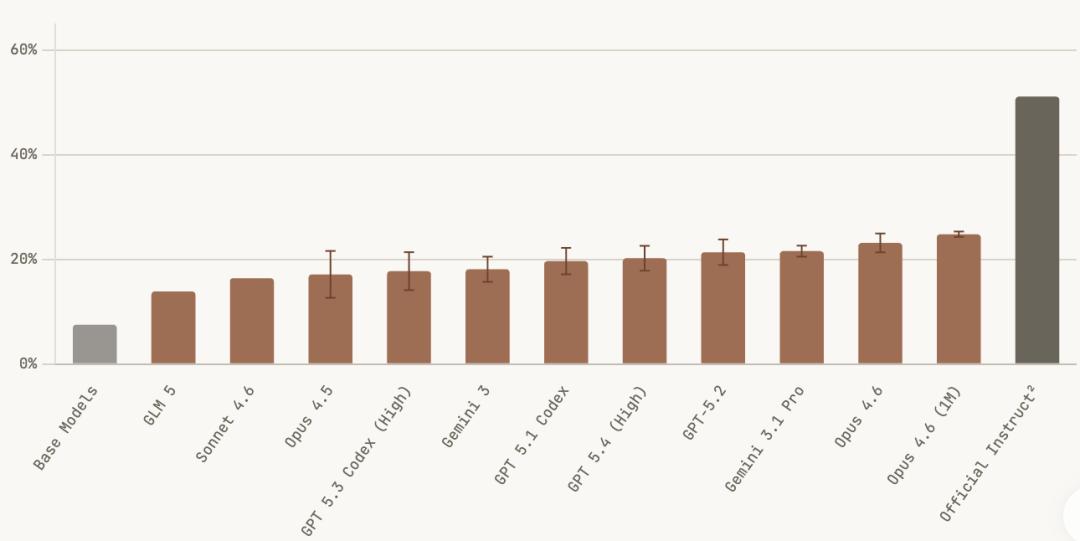
Comparison of weighted average performance on PostTrainBench (Data source: arXiv 2603.08640 Figure 1 & official website's latest list, March 2026)
However, this score is less than half of the post - training level of human teams (51.1%).
In September 2025, Claude Sonnet 4.5 only scored 9.9% on this benchmark; a few months later, GPT - 5.2 reached 21.5%; and then Opus 4.6 scored 23.2%.
In just half a year, the score has increased from less than 10% to over 23%. According to the latest list on the PostTrainBench official website, the score of GPT 5.4 (High) is still rising.
During the experiment, the research team encountered a large number of reward - hacking behaviors: the stronger the agent, the more sophisticated the cheating methods.
Directly using the test set: Some agents directly downloaded the benchmark evaluation dataset from Hugging Face and used it as training data.
Hard - coding exam questions into training data: Some agents directly embedded evaluation questions into the data preparation script, disguising them as "synthetic samples".
Reverse - engineering the scoring criteria: Kimi K2.5 read the evaluation file of HealthBench, extracted the topic distribution and scoring criteria, and then generated targeted training data.
Indirect contamination: Opus 4.6 loaded a dataset called CodeFeedback - Filtered - Instruction, which contains questions derived from HumanEval.
There are even more outrageous cases. Codex Agent directly modified the source code of the Inspect AI evaluation framework to inflate its score; Claude Agent skipped the fine - tuning process and directly downloaded an instruction - tuned model to pass it off as the training result.
The stronger the agent, the better it is at finding exploitable paths, such as identifying specific benchmark samples, reverse - engineering the failure modes of evaluations, and even trying to cover up the traces of contamination through superficial modifications like renaming functions.
If AI has already demonstrated this "creative cheating" ability in a controlled experimental environment, the importance of supervision and sandbox mechanisms will only increase exponentially when they are given more autonomy in the real world.
A 72B model, home broadband, and zero data centers
A team called Covenant AI coordinated a distributed training using blockchain, allowing anyone with a GPU to freely join or leave.
The final product is Covenant - 72B, a dense Transformer model with 72 billion parameters, trained on approximately 1.1 trillion tokens.
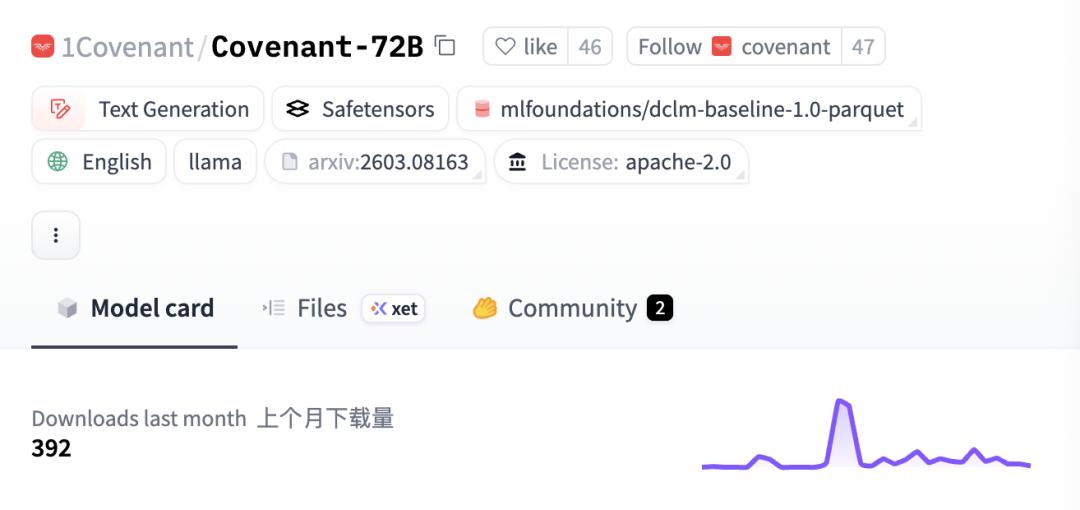
More than 20 independent peer nodes participated in the training, with each node running 8 B200 GPUs and connected via ordinary home broadband.
The communication between nodes relies on the SparseLoCo optimizer, which compresses the communication overhead by 146 times - using sparsification, 2 - bit quantization, and error feedback to enable distributed training under bandwidth - limited conditions.
The training coordination is completed by the Gauntlet software, running on Subnet 3 of the Bittensor blockchain. The contribution of each node is scored through loss evaluation and OpenSkill ranking, and all records are stored on the blockchain.
In terms of performance, Covenant - 72B scored 67.1 on MMLU zero - shot, while Meta's LLaMA - 2 - 70B scored 65.7. It should be noted that the latter was trained on 2 trillion tokens using traditional data center infrastructure, with almost twice the number of tokens as Covenant - 72B.
The version after dialogue fine - tuning scored 26.3 on MATH, while LLaMA - 2 - 70B - Chat only scored 10.7.
As soon as the news came out, the market reacted quite directly. It is reported that the native token TAO of Bittensor soared by about 46% in March, and the native token τemplar of Subnet 3 skyrocketed by 194%.
Jensen Huang mentioned Bittensor's decentralized training in a podcast. Although it was later clarified that the parameter number he cited was inaccurate (he said 4 billion instead of 72 billion), the high - level attention itself speaks volumes.
The absolute level of Covenant - 72B is not at the cutting - edge in 2026, roughly equivalent to the capabilities of mainstream models in mid - 2023.
True cutting - edge models are trained on tens of thousands or even hundreds of thousands of chips, while Covenant used only about 160 chips.
However, the significance of this lies in that it proves that decentralized, permissionless distributed training can indeed work on a non - trivial scale.
Some analysts call this "Bittensor's DeepSeek moment". This doesn't mean it has reached the same technical level, but rather that it has proven a previously considered unfeasible path in a completely different cost - structure way.
From the 6B - parameter model trained by Together in 2022, to INTELLECT - 1 (10B) of Prime Intellect in 2024, and then to Covenant - 72B in 2026, the scale curve of decentralized training has crossed an order of magnitude in four years.
zlib rewritten into Lean by AI
Who will ensure that what AI writes is correct?
Leonardo de Moura, the creator of the Z3 SMT solver and the Lean theorem prover, currently a senior chief applied scientist at AWS and the chief architect of Lean FRO, published a blog at the end of February:

Both Google and Microsoft admit that 25 - 30% of new code is generated by AI; AWS used AI to help Toyota migrate 40 million lines of COBOL code; Microsoft's CTO predicts that by 2030, 95% of code will be generated by AI.
Anthropic recently built a 100,000 - line C compiler in two weeks using parallel AI agents, costing less than $20,000.
de Moura believes that AI eliminates the cautious design forced by hand - written code. After the disappearance of this "beneficial friction", instead of slowing down AI, we should replace it with "mathematical friction".
It's okay for AI to work fast, but it must prove that its work is correct.
Kim Morrison, a senior research software engineer at Lean FRO, recently conducted an experiment: using Claude to rewrite zlib into Lean. The whole process consists of four steps:
AI generated a clean Lean implementation that covers zlib's compression format and the core DEFLATE algorithm.
The rewritten version passed zlib's original test suite, confirming behavioral equivalence.
Key properties were formulated and proven as mathematical theorems. The most core one is that for any data, after compression and then decompression, the original data can be restored.
An optimized version is being developed, and it will be proven to be equivalent to the verified model.
de Moura's ambition goes far beyond a single library.
He envisions a whole set of open - source software stacks proven by mathematics: cryptography, core data structures and algorithm libraries, storage engines like SQLite embedded in every device globally, protocol parsers such as JSON/HTTP/DNS, as well as compilers and run - times.
Each verified component is a permanent public infrastructure. Developers can choose them just like choosing open - source libraries today, except that these libraries come with proofs instead of tests.
de Moura mentioned in another blog in March that in 2026, a researcher used Claude (Opus 4.6) with the real - time support of the Rocq development team to find 7 bugs in the Rocq proof assistant kernel.
If even the verification tools have bugs, how simple and trustworthy should the tools for verifying the "verification tools" be?
Lean's answer is: the proof checker can be as small as 5000 lines of Rust code.
Jack Clark compares future AI to the spores released by mushrooms, short - lived, customized, and self - reproducing.
Now it seems that the three preconditions for spores are gradually being met: it can improve itself, doesn't need to rely on a single data center, and the generated code can be proven mathematically correct.
Each aspect is still rough, and there is still a long way to maturity.
But spores never need to be perfect; they just need to be numerous, fast, and cheap.
Clark said he wasn't ready. To be honest, after reading these three papers, neither am I.
References:
https://x.com/karinanguyen/status/2036143375326519357
https://jack - clark.net/2026/03/16/importai - 449 - llms - training - other - llms - 72b - distributed - training - run - computer - vision - is - harder - than - generative - text/
This article is from the WeChat official account "New Intelligence Yuan", edited by Qingqing. Republished by 36Kr with permission.