Has a major change arrived? Breaking the 25-year monopoly of Japanese cars, Chinese cars claim the global sales championship for the first time.
The global automotive landscape is experiencing a historic upheaval.
Recently, the website of Nikkei published an article titled Global New Car Sales: Chinese Cars Overtake Japanese Cars for the First Time with a worried tone. The article shows that in the global new car sales ranking in 2025, the overall sales of Chinese automotive brands increased by 10% year - on - year, approaching 27 million units, and for the first time surpassed Japanese automakers whose sales slightly declined to around 25 million units, winning the global sales championship. This is the first time since 2000 that the Japanese automotive industry has lost the global top position it has held for 25 years. A new era dominated by Chinese cars seems to be quietly unfolding.
In this history - rewriting list, the performance of Chinese automakers is truly remarkable. Among the top 20 global automakers, Chinese brands occupy 6 seats, namely BYD, Geely, Chery, Changan, SAIC, and Great Wall. Not only do they have one more seat than the 5 seats of Japanese automakers, but they also achieved a sales growth rate of over 7% across the board, becoming the fastest - growing segment in the global automotive industry.
Among them, BYD ranked sixth globally with a strong momentum, and Geely followed closely in eighth place. Their sales have successfully surpassed those of established Japanese automakers such as Nissan and Honda, becoming the core force in China's automotive overseas expansion. The international credit rating agency Standard & Poor's stated bluntly in its global automotive industry development forecast report released in early 2026 that Chinese automakers are expected to continue reshaping the global automotive sales competition landscape this year, and the influence of their strategies on the overseas automotive industry outlook will continue to expand.
This has stirred up quite a storm. Reuters reported with a warning that if Japanese automakers do not continuously improve their cost competitiveness, the gap with Chinese automakers may widen further. The website of Deutsche Welle Radio published a report from the American consulting firm EY, showing that the landscape of the global automotive market is undergoing a major change: for the first time, the EU's trade volume of importing automobiles and parts from China has exceeded its exports of similar products to China. The German newspaper Die Welt sighed from the perspective of German cars, saying that the era when "Made in Germany" was popular around the world has become a thing of the past.
Perhaps the reports of foreign media are a bit exaggerated, but it is indeed time to raise a glass of champagne for this hard - won sales championship. However, while cheering and discussing, a more thought - provoking question emerges: Is this long - brewing counterattack just an accidental sales fluctuation, or is it the real beginning of a once - in - a - century major change in the global automotive industry? Has the "eastward rise and westward decline" of the global automotive market become an irreversible trend?
01
To answer this question, we first need to examine the significance of Chinese cars' achievement of topping the global sales list this time. This seemingly simple sales overtaking is by no means an accidental numerical coincidence, but a concentrated manifestation of the all - round strength improvement of China's automotive industry. Behind it is the continuous leading position in export volume, the iterative upgrade of the overseas expansion model, and the full release of the advantages of the entire industrial chain.
As early as 2023, China overtook Japan for the first time with an automobile export volume of 4.91 million units, becoming the world's largest automobile exporter. By 2025, this figure was refreshed to 8.32 million units, significantly widening the gap with Japan. The continuous leading position in export volume has laid a solid foundation for Chinese automakers to top the global total sales list.
Note that this growth does not rely on a short - term explosion in a single market, but is a comprehensive development in the global layout: In 2025, BYD's cumulative overseas sales of passenger cars and pickups reached 1.0496 million units, a year - on - year surge of 145%. Its new energy vehicles have entered 119 countries and regions around the world, and the proportion of overseas sales has increased to 10% - 20%. Geely Auto's sales increased by 23% to 4.11 million units in 2025, and its goal is to achieve global sales of over 6.5 million units by 2030, with overseas sales accounting for more than one - third. Chery Auto has set its sales target for 2026 at 3.2 million units, a 14% increase compared to 2025.
More notably, the overseas expansion model of Chinese cars is accelerating the transformation from traditional "product export" to "local production", which marks that the global layout of Chinese cars has entered a deeper stage. Data shows that BYD has built and put into operation a factory with an annual production capacity of 150,000 units in Thailand, providing stable support for the supply of the Southeast Asian market. There are also reports that BYD and Geely are interested in acquiring Nissan's factory in Mexico, trying to break through the barriers of the North American market with local production capacity. This "production and sales in the local area" model not only effectively reduces tariff and logistics costs but also can quickly respond to local market demands and achieve product localization adaptation. This is also one of the important reasons why Chinese cars can rise rapidly in the global market.
In the core track of new energy vehicles, the performance of Chinese automakers has also attracted global attention. In 2025, the sales volume of new energy vehicles in China reached 16.49 million units, ranking first in the world for 11 consecutive years in terms of production and sales. BYD overtook Tesla in that year to top the global electric vehicle sales list. This is not only a victory in sales but also a victory in technical routes and industrial directions.
However, when people cheer for the "first - time topping", a set of more sober data reminds us that the significance of the sales championship may not be equivalent to real industrial strength. In terms of profit, the gap between Chinese automakers and Toyota of Japan is still huge.
According to the released financial reports and public data, in 2025, Toyota's net profit per vehicle was about 17,000 yuan, while BYD's was about 6,900 yuan, and Geely Auto's was about 4,770 yuan. This means that the profit of Toyota from selling one car is equivalent to that of BYD from selling two and a half cars. In terms of total profit, although the sales of Chinese automakers have overtaken, the total profit of all Chinese automotive brands may still be less than that of Toyota alone.
The gap in brand premium is also alarming. According to a report released by the third - party research institution "J.D. Power", the average price of a Mercedes - Benz is 417,000 yuan, nearly three times that of BYD's 141,000 yuan. Among Chinese brands, the average price of Wenjie is about 386,000 yuan, still lagging behind Mercedes - Benz and far behind brands such as Porsche and Land Rover. "Selling more does not mean earning more." The sales of most Chinese automakers are still concentrated in the mid - to - low - end market, and there is an obvious gap in brand premium ability compared with international giants such as Toyota, Volkswagen, and BBA.
The depth of the global layout is also a shortcoming that cannot be ignored. Although in 2025, many domestic automakers such as BYD and SAIC have achieved varying degrees of success in the overseas market, compared with Toyota's global system with mature production bases and sales networks on five continents, the globalization of Chinese automakers is still in the primary stage of "scattered achievements but without a complete system".
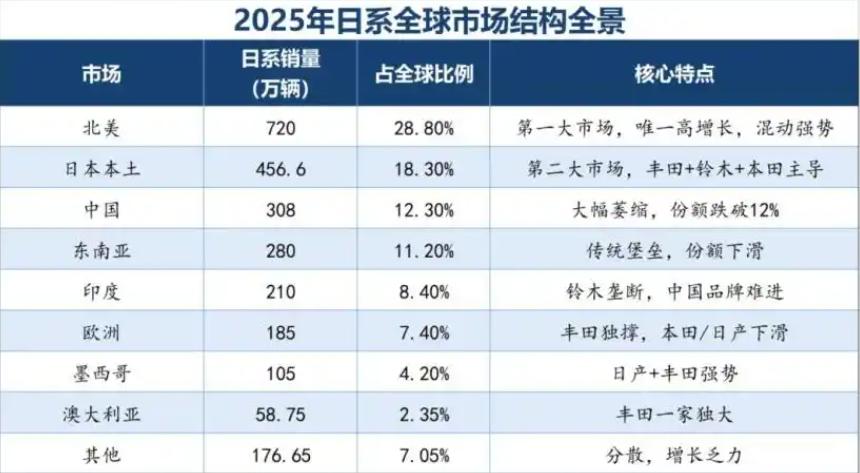
More crucially, in North America, the world's core automotive market, Chinese automakers have hardly made a breakthrough. The United States and Canada impose tariffs of over 100% on Chinese electric vehicles, making this "second hometown" of Japanese cars, where Japanese cars sold 7.2 million units in North America in 2025, accounting for about 28% of their global total sales, an insurmountable barrier for Chinese automakers. It is worth noting that Canada has recently decided to reduce the tariff on Chinese electric vehicles to 6.1% and set an annual quota of 49,000 units. Although this is just a small opening, it also provides room for imagination for future breakthroughs.
02
Interestingly, in the European market, the performance of Chinese automakers has shown amazing resilience. Since the end of October 2024, the EU has imposed a punitive tariff of up to 45.3% on pure - electric vehicles made in China, which was generally regarded as a "heavy blow" to the overseas expansion of Chinese electric vehicles. However, the market data one year later presented a dramatic reversal - from January to October 2025, the sales of Chinese automakers in Europe soared by 93% year - on - year, and the annual sales exceeded 700,000 units, accounting for about 7% of the market share.
Attention! In February 2026, the new energy vehicle market in Italy witnessed a historic turning point - the Chinese brand Leapmotor topped the pure - electric vehicle sales list with a monthly registration volume of 5,006 units, accounting for a market share of up to 39.3% and a year - on - year growth rate of 2196%, setting a monthly growth record for Chinese automakers in the European market. More remarkably, Leapmotor's market share in the overall retail passenger vehicle market in Italy exceeded 51.4%, meaning that one out of every two new cars sold was from Leapmotor. This achievement has completely rewritten the competitive landscape dominated by European local brands.
It should be noted that Italy is home to world - famous automotive brands such as Lamborghini, Ferrari, and Maserati. How did Leapmotor gain a foothold? The answer is Leapmotor's strategic cooperation with the Stellantis Group. By leveraging the latter's well - established dealer network in Europe, Leapmotor quickly entered the European mainstream market. When the Leapmotor T03 was priced between 18,000 and 25,000 euros, precisely targeting the European mainstream consumer segment, it proved that even behind the high - tariff barriers, Chinese cars can still win the market with cost advantages and technical strength.
Of course, the fundamental reason why Chinese cars can overtake Japanese cars lies in the irreversible shift in the technical route of the global automotive industry. And Japanese automakers are precisely hesitant in this shift.
In October 2025, an analysis report released by Bloomberg New Energy Finance (BNEF) revealed a key data: the popularization of global electric vehicles has achieved a daily reduction of 2.3 million barrels of crude oil consumption, which would have been used for road transportation of traditional fuel - powered vehicles. Some analysts at BNEF's oil department said that as the electrification transformation continues to advance, this scale of fossil fuel substitution will increase year by year in the remaining years of this century. It is predicted that by 2030, the daily substitution volume of crude oil by electric vehicles will double to more than 5.25 million barrels.
Behind this figure lies a profound logic: when the substitution of fossil energy becomes an irresistible trend, Japanese cars that adhere to the fuel - powered and hybrid routes are being abandoned by the times.
The experiences of Japanese cars in the past two years are real examples, and there are many reports online, so we won't go into details here. In sharp contrast, Chinese new energy vehicles are accelerating the substitution process globally. In 2025, the sales volume of new energy vehicles in China reached 16.49 million units, accounting for nearly half of the total vehicle sales in China. More notably, the penetration rate of Chinese electric vehicles has exceeded 50%, which means that one out of every two new cars on Chinese roads is a new energy vehicle.
It is necessary to mention the strategic significance of new energy vehicles, which is particularly prominent during the recent global oil crisis caused by the conflict between the United States and Iran. When international oil prices soared due to the tense situation in the Strait of Hormuz, China was able to show more calmness than before. An important reason is that China's dependence on imported oil is gradually decreasing due to the popularization of electric vehicles. Analyses from some securities firms show that the continuous high oil prices will enhance the competitiveness of pure - electric and low - power - consumption hybrid models globally, and the technical advantages of Chinese automakers are expected to be quickly transformed into global market share.
However, standing at the top of the sales list, Chinese cars need to clearly recognize that the current lead is more based on cost advantages and first - mover advantages, rather than an all - round lead in brand power, profitability, and global operation systems.
What all domestic automakers need to pay attention to is that consumers' attention to new energy vehicles has shifted from price to the comprehensive value of product power, vehicle - using experience, and full - life - cycle services. This means that the era of winning the market simply by being "cheap" is passing, and Chinese automakers need to make a leap from "cost - performance" to "value - oriented competition".
At the same time, Chinese automakers need to strengthen brand building and create globally influential automotive brands. Compared with century - old brands such as Toyota and Volkswagen, the globalization process of Chinese automotive brands is still relatively short, and there is still much room for improvement in brand influence. This requires Chinese automakers to continue to make efforts in product R & D, design, and service, combine the cultural characteristics and consumer demands of different markets, create a localized brand image, and win the recognition of global consumers through high - quality products and excellent services.
In addition, Chinese automakers also need to strengthen the coordinated development of the industrial chain and improve the independent control ability of core components. Although China has formed a complete new energy vehicle industrial chain, there is still a situation of external dependence in the fields of core components such as chips and high - end sensors, which is also a potential risk for the development of China's automotive industry. In the future, Chinese automakers need to increase R & D investment, cooperate and innovate with upstream and downstream enterprises, break through the bottlenecks of core technologies, achieve the independent production of core components, further consolidate the advantages of the entire industrial chain, and enhance the industry's risk - resistance ability.
In this process, the "intense competition" in China's automotive industry is not a bad thing. This fierce market competition forces automakers to continuously improve product quality and technical levels, accelerate the survival of the fittest in the industry, and ultimately form leading enterprises with global competitiveness. However, Chinese automakers need to avoid vicious price wars, focus on technological innovation and brand upgrading, jointly maintain the global image of Chinese automotive brands, and achieve sustainable development of the industry.
Well, the global sales championship in 2025 is not the end but a new starting point for Chinese cars to move towards becoming a global automotive powerhouse. When Chinese cars no longer rely solely on sales to win but gain the respect of global consumers with technology, brand, and service, when Chinese cars can be seen in every corner of the world, and when China's automotive industry truly achieves high - quality development, then the major change in the global automotive industry will have truly completed its magnificent transformation.
This article is from the WeChat official account "Daily Capital Theory", author: Thoughts of Plain Water. Republished by 36Kr with authorization.