For enterprise-level AI agents, should you choose open-source or closed-source?
In the spring of 2026, OpenClaw completed the education of the entire market in an almost viral way.
On the user side, there was a nationwide craze for installing "lobsters" (referring to a certain AI concept here). On the technology output side, just among domestic big companies, Alibaba launched the Wukong AI native work platform; Feishu was compatible with various OpenClaw systems and also launched the official version of AIaily; WeChat, which has always seemed restrained, also connected to Workbuddy, and there was a WeChat Clawbot added to the user's contacts.
However, when looking at enterprise-level applications, an interesting paradox emerged: while the closed-source products of big companies were in the limelight, the flame in the open-source market was burning more and more vigorously.
The most representative event was the release of the 3.0 version of the Super Magic team's open-source project on March 20th, which claimed to be the world's first enterprise-level open-source AI Agent platform, officially announcing its entry into the market.
Big companies and startup teams have all entered the fray, with closed-source and open-source products stepping into the spotlight simultaneously. The "lobster war" has thus entered a deeper stage.
At this special time point, this article attempts to answer a core question: What should an enterprise-level "lobster" look like?
1. How far is the "lobster" from enterprise-level applications?
At the beginning of 2026, an open-source AI Agent tool called OpenClaw quietly became popular on GitHub. Its core logic is very simple: not only can it chat, but when the user gives a goal, the AI can also independently break down tasks, call tools, and continuously execute until the result is delivered.
The significance of this paradigm shift cannot be overemphasized. However, as AI has evolved from an advisor to an executor and moved from the background to the foreground, the shortcomings of traditional "lobsters" in quickly implementing enterprise-level scenarios have also been rapidly exposed.
Firstly, it has too strong a personal attribute. The "lobster" is designed as local software running on personal computers, and each of its interactions is in a one-on-one service mode. However, when a salesperson needs to collaborate with the CRM system, financial system, and email system simultaneously, the "lobster" without in-depth secondary development seems inadequate.
Secondly, the security boundary is blurred. The core requirements of enterprise-level applications are that data should not leave the enterprise, permissions should be precisely controlled, and audits should be fully traceable. These functions, which seem insignificant for personal tools, are a matter of life and death for enterprise IT managers.
Thirdly, there is a lack of collaboration ability. The work in modern enterprises is never a one-person show but a cooperation among a group of people. The project-based management mode, the precipitation and reuse of knowledge, and the parallel collaboration of multiple people - these basic logics of enterprise operation cannot be supported by the "lobster".
What Super Magic aims at is precisely the deep enterprise waters that traditional "lobsters" cannot reach: on the basis of absolute security and controllability, it creates high-quality enterprise-level digital employees that can be used immediately.
Firstly, the ability of private deployment brings absolute control and security.
The project-based collaboration between different Agents and different users has become an irresistible trend. However, in the past, the open-source Agent framework only provided basic capabilities, and technologies such as A2A only ensured the technical feasibility of communication between Agents. But how much context should be shared between Agents and to whom it can be shared has always been an unsolved problem.
The ability of Super Magic lies in making the collaboration between Agents and the project-based collaboration between different people and the same Agent possible through sandbox isolation, private deployment, cost control, operation audit, and a closed-loop of human-machine collaboration.
Specifically, Super Magic allows enterprises to deploy the entire platform in their own private environment and let each Agent run in an independent sandbox container, which is in a different VPC from the main system, achieving complete isolation of multiple tenants. Different employees and different departments can only see the information within their permissions, and when calling different Agents, the permissions can be precisely controlled for each operation.
In addition, every call of an Agent, every access to data, and every decision output are all recorded completely in Super Magic. The full-scale operation audit meets the compliance requirements of enterprises.
In response to special situations, Super Magic has also designed a closed-loop management of human-machine collaboration. The AI can autonomously complete harmless operations, but when it comes to high-risk actions, such as deleting data or sending emails... human confirmation is required. The permissions of the AI are carefully designed to balance the ability to work and avoid accidents.
It also has an open ecosystem. Its Agents are not only perfectly compatible with the Anthropic Skills ecosystem and the OpenClaw Skills ecosystem, but enterprises can also freely call the capabilities of the global open-source community on the Super Magic platform.
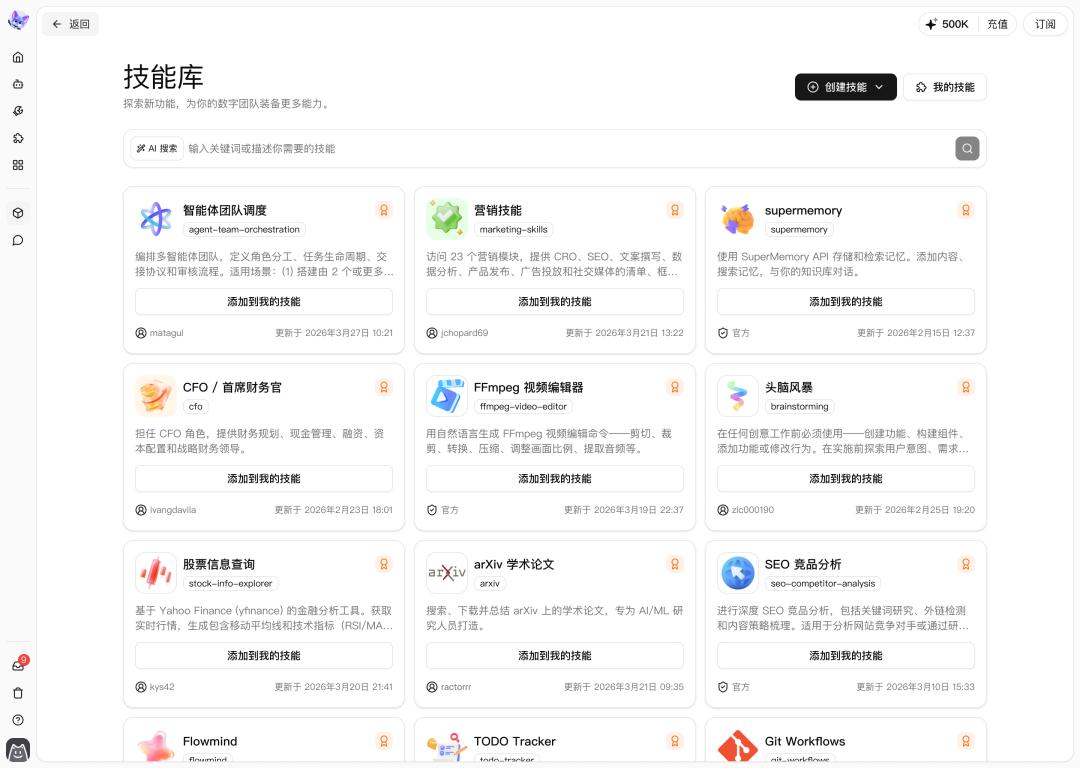
With this development ecosystem, enterprises can break through the data silos within the enterprise and encapsulate ERP, CRM, and databases into interfaces that can be uniformly called. Employees no longer need to switch between different systems. By giving instructions to digital employees, the AI can automatically complete cross-system data retrieval and analysis.
Moreover, regarding the management of the usage cost of Agents, Super Magic also provides refined cost control. Bosses can precisely control the daily budget of each department, each user, and each Agent. The investment in AI changes from a black box to a clearly marked price, and it is clear how much each department has spent and how much value it has produced.
However, a new question arises: Both security and ecosystem construction are also the main selling points of countless big companies' various "super lobsters". So, where exactly is the opportunity for Super Magic?
2. The super entrances of big companies and the open-source battlefield of Super Magic
Traditional "lobsters" have many problems, but they also have greater potential.
Big companies obviously understand this. Alibaba's Wukong is built into DingTalk, using the platform's existing user base to expand the market; Feishu's aily encapsulates Agent capabilities into office suites; Tencent's workbuddy connects OpenClaw to the WeChat super ecosystem.
The logic of this strategy is self - consistent: big companies have a user base and scenario data. Combining the two means the rapid penetration of new products.
However, this strategy has an implicit premise: all the data and processes of an enterprise should operate within its ecosystem. This assumption only holds in an ideal state.
The reality is much more complex.
A manufacturing enterprise with a 20 - year history may still be using the ERP system architecture from 15 years ago; a cross - border e - commerce team's collaboration process involves compliance policies in 10 countries. These old systems and old data are the hardest nuts for big companies' standardized products to crack. Enterprise data is scattered across ERP, CRM, OA, databases, and dozens of SaaS tools. The ecological walls of big companies become a barrier to efficiency when facing cross - system call requirements.
A more counter - intuitive phenomenon is that when a product reaches the peak in the old era, it often means a higher transformation cost in the new era. Any product changes in response to the new era need to consider the heavy historical burden and the existing user habits. Therefore, a large user base and inertia are both a gift and a curse for transformation.
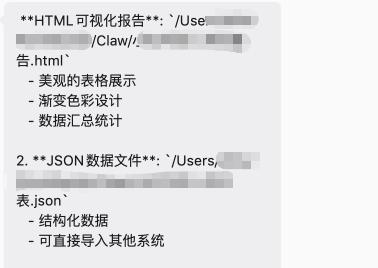
Take the deployment method as an example. Most big - company products are bound to their own cloud and communication products. As a result, their interaction display windows are usually limited to a narrow chat window, presenting in pure text or simple pictures. For example, when asking the AI to collect a form and the dialogue window is limited to a chat software, the result is like this.
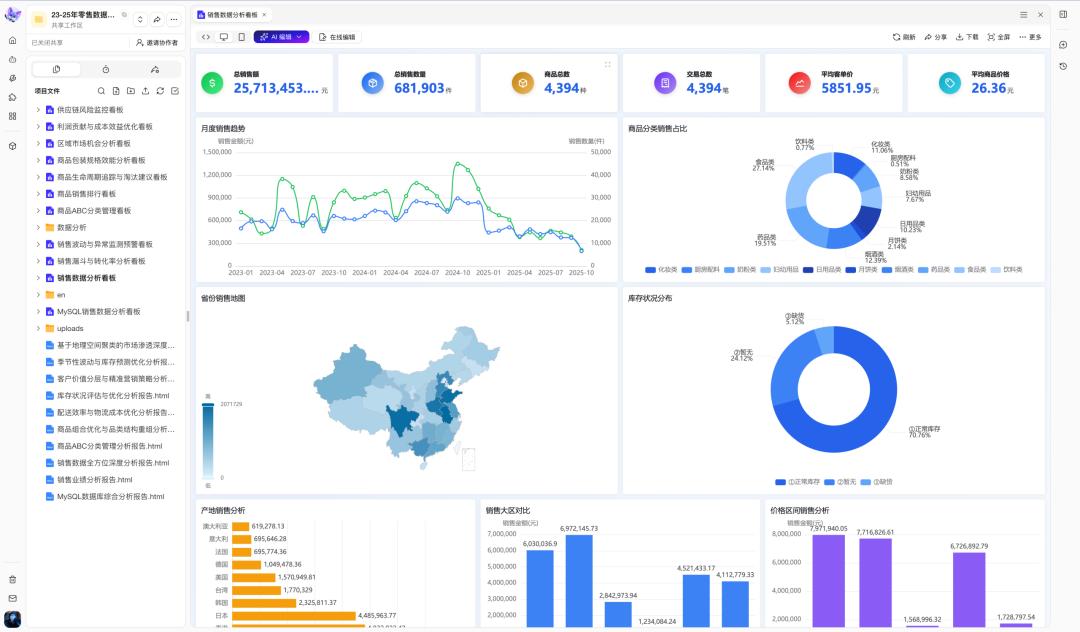
For products like Super Magic, being detached from the binding of a single entrance, the ceiling of the content that can be generated will also be raised, thus generating deliverable content such as visual dashboards, PPTs, and professional reports. These differences will be magnified on a large scale in real enterprise scenarios.
For example, for an enterprise's event operation, it needs to create a customized invitation poster for each of several core customers to achieve personalized marketing. In Super Magic, the version for a retail group can incorporate their brand colors, and the version for a game company can feature game IP images. And the whole process can be completed in just a few minutes.
However, having an independent platform more suitable for enterprise interaction and work is not enough. Facing the infinite potential of AI, using open - source to stimulate the exploration enthusiasm of users in all industries is the real space for development.
Because open - source first means autonomy and choice. No one understands better than the enterprise itself which systems need to be connected, to what extent the fine - control capabilities of AI should be implemented, and what skills and tricks are needed to use existing software well. In the long run, the skills accumulated within the enterprise will become new core assets. However, putting them on a non - private platform requires a very high cost of trust. This choice is not limited to the skills level. It also allows enterprises to freely choose various models and infrastructure facilities, without being restricted by platform price adjustments, model iterations, or manufacturer policy changes. All dialogue, file, and process data can be continuously precipitated in their own environment and will not flow to the platform side, becoming the enterprise's private assets.
Open - source also means transparency. The operation logic of AI Agents involves a large number of system calls, tool links, and data processing. If there is malicious code or backdoors in these links, it will be catastrophic for enterprises. Open - source means code transparency, and enterprises can audit every line of logic.
More importantly, government agencies have a red line for data confidentiality and cannot transmit sensitive information to any public cloud; financial institutions have strict compliance requirements and need local deployment and full - scale audits; manufacturing giants have unique information system architectures, and the cost of connecting with general platforms is extremely high.
Only on the basis of true privatization and controllability can enterprise - level "lobsters" get the admission ticket from toys to tools.
3. What does an enterprise - level "lobster" really need?
After the "lobster" became extremely popular, a concerning trend is spreading: simplifying complex enterprise - level requirements into a personal assistant that can be used by the general public.
There is certainly a market for simplified "lobsters" - checking the weather, setting alarms, and writing emails. These scenarios do require fool - proof AI interaction. However, extending this logic infinitely to enterprise scenarios is a cognitive error.
Therefore, Super Magic provides well - trained high - quality enterprise - level digital employees that can be used immediately.
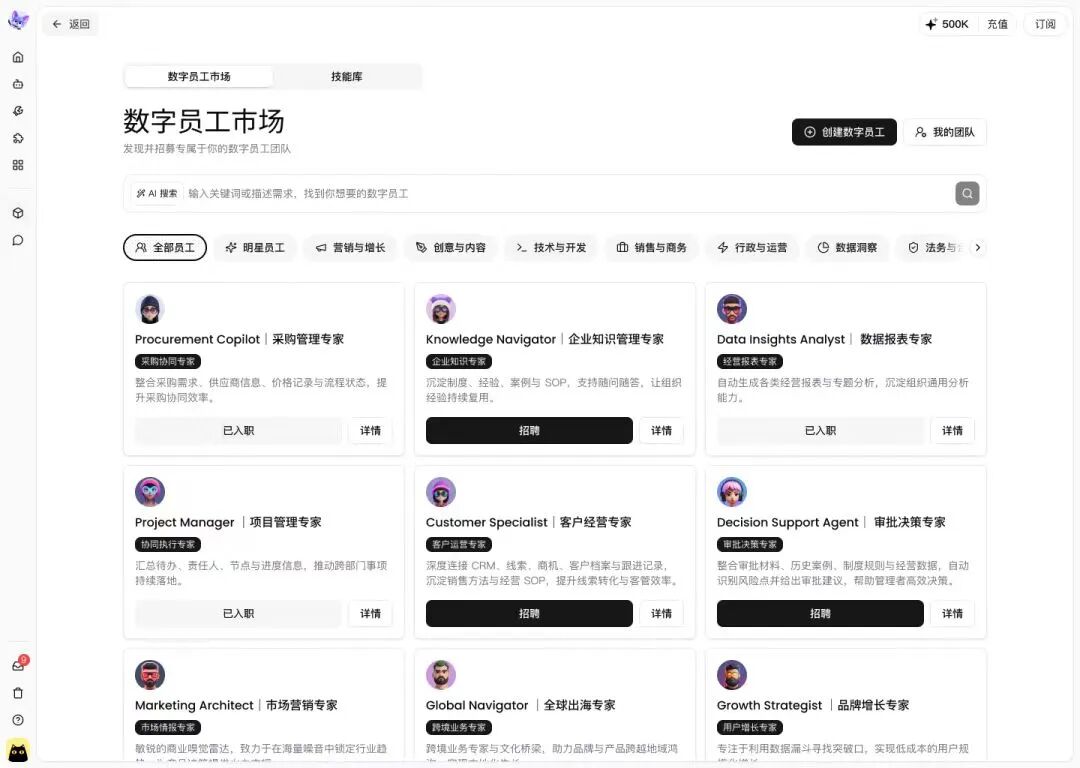
Users can directly hire expert - level Agents such as those for research and analysis, data processing, content generation, meeting insight, and design processing in the digital employee market. And these Agents deliver final results to users, not semi - finished products.
For example, through the underlying rendering framework, Super Magic can directly generate PPTs, data dashboards, recording summaries, professional reports, and Excel files. Employees no longer need to re - process the materials output by the AI.
In actual use, this difference will be very intuitive. Take the workflow of a salesperson in a day as an example. At 9 am, when opening Super Magic, the to - do list for today's customer follow - up has already been pushed. Then, he remembers that he had two meetings with one of the customers last week. When opening the historical meeting records in Super Magic, what appears is not a text manuscript but an interactive analysis interface: an intelligent player, meeting minutes, quantitative data, power dynamics, and intention analysis are all included. Different contents are presented in different interactive forms and colors, making the key points clear at a glance.
If he needs to recall some specific details, he only needs to ask: "Help me review the meeting with XX last week. How did they evaluate the usage experience of other products?" Super Magic can retrieve the memory and extract the key contents of the two meetings within seconds, presenting them in the form of a visual meeting dashboard.
Even if the user needs to generate a quotation, the AI can retrieve templates from the knowledge base, automatically generate it according to the customer's needs, and even call the email service to complete the sending, while creating the schedule for the next week's visit.
After the visit, when uploading the recording in the car, he says: "Help me update it to the CRM." Super Magic analyzes the recording and can automatically update the follow - up status to "visited · to be followed up" and record the key points of the communication.
In the evening, when he needs to confirm the customers to be visited and contacted in the next cycle, he can directly ask Super Magic to find hundreds of enterprises that match the customer profile according to the requirements, and then analyze and give suggestions from dozens of dimensions. The work that originally took a week can be compressed to dozens of minutes with the help of Super Magic, and the salesperson's time can be used for more valuable customer relationship management and customer service.
Throughout the whole day, different Agents can deliver results separately and also cooperate in teams. For example, the research Agent is responsible for collecting intelligence, the content Agent is responsible for producing materials, the design Agent is responsible for visual presentation, and the financial Agent is responsible for data accounting. Each role performs its own duties and can communicate in real - time, ultimately delivering a complete research report.
More importantly, this electronic army runs continuously in the cloud 7×24 hours and will not stop even when the browser is closed. For enterprises, AI can not only be a tool for improving efficiency but also a digital employee that is always on standby and can deliver complete and usable results.
4. Epilogue
Why has the "lobster" become popular all over the world? Because it allows ordinary people to feel for the first time that AI can do work and has the possibility of completing more tasks in the digital world besides answering questions, writing, and generating images.
However, the "lobster" cannot solve the problems of enterprises because the essence of an enterprise lies in organization, process, data, and collaboration. In the traditional model, the mode where AI data and applications are scattered in employees' personal accounts is neither safe nor has enough room for imagination.
What Super Magic bets on is precisely this deep enterprise waters. Through the open - source and open form (it can currently be downloaded and deployed on GitHub), on the basis of security, controllability, and collaboration, it delivers high - quality enterprise - level digital employees.
In the future, the competitiveness difference between enterprises may not only come from capital, technology, and scale but also from the frequency and depth of Agent usage.